
On Friday, you were one of the team. You grabbed lunch with them, complained about the same deadlines, and knew exactly what your job was. On Monday, you’re their manager. The people who used to vent to you now go quiet when you walk in, your calendar is suddenly full of meetings, and the work you were great at is now someone else’s job.
Nobody hands you a manual. Most people get promoted because they were good at the work, not because anyone checked whether they’d be good at leading others. Learning how to be a good manager means learning a different job, one where your success depends almost entirely on other people’s. Here’s what that job actually involves, with the habits, scripts, and research that make the difference.
The Hard Truth About New Managers
If managing feels harder than you expected, the numbers suggest you’re not imagining it.
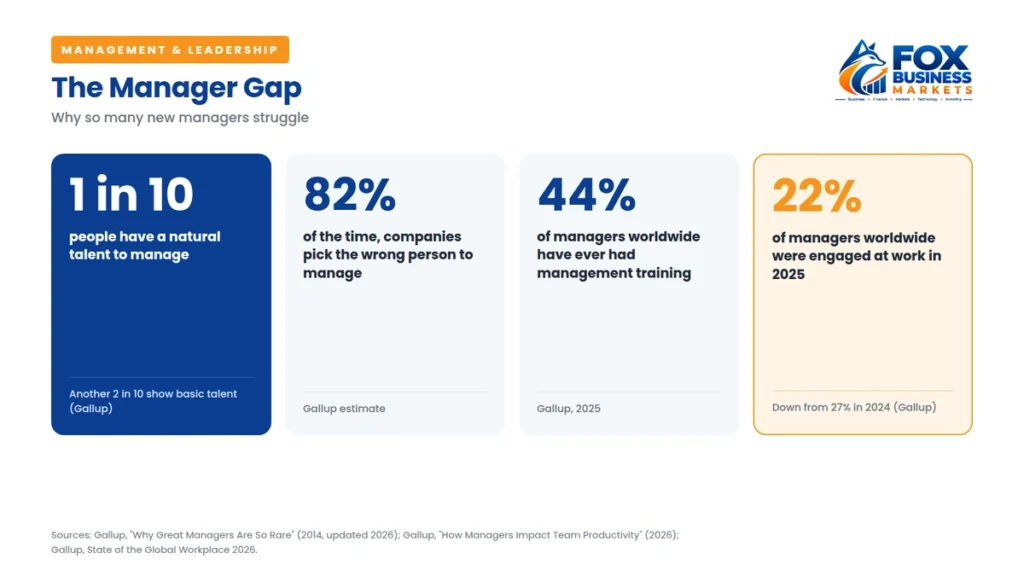
Gallup estimates that only “one in 10 people possess the inherent talent to manage,” and another two in 10 show a basic talent for it. Companies still “fail to choose the candidate with the right talent for the job 82% of the time” (Gallup). Training rarely fills the gap. Only 44% of managers worldwide had ever received management training, according to Gallup’s 2025 global workplace report (Gallup).
Even when training comes, it often comes late. In data on about 17,000 leaders, leadership firm Zenger Folkman found that the average supervisor was 33 years old, but the average age at which leaders first received training was 42. That’s roughly a decade of managing people with no formal preparation (Zenger Folkman).
The good news: learning how to be a good manager isn’t mostly about talent. It’s about a short list of habits you can practice.
What Great Managers Actually Do
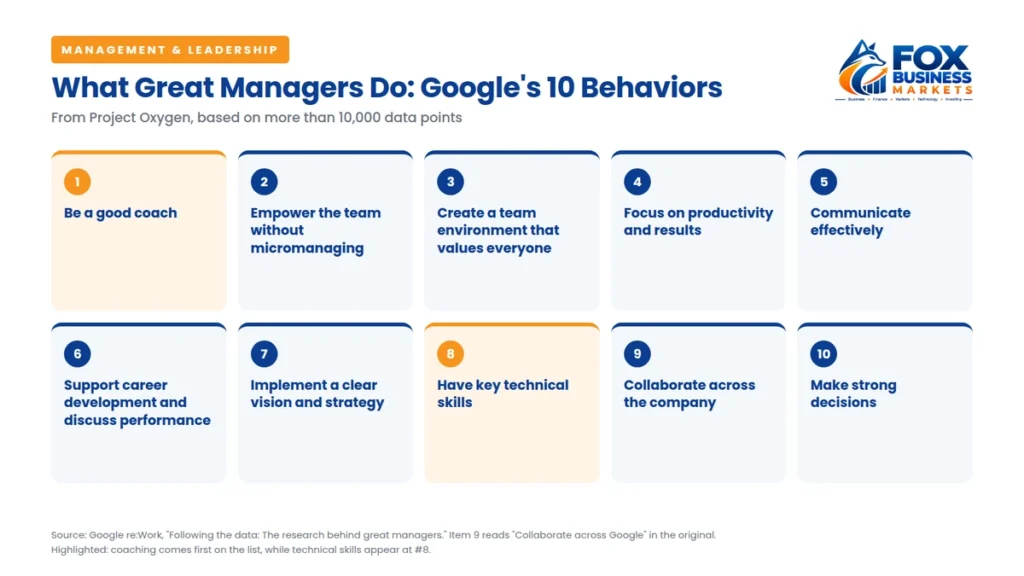
Google once tried to prove that managers didn’t matter. Its Project Oxygen research, built on more than 10,000 data points from performance reviews, feedback surveys, and interviews, found the opposite. Teams with highly effective managers were more likely to “achieve better results, be happier, and experience lower turnover” (Google re:Work).
Google then listed the behaviors its best managers shared. The first one on the list is “be a good coach.” Others include empowering the team “without micromanaging,” communicating effectively, supporting career development, and making strong decisions. Notice what’s near the bottom: “have key technical skills.” Expertise matters, but it’s not what makes someone a good manager. If you want to know how to be a good manager, that list is a better starting point than any job description.
How to Be a Good Manager: 9 Habits That Work
1. Stop Measuring Yourself by Your Own Output
This is the hardest shift. As an individual contributor, a good day meant you got a lot done. As a manager, a good day might mean you got nothing done yourself, but two people on your team got unstuck.
If you keep jumping in to do the work, you’ll feel productive while your team learns that you’ll always rescue them. Ask yourself at the end of each week: what did my team accomplish, and what did I do to help?
2. Have One Real Conversation With Each Person Every Week
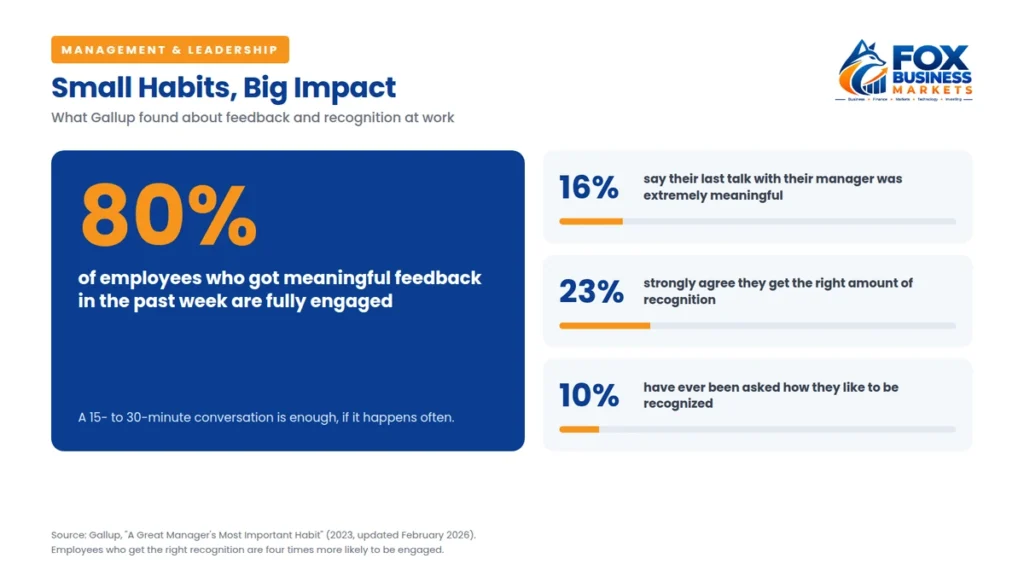
Gallup’s research points to one habit above the rest. “80% of employees who say they have received meaningful feedback in the past week are fully engaged,” and the conversation doesn’t need to be long. “Between 15 and 30 minutes is enough time for a meaningful conversation, but only if it happens frequently” (Gallup).
Most managers aren’t there yet. Only 16% of employees in Gallup’s research said their last conversation with their manager was extremely meaningful. And in a survey cited by MIT Sloan Management Review, one in four people had no regular one-on-one meetings at all. Those with weekly one-on-ones reported feeling 20% less anxious and 12% more successful at their jobs (MIT Sloan Management Review).
A simple one-on-one agenda that works:
- “What’s going well this week?”
- “Where are you stuck, and how can I help?”
- “Is there anything I’m doing that makes your job harder?”
- “What do you want to be doing more of in six months?”
Let them talk first. If you fill the time with your own status updates, it’s a meeting, not a conversation.
3. Make Expectations Painfully Clear
Many performance problems are really clarity problems. People can’t hit a target they can’t see. For every important task, make sure the person knows three things: what “done” looks like, when it’s due, and how much freedom they have in getting there.
A useful test: ask them to explain the task back to you in their own words. If their version doesn’t match yours, the problem isn’t them.
4. Give Feedback That’s Specific, Kind, and Direct
New managers usually make one of two mistakes. They avoid hard feedback because they want to be liked, or they deliver it so bluntly that people stop listening. Kim Scott, author of Radical Candor, describes the middle path as showing that you “Care Personally while you Challenge Directly, without being aggressive or insincere” (Radical Candor).
The Center for Creative Leadership’s Situation-Behavior-Impact (SBI) model gives you a structure: describe the situation, the specific behavior, and its impact, then ask about the person’s intent (Center for Creative Leadership). Here’s how it sounds:
“In this morning’s client call (situation), you interrupted Maria twice while she was presenting the numbers (behavior). She lost her place, and the client started asking you questions instead of her (impact). What was going on for you there?”
No labels like “rude” or “unprofessional.” Just facts, the result, and a real question.
5. Recognize Good Work the Way Each Person Wants It
Recognition is cheap, fast, and badly underused. Only 23% of employees strongly agree that they get the right amount of recognition for their work, and those who do are four times more likely to be engaged. Yet only 10% of employees are ever asked how they like to be recognized (Gallup).
That last number is the easy win. Some people love public praise. Others would rather crawl under the table. Ask.
6. Delegate Outcomes, Not Just Tasks
Delegating feels slower at first, because explaining a task takes longer than doing it. But managers who never let go cap their team’s growth, and their own. In a Gallup study of 143 CEOs, those with high “Delegator” talent generated 33% greater revenue than others. Only one in four entrepreneurs had that talent naturally (Gallup).
The trick is to hand over the result, not a checklist. “Find us a cheaper shipping option by Friday” builds more skill than “Call these three carriers and ask for a quote.”
7. Handle the Friends-to-Boss Problem Directly
If you were promoted from within, some of your new reports are former peers, and maybe friends. Don’t pretend nothing changed. Talk to each of them early, one on one: “Our relationship is going to be a bit different now. I still value our friendship, and I also need to be fair to everyone on the team. If something I do feels off, tell me.”
Then be consistent. Nothing destroys trust faster than favoring old friends or, just as bad, being harder on them to prove you’re not.
8. Make Decisions, and Explain Them
Teams can handle decisions they disagree with. What they struggle with is waiting while nothing gets decided. Google’s list of great-manager behaviors includes “make strong decisions,” and that doesn’t mean making them alone. Ask for input when there’s time, decide, then explain your reasoning in a sentence or two. People who understand the why will carry out the what.
9. Protect Your Own Energy
Management is draining, and the numbers show it. Gallup found that manager engagement fell from 27% to 22% between 2024 and 2025, the largest one-year drop it recorded. In its 2026 data, 45% of managers said they felt stress “a lot of the day,” compared with 39% of individual contributors (Gallup; Gallup).
Block time for focused work, find a peer or mentor you can be honest with, and stop answering messages at midnight. A burned-out manager can’t support anyone else.
Your First 90 Days as a Manager
The first three months are where you learn how to be a good manager in practice, not in theory. A simple plan:
| Period | Focus | What to do |
| Days 1–30 | Listen | Hold a one-on-one with every person. Ask what’s working, what isn’t, and what they’d change. Change very little. |
| Days 31–60 | Clarify | Set clear goals and expectations. Start weekly one-on-ones. Fix one or two obvious problems your team raised. |
| Days 61–90 | Build | Delegate a meaningful project. Give your first round of structured feedback. Ask your team how you’re doing. |
Mistakes New Managers Make
Knowing how to be a good manager also means knowing what to avoid. The most common mistake is trying to be liked instead of trusted. Being liked is nice. Being trusted means people believe you’ll be fair, honest, and in their corner, even when you say no.
Close behind: changing everything in the first month, avoiding a tough conversation until it becomes a crisis, and taking credit for the team’s wins while handing out blame for its misses. Do the reverse. Give your team the credit, and take the heat yourself.
If you run your own small business, these lessons apply even more, because you set the tone for everyone. Our guide to leadership styles explains how to adjust your approach for different people and situations, and our guide on how to start a small business covers the basics of building a team from scratch.
Frequently Asked Questions
What makes a good manager?
Research from Google and Gallup points to the same core habits: coaching people, communicating clearly, giving regular feedback, recognizing good work, supporting career growth, and making decisions. Technical expertise helps, but it matters less than most new managers expect.
How to be a good manager with no experience?
Start by listening. Hold one-on-ones with every person, set clear expectations, and have a short, meaningful conversation with each team member every week. Ask for feedback on your own performance early and often.
How often should managers have one-on-ones?
Weekly is ideal. Gallup’s research suggests 15 to 30 minutes is enough for a meaningful conversation, as long as it happens regularly.
How do you manage former coworkers?
Address the change directly in a private conversation, be consistent and fair with everyone, and avoid both favoritism and overcorrecting by being harder on former friends.
What is the biggest mistake new managers make?
Many keep doing the work themselves instead of helping their team do it. Others avoid hard conversations because they want to be liked.
Can you learn how to be a good manager?
Yes. While Gallup estimates only about one in 10 people have a natural talent for managing, the habits of good managers, such as regular feedback, clear expectations, and delegation, can be learned and practiced.
The Bottom Line
You won’t learn how to be a good manager in a week, and you’ll get some of it wrong. That’s normal. Pick one habit from this list, practice it until it’s automatic, then add another. Your team won’t remember the day you got promoted. They’ll remember whether working for you made them better.