
Picture a manager we’ll call Dana. She’s sharp, fast, and better at the work than anyone on her team, so when something goes wrong, she fixes it herself. At first, the team loves it. Six months later, nobody brings her ideas anymore. They wait to be told what to do, and Dana can’t figure out why her best people seem bored.
Dana doesn’t have a skills problem. She has a style problem. She leans on one way of leading, the one that made her successful as an individual, and she uses it everywhere. Most managers do the same thing. Learning the main leadership styles won’t turn you into a different person, but it will show you which tools you’re ignoring, and when your favorite one is quietly hurting your team.
What a Leadership Style Actually Is
Your leadership style is the pattern in how you make decisions, give direction, and treat the people who work for you. It isn’t a personality type. It’s behavior, and behavior can change.
The idea goes back to a 1939 experiment that still holds up. Psychologist Kurt Lewin and his colleagues set up after-school clubs for 10-year-old boys and trained adult leaders to run them in one of three ways: giving orders, involving the group in decisions, or stepping back and letting the boys do whatever they wanted. The leaders rotated styles every six weeks. The hands-off groups produced the worst work of the three and showed little cooperation. The democratic groups shared ideas and worked together. The groups run by order-givers did what they were told, but the researchers found discontent building under the surface (Ferguson et al., Group Dynamics; Florida International University).
Nearly a century later, the lesson holds: how you lead changes how people behave, sometimes in ways you won’t see until it’s too late.
The 8 Leadership Styles You’ll See Most Often
There are dozens of models, and they overlap. These eight come up most in research and in real workplaces.
1. Autocratic (Directive)
You decide, and the team carries it out. Daniel Goleman, who studied this style under the name “coercive,” summed it up in a phrase: “Do what I tell you.”
It works in a genuine crisis, when there’s no time to debate, or with a new employee who needs clear instructions on day one. It backfires when it becomes your default. Smart people stop thinking when their ideas are never used.
2. Democratic (Participative)
You ask the team for input before deciding. Goleman’s shorthand: “What do you think?”
This style builds buy-in and often produces better decisions, because the people closest to the work usually know things you don’t. The cost is speed. If every choice turns into a meeting, people get frustrated, and in an emergency there’s no time for a vote.
3. Laissez-Faire (Hands-Off)
You give people almost total freedom and stay out of the way. It sounds like trust. In practice, it’s often just absence.
The evidence here is blunt. In a major review of leadership research, laissez-faire leadership had a strong negative link to results, a correlation of −0.37 (Judge & Piccolo, Journal of Applied Psychology, 2004). Giving experienced experts room to work is fine. Disappearing isn’t.
4. Transformational
You inspire people around a shared vision and push them to grow beyond their current role. Historian James MacGregor Burns introduced the idea in 1978, and psychologist Bernard Bass later built it into a model based on inspiration, intellectual challenge, and attention to each person’s development (Frontiers in Psychology).
Of all the leadership styles studied, this one has the strongest overall track record. The same 2004 review, which pulled together 87 sources, found a correlation of 0.44 between transformational leadership and outcomes such as follower satisfaction and leader effectiveness. The catch: vision without follow-through turns into speeches.
5. Transactional
You set clear expectations and reward people for meeting them. Hit the target, earn the bonus. It’s less exciting than transformational leadership, and it gets far less attention.
That’s a mistake. In the same review, “contingent reward,” the core of transactional leadership, scored nearly as well, at 0.39, and outperformed transformational leadership on some measures. Clear deals and fair rewards still matter.
6. Servant Leadership
You put your team’s growth and well-being first, and you see your job as removing obstacles for them. The term comes from Robert Greenleaf, who wrote in 1970: “The servant-leader is servant first.” His test for whether it’s working is a hard one: “Do those served grow as persons?” (Greenleaf Center)
It builds deep loyalty. Its weak spot: leaders who only serve can dodge hard calls, like telling someone their work isn’t good enough.
7. Situational
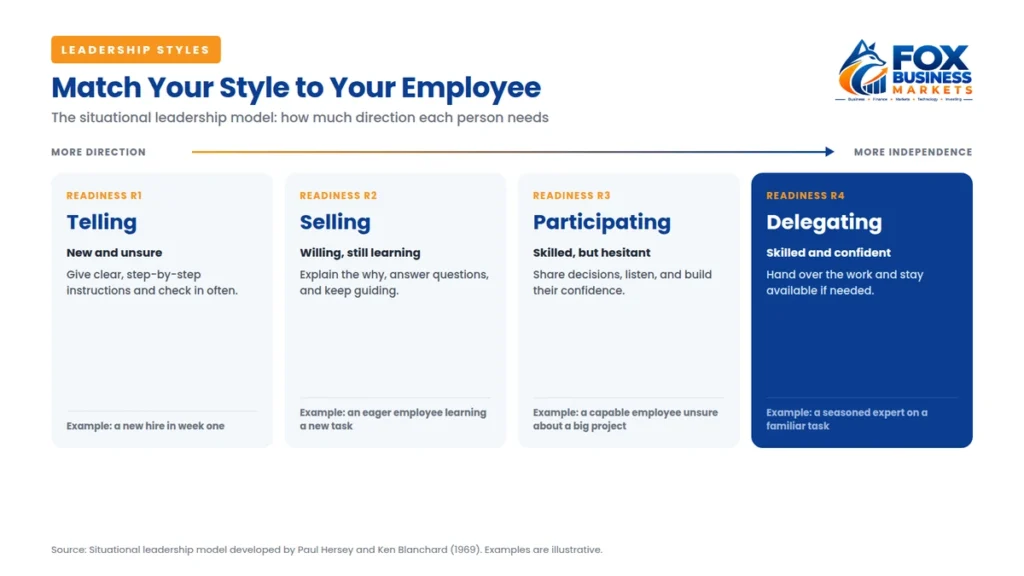
You change your approach based on the person and the task. Paul Hersey and Ken Blanchard developed the model in 1969, matching four styles (telling, selling, participating, and delegating) to how ready an employee is, based on their skill and willingness (INFLIBNET).
A new hire needs instructions. A confident expert needs room. Situational leadership is less a style than a rule for switching between the other leadership styles.
8. Coaching
You focus on developing people for the long term: asking questions, giving feedback, and helping them stretch. Goleman’s phrase for it: “Try this.”
Coaching pays off slowly. It’s the wrong tool when a deadline is tomorrow, and it doesn’t work on someone who doesn’t want to improve.
What the Research Says Actually Works
The most useful study of leadership styles at work comes from Goleman’s analysis of 3,871 executives, published in Harvard Business Review in 2000. Using data from the consulting firm Hay/McBer, he measured how six styles affected “climate,” the working atmosphere that drives performance, including clarity, standards, flexibility, and commitment (Harvard Business Review).
Here’s how each style correlated with climate, based on the figures in Goleman’s article:
Style | In a phrase | Effect on climate |
| Authoritative | “Come with me.” | +0.54 |
| Affiliative | “People come first.” | +0.46 |
| Democratic | “What do you think?” | +0.43 |
| Coaching | “Try this.” | +0.42 |
| Pacesetting | “Do as I do, now.” | −0.25 |
| Coercive | “Do what I tell you.” | −0.26 |
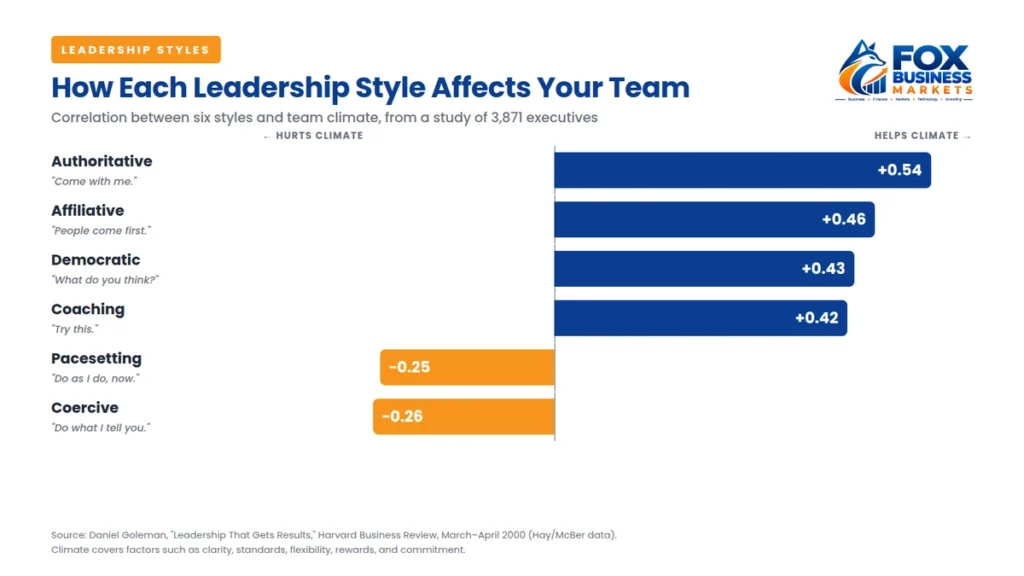
Two things stand out. First, “authoritative” here doesn’t mean bossy. It means giving people a clear vision and letting them choose how to get there. Second, pacesetting, the high-performer habit of setting a fast pace and expecting everyone to keep up, hurt the climate almost as much as giving orders. That’s Dana’s problem exactly.
The biggest finding was about range, not any single style. Leaders “who have mastered four or more—especially the authoritative, democratic, affiliative, and coaching styles—have the very best climate and business performance,” Goleman wrote.
Why Your Style Matters More Than You Think
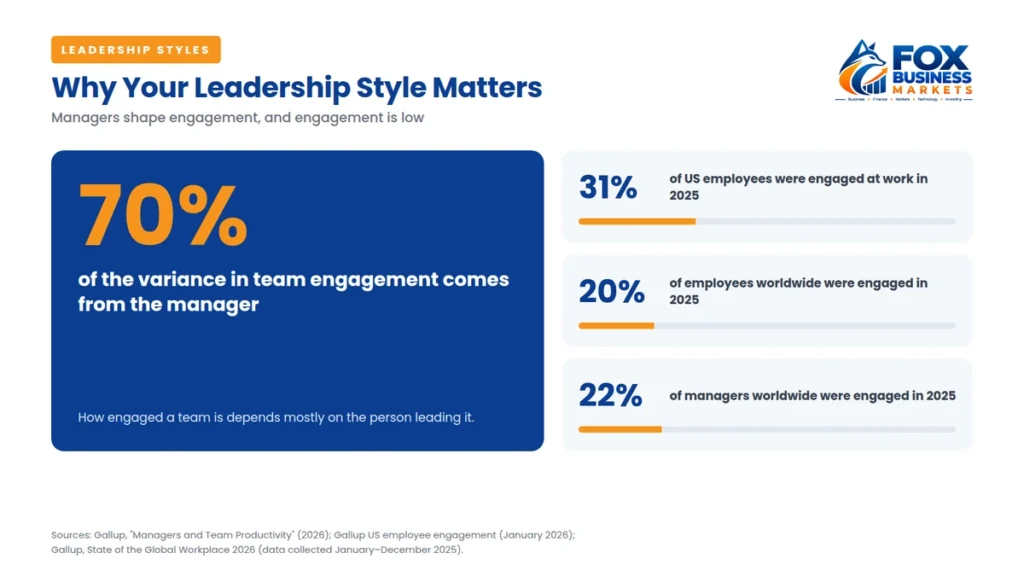
According to Gallup, “managers account for 70% of the variance in team engagement” (Gallup). Put simply, how engaged a team is depends mostly on the person running it.
And engagement is low. Only 31% of US employees were engaged at work in 2025, unchanged from the year before (Gallup). Worldwide, the figure was 20%. Managers themselves aren’t doing much better: just 22% were engaged (Gallup).
Which Leadership Styles Fit Which Situation
Different moments call for different leadership styles. Here’s a practical starting point:
Situation | Style that usually works | Avoid |
| A real crisis, with no time to discuss | Autocratic, briefly | Endless consensus |
| A new employee in their first weeks | Directive, then coaching | Hands-off |
| An experienced, motivated expert | Delegating or democratic | Micromanaging |
| A team that’s lost its direction | Authoritative (vision-led) | Pacesetting |
| Someone who keeps missing targets | Clear transactional expectations, plus coaching | Avoiding the conversation |
| Low morale after a hard stretch | Affiliative or servant | Pushing harder |
The real skill is noticing when the situation has changed, and switching before your team has to tell you.
How to Find Your Leadership Style
Most people rely on two or three leadership styles without realizing it, and one of them is the default. To find yours, answer these honestly:
- When something goes wrong, what’s your first move? Fixing it yourself suggests pacesetting. Calling a meeting suggests democratic.
- How do you decide who works on what? If you always assign, you lean directive. If people pick, you lean delegating.
- What do you talk about in one-on-ones? Tasks and deadlines point to transactional. Career goals point to coaching.
- What would your team say you do too much of? This is the most useful question, and the hardest to answer alone. Ask someone you trust.
- Which style from the list above makes you uncomfortable? That’s the one you probably need to practice.
Then pick one underused style and practice it on purpose for a month. If you always decide alone, ask for input on your next three decisions.
A Real Example: Satya Nadella at Microsoft
When Satya Nadella became Microsoft’s CEO in 2014, he pushed the company toward a coaching-heavy, learning-first culture. In Microsoft’s 2018 annual report, he described the shift as “moving from a group of people who know it all to a group of people who want to learn it all” (Microsoft).
Years later, he was still using the same language. In a 2025 memo to employees, he wrote that the “everyday practice of being a learn-it-all, not a know-it-all” had “reshaped our culture and helped us lead with greater humility and empathy” (Microsoft). It’s a reminder that a leadership style isn’t just how one manager behaves. Repeated long enough, it becomes the culture.
In a small business, the owner’s style usually is the culture. If you’re building one from scratch, our guide on how to start a small business covers the setup, and our guide to business strategy explains how to set the direction your team will follow.
Frequently Asked Questions
What are the main leadership styles?
The most common are autocratic, democratic, laissez-faire, transformational, transactional, servant, situational, and coaching. Daniel Goleman’s research also describes affiliative, authoritative, and pacesetting styles.
Which leadership style is most effective?
There’s no single best style. Research links transformational leadership to strong results, and Goleman found that authoritative, vision-led leadership had the most positive effect on team climate. But the best leaders use several styles and switch based on the situation.
What is the worst leadership style?
Laissez-faire, or hands-off, leadership has one of the clearest negative links to results in the research. Coercive and pacesetting styles also hurt team climate when they’re used as a default.
Can you change your leadership style?
Yes. A leadership style is a set of habits, not a fixed trait. Start by identifying your default, then deliberately practice one underused style in low-stakes situations.
What is the difference between transformational and transactional leadership?
Transformational leaders inspire people around a vision and help them grow. Transactional leaders set clear goals and reward people for meeting them. Strong managers use both.
What leadership styles work best for a small business?
Small teams often benefit from a mix of democratic and coaching styles, because every person’s ideas and growth matter. In a crisis, though, the owner may need to take quick, direct control.
The Bottom Line
The goal isn’t to find your one true leadership style and stick to it. It’s to notice which style you reach for without thinking, and to build the habit of reaching for a different one when your team needs it. Dana didn’t need a new personality. She needed to stop fixing everything and start asking, “What do you think?”