A business strategy is a company’s plan for how it will win: which customers it will serve, what it will offer them, and why they should choose it over the competition. It’s a set of choices, including what not to do, that gives a business a lasting advantage. Without one, a company tends to copy rivals and compete only on price.
Good strategy isn’t just for big corporations. A local bakery, a cleaning service, or a software startup all need a clear answer to the same question: why will customers pick us? This guide explains what business strategy is, the main types, real examples, and a simple process to build one for your own business.
Key Takeaways
- Strategy means choosing a unique position and making trade-offs. As Michael Porter puts it, “Competitive strategy is about being different.”
- The main types are cost leadership, differentiation, focus, growth strategies, and blue ocean strategy.
- A good strategy has three parts: a diagnosis of the challenge, a guiding policy, and coherent actions.
- Planning pays off: in one study, entrepreneurs who wrote formal plans were 16% more likely to build a viable business.
How We Researched This
We went to the original sources: Michael Porter’s work at Harvard Business School, Richard Rumelt’s writing in McKinsey Quarterly, H. Igor Ansoff’s 1957 Harvard Business Review article, and W. Chan Kim and Renée Mauborgne’s research on blue ocean strategy. Company figures come from annual reports and SEC filings, with a link for every quote and figure.
What Is Business Strategy?
The clearest definition comes from Harvard Business School professor Michael Porter. In his 1996 Harvard Business Review article “What Is Strategy?” he wrote: “Competitive strategy is about being different.” He added that “the essence of strategy is choosing what not to do” (Harvard Business Review).
Porter also drew a key line between strategy and simply working harder. Operational effectiveness, he explained, “means performing similar activities better than rivals perform them.” That’s important, but “it is not strategy.” If you do the same things as everyone else, only faster or cheaper, competitors can copy you. A real strategy means doing different things, or doing similar things in a different way, so your advantage lasts.
Write Your Strategy in One Statement
Harvard Business School professors David Collis and Michael Rukstad argue that a company should be able to state its strategy in about 35 words. A strong strategy statement covers three things (Harvard Business Review):
- Objective: what you’re trying to achieve.
- Scope: which customers, products, and locations you’ll focus on.
- Advantage: why customers will choose you.
Business Strategy vs. Mission, Goals, and Tactics
These terms are often mixed up. Here’s how they differ:
| Term | What it answers | Example for a coffee shop |
| Mission | Why do we exist? | Give our neighborhood a welcoming place to start the day |
| Goal | What do we want to achieve? | Reach $40,000 in monthly sales within two years |
| Strategy | How will we win? | Be the best specialty coffee for commuters, with the fastest service in the area |
| Tactics | What specific actions will we take? | Mobile ordering, a loyalty app, and opening at 6 a.m. |
The Levels of Strategy
Larger companies make strategy at three levels:
- Corporate strategy decides which industries and markets the company competes in, such as whether to expand, acquire, or exit a business.
- Business-level strategy decides how a company competes within one market. This is what most people mean by strategy.
- Functional strategy covers how each department, such as marketing, operations, or finance, supports that plan.
For a small business, these levels usually blend together. The owner makes all three kinds of decisions.
5 Types of Business Strategy
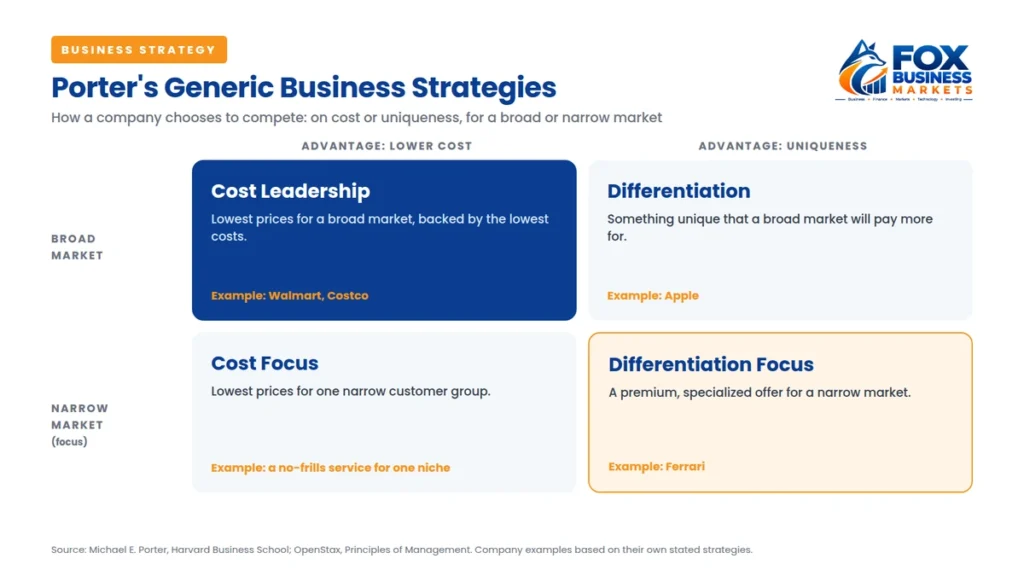
1. Cost Leadership
A cost leader offers its product or service “at a lower price than its rivals can,” as the OpenStax Principles of Management textbook explains (OpenStax). It needs the lowest costs in its industry to stay profitable.
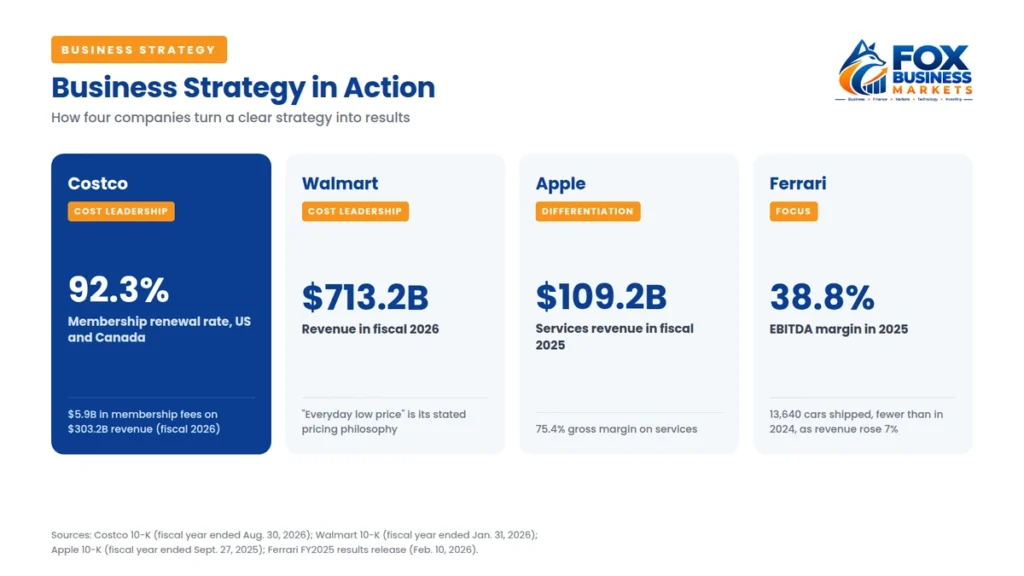
Walmart is the classic example. In its latest annual report, it describes its “everyday low price” (EDLP) philosophy: “we price items at a low price every day so our customers trust that our prices will not change under frequent promotional activity.” Walmart’s revenue reached $713.2 billion in its fiscal year ending January 31, 2026 (Walmart 10-K).
2. Differentiation
A differentiator offers something customers value enough to pay more for. As Porter’s Institute for Strategy and Competitiveness notes, “to command a premium price, a company must deliver distinctive value to customers” (Harvard Business School).
Apple charges premium prices for its devices and keeps customers inside its ecosystem of apps and services. In fiscal 2025, Apple’s Services revenue reached $109.2 billion, with a 75.4% gross margin (Apple 10-K).
3. Focus (Niche) Strategy
A focus strategy concentrates on a narrow market and serves it better than broad competitors can. Ferrari deliberately limits how many cars it makes. It shipped 13,640 cars in 2025, slightly fewer than in 2024, yet its revenue rose 7% to €7.1 billion, with a 38.8% EBITDA margin. Its CEO credited “the strength of its carefully-managed volume strategy” (Ferrari).
Focus is often the best fit for small businesses, which can’t outspend large rivals but can know one type of customer better than anyone else.
4. Growth Strategies (the Ansoff Matrix)
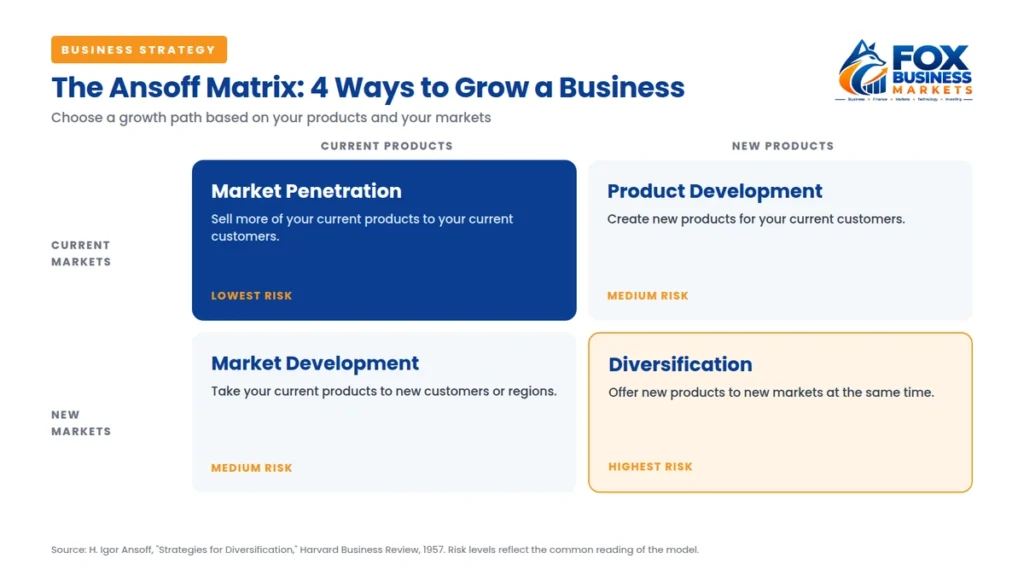
In 1957, H. Igor Ansoff described four ways a company can grow in his Harvard Business Review article “Strategies for Diversification”:
- Market penetration: sell more of your current products to your current market.
- Market development: take current products to new markets.
- Product development: create new products for your current market.
- Diversification: offer new products in new markets, the riskiest option.
5. Blue Ocean Strategy
Most companies fight over existing demand in crowded “red oceans.” W. Chan Kim and Renée Mauborgne argue that companies can instead create new market space, where “demand is created rather than fought over” (Harvard Business Review). They define the strategy as the “simultaneous pursuit of differentiation and low cost to open up a new market space and create new demand” (Blue Ocean Strategy).
Real Business Strategy Examples
Costco: low prices funded by memberships. Costco’s annual report describes its approach as “offering low prices on a limited selection of nationally-branded and private-label products.” Membership fees make the model work: in fiscal 2026, Costco earned $5.9 billion from fees on total revenue of $303.2 billion, and its renewal rate was 92.3% in the US and Canada (Costco 10-K). Its limited selection is a clear trade-off: fewer choices, but lower costs and prices.
Netflix: changing strategy before it had to. Netflix launched as a DVD-by-mail service in 1998 and “in 2007, Netflix began streaming” (Netflix). It later added original content and an ad-supported plan. In 2025, Netflix reported $45.2 billion in revenue and more than 325 million paid memberships (Netflix).
A small business example. Imagine a local fitness studio competing with big-box gyms. Instead of matching their low monthly prices, it focuses on adults over 50 with small classes, physical therapist-designed programs, and flexible daytime schedules. It charges more and serves fewer people, but wins loyal members that big gyms overlook. That’s a focus strategy.
What Makes a Good Strategy?
Strategy expert Richard Rumelt says every good strategy has a three-part “kernel” (McKinsey Quarterly):
- Diagnosis: “an explanation of the nature of the challenge.”
- Guiding policy: “an overall approach chosen to cope with or overcome the obstacles identified in the diagnosis.”
- Coherent actions: “steps that are coordinated with one another to support the accomplishment of the guiding policy.”
Rumelt warns against “fluff,” which he describes as “a restatement of the obvious, combined with a generous sprinkling of buzzwords.” A goal like “be the best in our industry” isn’t a strategy. It doesn’t say how you’ll get there.
Many companies struggle with this. In a 2025 McKinsey survey of 416 senior executives, only 21% said their strategies passed four or more of McKinsey’s ten tests of a strong strategy, down from 35% in 2010 (McKinsey).
How to Build a Business Strategy in 6 Steps
- Understand your market. The SBA says “market research helps you find customers for your business,” while “competitive analysis helps you learn from businesses competing for your potential customers.” Ask whether there’s demand, how many similar options exist, and what customers pay for them (SBA).
- Diagnose your main challenge. What’s the biggest obstacle between you and your goal? Be specific.
- Choose your position. Decide whether you’ll compete on low cost, a distinct offering, or a focused niche. Avoid trying to be everything to everyone.
- Decide what you won’t do. Write down the customers, products, or services you’ll turn away. This is where real strategy happens.
- Write your strategy statement. Cover your objective, scope, and advantage in about 35 words.
- Turn it into actions and review it. Set a few coordinated actions, assign owners, track results, and revisit your strategy at least once a year or when your market changes.
Writing it down matters. In a study of 1,088 founders published in the Strategic Entrepreneurship Journal, entrepreneurs who wrote formal plans were 16% more likely to achieve viability than similar entrepreneurs who didn’t (Harvard Business Review). If you’re just getting started, our guide on how to start a small business covers the setup steps.
Common Strategy Mistakes
- Confusing goals with strategy. “Grow 20% next year” is a target, not a plan for how to win.
- Trying to serve everyone. Porter warns that companies “stuck in the middle” between low cost and differentiation often end up with neither advantage.
- Copying competitors. If your plan looks like everyone else’s, you’ll end up competing only on price.
- Never revisiting the plan. Markets change. Netflix’s shift to streaming shows the value of adapting early.
- Ignoring the numbers. Check that your strategy is profitable. Our business idea profit calculator can help you test prices and costs.
Frequently Asked Questions
What is business strategy in simple words?
A business strategy is a plan for how a company will win customers and beat competitors. It defines who you serve, what you offer, and why customers should choose you instead of someone else.
What are the 5 types of business strategy?
The five main types are cost leadership, differentiation, focus (niche), growth strategies such as those in the Ansoff matrix, and blue ocean strategy, which creates a new market instead of competing in an existing one.
What is an example of a business strategy?
Costco uses a low-cost strategy funded by membership fees. It offers a limited selection at low prices, and in fiscal 2026 it earned $5.9 billion from membership fees, with a 92.3% renewal rate in the US and Canada.
What is the difference between strategy and tactics?
Strategy is the overall plan for how you’ll win. Tactics are the specific actions you take to carry out that plan, such as a promotion, a new hire, or a marketing campaign.
What are the 3 parts of a good strategy?
According to strategy expert Richard Rumelt, a good strategy has a diagnosis of the challenge, a guiding policy for dealing with it, and a set of coherent actions that support that policy.
How often should a small business review its strategy?
Review your strategy at least once a year, and sooner if your market, customers, or costs change significantly. Track a few key numbers so you can see whether it’s working.
Final Takeaway
Strategy is a clear set of choices about where you’ll compete and how you’ll win, including what you won’t do. Whether you follow Costco’s low-cost model, Apple’s differentiation, or Ferrari’s tight focus, the principle is the same: be different in a way customers value and competitors can’t easily copy. Start with a clear diagnosis, write your strategy in one statement, and turn it into a few coordinated actions you review regularly.

