
The most reliable business growth strategies start close to home: selling more to the customers you already have, keeping them longer, and adding products they want. From there, businesses can grow by selling online, opening new locations, exporting, franchising, or buying another company. Each path carries a different level of cost and risk, so the right choice depends on your strengths, your cash, and your market.
Growth isn’t easy right now. In September 2026, only 7% of small business owners told the National Federation of Independent Business (NFIB) that it was a good time to expand (NFIB). That makes choosing the right strategy even more important. This guide covers 10 proven business growth strategies, with real examples and the latest data.
Key Takeaways
- Most growth comes from the core business. McKinsey found that “80 percent of growth comes from a company’s core industry.”
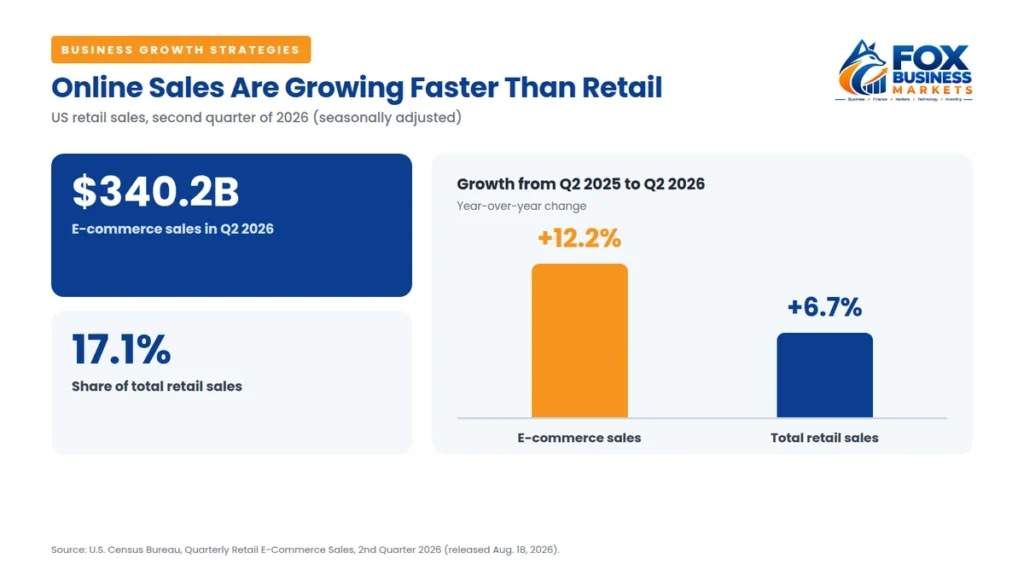
- E-commerce made up 17.1% of US retail sales in the second quarter of 2026 and grew nearly twice as fast as total retail.
- Keeping customers is often cheaper than finding new ones. HBR cites Bain research showing a 5% increase in retention can raise profits by 25% to 95%.
- Lower-risk strategies, such as selling more to current customers, usually make sense before riskier moves, such as entering new markets.
How We Researched This
To identify the most effective business growth strategies, we used research from McKinsey and Harvard Business Review, survey data from the NFIB and the Federal Reserve Banks’ Small Business Credit Survey, Census Bureau e-commerce data, SBA program guidance, and the International Franchise Association. Company examples come from annual reports and shareholder letters. Every figure links to its source.
Where Does Business Growth Come From?
Fast growth is rarer than many people think. In a study of the 5,000 largest public companies from 2005 to 2019, McKinsey found that “a typical company grew at a measly 2.8 percent per year during the ten years preceding COVID-19.” It also found that “80 percent of growth comes from a company’s core industry” (McKinsey).
The lesson for small businesses: before chasing something new, make sure you’re getting the most out of what you already do well. A clear business strategy helps you decide where to grow and what to leave alone.
Small Business Growth Outlook in 2026
Owners are cautious. NFIB’s September 2026 survey found (NFIB):
- Only 7% said it was a good time to expand, down 5 points from August.
- A net 17% planned to create new jobs in the next three months.
- 22% planned capital outlays in the next six months.
- 32% had job openings they couldn’t fill.
The Federal Reserve’s latest survey of small employer firms found that 39.7% reported revenue growth over the prior 12 months, and 46% of firms that sought financing did so to pursue an expansion or new opportunity (Federal Reserve). For more context, see our roundup of small business statistics.
10 Business Growth Strategies
1. Sell More to Your Current Customers
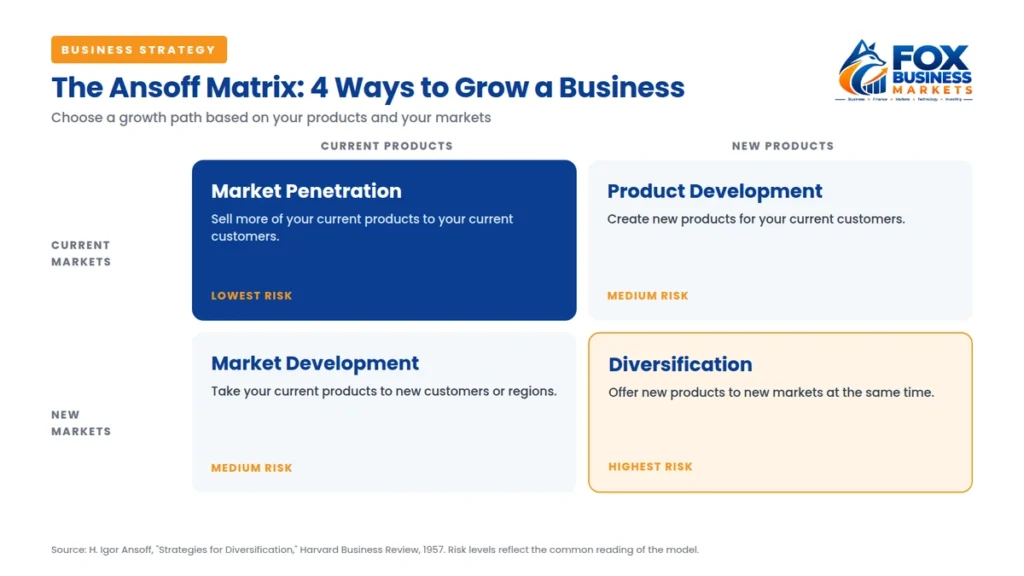
This is the lowest-risk way to grow. H. Igor Ansoff called it “market penetration.” Raise the average order with bundles, add-ons, or premium versions, and encourage repeat purchases with reminders, subscriptions, or loyalty programs. Your existing customers already trust you, so each sale costs less to win.
2. Keep Customers Longer
Losing customers means constantly replacing them. Harvard Business Review cites research by Frederick Reichheld of Bain & Company showing that “increasing customer retention rates by 5% increases profits by 25% to 95%” (Harvard Business Review). Track why customers leave, follow up after each sale, and fix the problems that drive people away.
3. Sell Online
Online sales keep gaining ground. In the second quarter of 2026, US e-commerce sales reached $340.2 billion, or 17.1% of total retail sales. They grew 12.2% from a year earlier, while total retail sales grew 6.7% (Census Bureau). Even service businesses can grow online with booking, digital products, or virtual services.
4. Add New Products or Services
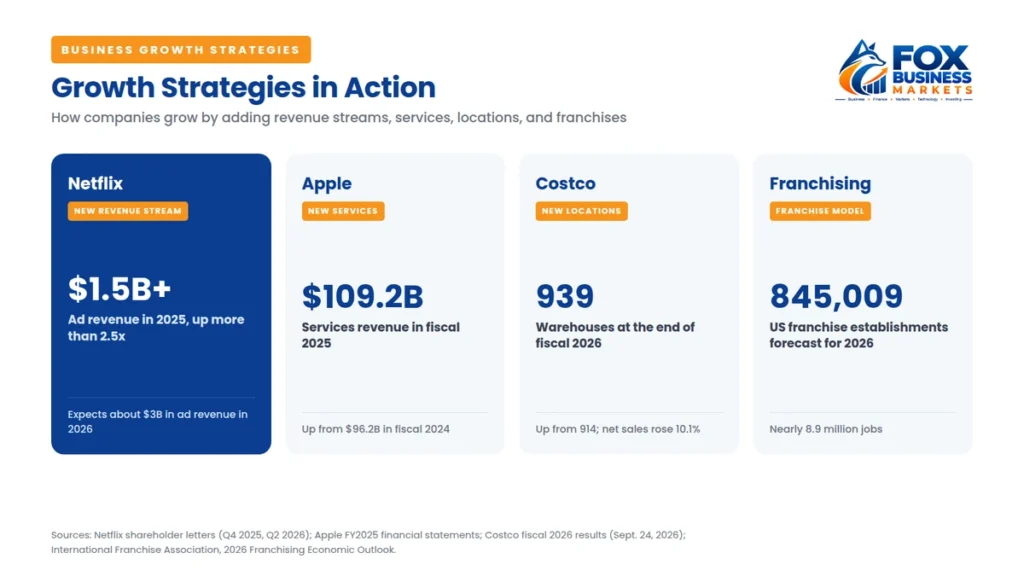
Product development means selling something new to the customers you already serve. Apple is a strong example: alongside its devices, its Services business, including the App Store, iCloud, and Apple Music, grew from $96.2 billion in fiscal 2024 to $109.2 billion in fiscal 2025 (Apple). A small business version might be a bakery adding catering, or an accountant adding payroll services.
5. Open New Locations or Enter New Markets
Taking a proven model to new places is a classic growth path. Costco operated 939 warehouses at the end of fiscal 2026, up from 914 a year earlier, while its net sales grew 10.1% to $297.2 billion (Costco). For a small business, a new market might be a nearby town, a new customer group, or a second location. Test demand first, since a new location doubles many of your fixed costs.
6. Add a New Revenue Stream
Sometimes growth comes from a new way of charging. Netflix launched a lower-priced plan with ads, and its “ad revenue grew by more than 2.5x vs. 2024 to over $1.5 billion” in 2025 (Netflix). By July 2026, it said it remained “on track to deliver approximately $3 billion in ads revenue in 2026” (Netflix). Small businesses can add memberships, subscriptions, rentals, or classes.
7. Export to New Countries
Exporting isn’t just for big companies. Small businesses make up 97.2% of US exporters and 33% of known export value (SBA Office of Advocacy). The SBA’s State Trade Expansion Program (STEP) “helps businesses that want to export” by funding state programs that cover costs such as trade missions, trade shows, translation, and export training (SBA).
8. Franchise Your Business
Franchising lets others open locations using your brand and system, funded with their own money. It’s a large sector: the International Franchise Association forecasts 845,009 franchise establishments in 2026, employing nearly 8.9 million people (International Franchise Association). Franchising works best for businesses with a proven, repeatable model, and it involves legal requirements, so get professional advice first.
9. Buy Another Business
Acquiring a competitor, supplier, or complementary business can add customers, staff, and revenue at once. SBA 7(a) loans, which go up to $5 million, can be used for “changes of ownership (complete or partial)” (SBA). Our guide to small business loans explains the options and the 2026 rule changes.
10. Use AI and Automation to Scale
Growth often stalls when owners run out of time. Automation can free up hours for selling and serving customers. In the Fed’s survey, “nearly half of firms (46%) reported that their business or its employees currently use AI,” and among them, 71% said it increased productivity, while 31% reported higher sales (Federal Reserve). Start with routine tasks such as scheduling, invoicing, customer emails, and social media drafts.
How to Choose the Right Growth Strategy
The best business growth strategies match your strengths and your appetite for risk. The Ansoff matrix ranks them roughly from safest to riskiest:
Growth path | Examples from this list | Risk |
| Market penetration (current products, current customers) | Sell more, keep customers longer | Lowest |
| Product development (new products, current customers) | New products, new revenue streams | Medium |
| Market development (current products, new markets) | Online sales, new locations, exporting, franchising | Medium |
| Diversification (new products, new markets) | Buying an unrelated business | Highest |
Start with a SWOT analysis to see which opportunities fit your strengths. Then ask three questions: Do we have proof of demand? Can we afford it if it takes twice as long as planned? Does it build on what we already do well?
How to Fund Your Growth
Most small businesses fund growth with profits, owner savings, or loans. Before you borrow, estimate the full cost, including new staff, inventory, and marketing, and how long it will take to pay off. Update your business plan with realistic projections, and use our business revenue calculator to model how much more you need to sell.
How to Measure Your Growth
Business growth strategies only work if you track the right numbers. Pick a few key metrics and review them every month:
- Revenue growth rate: how much sales grew compared with the same period last year.
- Customer retention rate: the share of customers who buy from you again.
- Average order value: how much a typical customer spends per purchase.
- Gross margin: how much you keep from each sale after direct costs. Growth with shrinking margins can hurt profits.
- Cash runway: how many months you could keep operating if sales slowed down.
If a strategy isn’t moving these numbers after a fair test, adjust it or try a different one. The most successful business growth strategies are the ones you measure, learn from, and improve over time.
Common Growth Mistakes
- Growing faster than your cash. More sales often mean paying for inventory and staff before customers pay you. Plan your cash flow carefully.
- Ignoring the core business. New projects can pull attention away from the customers who pay your bills.
- Expanding without proof. Test a new product or market on a small scale first.
- Hiring too late or too early. Hire for clear, steady demand, not one busy month.
- Chasing every opportunity. Pick one or two strategies and do them well.
Frequently Asked Questions
What are the main business growth strategies?
The main strategies are selling more to current customers, improving retention, selling online, adding new products, opening new locations, adding revenue streams, exporting, franchising, buying another business, and using automation to scale.
What is the easiest way to grow a small business?
Selling more to your existing customers is usually the easiest and lowest-risk option, because they already know and trust you. Upselling, bundles, and loyalty programs are good places to start.
What are the 4 types of growth strategy?
The Ansoff matrix describes four types: market penetration, product development, market development, and diversification. They range from lowest risk to highest risk.
How do I grow my business with no money?
Focus on low-cost strategies: improve customer retention, ask for referrals, raise the average order with add-ons, and use free tools to sell online. Reinvest profits before taking on debt.
When should a small business expand?
Expand when you have steady demand you can’t meet, healthy profits, and enough cash to cover the extra costs if growth takes longer than expected.
Is growing too fast bad for a business?
It can be. Rapid growth can strain cash flow, quality, and staff. Grow at a pace your finances and team can support.
Final Takeaway
The smartest business growth strategies build on what already works. Start by selling more to your current customers and keeping them longer, then expand into new products, channels, or markets as your cash and confidence grow. Test before you invest, watch your cash flow, and choose one or two strategies to focus on at a time.