Quick answer: Most drivers should carry at least 100/300/100 in liability coverage: $100,000 per injured person, $300,000 per accident, and $100,000 for property damage, far above most state minimums. Add collision and comprehensive if your car is financed or hard to replace, plus uninsured motorist coverage.
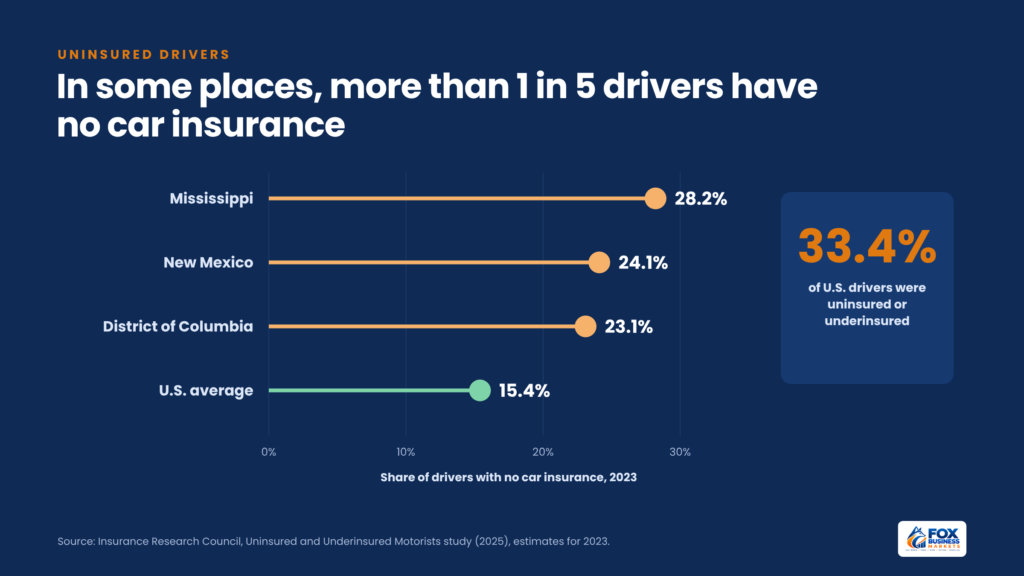
One in three U.S. drivers, 33.4%, was either uninsured or underinsured in 2023, according to the Insurance Research Council. If one of them hits you, you’re left relying on your own coverage, if you carry the right kind.
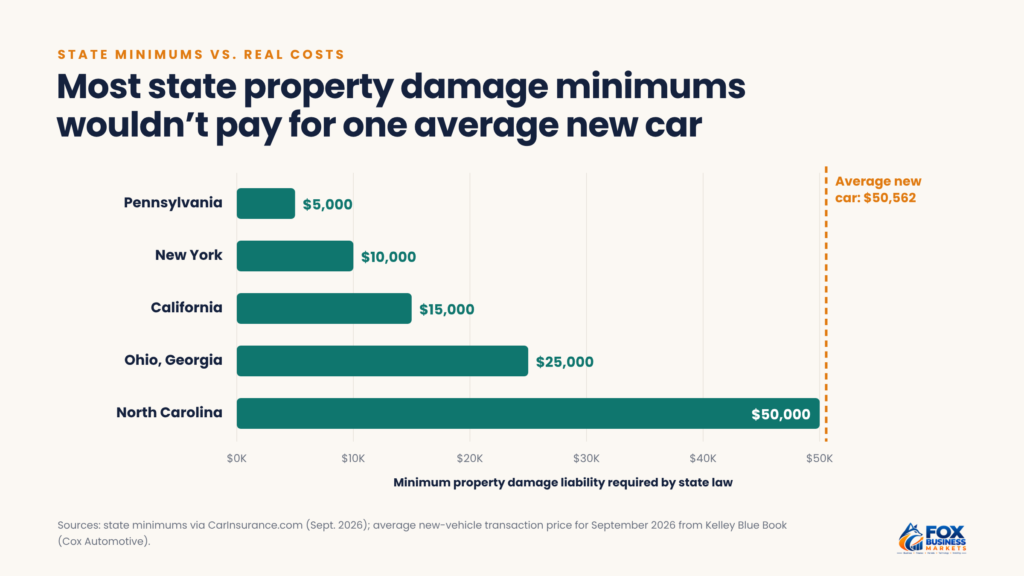
You may be underinsured too. In nearly every state, the legal minimum covers $25,000 or less in property damage, while the average new vehicle sold for $50,562 in September 2026, according to Kelley Blue Book. A single serious crash can cost far more than a minimum policy pays.
This guide explains how much car insurance you need: what each coverage does, how to read limits like 25/50/25, how much liability to carry for your situation, and when collision, comprehensive, and add-ons are worth the cost.
What Does Car Insurance Cover?
A car insurance policy bundles several coverages. Each one pays for a different kind of loss.
Coverage | What it pays for | Required? |
| Bodily injury liability | Injuries you cause to other people | Required in nearly every state |
| Property damage liability | Damage you cause to other people’s cars and property | Required in nearly every state |
| Uninsured/underinsured motorist | Your injuries, and sometimes car damage, when the at-fault driver has no or too little insurance | Required in about 23 states and D.C. |
| Personal injury protection (PIP) | Medical bills and lost wages for you and your passengers, regardless of fault | Required in no-fault states and a few others |
| Medical payments (MedPay) | Medical bills for you and your passengers, regardless of fault | Optional in most states |
| Collision | Damage to your car from a crash, regardless of fault | Optional by law; usually required by lenders |
| Comprehensive | Theft, fire, hail, flooding, vandalism, and hitting an animal | Optional by law; usually required by lenders |
Liability coverage protects other people from you. Collision and comprehensive protect your own car. Uninsured motorist, PIP, and MedPay protect you and your passengers.
What Do Numbers Like 25/50/25 Mean?
Liability limits are written as three numbers, in thousands of dollars:
- Bodily injury per person: the most the policy pays for one injured person.
- Bodily injury per accident: the most it pays for all injuries in one crash.
- Property damage per accident: the most it pays for damage to other people’s property.
A 25/50/25 policy pays up to $25,000 for one person’s injuries, $50,000 for all injuries in the crash, and $25,000 for property damage. Some policies use a single combined limit instead, such as $300,000 for all injuries and property damage in one accident.
Minimums vary widely by state. California requires 30/60/15, Texas 30/60/25, and Ohio and Georgia 25/50/25, while Pennsylvania requires only 15/30/5. Some states have raised their minimums recently: North Carolina now requires 50/100/50, Virginia requires 50/100/25, and New Jersey moved to 35/70/25 in January 2026.
Is State Minimum Coverage Enough?
For most drivers, no. State minimums are the least you can carry to drive legally, not an amount designed to protect you.
Compare the minimums with what claims actually cost:
- Injury claims: The average bodily injury liability claim was $24,281 for 2022–2024 model-year vehicles, according to the Highway Loss Data Institute. A serious injury with surgery, rehab, or lost income can run well into six figures.
- Property damage claims: The average property damage liability claim was $6,015, but totaling a new SUV or hitting several cars can cost far more. At today’s new-car prices, a $10,000 or $15,000 limit may not cover even one car.
When the damage you cause is bigger than your limits, you’re personally responsible for the rest. The injured person can sue you, and a court judgment can lead to wage garnishment or claims against your savings and other assets in many states.
State minimums can make sense for a driver with very few assets and a tight budget. Get quotes at several limit levels before you decide.
What Happens if You Cause a Crash With Too Little Coverage?
Consider a hypothetical crash. You run a red light and hit a new SUV with two people inside. The SUV is totaled at $48,000. One occupant has a broken leg with $60,000 in medical bills and lost wages, and the other has $15,000 in injuries.
With 25/50/25 coverage:
- Property damage: Your policy pays $25,000. You owe the remaining $23,000.
- Injuries: Your policy pays $25,000 for the first occupant, the per-person limit, and $15,000 for the second, for $40,000 total, within the $50,000 per-accident limit. You owe the first occupant’s remaining $35,000.
That’s $58,000 you could be sued for personally. With 100/300/100 coverage, the policy would have paid all of it.
Your insurer also pays your lawyer, usually on top of your limits. But once it has paid out the full limit, its duty to defend you generally ends, and you could be left to hire your own attorney. Higher limits make that less likely.
How Much Liability Coverage Should You Carry?
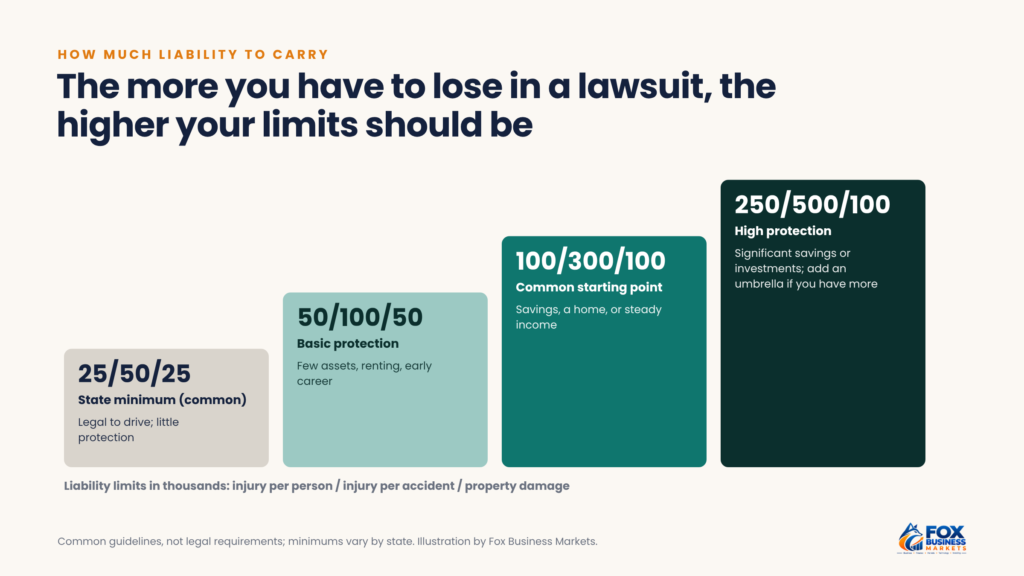
A practical rule is to carry enough liability coverage to protect what you own and what you’ll earn. The more you have to lose in a lawsuit, the higher your limits should be.
Your situation | Suggested liability limits |
| Few assets, renting, early in your career | At least 50/100/50, or more if affordable |
| Typical household with savings, a home, or a steady income | 100/300/100 |
| Homeowner with significant savings or investments | 250/500/100 |
| High net worth, teen drivers in the house, or a public-facing job | 250/500/100 plus an umbrella policy |
To size your own limit, add up what a lawsuit could reach: home equity, savings, taxable investments, and future wages. State laws often protect retirement accounts and part of your home equity, so a lawyer or agent can tell you what’s exposed where you live.
These are common guidelines, not legal requirements. Going from minimum limits to 100/300/100 often costs less than people expect, because the first dollars of liability coverage carry most of the cost. Ask for quotes at each level and compare.
Umbrella insurance adds another layer, usually in $1 million increments, on top of your car and home liability coverage. Insurers that sell umbrella policies generally require your auto liability to be at a set level first, often $300,000 to $500,000 per accident (for example, 250/500 limits), so check the requirement before you set your car limits.
Do You Need Collision and Comprehensive Coverage?
Collision and comprehensive cover your own car. Whether you need them depends on two things: whether someone else requires them, and whether you could replace the car yourself.
You almost always need them if:
- Your car is financed or leased. Lenders and leasing companies typically require both until the loan is paid off, often with a cap on your deductible, and leases may also require higher liability limits.
- Your car is newer or valuable. If a crash or theft would leave you unable to afford another car, keep the coverage.
You may be able to drop them if:
- Your car is worth little. A common rule of thumb is to consider dropping collision and comprehensive when their yearly cost is more than about 10% of the car’s value.
- You have cash to replace the car. If you could buy a similar car out of savings without hardship, you can take on that risk yourself.
Collision and comprehensive pay out only up to the car’s actual cash value, what the car was worth just before the loss, after depreciation, not what you paid. On an older car worth $3,000, the most you’d collect is $3,000 minus your deductible.
How Do You Choose a Deductible?
Your deductible is what you pay toward a collision or comprehensive claim before insurance pays the rest. Common choices are $250, $500, and $1,000.
A higher deductible lowers your premium, sometimes noticeably. The trade-off is a bigger bill when you file a claim.
Choose the highest deductible you could pay tomorrow without borrowing. If you have $1,000 or more set aside in an emergency fund, a $1,000 deductible is often a sensible choice. If you’d have to put a $1,000 repair on a credit card, a lower deductible may be worth the higher premium.
Some insurers let you set a lower deductible for comprehensive than for collision, since comprehensive claims, like a cracked windshield, are often smaller.
Do You Need Uninsured and Underinsured Motorist Coverage?
Yes, for most drivers. Uninsured motorist (UM) coverage pays for your injuries when the at-fault driver has no insurance or flees the scene. Underinsured motorist (UIM) coverage pays when the at-fault driver’s limits are too low to cover your costs.
The risk is real. The Insurance Research Council estimates 15.4% of drivers were uninsured in 2023, with the highest rates in Mississippi (28.2%), New Mexico (24.1%), and the District of Columbia (23.1%).
A common approach is to match your UM/UIM limits to your own liability limits. If you carry 100/300 for injuries you cause, carry 100/300 for injuries others cause you.
Some states cap UM/UIM at your liability limits, and some let you “stack” coverage across several cars for a higher limit, so ask your agent what your state allows.
Some states also offer uninsured motorist property damage coverage, which pays to repair your car when an uninsured driver is at fault. If you already carry collision, check whether this adds much protection, since collision covers your car regardless of fault.
What About PIP and Medical Payments Coverage?
Personal injury protection (PIP) and medical payments (MedPay) both pay medical bills for you and your passengers after a crash, no matter who caused it.
PIP is required in no-fault states, such as Florida, Michigan, and New York. Beyond medical bills, it can cover lost wages and other costs, depending on the state.
MedPay is a smaller, optional coverage in most other states. It pays medical bills and sometimes your health insurance deductible and copays.
If you have strong health insurance and disability coverage, you may need only modest PIP or MedPay above your state’s requirement. If your health plan has a high deductible, or you often drive with passengers who may lack coverage, higher limits can fill the gap.
Which Optional Coverages Are Worth Adding?
These add-ons are usually inexpensive and fill specific gaps:
- Gap insurance. If your car is totaled, collision pays its actual cash value, which can be less than what you still owe on the loan, especially in the first years. Gap insurance pays the difference. Consider it if you made a small down payment or have a long auto loan.
- Rental reimbursement. Pays for a rental while your car is being repaired after a covered claim. Consider it if you don’t have another car to use.
- Roadside assistance. Covers towing, jump-starts, and lockouts. Check first whether you already have it through your car’s warranty, a credit card, or an auto club.
- New car replacement. Pays for a new car of the same make and model, rather than the depreciated value, if a newer car is totaled. Usually available only for cars in their first year or two.
Skip add-ons that duplicate coverage you already have, and read each one’s limits.
What Affects How Much You Pay?
The national average combined premium for liability, collision, and comprehensive was $1,438 per vehicle in 2023, according to the NAIC, and prices have climbed since. Your own rate depends on factors like these:
- Driving record. Accidents, speeding tickets, and DUIs raise rates for several years.
- Where you live. Urban areas with more traffic, theft, and claims cost more.
- Age and experience. Young drivers, especially teens, pay the most.
- Your car. Repair costs, safety ratings, and theft rates all affect price.
- Coverage and deductibles. Higher limits and lower deductibles cost more.
- Credit-based insurance score. In most states, insurers use a score built from your credit history. A few states, including California, Hawaii, and Massachusetts, don’t allow it for car insurance. Building a good credit score can lower your rate where it’s used.
- Annual mileage. Driving less usually means paying less.
How Should Your Coverage Change When You Add a Teen Driver?
Adding a teen driver is one of the biggest jumps in car insurance costs, because new drivers have the highest crash rates. It’s also when stronger coverage is most valuable, since a serious crash by your teen would be paid from your policy, and a lawsuit could reach your assets.
A few steps can help, along with the discounts in the section below:
- Keep your liability limits high, and consider an umbrella policy once you have a teen driver.
- Add the teen to your policy rather than buying a separate one, which usually costs more.
- Assign the teen to the least expensive car if your insurer rates drivers by vehicle.
Shop your policy again once your teen has a year or two of clean driving, since rates usually fall with experience.
Does “Full Coverage” Mean You’re Fully Covered?
No. “Full coverage” isn’t an official type of policy. It usually means a policy with liability, collision, and comprehensive. But a “full coverage” policy can still carry minimum liability limits that leave you exposed after a serious crash.
It may not include uninsured motorist coverage, gap insurance, rental reimbursement, or roadside assistance. And collision and comprehensive pay only the car’s actual cash value, minus your deductible.
When an agent or website quotes “full coverage,” ask for the specific liability limits, deductibles, and coverages in writing.
How Can You Lower Your Premium Without Cutting Protection?
Keeping strong liability limits doesn’t have to break your budget. Try these first:
- Shop around. Compare quotes from at least three insurers for the same limits and deductibles. Prices for identical coverage can vary widely.
- Raise your deductible to an amount your savings can cover.
- Bundle policies. Many insurers discount car insurance when you buy other types of insurance, such as homeowners or renters, from them.
- Ask for every discount. Common ones include safe driver, good student, multi-car, paying in full, paperless billing, and completing a defensive driving course.
- Try usage-based insurance. Some insurers track your driving through an app or device and lower rates for safe driving.
- Drop collision and comprehensive on an older car when the math in the section above says they no longer pay off.
If the premium is still hard to fit in, our guide on how to make a budget can help you plan for it.
When Should You Review Your Car Insurance?
Check your coverage at least once a year at renewal, and whenever your life changes in a way that affects your risk or your assets:
- You buy a home, get a raise, or build up savings, which means you have more to protect.
- You buy, sell, or pay off a car.
- You move, even within the same state, since rates depend on location.
- A driver joins or leaves your household.
- You start driving much more or much less, such as switching to remote work.
Frequently Asked Questions
Does my car insurance cover someone else driving my car?
Usually, yes, if you gave them permission. In most cases, insurance follows the car, so your policy pays first if a friend crashes your car, and their own insurance may add coverage after your limits run out. Regular drivers in your household should be listed on your policy, so add anyone who drives your car often.
Does my car insurance cover a rental car?
Your personal policy often extends its liability coverage to a rental car you drive in the U.S., and its collision and comprehensive coverage if you carry them on your own car, but not always to loss-of-use or administrative fees the rental company charges. Some credit cards add rental car coverage too. Call your insurer and card issuer before your trip so you know whether to accept the rental counter’s coverage.
Do I need car insurance if I don’t own a car?
Not legally, if you never drive. But if you drive borrowed or rented cars often, a non-owner car insurance policy gives you liability coverage that follows you. It’s also how drivers who need to file an SR-22 can meet that requirement without owning a car. Ask for a non-owner quote, which is usually cheaper than a standard policy.
Does my policy cover me if I drive for Uber, Lyft, or a delivery app?
Usually not while you’re logged into the app. Most personal policies exclude driving for pay, and while you’re waiting for a request, the company’s coverage is limited, typically liability only at lower limits, and doesn’t pay for damage to your own car until you accept a ride or delivery. Ask your insurer for a rideshare or delivery endorsement before your first shift.
Set Your Limits to Protect What You Own
Pull up your declarations page and find three things: your liability limits, your deductibles, and whether you carry uninsured motorist coverage. If your limits are near your state’s minimum, get quotes for 100/300/100 or higher. Then compare quotes from at least three insurers at those limits before your next renewal.
This article is for general information only and isn’t financial, legal, or insurance advice. Policies and rules vary by insurer and state, so read your policy and talk to a licensed professional before making decisions.