Alana had $10,000 spread across three credit cards, most of it from a family move and a car repair that came in the same year. She’s a 41-year-old veterinary technician in Columbus, Ohio, and she was paying close to 22% interest. Her payments barely touched the balance. So she sat down with an advisor at her credit union to ask a simple question: could a personal loan get her out faster and cheaper? (Alana is a composite example, but the numbers below use real U.S. rates from 2026.)
This guide explains how to get a personal loan in the U.S. step by step: what lenders check, how to compare offers without hurting your credit, what a loan really costs, and the scams to avoid.
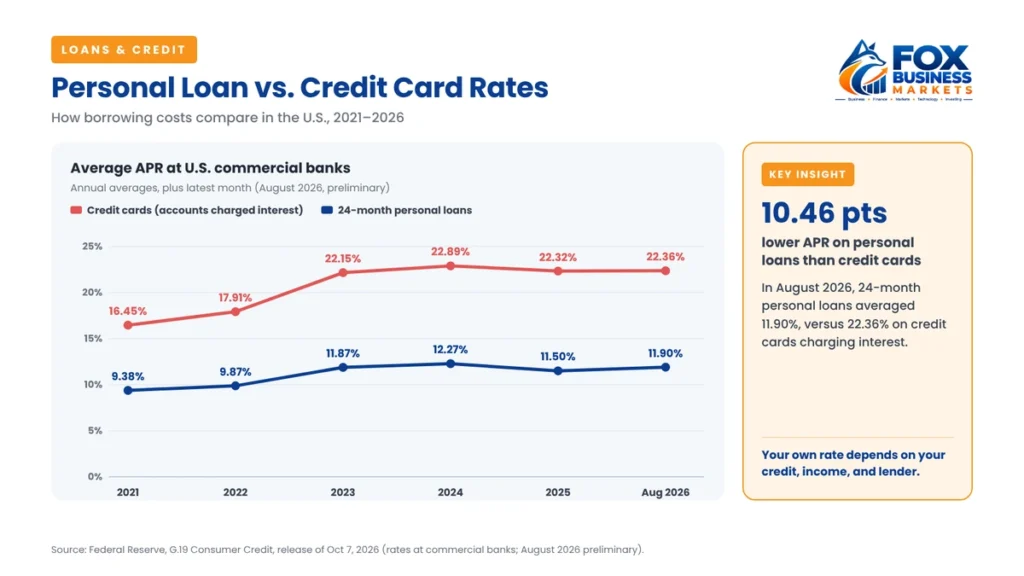
Quick answer: To get a personal loan, check your credit, decide how much you need, and figure out what monthly payment you can afford. Then prequalify with several banks, credit unions, and online lenders, compare offers by APR and total cost, and submit a full application with proof of income and ID. Approved borrowers often get funds within a few business days. The average rate on a 24-month personal loan at U.S. commercial banks was 11.90% in August 2026, according to the Federal Reserve, but your rate depends on your credit and income.
What Is a Personal Loan?
A personal loan is money you borrow in one lump sum and repay in fixed monthly payments over a set term. The Consumer Financial Protection Bureau (CFPB) describes personal installment loans as closed-end loans that “can range in size from several hundred dollars to several thousand dollars or more,” with terms that “can range from a few months to several years.”
Most personal loans are unsecured, which means there’s no collateral like a house or car. The lender decides based on your credit history and income. People commonly use them to consolidate credit card debt, pay for home repairs, or cover large or unexpected expenses. For how they compare with mortgages, auto loans, and credit cards, see our guide to types of loans.
Personal loans are popular. Americans owed a record $281 billion on unsecured personal loans in the second quarter of 2026, up 9.6% from a year earlier, and 26.9 million consumers had one, according to TransUnion (credit bureau data).
How Do You Get a Personal Loan Step by Step?
Here’s how to get a personal loan in seven steps.
Step 1: Know Exactly Why and How Much You Need
Start with the number. Borrow only what you need, because every extra dollar costs interest. If you’re consolidating debt, add up your balances. If it’s a project, get written quotes first.
Ask yourself whether a loan is the right tool. If the expense is small and you have savings, using your emergency fund may cost less. If you’re juggling several debts, our guide on how to pay off debt covers other strategies.
Step 2: Check Your Credit Reports and Score
Your credit score is the biggest factor in your rate, so checking it is the first real step in how to get a personal loan. Get your free credit reports from Equifax, Experian, and TransUnion at AnnualCreditReport.com, and dispute any errors before you apply. Many banks and card issuers also show you a free score.
Not sure where you stand? Our guide to what is a good credit score explains the ranges. If your score is low, a few months of work can lower your rate; see how to improve your credit score.
Step 3: Figure Out Your Debt-to-Income Ratio
Lenders want to know you can afford the payment, and that’s a big part of how to get a personal loan approved. Your debt-to-income ratio (DTI), according to the CFPB, “is all your monthly debt payments divided by your gross monthly income.” For example, $2,000 in monthly debt payments on a $6,000 gross monthly income is a 33% DTI.
Each lender sets its own DTI limit. A lower DTI improves your chances and your rate. If you’re consolidating, the new loan payment replaces your old card payments, so your DTI may not rise much.
Step 4: Choose the Right Type of Lender
Where you apply shapes how to get a personal loan at a fair rate. You can borrow from three main types of lenders:
Lender | Strengths | Watch for |
| Banks | Existing customers may get rate discounts; easy to manage with your other accounts | May require good credit |
| Credit unions | Often lower rates; federal credit unions generally can’t charge more than 18% APR | You must become a member |
| Online lenders | Fast decisions; prequalification online; some serve fair credit | Rates and fees vary widely |
Federal credit unions are subject to a rate ceiling. In 2026, the National Credit Union Administration (NCUA) extended the temporary 18% interest rate ceiling for most federal credit union loans through September 10, 2027. Small-dollar payday alternative loans (PALs) are an exception and can charge up to 10 percentage points above the ceiling, currently 28%. State-chartered credit unions follow their own state’s rules.
If you’re an active-duty servicemember (including active Guard or Reserve) or a covered dependent, the Military Lending Act generally caps the cost of many consumer loans, including most personal loans, at a 36% military annual percentage rate, according to the CFPB.
Step 5: Prequalify and Compare Offers
Prequalification shows you estimated rates and terms using a soft credit check, which doesn’t affect your credit score. Prequalify with at least three lenders, including your bank or credit union.
This step matters more for personal loans than for mortgages or auto loans. FICO’s scoring models count multiple mortgage, auto, and student loan inquiries made within a short window as a single inquiry, but FICO lists only those three loan types for that rate-shopping treatment. So compare with soft-pull prequalification first, and submit a full application, which triggers a hard inquiry, only with the lender you choose.
Step 6: Compare the APR, Fees, and Total Cost
Compare offers by APR, not just the interest rate. The APR includes certain fees, so it shows a truer cost. The CFPB says personal installment loans may have fees such as an “origination fee,” a “documentation fee,” late fees, and optional credit or disability insurance.
Origination fees matter because many lenders subtract them from your loan. If you borrow $10,000 with a 5% origination fee, you may receive only $9,500 but repay the full $10,000 plus interest. On a three-year loan at 11.90%, that fee raises the APR to about 15.5%. Also check for prepayment penalties and whether autopay earns a rate discount.
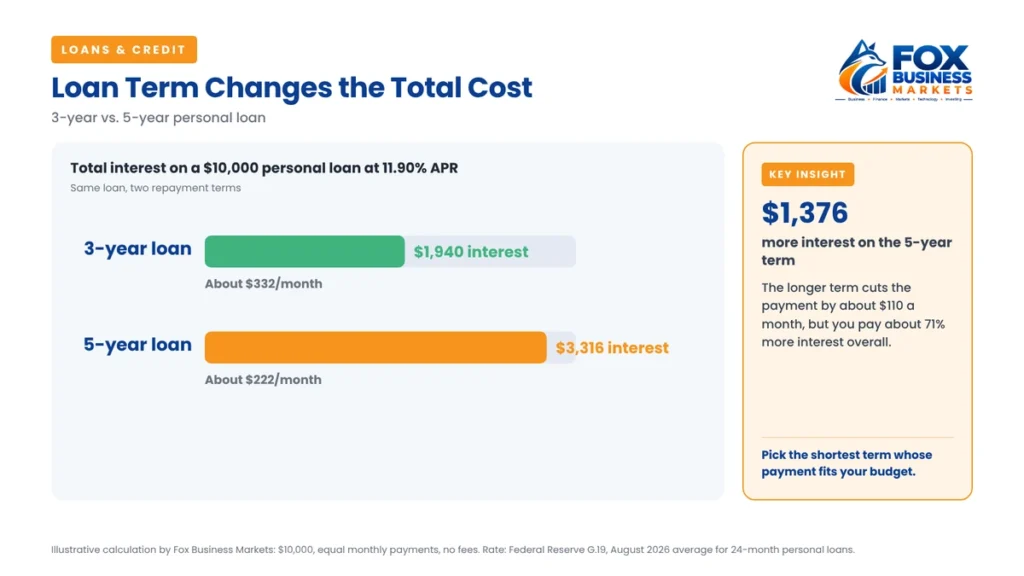
Look at the term, too. A longer term lowers the monthly payment but costs more overall:
$10,000 loan at 11.90% APR | Monthly payment | Total interest |
| 3 years (36 months) | About $332 | About $1,940 |
| 5 years (60 months) | About $222 | About $3,316 |
Illustrative calculation by Fox Business Markets, assuming equal monthly payments and no fees. The rate is the Federal Reserve’s August 2026 average for 24-month personal loans at commercial banks; your rate will differ.
Step 7: Apply and Get Your Money
Once you choose a lender, submit a full application. Most lenders ask for:
- A government-issued photo ID
- Your Social Security number
- Proof of income, such as recent pay stubs, W-2s, or tax returns
- Proof of address
- Your employer’s details and your monthly housing cost
- Bank account details for the deposit
Read the final loan agreement before you sign. Under the federal Truth in Lending Act, lenders must disclose the APR, finance charge, amount financed, and total of payments. Many online lenders fund approved loans within a few business days. Some debt consolidation loans can pay your card issuers directly.
What Do Lenders Look at for a Personal Loan?
Knowing how to get a personal loan means knowing what lenders check. Most look at:
- Credit score and history: Your payment history, how much credit you use, and any recent late payments, collections, or bankruptcies.
- Income and employment: Steady income that can cover the payment.
- Debt-to-income ratio: How much of your income already goes to debt.
- Loan amount and purpose: Some lenders limit how loans can be used.
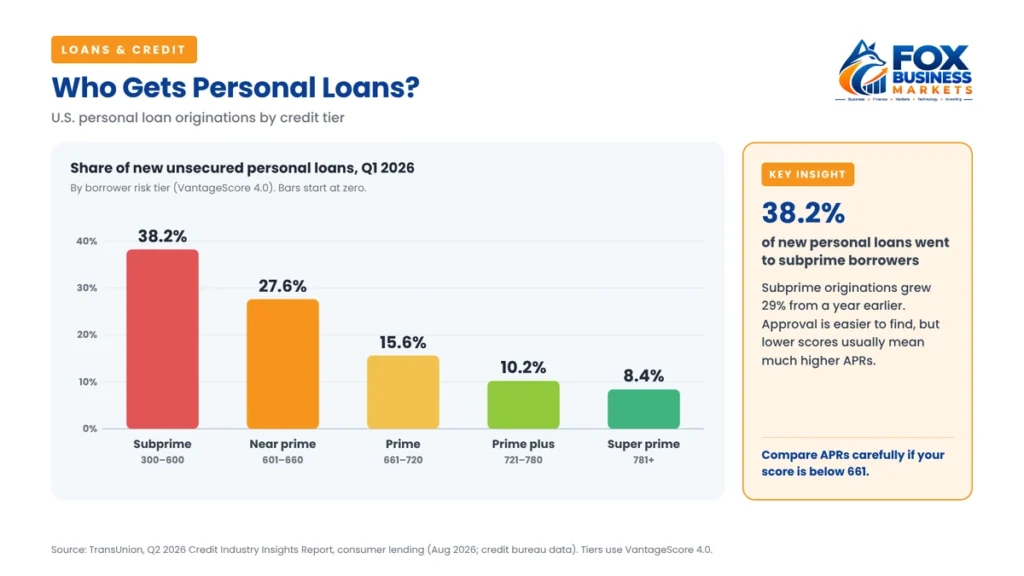
Lenders are also lending to more borrowers with lower scores. In the first quarter of 2026, subprime borrowers accounted for 38.2% of new unsecured personal loans, according to TransUnion’s Q2 2026 consumer lending report, which uses VantageScore 4.0 tiers. But approval isn’t the same as a good deal. Borrowers with lower scores usually pay much higher rates.
Can You Get a Personal Loan With Bad Credit?
Yes, but it costs more, and you need to be careful. If your credit is fair or poor, here are better options:
- Start with a credit union. Federal credit unions generally cap APRs at 18%, and some offer small loans to members with limited credit.
- Ask about payday alternative loans (PALs). Federal credit unions can offer PALs I loans of $200 to $1,000 with terms of one to six months (you must be a member for at least a month), and PALs II loans of up to $2,000 with terms of one to 12 months. Application fees are capped at $20 under NCUA rules.
- Add a co-signer or co-borrower with stronger credit, if someone is willing to share the responsibility.
- Consider a secured personal loan, backed by a savings account or CD, which can come with a lower rate.
- Improve your credit first, if you can wait a few months.
Avoid payday loans and car title loans if you can. They can carry very high costs and short repayment periods.
What If Your Personal Loan Application Is Denied?
If you’re denied, the lender must give you the specific reasons or tell you how to get them, according to the CFPB. If a credit report played a role, you can get a free copy from that credit bureau within 60 days and dispute any errors.
Then fix what you can: pay down card balances, correct report errors, reduce your DTI, or apply for a smaller amount. Waiting a few months between applications also limits hard inquiries.
How Do You Spot a Personal Loan Scam?
Scammers target people who need money fast. The Federal Trade Commission warns that legitimate lenders don’t “promise or guarantee you a loan or credit before you apply.” According to the FTC, watch for these red flags:
- Upfront fees before you get the loan, especially ones called “insurance,” “processing,” or “paperwork.” “Don’t pay for a promise,” the FTC says.
- Guaranteed approval or “bad credit? no problem” offers.
- Calls offering you a loan out of the blue.
Before you apply, the FTC also says to check that the lender is registered in your state, through your state attorney general or banking regulator.
Real lenders can charge an application or origination fee, but none will say that paying a fee guarantees approval.
Is a Personal Loan a Good Idea?
Learning how to get a personal loan is only half the decision. A personal loan can be a smart move when it lowers your interest rate or gives you a clear payoff date. It’s often cheaper than a credit card. In August 2026, the average rate on 24-month personal loans at commercial banks was 11.90%, compared with 22.36% on credit card accounts charged interest, according to the Federal Reserve’s G.19 consumer credit release.
It’s a poor idea if you’d use the loan for everyday spending, if the payment would strain your budget, or if you’d run your cards back up after consolidating. Before you borrow, make sure the payment fits your budget.
Frequently Asked Questions
How do I get a personal loan?
Check your credit, decide how much you need, and calculate an affordable payment. Prequalify with several banks, credit unions, and online lenders using soft credit checks. Compare offers by APR and total cost, then submit a full application with your ID, Social Security number, and proof of income. Many approved loans are funded within a few business days.
What credit score do I need for a personal loan?
There’s no single minimum, because each lender sets its own standards. Borrowers with good credit, generally a FICO Score of 670 or higher, usually qualify for better rates. Some lenders approve borrowers with fair or poor credit, but at higher APRs. Credit unions may be more flexible with members.
Does checking personal loan rates hurt my credit?
Prequalifying uses a soft credit check, which doesn’t affect your credit score. A full application usually triggers a hard inquiry, which may lower your score slightly for a short time. FICO doesn’t treat several personal loan inquiries as one the way it does for mortgages, auto loans, and student loans, so compare with prequalification first.
How long does it take to get a personal loan?
Many online lenders give a decision within minutes to a day and fund approved loans within a few business days. Banks and credit unions may take a little longer, especially if you’re a new customer or member. Having your ID, pay stubs, and bank details ready speeds things up.
What is a good interest rate on a personal loan?
A good rate is one at or below the average for your credit profile. The average rate on a 24-month personal loan at U.S. commercial banks was 11.90% in August 2026, according to the Federal Reserve. Federal credit unions generally can’t charge more than 18% APR. Always compare offers by APR, not just the interest rate.
Can I get a personal loan with no credit history?
It’s possible, but harder. Try a credit union, especially one where you already bank, or apply with a co-signer who has good credit. A secured personal loan backed by savings is another option. You can also build credit first with a secured credit card or a credit-builder loan.
The Bottom Line
Alana prequalified with her credit union and two online lenders. Her credit union offered the lowest APR with no origination fee, and its advisor helped her pick a three-year term instead of five. Her monthly payment is fixed, her cards are at zero, and she knows the exact month she’ll be debt-free.
That’s how to get a personal loan the smart way: know your number, check your credit and DTI, prequalify with several lenders, compare APRs and total cost, and read the agreement before you sign. Stay away from anyone who guarantees approval or wants a fee upfront. For the bigger picture, see our personal finance guide.