Quick answer: The main types of insurance most Americans need are health, auto, homeowners or renters, life, and disability insurance. Some people also benefit from long-term care, umbrella, and flood coverage. Each one trades a predictable payment, called a premium, for protection against a cost you couldn’t comfortably pay on your own.
About 26.7 million people in the U.S., 7.9%, had no health insurance for all of 2025, according to the Census Bureau. Separately, 92 million adults say they need life insurance or more of it, according to the 2026 Insurance Barometer Study from LIMRA and Life Happens.
Those gaps rarely come from carelessness. Insurance is confusing: every policy has its own terms and exclusions, and it’s hard to know which coverage you truly need and which is optional.
This guide explains the main types of insurance, who needs each one, what they cover and leave out, and how to decide what to buy first.
How Does Insurance Work?
Insurance spreads the cost of rare but expensive events across many people. Thousands of policyholders pay premiums into a pool. The few who suffer a covered loss, such as a car crash, a house fire, or a serious illness, are paid from that pool.
Every policy uses the same basic terms:
Term | What it means |
| Premium | What you pay for coverage, usually monthly or yearly |
| Deductible | What you pay out of pocket on a claim before insurance pays |
| Coverage limit | The most the insurer will pay for a covered loss |
| Exclusions | Events or costs the policy doesn’t cover |
| Claim | Your request for the insurer to pay for a covered loss |
| Beneficiary | The person who receives a life insurance payout |
A higher deductible usually means a lower premium, because you agree to cover more of each loss yourself. That tradeoff only works if you have cash set aside. An emergency fund that can cover your largest deductible lets you choose cheaper policies without risking a crisis when you file a claim.
What Are the Main Types of Insurance?
Type | What it protects | Who needs it | Usually required? |
| Health | Medical bills | Nearly everyone | No federal penalty since 2019; some states require it |
| Auto | Injuries and damage from car accidents | Every driver | Yes, in almost every state |
| Homeowners | Your home, belongings, and liability | Homeowners | Required by mortgage lenders |
| Renters | Your belongings and liability | Renters | Some landlords require it |
| Life | Your family’s income if you die | Anyone with dependents or shared debts | No |
| Disability | Your income if you can’t work | Most workers | No (several states run disability or paid leave programs) |
| Long-term care | Help with daily living as you age | People in their 50s and 60s planning ahead | No |
| Umbrella | Liability above your auto and home limits | People with significant assets | No |
| Flood | Flood damage to your home and belongings | Homeowners and renters in flood-prone areas | Required by lenders in high-risk flood zones |
Health Insurance
Health insurance pays for doctor visits, hospital stays, prescriptions, and preventive care. Without it, a single hospitalization can cost tens of thousands of dollars.
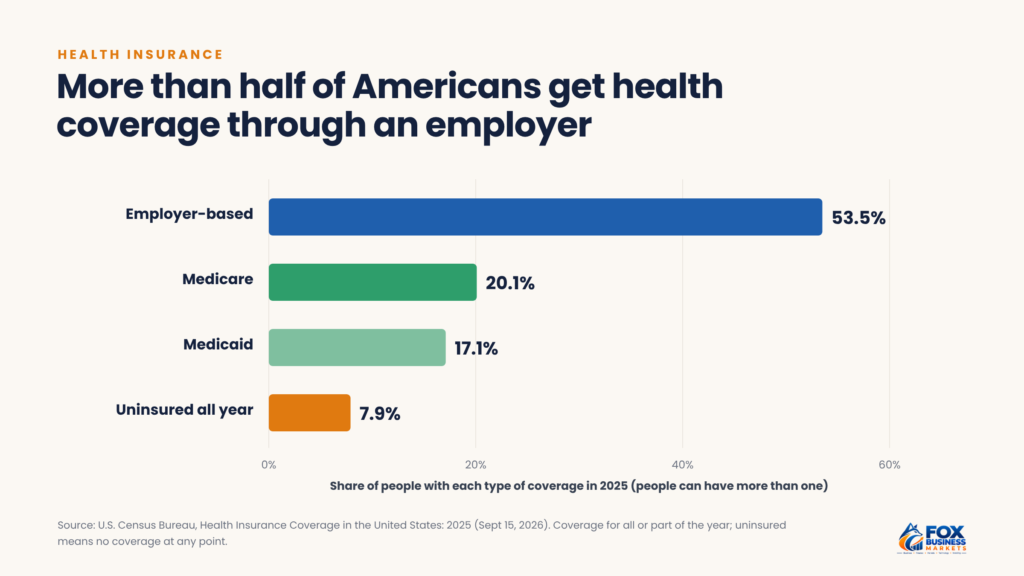
Most Americans get coverage through work. In 2025, 53.5% of people had employer-based coverage for some or all of the year, according to the Census Bureau’s Health Insurance Coverage in the United States: 2025, released in September 2026. Public programs such as Medicare and Medicaid covered many others, and 7.9% of people were uninsured for the entire year.
If your job doesn’t offer coverage, you can buy a plan through the federal Health Insurance Marketplace at HealthCare.gov or your state’s exchange, generally during the annual open enrollment period. Losing other coverage, moving, marrying, or having a baby can qualify you for a special enrollment period outside that window. People with low incomes may qualify for Medicaid, depending on their state.
When comparing plans, look beyond the monthly premium. The deductible, copays, and out-of-pocket maximum decide what you’ll actually pay when you get care.
Auto Insurance
Almost every state requires drivers to carry auto insurance, mainly liability coverage that pays for injuries and damage you cause to others. The main parts of a policy are:
- Liability: Pays for others’ injuries and property damage when you’re at fault. This is the core of what states require.
- Collision: Pays to repair or replace your car after a crash, regardless of fault.
- Comprehensive: Covers theft, vandalism, hail, flooding, fire, and hitting an animal.
- Uninsured/underinsured motorist: Protects you if the other driver has too little insurance or none.
- Medical payments or personal injury protection (PIP): Pays medical bills for you and your passengers. Some states require PIP.
State minimum limits are often low compared with the cost of a serious crash, so many drivers buy more liability coverage than the law requires. If you have a car loan or lease, your lender will typically require collision and comprehensive coverage too, and you may want gap insurance (see the FAQ below). Our guide to types of loans explains how auto loans work.
Prices have started to cool after years of steep increases. The Consumer Price Index for motor vehicle insurance was 5.1% lower in August 2026 than a year earlier, according to the Bureau of Labor Statistics. Prices have fallen year over year every month since May 2026, the first annual declines since 2021. Your own rate depends on your driving record, car, location, and, in most states, your credit-based insurance score.
Homeowners and Renters Insurance
Homeowners insurance covers your house, other structures like a detached garage, your belongings, and personal liability if someone is hurt on your property. It also pays for temporary housing if a covered disaster makes your home unlivable. Mortgage lenders require it.
Premiums have climbed. Average homeowners premiums per policy increased in every region of the country from 2018 to 2024, by 18.3% to 43.3% after inflation depending on the region, according to a National Association of Insurance Commissioners (NAIC) analysis released in August 2026. Company-initiated non-renewal rates rose 96% to 216% over the same period, depending on the region.
Renters insurance covers your belongings and your liability, not the building itself, which is the landlord’s responsibility. It’s usually inexpensive and often overlooked, even though a fire or burglary can destroy thousands of dollars of furniture, clothes, and electronics.
Flood is the big exclusion. “Most homeowners and renters insurance policies do not cover flood damage,” according to FEMA’s National Flood Insurance Program FloodSmart fact sheet. Flood policies generally have a 30-day waiting period before they take effect, so you can’t wait until a storm is forecast. About one-third of flood insurance claims from 2013 to 2023 came from areas outside current high-risk flood zones, FEMA reported.
Earthquake damage is also usually excluded and requires separate coverage.
Life Insurance
Life insurance pays a sum of money, called the death benefit, to your beneficiaries when you die. It replaces your income for people who depend on it and can pay off debts like a mortgage.
The two main kinds are:
- Term life insurance: Covers you for a set period, such as 20 or 30 years. It’s the simplest and cheapest way to buy a large amount of coverage.
- Permanent life insurance (such as whole life): Covers you for life and builds cash value, but costs far more for the same death benefit.
For most families, term coverage provides the most protection per dollar, and the money saved by choosing it over permanent coverage can go toward investing for long-term goals.
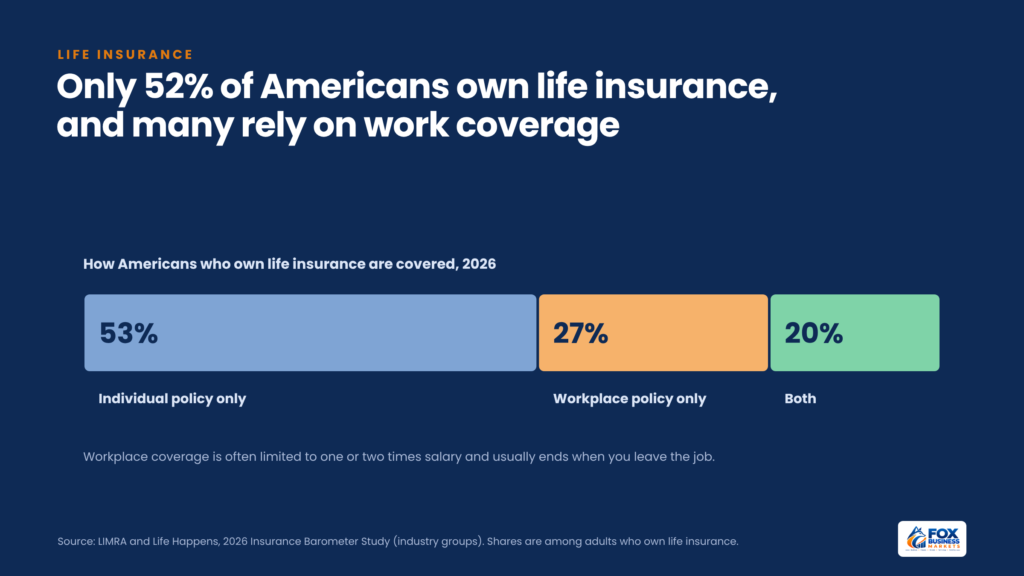
About 52% of Americans own at least one life insurance policy, according to the 2026 Insurance Barometer Study from LIMRA and Life Happens, industry groups. Many people avoid it because of cost, yet roughly three-quarters of consumers overestimate what life insurance costs, the study found.
Coverage through work is convenient but often limited, commonly one or two times your salary, and it usually ends when you leave the job. Among Americans with life insurance, 27% have only workplace coverage, according to the same study.
Not everyone needs life insurance. If no one depends on your income and you don’t have co-signed debts, you may not need it. If you have children, a non-working spouse, or a mortgage in both names, it’s usually one of the first policies to buy.
Disability Insurance
Disability insurance replaces part of your paycheck if illness or injury keeps you from working. For most workers, their ability to earn an income is their biggest financial asset, so this coverage can matter more than life insurance during working years.
The risk is higher than many people assume. About 1 in 4 of today’s 20-year-olds will become disabled and qualify for Social Security disability benefits before reaching age 67, according to the Social Security Administration.
- Short-term disability usually replaces part of your income for a few months.
- Long-term disability can pay for years, sometimes until retirement age.
Social Security Disability Insurance exists, but qualifying is strict and benefits are often modest. Many employers offer group disability coverage; if yours doesn’t, or if you’re self-employed, an individual policy is worth pricing.
Long-Term Care Insurance
Long-term care insurance pays for help with daily activities like bathing, dressing, and eating, at home, in assisted living, or in a nursing home.
Many people assume Medicare covers this. It doesn’t, in most cases. Medicare “doesn’t cover custodial care if it’s the only care you need,” and it “generally doesn’t cover long-term nursing home stays, unless you’re receiving skilled nursing care,” according to Medicare.gov.
Medicaid does pay for long-term care, but only after you’ve spent down most of your assets. Long-term care policies are usually bought in your 50s or early 60s, when premiums are lower and you’re more likely to qualify. Some life insurance policies include long-term care riders as an alternative.
Umbrella Insurance
Umbrella insurance adds extra liability coverage, often $1 million or more, on top of your auto and homeowners or renters policies. It pays when a lawsuit or serious accident exceeds the limits of those policies.
It’s typically inexpensive for the amount of protection. People with significant savings, home equity, a pool, a teen driver, or rental property are the most common buyers, because they have more to lose in a lawsuit.
What Other Types of Insurance Should You Know About?
Beyond the core policies, you’ll see many smaller policies offered. Most are optional, and some are better value than others:
- Dental and vision insurance: Often offered at work. Worth it if you expect regular care or need glasses, but annual benefit caps are usually low.
- Pet insurance: Helps with large vet bills from accidents or illness. Compare it with setting aside a dedicated savings fund for your pet.
- Travel insurance: Covers trip cancellations, lost bags, and medical care abroad. Most useful for expensive, prepaid trips or travel outside the U.S., where your health plan may not pay.
- Critical illness and accident policies: Pay a lump sum for specific diagnoses or injuries. They can fill gaps but don’t replace health or disability insurance.
- Identity theft protection: Mostly monitoring services. Many of the same protections, like credit freezes, are free.
A useful test for any of these: if the cost you’re insuring against is one you could pay from savings without real hardship, you probably don’t need a policy for it.
Is Insurance a Waste of Money If You Never File a Claim?
No. If you never file a claim, the policy still did its job: it protected you against a loss you couldn’t have absorbed. Insurance isn’t an investment that should “pay off.”
That said, not every policy is worth buying. Insurance makes the most sense for large losses you couldn’t cover yourself, such as a liability lawsuit, a house fire, or years of lost income. It makes less sense for small, affordable costs. Extended warranties, phone insurance, and very low deductibles often cost more over time than they pay back.
Which Insurance Should You Buy First?
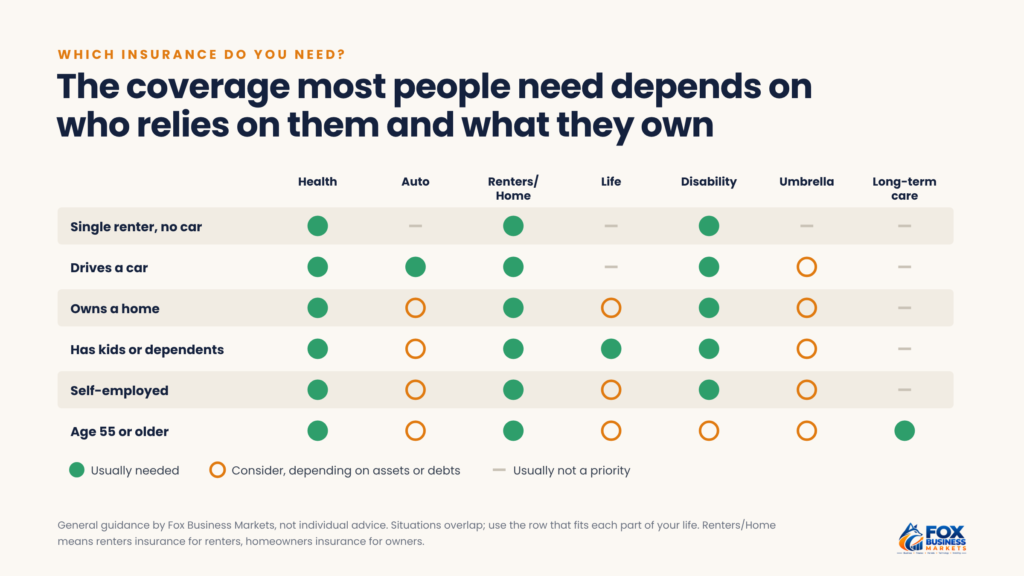
Priorities depend on your situation, but a common order is:
- Health insurance. One hospital stay can cost tens of thousands of dollars. Get coverage through work, the Marketplace, or Medicaid.
- Auto insurance, if you drive. It’s legally required, and liability coverage protects your savings and future income.
- Renters or homeowners insurance. Renters coverage is inexpensive; homeowners coverage is required with a mortgage.
- Disability insurance. Protects your income, especially if you’re the main earner or self-employed.
- Life insurance, if anyone depends on you. Term coverage is usually the best value.
- Umbrella and long-term care, as your assets grow and you approach retirement.
Fit the premiums into your monthly plan. Our guide on how to make a budget shows how to set aside money for fixed costs like insurance.
How Do You Compare Insurance Quotes?
Prices for the same coverage can differ by hundreds of dollars a year, so comparing quotes pays off. To compare fairly:
- Match the coverage. Ask every insurer to quote the same limits, deductibles, and add-ons. A cheaper quote with lower limits isn’t a better deal.
- Read the exclusions. Two policies with the same price can cover very different events.
- Check the insurer’s financial strength. Ratings from agencies such as AM Best show whether a company is likely to be able to pay claims.
- Look up complaint records. The NAIC’s free Consumer Insurance Search tool shows complaint data for insurers in your state.
- Ask about the claims process. Find out how to file a claim and how quickly payments are typically made.
- Consider an independent agent or broker, who can quote several insurers at once. A captive agent sells for just one company.
Once you choose, set a reminder to compare again at renewal. Insurers adjust rates often, and loyalty doesn’t always earn the best price.
How Can You Lower Your Insurance Costs?
- Raise your deductibles, but only to an amount your savings can cover.
- Bundle policies. Many insurers discount auto and home or renters coverage bought together.
- Ask about discounts for safe driving, good grades, security systems, or paying in full.
- Improve your credit. In most states, insurers can use credit-based insurance scores to set auto and home rates. Our guide to what is a good credit score explains how scores work.
- Review coverage after big life changes, like marriage, a new baby, a home purchase, or paying off a car.
Frequently Asked Questions
Does my homeowners insurance cover a tree that falls on my house?
Usually. If wind, lightning, or another covered event knocked it down, your policy typically pays to repair the damage and remove the tree from the structure. If the tree fell because it was dead or neglected, the insurer may deny the claim. Check your policy’s tree-removal limits, and remove dead trees before they fall.
Do I need gap insurance on a new car?
Gap insurance pays the difference between what you owe on a car loan or lease and the car’s value if it’s totaled or stolen. New cars lose value quickly, so you can owe more than the car is worth for the first few years, especially with a small down payment. Ask your auto insurer for a quote, which is often cheaper than the dealer’s.
Can an insurance company cancel my policy?
Yes, but state laws limit when and how. Insurers can usually cancel for nonpayment, fraud, or a major change in risk, and they can choose not to renew a policy at the end of its term with advance written notice. If you get a non-renewal notice, line up a new policy before the old one ends so you don’t have a gap in coverage.
Does my car insurance cover a rental car?
Often. If you’re renting a car for personal use in the U.S., your own auto policy’s liability coverage, plus collision and comprehensive if you carry them, typically extends to the rental. Some credit cards add secondary rental coverage too. Policies differ, so call your insurer before you travel and decide whether to buy the rental company’s damage waiver.
Review Your Coverage Before You Need It
Start with health, auto, and home or renters coverage, then protect your income with disability and, if others depend on you, life insurance. Compare prices at renewal and add flood or umbrella coverage as your situation changes.
This article is for general information only and isn’t financial, legal, or insurance advice. Policies and rules vary by insurer and state, so read your policy and talk to a licensed professional before making decisions.