
Marcus found out his credit score was a problem the day he tried to refinance his truck. He’s an electrician in Kansas City, he earns good money, and he’d never missed a mortgage payment. But the lender’s offer came back nearly four percentage points higher than the rate his coworker got. The reasons, listed on a notice from the lender, were short: high balances on his credit cards, and one 60-day late payment from a store card he’d forgotten about two years earlier. (Marcus is a composite example, but these are two of the most common reasons scores fall.)
The good news is that most credit scores can be improved, and the steps are well known. This guide explains how to improve your credit score in the U.S. step by step, what actually moves your score, how long it takes, and which “quick fixes” to avoid.
Quick answer: To improve your credit score, pay every bill on time, keep your credit card balances low relative to your limits, check your credit reports for errors and dispute them, avoid opening many new accounts at once, and keep older accounts open. Payment history and amounts owed make up about 65% of a FICO Score, so those two habits matter most.
What Affects Your Credit Score?
Before you learn how to improve your credit score, it helps to know what it measures. Your credit score is a three-digit number, usually from 300 to 850 for FICO Scores, that estimates how likely you are to repay debt. In the U.S., lenders most commonly use scores from FICO and VantageScore, built from the information in your credit reports at the three nationwide credit bureaus: Equifax, Experian, and TransUnion.
According to myFICO, FICO Scores are based on five categories:
Factor | Share of FICO Score | What it means |
| Payment history | 35% | Whether you’ve paid past credit accounts on time |
| Amounts owed | 30% | How much you owe, including how much of your available credit you’re using |
| Length of credit history | 15% | How long your accounts have been open |
| New credit | 10% | Recent applications and newly opened accounts |
| Credit mix | 10% | The types of credit you have, such as cards and installment loans |
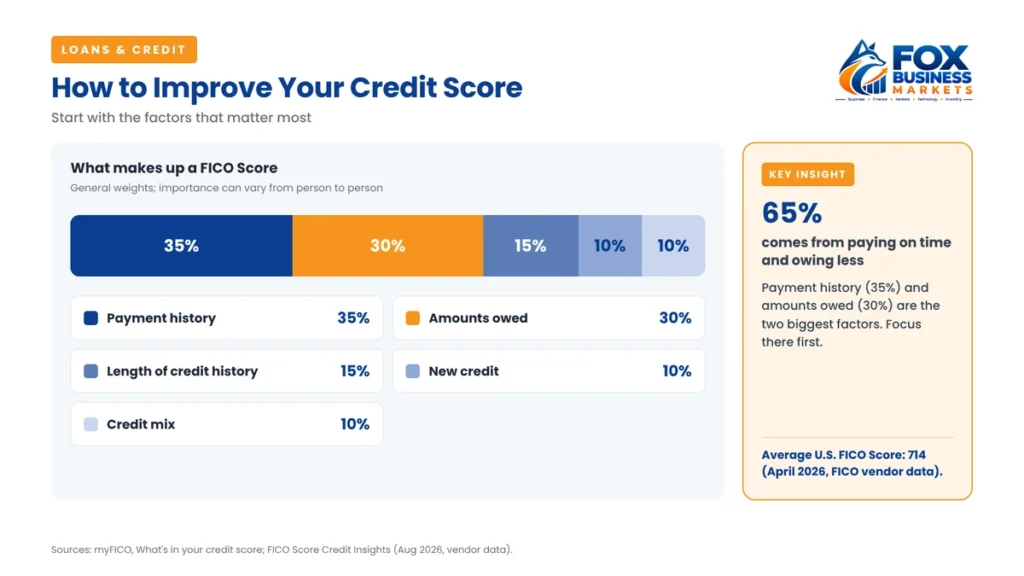
FICO notes that “the importance of these categories may vary from one person to another.” The national average FICO Score was 714 as of April 2026, according to FICO’s Score Credit Insights report (vendor data). To see where your number fits, read our guide on what is a good credit score.
How to Improve Your Credit Score in 8 Steps
Here’s how to improve your credit score, starting with the steps that have the biggest impact.
Step 1: Check Your Credit Reports for Free
You can’t fix what you can’t see. You can check your credit reports from Equifax, Experian, and TransUnion for free every week at AnnualCreditReport.com, according to the Federal Trade Commission (FTC). The FTC also notes that, through the end of 2026, Equifax offers six additional free reports per year on its website.
Look for accounts you don’t recognize, late payments you believe were on time, wrong balances, and old debts that should have aged off. Your credit report and your credit score are different things: the report is the record, and the score is calculated from it.
Step 2: Dispute Any Errors
If you find a mistake, dispute it with the credit bureau that shows it and with the company that supplied the information. According to the Consumer Financial Protection Bureau (CFPB), a credit reporting company “generally must investigate the dispute within 30 days of receiving it,” with up to 45 days if you file after getting your free annual report or send more information during the investigation, and must tell you the results within five business days after finishing.
Disputes are free. You don’t need to pay anyone to file them for you.
Step 3: Pay Every Bill on Time
Payment history is the single biggest factor in your FICO Score, at about 35%. One late payment can stay on your report for years, so the most important habit is simply never missing a due date.
Set up autopay for at least the minimum payment on every credit card and loan, and add calendar reminders. If you’ve already missed a payment, get current as quickly as possible. A payment generally isn’t reported as late to the bureaus until it’s at least 30 days past due, so catching a missed payment within a few days can prevent damage to your score, though you may still owe a late fee. If you’ve been a good customer and slipped once, it’s worth calling the lender to ask for a goodwill adjustment, though lenders aren’t required to grant it.
Step 4: Lower Your Credit Card Balances
Amounts owed make up about 30% of your FICO Score, and for credit cards the key measure is your credit utilization: your balances divided by your credit limits. If you have $3,000 in balances on cards with a total $10,000 limit, your utilization is 30%.
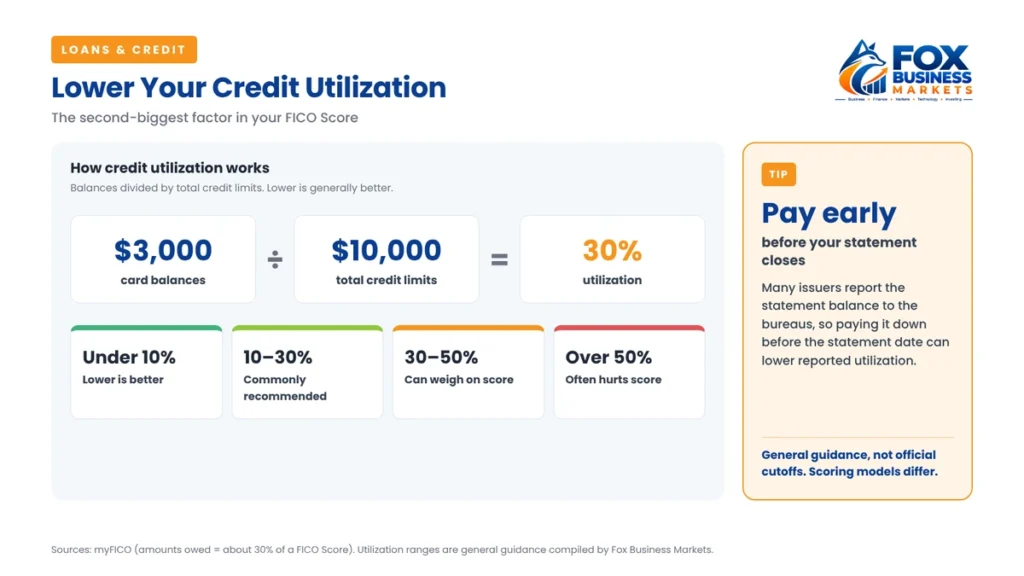
There’s no magic cutoff, but many experts suggest staying below 30%, and people with the highest scores tend to use far less. Ways to lower utilization:
- Pay down balances, starting with the cards closest to their limits.
- Pay before the statement closing date, since many card issuers report the balance shown on your statement.
- Ask for a credit limit increase, as long as you won’t spend more. Ask whether it requires a hard credit check.
- Don’t close paid-off cards without thinking about how it affects your total available credit.
Our guide on how to pay off debt explains the avalanche and snowball methods for paying balances down faster.
Step 5: Limit New Credit Applications
New credit accounts for about 10% of your FICO Score. Each application for credit can trigger a hard inquiry, and opening several accounts in a short time can lower your score temporarily and shorten the average age of your accounts.
Apply only for credit you actually need. Checking your own credit and “prequalifying” usually involve soft inquiries, which don’t affect your score. When you’re shopping for a mortgage, auto, or student loan, FICO counts multiple inquiries for the same type of loan within 45 days as one on newer score versions, but only within 14 days on older versions that many mortgage lenders still use, so try to do your comparing within about two weeks.
Step 6: Keep Old Accounts Open
Length of credit history makes up about 15% of your FICO Score. Your oldest accounts help, so keeping a no-fee card open and using it occasionally for a small purchase you pay off can support your score. If an old card has a high annual fee you no longer want to pay, ask the issuer to switch it to a no-fee version instead of closing it.
Step 7: Build Credit If You’re Starting Out
If you have little or no credit history, you need accounts that report to the bureaus. Common options include:
- A secured credit card, backed by a deposit that usually becomes your credit limit.
- A credit-builder loan, often from a credit union, where your payments are held in savings until the loan is repaid.
- Becoming an authorized user on a family member’s card with a long, positive history and low balance. Make sure the issuer reports authorized users, and know that the primary holder’s late payments can hurt you too.
- Rent and utility reporting, offered by some services and landlords; check whether the scoring model a lender uses counts it.
Step 8: Stay on Top of Student Loans and BNPL
Knowing how to improve your credit score in 2026 also means watching some newer risks. FICO (vendor data) found that about 3.2 million consumers with a student loan payment due had a recent student loan delinquency, and their FICO Scores fell an average of 38 points year over year. If you have federal student loans, log in to StudentAid.gov to confirm your repayment plan and due date.
Buy now, pay later plans are also widespread: a Harris Poll survey conducted for FICO in July 2026 found that 41% of U.S. adults say they currently use BNPL. Treat each plan like any other bill and set reminders, because missed payments can lead to fees and, with some lenders, credit reporting.
How Long Does It Take to Improve Your Credit Score?
How to improve your credit score quickly depends on what’s holding it down. Some changes can show up within a month or two, while others take years.
Problem | How quickly it can improve |
| High credit card utilization | Often within one or two billing cycles after balances are reported lower |
| Errors on your credit report | Usually after the dispute is resolved, typically within 30 to 45 days |
| Few or no accounts | Several months of on-time payments on new accounts |
| Recent late payment | Impact fades over time; the record can stay up to seven years |
| Collections, charge-offs, bankruptcy | Long-term; most negative items stay seven years, bankruptcy up to 10 |
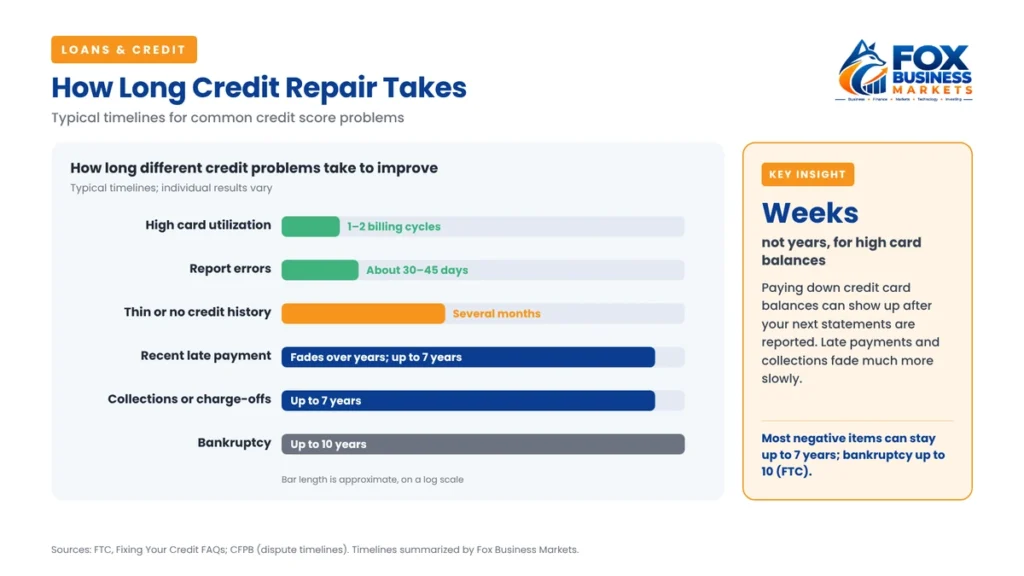
According to the FTC, “most negative information will stay on your report for seven years,” and bankruptcy information stays for 10 years. Negative items generally hurt less as they age, especially if you add positive history in the meantime.
What About Medical Debt on Your Credit Report?
Medical debt rules have changed several times. In 2022 and 2023, the three nationwide credit bureaus stopped reporting paid medical debt, began waiting a year before reporting unpaid medical debt, and (in 2023) stopped reporting medical collections under $500, according to the National Consumer Law Center.
A CFPB rule that would have removed most medical debt from credit reports was vacated by the U.S. District Court for the Eastern District of Texas in July 2025, so it never took effect. However, at least 15 states and the District of Columbia have passed their own laws limiting medical debt on credit reports, according to the NCLC. If a medical bill shows up on your report, check whether your state’s law applies, ask the provider about financial assistance, and dispute anything that’s wrong.
Should You Pay for Credit Repair?
Usually not. When it comes to how to improve your credit score, anything a credit repair company can legally do, you can do yourself for free: get your reports, dispute errors, and set up a payment plan. The FTC warns that companies that promise to repair your credit “can’t remove true information,” and that it’s illegal for credit repair companies to “charge you before they help you.”
Be skeptical of anyone who promises to remove accurate late payments, guarantees a specific score increase, or tells you to create a “new” credit identity. Those are red flags for scams.
Frequently Asked Questions
How can I raise my credit score fast?
When people ask how to improve your credit score fast, the answer is usually to pay down credit card balances, which lowers your credit utilization, and to dispute any errors on your credit reports. Lower balances can show up within a billing cycle or two after they’re reported. Paying every bill on time protects your progress.
What is the biggest factor in a credit score?
Payment history is the biggest factor in FICO Scores, at about 35%, followed by amounts owed at about 30%. Together they make up roughly two-thirds of the score. That’s why paying on time and keeping credit card balances low are the two most important habits for building good credit.
Does checking my credit score lower it?
No. Checking your own credit report or score is a soft inquiry and doesn’t affect your score. You can check your reports from all three bureaus for free every week at AnnualCreditReport.com. Applying for new credit can trigger a hard inquiry, which may lower your score slightly for a time.
How long do late payments stay on your credit report?
Late payments and most other negative information can stay on your credit report for up to seven years, according to the FTC, and bankruptcies for up to 10 years. Their impact generally fades as they age, especially if you keep adding on-time payments and low balances in the meantime.
Does closing a credit card hurt your credit score?
It can. Closing a card reduces your total available credit, which may raise your credit utilization, and eventually shortens your credit history. If a card has no annual fee, it’s often better to keep it open and use it occasionally. If it has a high fee, ask the issuer about a no-fee version.
Is it worth paying a credit repair company?
Usually not. You can do everything a legitimate credit repair company does yourself, for free, including disputing errors. The FTC says these companies can’t remove accurate negative information and can’t legally charge you before they perform their services. Be wary of any promise of guaranteed results.
The Bottom Line
Marcus didn’t need a credit repair company. He paid his card balances down from about 70% of his limits to under 20% over four months, set up autopay on every account, and asked the store card for a goodwill adjustment (it said no, but the late payment kept fading with time). When he applied again, his refinance offer was about two points lower than before.
That’s how to improve your credit score in practice: pay on time, every time, keep balances low, check your reports for errors, and give positive habits time to work. There are no shortcuts, but the right steps add up faster than most people expect. For the bigger picture on borrowing, see our guide to the types of loans, and our personal finance guide.