
Quick answer: For 2026, the standard deduction is $16,100 for single filers and $32,200 for married couples filing jointly. Itemize only if your mortgage interest, state and local taxes, charitable gifts, and other deductible expenses beat that amount plus the new charitable deduction for non-itemizers. Most households still come out ahead with the standard deduction.
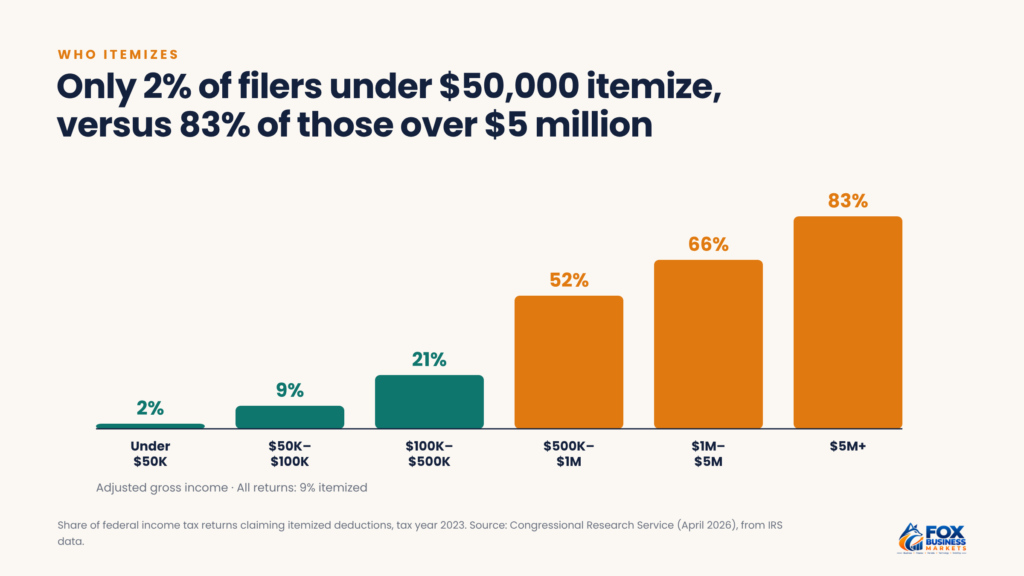
Only about 9% of tax returns claimed itemized deductions in tax year 2023, according to the Congressional Research Service. In 2017, before the standard deduction roughly doubled, 30.6% of returns itemized, according to USAFacts.
That shift made filing simpler for most people, but it also means many households pay for expenses, like mortgage interest or charitable gifts, that no longer lower their taxes. And 2026 brings new rules: a much higher cap on state and local tax deductions, a charitable deduction for people who don’t itemize, and new limits for high earners.
This guide compares the standard deduction vs. itemized deductions for 2026: the amounts, what you can itemize, who comes out ahead, and strategies like bunching that can make itemizing pay off.
What Is the Standard Deduction for 2026?
The standard deduction is a flat amount you subtract from your income before tax brackets apply. You don’t need receipts or records to claim it. For 2026, set by IRS Revenue Procedure 2025-32:
| Filing status | 2026 standard deduction |
| Single | $16,100 |
| Married filing separately | $16,100 |
| Head of household | $24,150 |
| Married filing jointly | $32,200 |
| Qualifying surviving spouse | $32,200 |
Extra amounts for age and blindness. If you’re 65 or older or blind, you get an additional $2,050 as a single filer or head of household, or $1,650 per qualifying condition for each spouse if married. A married couple who are both 65 or older would get $32,200 plus $3,300, for $35,500.
Senior deduction. From 2025 through 2028, people 65 and older can also deduct up to $6,000 each, on top of the standard or itemized deduction. It phases out above $75,000 of modified adjusted gross income for single filers and $150,000 for joint filers, requires a valid Social Security number, and married couples must file jointly to claim it.
Dependents. If someone can claim you as a dependent, your standard deduction is limited, to the greater of $1,350 or your earned income plus $450, up to the regular amount.
What changed from 2025 to 2026:
| 2025 | 2026 | |
| Standard deduction (single / joint) | $15,750 / $31,500 | $16,100 / $32,200 |
| SALT cap | $40,000 | $40,400 |
| Charitable deduction without itemizing | No | Up to $1,000 / $2,000 |
| 0.5%-of-AGI floor on itemized charitable gifts | No | Yes |
| 35-cent limit per dollar for top-bracket itemizers | No | Yes |
What Can You Deduct if You Itemize?
Itemized deductions are specific expenses you list on Schedule A. The main ones for 2026:
| Deduction | 2026 rules |
| State and local taxes (SALT) | Income or sales tax plus property taxes, capped at $40,400 ($20,200 if married filing separately); the cap shrinks for modified AGI above $505,000 ($252,500 if married filing separately) but not below $10,000 |
| Mortgage interest | Interest on up to $750,000 of mortgage debt used to buy, build, or improve your home ($375,000 if married filing separately); loans taken out before Dec. 16, 2017, keep the $1 million limit |
| Mortgage insurance premiums | Deductible again starting in 2026, phasing out between $100,000 and $109,000 of AGI |
| Charitable gifts | Cash and property given to qualified charities; starting in 2026, only the amount above 0.5% of your AGI counts |
| Medical and dental expenses | The amount above 7.5% of your AGI |
| Casualty and theft losses | Only losses from federally declared disasters and, starting in 2026, state-declared disasters |
| Gambling losses | Starting in 2026, 90% of losses, and no more than your winnings |
Some expenses can no longer be itemized at all, including unreimbursed employee expenses, tax preparation fees, and investment advisory fees. The 2017 tax law suspended them starting in 2018, and the 2025 law made that permanent.
Standard Deduction vs. Itemized: How Do You Decide?
The standard deduction vs. itemized decision starts with two totals. Add up your itemized deductions and compare them with your standard deduction plus any cash gifts to charity, up to $1,000 ($2,000 if married filing jointly). Starting in 2026, people who don’t itemize can deduct those gifts too, so itemizing has to beat both.
A quick worksheet:
| Line | What to enter |
| State and local taxes | Income (or sales) tax plus property tax, up to the $40,400 cap |
| Mortgage interest | From Box 1 of your Form 1098 |
| Charitable gifts | Total gifts minus 0.5% of your AGI |
| Medical expenses | Total minus 7.5% of your AGI |
| Other itemized deductions | Mortgage insurance, disaster losses, and so on |
| Itemized total | Sum of the lines above |
| Compare with | Standard deduction plus cash gifts up to $1,000 or $2,000 |
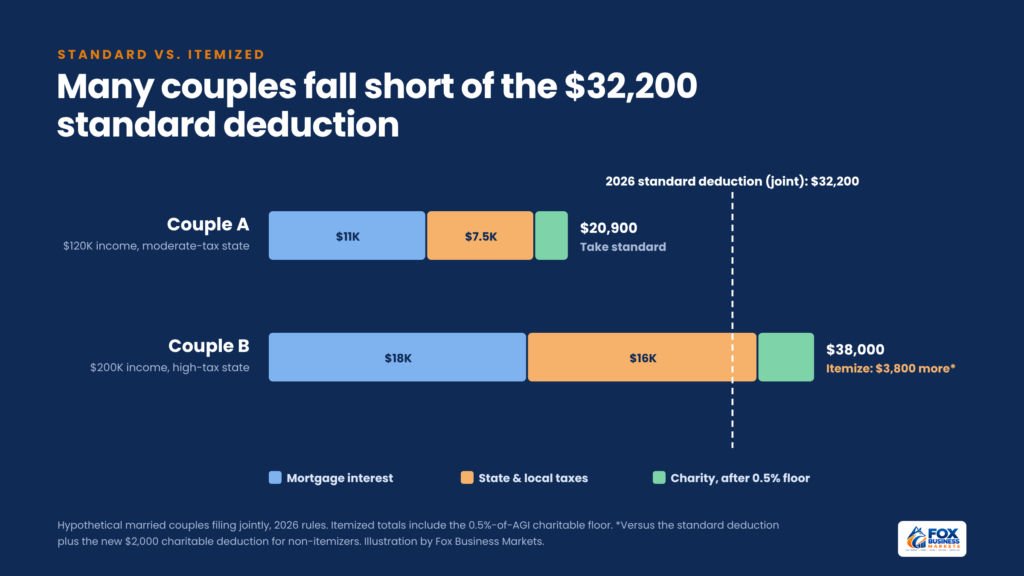
Example 1: A couple who should take the standard deduction. A married couple pays $11,000 in mortgage interest, $7,500 in state income and property taxes, and gives $3,000 to charity. After the 0.5% charitable floor on their $120,000 AGI ($600), their itemized total is about $20,900. That’s well below the $32,200 standard deduction, so they take the standard deduction, and they can also deduct $2,000 of their $3,000 in gifts on top of it.
Example 2: A couple who should itemize. A married couple in a high-tax state pays $18,000 in mortgage interest, $16,000 in state income and property taxes, and gives $5,000 to charity. With a $200,000 AGI, the charitable floor removes $1,000, leaving $38,000 in itemized deductions. If they took the standard deduction instead, they could deduct $32,200 plus $2,000 of their gifts, or $34,200. Itemizing gives them $3,800 more, which saves about $836 in the 22% bracket.
Run the comparison every year. A paid-off mortgage, a move, or a big medical bill can change the answer.
Who Usually Benefits From Itemizing?
Itemizing is most common among higher earners, who tend to have bigger mortgages, higher state taxes, and larger charitable gifts. Share of 2023 returns that itemized, by income:
| Adjusted gross income | Share that itemized |
| Under $50,000 | 2% |
| $50,000 to $100,000 | 9% |
| $100,000 to $500,000 | 21% |
| $500,000 to $1 million | 52% |
| $1 million to $5 million | 66% |
| $5 million or more | 83% |
You’re more likely to come out ahead by itemizing if you:
- Have a large mortgage, especially in the early years of the loan, when most of each payment is interest. Your rate drives that interest bill; our guide to the factors affecting your mortgage rate explains why two buyers can pay very different amounts of interest.
- Live in a high-tax state and pay significant income and property taxes.
- Give generously to charity, well beyond a few thousand dollars a year.
- Have large medical bills compared with your income, such as a surgery, long-term care, or a major dental procedure. On an $80,000 AGI, only expenses above $6,000 count. A solid emergency fund helps you cover those bills while you wait for the tax savings.
Does Buying a Home Mean You Should Itemize?
Not necessarily. Before 2018, buying a home pushed most owners into itemizing. With today’s larger standard deduction, many homeowners still come out ahead with the standard deduction.
Consider a married couple with a new $400,000 mortgage at 6.5%. In the first year, they pay about $25,900 in interest. Add $8,000 in property and state income taxes, and their itemized total is about $33,900, only $1,700 above the $32,200 standard deduction. In the 12% bracket, itemizing saves them about $200 that year, and if they give $1,700 or more in cash to charity, the standard deduction plus the new charitable deduction would come out ahead. As the loan balance falls, so does the interest, and within a few years the standard deduction will likely be larger.
Homeownership still brings tax benefits, such as excluding up to $250,000 of profit ($500,000 for married couples) when you sell a main home you’ve lived in for two of the last five years. But the mortgage interest deduction is worth far less to most buyers than it used to be, so don’t count on it when deciding how much house you can afford.
How Does the New $40,400 SALT Cap Change the Math?
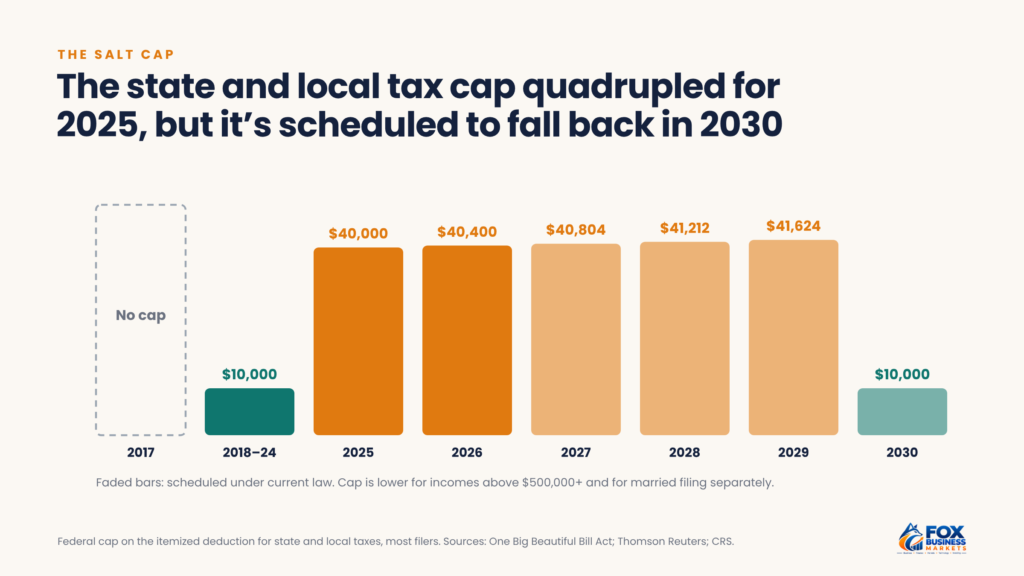
The state and local tax deduction changed more than any other for 2025 and 2026. From 2018 through 2024, it was capped at $10,000. The One Big Beautiful Bill Act raised the cap to $40,000 for 2025 and $40,400 for 2026, with 1% increases each year through 2029. In 2030, it’s scheduled to drop back to $10,000.
The higher cap comes with an income test. For 2026, the cap shrinks by 30% of modified adjusted gross income above $505,000, but it never falls below $10,000. At about $606,000 of MAGI, the cap is back to $10,000 ($303,000 if married filing separately).
For homeowners in states like California, New Jersey, and New York, the larger SALT deduction may tip the balance toward itemizing for the first time since 2017. If your state and property taxes were well above $10,000, recheck itemizing for 2025 and 2026.
If you live in a state without an income tax, such as Texas or Florida, you can deduct state and local sales taxes instead, using the IRS sales tax tables plus the tax on big purchases like a car or boat. And if you itemized one year and got a state tax refund the next, part of that refund may be taxable; look for a Form 1099-G.
A cap for top earners. Starting in 2026, if you’re in the 37% bracket, each dollar of itemized deductions saves no more than 35 cents.
Can You Deduct Charitable Gifts Without Itemizing?
Starting in 2026, yes. People who take the standard deduction can deduct up to $1,000 in cash gifts to qualified charities, or $2,000 for married couples filing jointly. Gifts must be in cash, check, card, or another monetary form, and must go to public charities, not donor-advised funds or private foundations.
This new deduction is on top of your standard deduction, so you don’t have to choose. Keep a bank record or receipt for every gift, and get a written acknowledgment for any single gift of $250 or more.
Itemizers also face a new floor in 2026: only charitable gifts above 0.5% of your AGI are deductible. On a $150,000 AGI, the first $750 of gifts doesn’t count.
What Is Bunching, and Can It Help You Itemize?
Bunching means concentrating deductible expenses into one year so you can itemize that year, then taking the standard deduction the next. It works best with expenses you can time, mainly charitable gifts and some property tax payments.
Example. A married couple with a $150,000 AGI has $26,000 in mortgage interest and state and local taxes each year and gives $8,000 to charity annually. After the $750 charitable floor, their yearly itemized total is about $33,250, less than the $34,200 they’d get from the $32,200 standard deduction plus the new $2,000 charitable deduction. If they give two years of donations, $16,000, in one year, they can itemize about $41,250 that year and take the $32,200 standard deduction the next. Over two years, they deduct about $73,450, compared with $68,400 if they took the standard deduction plus the $2,000 charitable deduction each year, about $5,000 more.
A donor-advised fund makes bunching easier: you contribute a large amount in one year and claim the deduction then, but recommend grants to charities over several years. Plan these moves before Dec. 31, since gifts count in the year you make them. A donor-advised fund contribution counts in the year you make it, and prepaying property tax counts only if the tax has already been assessed.
Are Itemized Deductions the Only Way to Lower Taxable Income?
No. Some of the most valuable deductions are “above the line,” meaning you can take them whether you itemize or not. They reduce your adjusted gross income directly:
- Traditional IRA contributions, if you qualify. Our comparison of a Roth IRA vs. traditional IRA explains when a deductible IRA makes sense.
- Health savings account contributions: up to $4,400 for self-only coverage or $8,750 for family coverage in 2026.
- Student loan interest: up to $2,500, subject to income limits.
- Half of self-employment tax and self-employed health insurance premiums.
- Educator expenses for eligible K-12 teachers.
Several temporary deductions from 2025 through 2028 also work without itemizing, including deductions for qualified tips and overtime, car loan interest on new U.S.-assembled vehicles and the senior deduction described above.
Pre-tax 401(k) contributions also lower taxable income; they’re left out of the wages on your W-2, so there’s nothing to deduct.
How Much Does Itemizing Actually Save You?
A deduction saves you money at your marginal rate, the rate on your top dollar of taxable income. A $1,000 deduction saves $120 in the 12% bracket, $220 in the 22% bracket, and $350 in the 35% bracket.
Itemizing saves only the difference between the two amounts times your marginal rate. In Example 2 above, the extra $3,800 of deductions saved about $836, not 22% of the full $38,000. Our guide to tax brackets shows how to find your marginal rate, and our overview of how taxes work explains how deductions fit with credits and withholding.
How Do You Claim Itemized Deductions?
Itemizing takes a little more paperwork than the standard deduction:
- Gather your records: Form 1098 from your mortgage lender, property tax bills, state income tax payments (from your W-2s and any estimated payments), charity receipts, and medical bills.
- Fill out Schedule A and attach it to your Form 1040. Tax software does this for you when you enter the amounts.
- Apply the limits: the $40,400 SALT cap, the 7.5% medical floor, the 0.5% charitable floor, and any income-based phaseouts.
- Compare the Schedule A total with your standard deduction. Software will usually pick the larger one automatically, but check that it did.
- Keep the records for at least three years: Form 1098, property tax bills, and charity acknowledgments. Amounts that don’t match what your lender or employer reported to the IRS are what trigger letters.
Frequently Asked Questions
Can married couples filing separately choose different deduction methods?
No. If one spouse itemizes on a separate return, the other must itemize too, even if their itemized deductions are less than the standard deduction. Couples who file separately should compare both spouses’ totals before deciding how to file.
Do I have to itemize on my state return if I itemize on my federal return?
It depends on the state. Some states require you to use the same method on both returns, while others let you choose, and a few have no standard deduction at all. Check your state’s instructions before filing, since a separate choice can save money in some states.
Does itemizing increase my chance of an audit?
No. The IRS picks returns mainly through computer scoring and mismatches with forms it already has, like W-2s, 1099s, and your lender’s Form 1098. Deductions that look unusually large for your income draw attention, not itemizing itself. Before filing, check that your mortgage interest matches Box 1 of your Form 1098.
Can I amend my return if I chose the wrong deduction?
Yes. You can file Form 1040-X to switch methods, generally within three years of filing the original return or two years of paying the tax, whichever is later. Gather the records for your itemized deductions first, and file the amendment only if the change produces a meaningful refund.
Compare Both Totals Before You File
Before tax season, pull your Form 1098, property tax bills, state tax payments, and charity receipts, and add them up. If the total is close to your standard deduction plus the new charitable deduction, consider bunching gifts into one year before Dec. 31. If it’s well below, take the standard deduction, claim the new charitable deduction of up to $1,000 or $2,000, and focus on above-the-line moves like an IRA or HSA contribution.
This article is for general information only and isn’t financial, tax, legal, or investment advice. Consider your own situation or talk to a qualified professional before making decisions.