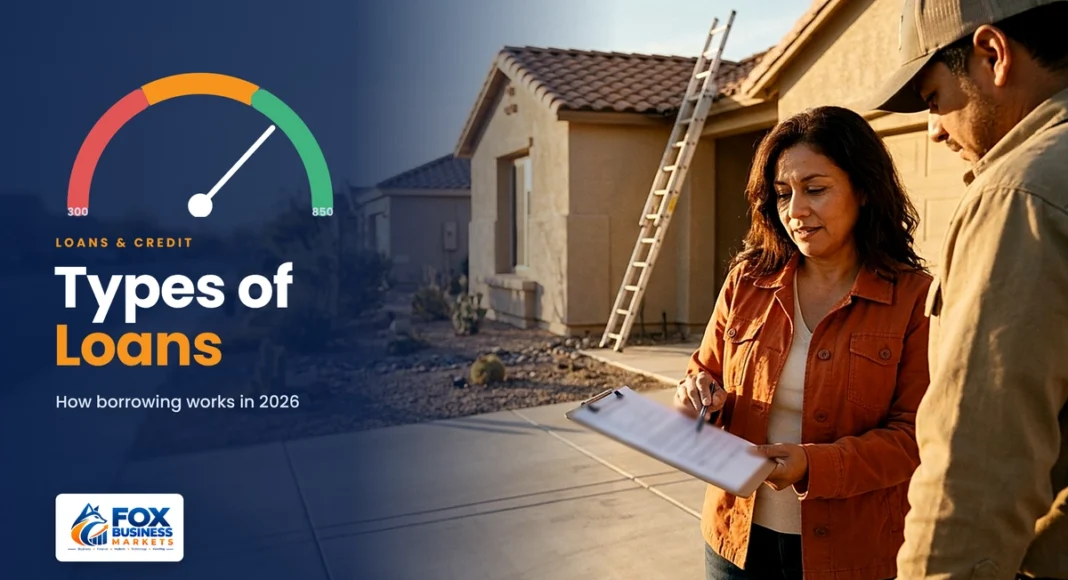
When the roof started leaking last spring, Rosa got a quote for $8,000. She manages a dental office in Phoenix, she had some savings, but not that much. Within a week she had three offers: put it on her credit card, take a personal loan from her credit union, or borrow against her home. They all promised the same thing, a new roof, but over three years the credit card and the personal loan were nearly $1,500 apart in interest. (Rosa is a composite example, but the math uses real U.S. rates from 2026.)
Choosing the right loan matters as much as deciding to borrow. This guide explains the main types of loans available to U.S. consumers, how each one works, what they cost in 2026, and how to choose the one that fits your situation.
Quick answer: The main types of loans are mortgages, home equity loans and lines of credit, auto loans, student loans, personal loans, and credit cards, plus riskier options like buy now, pay later and payday loans. Loans differ in whether they’re secured by collateral, whether they’re installment or revolving, and what they cost. In the U.S. in 2026, rates on mainstream loans ranged from about 6.5% on federal undergraduate student loans to more than 22% on credit cards charging interest; payday loans can cost far more.
How Do Loans Work?
A loan is money you borrow and agree to repay over time, usually with interest. The lender charges interest as the price of borrowing, and the annual percentage rate (APR) combines that interest with certain fees so you can compare offers.
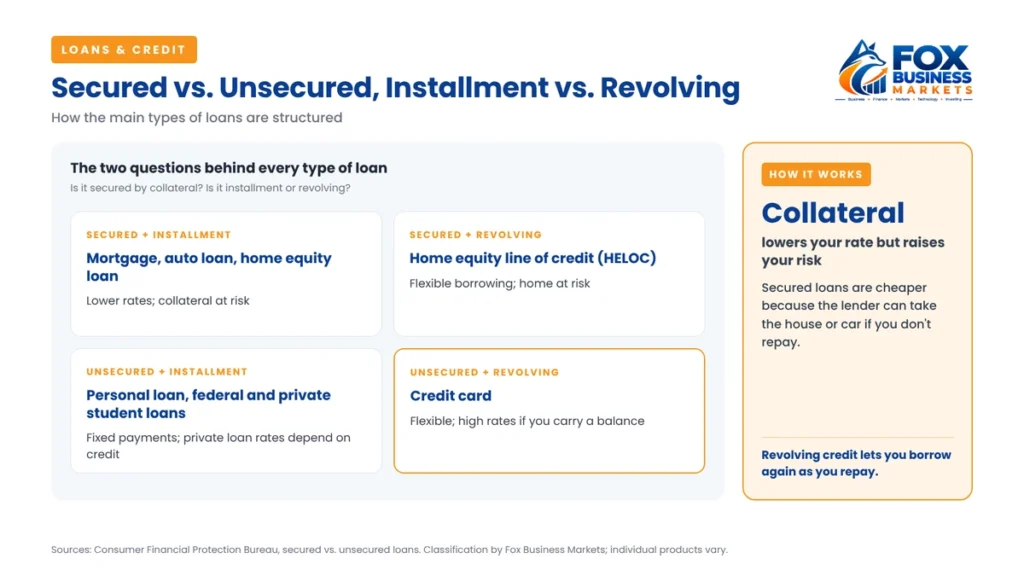
Two questions explain most of the differences between types of loans:
Is it secured or unsecured? A secured loan is backed by collateral, something the lender can take if you don’t repay, like a house or a car. Because the lender’s risk is lower, secured loans usually charge lower rates. An unsecured loan, like most personal loans and credit cards, has no collateral, so lenders rely on your credit history and income and charge more. The Consumer Financial Protection Bureau (CFPB) explains the difference in a classroom activity on secured vs. unsecured loans.
Is it installment or revolving? An installment loan gives you a lump sum that you repay in fixed payments over a set term, like a car loan or mortgage. Revolving credit, like a credit card or home equity line of credit (HELOC), gives you a credit limit you can borrow from, repay, and borrow again.
What Are the Main Types of Loans?
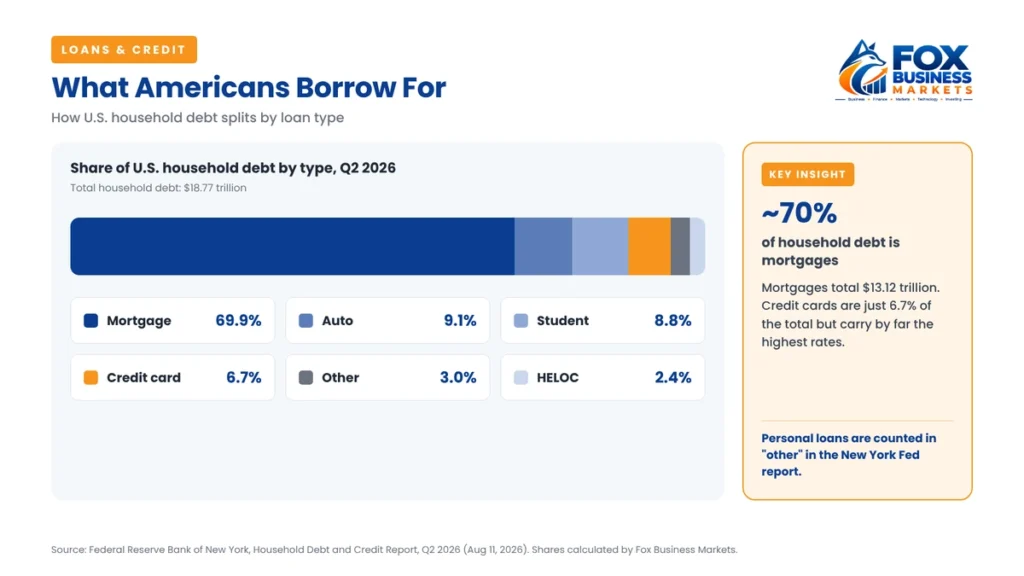
The main types of loans for U.S. consumers are mortgages, home equity loans and HELOCs, auto loans, student loans, personal loans, and credit cards. Together, Americans owed $18.8 trillion on these and other household debts in the second quarter of 2026, according to the Federal Reserve Bank of New York’s Household Debt and Credit Report.
Type of loan | Secured? | Structure | Typical use | U.S. balance (Q2 2026) |
| Mortgage | Yes, by your home | Installment | Buying or refinancing a home | $13.12 trillion |
| Home equity line of credit | Yes, by your home | Revolving | Renovations, large expenses | $0.46 trillion |
| Auto loan | Yes, by the vehicle | Installment | Buying a car | $1.71 trillion |
| Student loan | No | Installment | College and graduate school | $1.65 trillion |
| Credit card | Usually no | Revolving | Everyday purchases, short-term borrowing | $1.26 trillion |
| Personal loan | Usually no | Installment | Consolidating debt, large expenses | Included in “other” (consumer finance and retail loans, $0.57 trillion) |
1. Mortgages
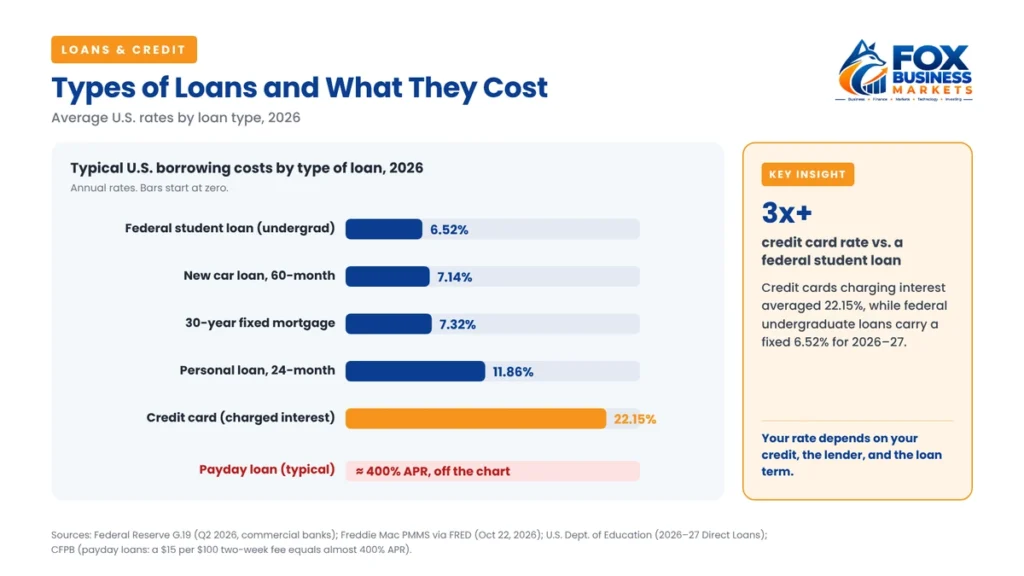
A mortgage is a loan to buy or refinance a home, secured by the home itself. Terms are usually 15 or 30 years, with fixed or adjustable rates. Mortgages make up about 70% of all U.S. household debt. The average 30-year fixed mortgage rate was 7.32% in the week of October 22, 2026, and the 15-year fixed averaged 6.68%, according to Freddie Mac’s Primary Mortgage Market Survey as published by FRED. For what drives your personal rate, see our guide to the factors affecting your mortgage rates.
2. Home Equity Loans and HELOCs
A home equity loan gives you a lump sum, and a home equity line of credit (HELOC) gives you a revolving credit line, both borrowed against the equity in your home. Rates are usually lower than personal loans or credit cards because your home is the collateral. HELOCs usually have variable rates and may carry closing costs or annual fees. The tradeoff is serious: if you can’t repay, you could lose your home. Americans owed $459 billion on HELOCs in the second quarter of 2026, according to the New York Fed.
3. Auto Loans
An auto loan finances a new or used vehicle, secured by the vehicle. Terms commonly run 36 to 72 months or longer. The average rate on a 60-month new car loan at commercial banks was 7.14% in the second quarter of 2026, according to the Federal Reserve’s G.19 report. Dealer financing, credit unions, and online lenders can offer different rates, so compare before you sign.
4. Student Loans
Federal student loans have fixed rates set by law each year and come with protections like income-based repayment (for new loans, the Repayment Assistance Plan). For loans first disbursed from July 1, 2026, through June 30, 2027, the rate is 6.52% for undergraduate Direct Loans, 8.07% for graduate and professional Direct Unsubsidized Loans, and 9.07% for Direct PLUS loans (Parent PLUS, and Grad PLUS only for borrowers grandfathered under the 2025 budget law), according to the U.S. Department of Education’s Federal Student Aid. Private student loans are offered by banks and other lenders, with rates based on credit and fewer protections.
5. Personal Loans
A personal loan is usually an unsecured installment loan you can use for almost anything: consolidating credit card debt, paying for a home repair, or covering a large expense. The average rate on a 24-month personal loan at commercial banks was 11.86% in the second quarter of 2026, according to the Federal Reserve. Rates from online lenders can be much higher for borrowers with fair or poor credit. Our step-by-step guide on how to get a personal loan explains how to qualify and compare offers.
6. Credit Cards
A credit card is revolving credit: you can borrow up to your limit, repay, and borrow again. If your card has a grace period and you pay your statement balance in full by the due date each month, you generally won’t pay interest on purchases. Cash advances and many balance transfers start charging interest right away. If you carry a balance, it gets expensive. The average rate at commercial banks on credit card accounts assessed interest was 22.15% in the second quarter of 2026, according to the Federal Reserve’s G.19 report. U.S. credit card balances reached $1.26 trillion. Our credit card statistics roundup has the latest data.
What About Buy Now, Pay Later and Payday Loans?
Buy now, pay later (BNPL) and payday loans are short-term options that can be convenient but carry real risks.
Buy now, pay later splits a purchase into a few payments, often interest-free if you pay on time. In 2025, 16% of U.S. adults used BNPL, and 26% of users said they had paid late at least once, according to the Federal Reserve’s household survey. Multiple BNPL plans at once can be hard to track.
Payday loans are small, short-term loans due on your next payday. According to the CFPB, fees can range from $10 to $30 for every $100 borrowed, and a typical $15-per-$100 fee “equates to an annual percentage rate of almost 400 percent for a two-week loan.” Here’s an honest opinion: avoid payday loans if you have any other option, such as a small-dollar loan from a credit union, a paycheck advance from your employer, or a payment plan with the company you owe.
How Much Does Each Type of Loan Cost?
Loan costs vary enormously by type, and the gap adds up fast. Here’s what Rosa’s $8,000 roof would cost over three years at average 2026 rates:
Option | APR | Monthly payment | Total interest over 3 years |
| Credit card (average rate for accounts charged interest) | 22.15% | About $306 | About $3,021 |
| Personal loan (24-month average rate) | 11.86% | About $265 | About $1,546 |
Illustrative calculation by Fox Business Markets, assuming equal monthly payments over 36 months. The personal loan rate used is the Federal Reserve’s average for 24-month loans; actual rates for 36-month loans and for your credit profile will differ.
The personal loan would save her about $1,475 in interest compared with carrying the balance on a credit card. A home equity loan could cost less still, but it would put her house on the line.
How Does Your Credit Score Affect Your Loan?
Your credit score is one of the biggest factors in what you’ll pay. Lenders use it to judge how likely you are to repay, and borrowers with higher scores generally qualify for lower rates and better terms on almost every type of loan.
According to myFICO, FICO scores are based on payment history (35%), amounts owed (30%), length of credit history (15%), new credit (10%), and credit mix (10%). The national average FICO Score was 714 as of April 2026, according to FICO (vendor data).
If your score needs work, our guides on how to improve your credit score and what is a good credit score explain what lenders look for and how to raise your score before you apply.
How Do You Choose the Right Type of Loan?
Choose the right type of loan by matching it to your purpose, your timeline, and the risk you’re willing to take. Here’s a simple way to think about it:
- Use the loan built for the purpose. Mortgages for homes, auto loans for cars, and federal student loans for school almost always beat general-purpose borrowing for those goals.
- Compare the APR, not just the monthly payment. A longer term lowers the payment but usually raises the total interest.
- Think hard before using your home as collateral. Home equity loans are cheaper but riskier.
- Avoid carrying credit card balances. At more than 22%, cards are one of the most expensive ways to borrow.
- Shop around. Get quotes from banks, credit unions, and online lenders. Many offer prequalification with a soft credit check.
- Only borrow what you can repay. Run the monthly payment against your budget first. Our guide on how to make a budget can help.
If you already have more debt than you can comfortably manage, start with our guide on how to pay off debt before taking on more. For business borrowing, see our separate guide to small business loans.
Frequently Asked Questions
What are the main types of loans?
The main types of loans are mortgages, home equity loans and lines of credit, auto loans, student loans, personal loans, and credit cards. Other options include buy now, pay later plans and payday loans. Loans differ in whether they’re secured by collateral, whether they’re installment or revolving, and how much they cost.
What is the difference between secured and unsecured loans?
A secured loan is backed by collateral, such as a home or car, that the lender can take if you don’t repay. Mortgages and auto loans are secured. An unsecured loan, like most personal loans and credit cards, has no collateral, so lenders rely on your credit and income and usually charge higher rates.
What is the cheapest type of loan?
Mortgages, home equity loans, bank auto loans, and federal student loans usually have the lowest rates. In 2026, federal undergraduate loans carried a fixed 6.52%, the average 60-month new car loan at banks was 7.14%, and the 30-year fixed mortgage averaged 7.32% in late October. Credit cards, title loans, and payday loans cost the most.
Is a personal loan better than a credit card?
For a large expense you’ll repay over time, a personal loan is often cheaper. In the second quarter of 2026, the average 24-month personal loan rate at banks was 11.86%, compared with 22.15% on credit cards charging interest. Credit cards can be better for short-term purchases you pay off in full each month.
What credit score do I need to get a loan?
It depends on the lender and the type of loan. Many lenders offer loans to borrowers across a wide range of scores, but higher scores qualify for lower rates and better terms. The national average FICO Score was 714 as of April 2026. Checking prequalification offers can usually show your likely rates without hurting your score.
Are payday loans a good idea?
Usually not. According to the CFPB, a typical payday loan fee of $15 per $100 borrowed equals an APR of almost 400% for a two-week loan. Before using one, consider a credit union small-dollar loan, a paycheck advance from your employer, or a payment plan with the company you owe.
The Bottom Line
Rosa took the personal loan from her credit union. Her payment is about $41 a month lower than if she’d carried the roof on her credit card, and over three years she’ll keep roughly $1,475 more of her own money. She didn’t borrow against her house because she didn’t want her home on the line for a repair she could afford another way.
That’s the core lesson of the different types of loans: the right one depends on what you’re buying, how long you need, and the risk you’re willing to take. Use loans built for their purpose, compare APRs from several lenders, protect your credit score, and avoid the most expensive options, like carried credit card balances and payday loans. For the bigger picture, see our personal finance guide.