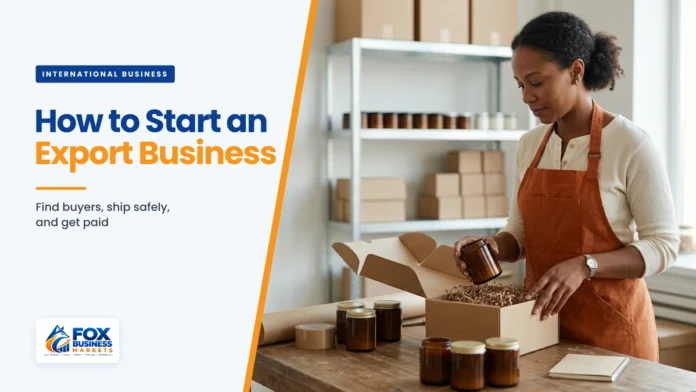
Denise makes small-batch soy candles in a rented workshop outside Atlanta. One Monday she opened an email from a gift-shop distributor in Toronto asking for a price on 600 candles a month. She was thrilled for about five minutes. Then the questions started. Did she need a license? Who pays the Canadian duties? What if the distributor never paid? (Denise is a composite example, not a real business.)
Many first-time exporters start like this, with an inquiry they didn’t seek. If you’re figuring out how to start an export business, here’s the short answer: most U.S. products don’t need an export license, but you do need to classify your goods, screen your buyer, price for the foreign market, pick a safe payment method, and file export data when required. Free and low-cost government programs can help with each step.
Is Exporting Worth It for a Small Business?
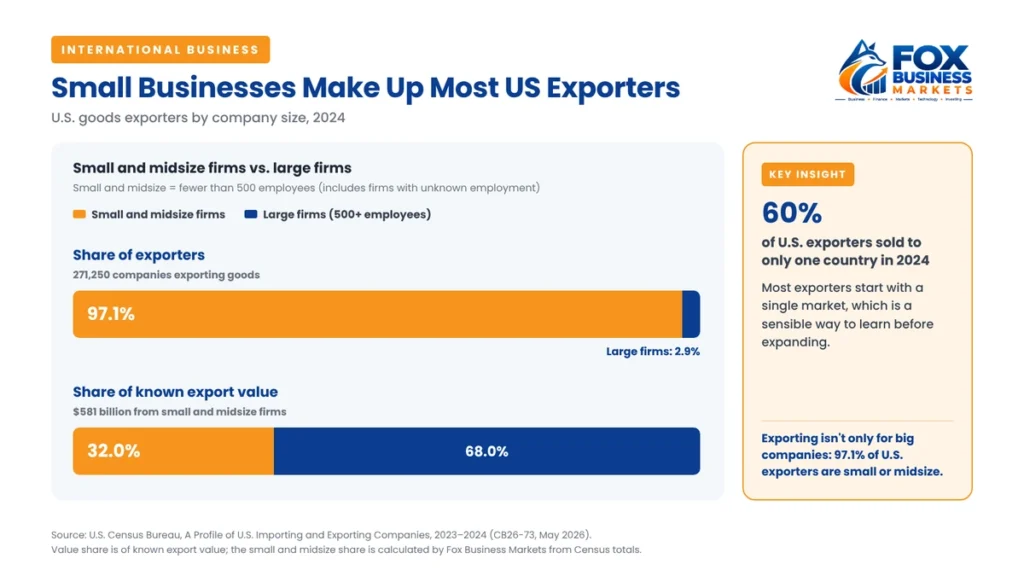
For many small companies, yes, and anyone researching how to start an export business should know it’s less exotic than it sounds. Of the 271,250 U.S. companies that exported goods in 2024, 97.1% were small or medium-sized businesses with fewer than 500 employees, according to the Census Bureau (May 2026). Those firms shipped about $581 billion in goods, roughly 32% of the known export value.
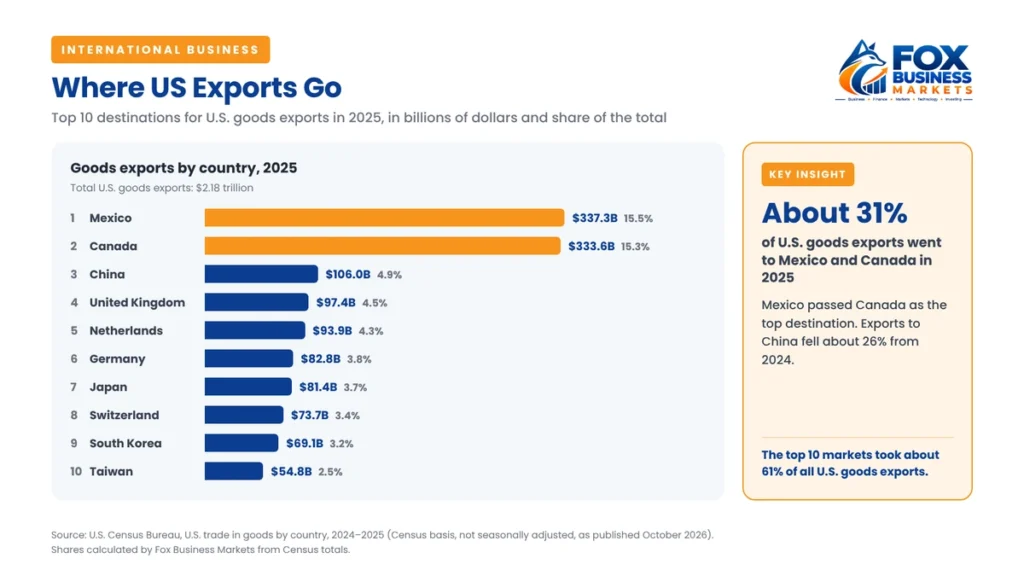
Where do U.S. goods go? In 2025, the U.S. exported $2.18 trillion in goods, according to the Census Bureau. Mexico ($337.3 billion) edged out Canada ($333.6 billion) as the top destination, and together they took about 31% of the total. China ranked third at $106.0 billion, down about 26% from 2024, and the top 10 markets took about 61% of all U.S. goods exports. Our US trade statistics cover the full picture, including the trade deficit.
Most exporters start small, too. The same Census report found that 60% of exporters sold to only one country in 2024. That’s a sensible way to begin: pick one market, learn it, then expand. If exporting is part of a larger plan to grow, our guide to business growth strategies shows where it fits.
Here’s an honest opinion on when not to export yet: if your product isn’t selling steadily at home, if you can’t fill a larger order without cutting quality, or if you can’t wait 60 to 90 days to be paid, fix those first.
Do You Need a License to Export from the US?
Usually not, and that surprises many people learning how to start an export business. According to the International Trade Administration (ITA), “about 95 percent of all items exported from the United States don’t require an export license.” Most everyday commercial goods are classified as “EAR99,” meaning they’re subject to the Export Administration Regulations but not on the Commerce Control List, and they typically ship under “NLR,” or No License Required.
A license can be required when the product itself is controlled (it has an Export Control Classification Number, or ECCN, that requires a license for your destination), when it’s going to an embargoed or sanctioned destination, or when the buyer or end use is restricted. Defense items fall under separate State Department rules. Penalties are serious: civil fines under the Export Control Reform Act can reach $374,474 per violation or twice the value of the transaction, whichever is greater.
Destinations matter. The Treasury Department’s Office of Foreign Assets Control (OFAC) runs comprehensive sanctions on places such as Cuba, Iran, North Korea, and Crimea and the so-called DNR and LNR regions of Ukraine, plus broad restrictions on Russia. Older lists are out of date: OFAC says it “no longer maintains comprehensive sanctions on Syria,” although some individuals remain blocked and Commerce export controls still apply, so items on the Commerce Control List generally still need a license.
How do you screen buyers against restricted-party lists?
Use the free Consolidated Screening List on trade.gov. It combines the export screening lists of the Departments of Commerce, State, and Treasury into one search, and it updates daily. Check every new buyer, distributor, and freight destination before you ship, keep a record of the search, and dig deeper if you get a possible match. The list isn’t the final word: the government says to check the official lists, and companies 50% or more owned by sanctioned parties can be off-limits even when they aren’t named.
How to Start an Export Business: Step by Step
Here is how to start an export business in a practical order.
- Check that you’re export-ready. You need steady sales, spare capacity, and cash to wait for payment.
- Pick one or two target markets. Canada is the most common destination by number of U.S. exporters (about 34% sold there in 2024), and Mexico and Canada are the two largest export markets by value.
- Classify your product. Find its Schedule B number and look up the destination country’s import duty.
- Check export controls and screen your buyer. Confirm your product is EAR99 or find its ECCN, and run the buyer through the Consolidated Screening List.
- Find buyers or distributors. Use your network, trade shows, online marketplaces, or the U.S. Commercial Service.
- Price for export. Choose an Incoterm and build in freight, insurance, documentation, and currency costs.
- Choose a payment method. Match the payment terms to how well you know the buyer.
- Ship and file export data. Hire a freight forwarder and file Electronic Export Information when required.
- Use free trade agreements. Provide a certification of origin so your buyer can claim lower duties, but check whether new retaliatory tariffs apply anyway.
What is a Schedule B number?
A Schedule B number is the 10-digit U.S. export classification code the Census Bureau uses to track exports. Its first six digits match the international Harmonized System and the U.S. import code; the remaining digits may differ. The Census Bureau offers a free Schedule B search tool. Your buyer will use the same first six digits to find the duty in its own country.
When do you need to file EEI in AESDirect?
Electronic Export Information (EEI) is the export data you, as the U.S. principal party in interest, or your forwarder file in the free AESDirect system. It’s generally required when goods under any single Schedule B number, going to one buyer on one shipment, are worth more than $2,500. It’s also required regardless of value when the shipment needs an export license or meets certain other conditions, such as defense items or used vehicles (15 CFR 30.37 and 30.2).
Most shipments to Canada are exempt (15 CFR 30.36), unless one of those conditions applies or the goods are moving on to another country. Timing depends on the mode: 24 hours before loading for ocean cargo, two hours before departure for air, and one hour before reaching the border for trucks. Civil penalties can reach up to $17,412 per violation, so many small exporters let their forwarder file.
How Do You Find Foreign Buyers?
When you work out how to start an export business, start with people who already want your product: past inquiries, website visitors from abroad, and customers who mention overseas contacts. Then add structured help. The U.S. Commercial Service, part of the ITA, has more than 100 U.S. offices and trade experts in more than 80 countries.
Its services now cost more for small firms. On July 22, 2026, the Commercial Service ended its discounted small-business fees and moved every company to one price list. A Gold Key Service, which sets up meetings with up to five interested potential partners in a market, now costs $3,250 plus direct costs such as travel and interpreters. An International Partner Search is $2,500, and an Initial Market Check is $1,950 per market. Your state’s trade office may help cover those costs through the STEP grant program.
Trade shows, marketplaces, and your own website can also work. Here’s an honest opinion: for a first market, a good local distributor is usually worth more than a dozen marketplace listings, because the distributor handles import paperwork, local marketing, and returns.
How Do Exporters Get Paid Safely?
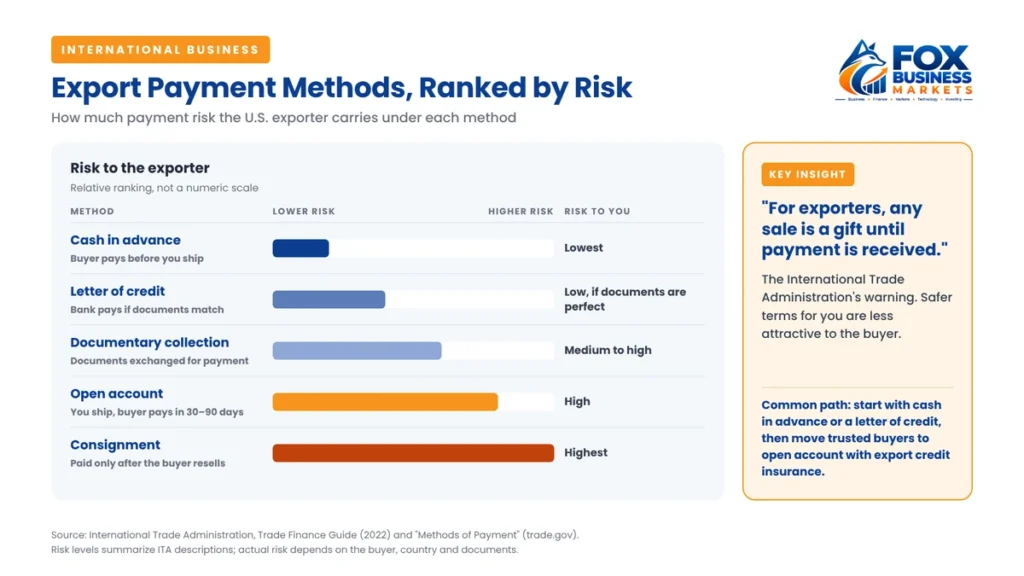
The ITA puts the risk bluntly: “For exporters, any sale is a gift until payment is received.” The right payment method depends on how well you know the buyer and how competitive the market is. The table summarizes the ITA’s Trade Finance Guide.
Payment method | How it works | Risk to you (exporter) | Best for |
| Cash in advance | Buyer pays before you ship, usually by wire | Lowest | New buyers, small orders, risky markets |
| Letter of credit | Buyer’s bank commits to pay if your documents match the terms | Low, if documents are perfect | Larger orders with new buyers |
| Documentary collection | Banks exchange shipping documents for payment, with no payment guarantee | Medium to high | Established buyers in stable markets |
| Open account | You ship, buyer pays later, often in 30 to 90 days | High | Trusted buyers; pair with export credit insurance |
| Consignment | You’re paid only after the buyer resells the goods | Highest | Rarely a good idea for beginners |
Cash in advance is safest, but the ITA warns that exporters who demand it “may lose out to competitors.” Many small exporters start there or with a letter of credit, then move trusted buyers to open account backed by export credit insurance. Export-Import Bank (EXIM) Express Insurance, designed for newer small exporters, covers 95% of the invoice for commercial and political risks.
What Government Help Is Available for New Exporters?
If you’re working out how to start an export business on a tight budget, there’s more help than most owners expect, though some programs face budget pressure:
- SBA STEP grants: The State Trade Expansion Program funds trade missions, trade show booths, translation, and export training through state trade offices. SBA planned $20 million in awards for fiscal 2026, though the administration has proposed eliminating the program for 2027 (Congressional Research Service, May 2026).
- SBA export loans: Export Express loans go up to $500,000. Export Working Capital and International Trade loans go up to $5 million, with SBA guarantees of up to 90% (SBA, January 2026). Since March 1, 2026, SBA 7(a) loans, including export loans, require 100% of owners to be U.S. citizens or nationals living in the U.S.
- EXIM Bank: Export credit insurance and working capital loan guarantees. EXIM’s charter runs through December 31, 2026, and reauthorization bills were still pending in Congress as of late summer 2026. If the charter lapses, EXIM generally can’t approve new deals, so check its status before you rely on it.
- Trade agreements: The U.S. has 14 free trade agreements with 20 countries. Under the U.S.-Mexico-Canada Agreement (USMCA), the importer, exporter, or producer can complete a certification of origin. The agreement remains in force after the July 2026 joint review, with annual reviews to follow, and runs to July 1, 2036 unless extended.
If you need to finance inventory for a big first order, also compare our guide to small business loans.
Exporting Mistakes You Should Avoid
Learning how to start an export business also means dropping a few myths.
“Exporting is only for big companies.” The Census data say otherwise: 97.1% of U.S. exporters are small or medium-sized.
“A letter of credit guarantees payment.” It doesn’t, unless your documents match the credit exactly. The ITA notes that banks “deal in documents only, not goods,” and the International Chamber of Commerce estimates that 65% to 80% of documents presented under letters of credit are refused on first presentation, usually over dates and mismatched details. A refusal doesn’t always mean you won’t be paid, but it delays payment, adds fees, and can give the buyer a way out. Use a bank or forwarder experienced in letter-of-credit documents.
“If it’s legal to sell in the US, I can ship it anywhere.” Export controls, sanctions, and the destination’s own labeling and safety rules still apply.
“The buyer’s duties aren’t my problem.” They are, because they affect your price. The ITA warns that tariffs, VAT, fees, and shipping can push the buyer’s cost to “more than double the price charged in the United States.”
Foreign tariffs on U.S. goods also changed in 2026. On September 8, 2026, Canada imposed counter-tariffs of 15%, 25%, and 50% on about C$27.6 billion of U.S. goods, including steel, dairy, appliances, and electronics. Those counter-tariffs apply even to goods that qualify under USMCA and even to low-value courier shipments, according to the Canada Border Services Agency, though Canada offers some refund (remission) routes. Check your product against Finance Canada’s list before quoting.
Also, think twice before agreeing to DDP (Delivered Duty Paid) terms, which make you responsible for the buyer’s import duties and taxes.
Frequently Asked Questions
Do I need a license to export products from the US?
Usually not. The ITA says about 95% of U.S. exports don’t need a license. You may need one if your product appears on the Commerce Control List, if you’re shipping to a sanctioned or embargoed destination, or if the buyer or end use is restricted. Screen every buyer on the Consolidated Screening List.
How much does it cost to start an export business?
It depends on your product and market. You can classify goods, file EEI in AESDirect, and screen buyers for free. Paid help includes freight forwarders, market research, and trade shows. U.S. Commercial Service market research and matchmaking services cost $1,950 to $3,250 each, though state STEP grants may cover part.
What is the easiest country to export to from the US?
Canada is the most common destination by number of U.S. exporters, and Mexico and Canada are the largest markets by value, both close and covered by the U.S.-Mexico-Canada Agreement. Mexico edged out Canada as the top destination in 2025. Check current tariffs first: Canada imposed new counter-tariffs in September 2026.
Do I need to file EEI for every export shipment?
No. EEI is generally required when goods under any one Schedule B number in a shipment are worth more than $2,500, or regardless of value when an export license or certain other conditions apply. Most shipments to Canada are exempt. Your freight forwarder can file it for you in AESDirect.
How do I make sure a foreign buyer pays me?
Match the payment method to the risk. Cash in advance is safest for new buyers. A letter of credit protects you if your documents are perfect. Open account terms are risky but competitive, so consider EXIM export credit insurance, which can cover 95% of the invoice for eligible small businesses.
Can I export products I sell online?
Yes. Many small businesses export through their own websites and online marketplaces. You still need to classify products, screen buyers, follow destination rules, and price in shipping, duties, and taxes. Canada waives duties on qualifying U.S. courier shipments only up to C$150 and taxes up to C$40, and its 2026 counter-tariffs still apply below those limits.
The Bottom Line
Denise didn’t need a license for her candles, and she didn’t need to file EEI for Canada. She did need to screen the distributor, check Finance Canada’s counter-tariff list (her candles weren’t on it), quote under clear Incoterms, and ask for cash in advance on the first two orders. Six months later, the account moved to 30-day terms with insurance.
That’s how to start an export business in real life: one buyer, one market, careful paperwork, and payment terms you can live with. If you’re also bringing in materials from abroad, read our guide on how to import products and our explainer on what tariffs are. Still setting up the company itself? Start with how to start a small business, and compare storefronts in our best ecommerce platforms review.