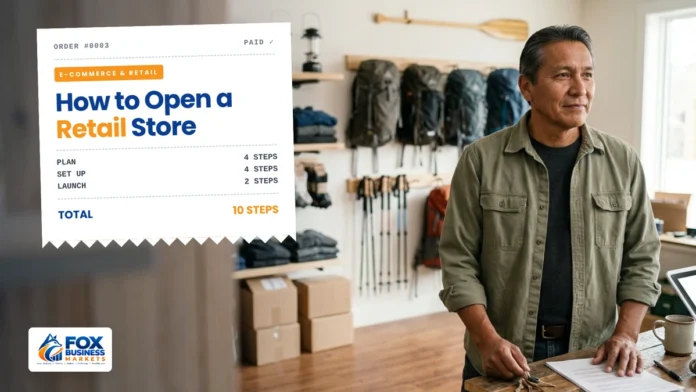
A man who has spent 30 years hiking, fishing, and guiding trips decides to open an outdoor gear shop in his town. He finds the perfect corner space near the trailhead. The landlord says the rent is “$3,000 a month,” and he’s ready to sign that afternoon.
Then his daughter, who works in accounting, reads the lease. It’s a triple-net lease. On top of the $3,000, he’d pay a share of the building’s property taxes, insurance, and common-area maintenance, with no cap on how much those can rise. Rent goes up every year, and he’d personally guarantee all five years. The “$3,000 store” was really a much bigger commitment.
That’s the part most guides on how to open a retail store skip. Picking products is the fun part. The lease, the startup budget, and the first year of cash flow decide whether the doors stay open.
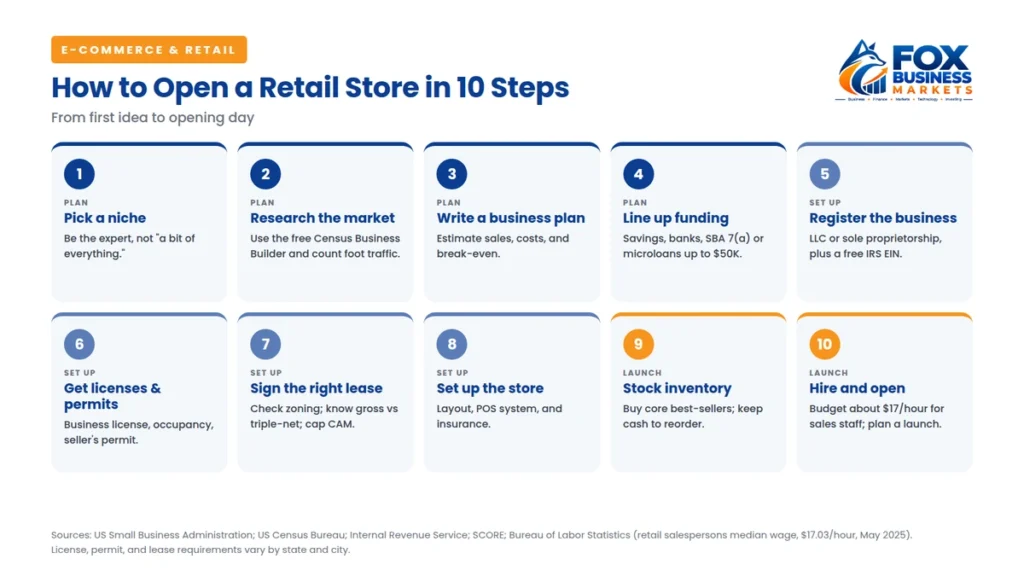
Quick answer: To open a retail store, define your niche, research your local market, write a business plan, budget your startup costs and line up funding, register your business, get licenses and a seller’s permit, sign a lease you fully understand, set up your store and point-of-sale system, stock inventory, then hire and launch.
Is Opening a Retail Store Still Worth It?
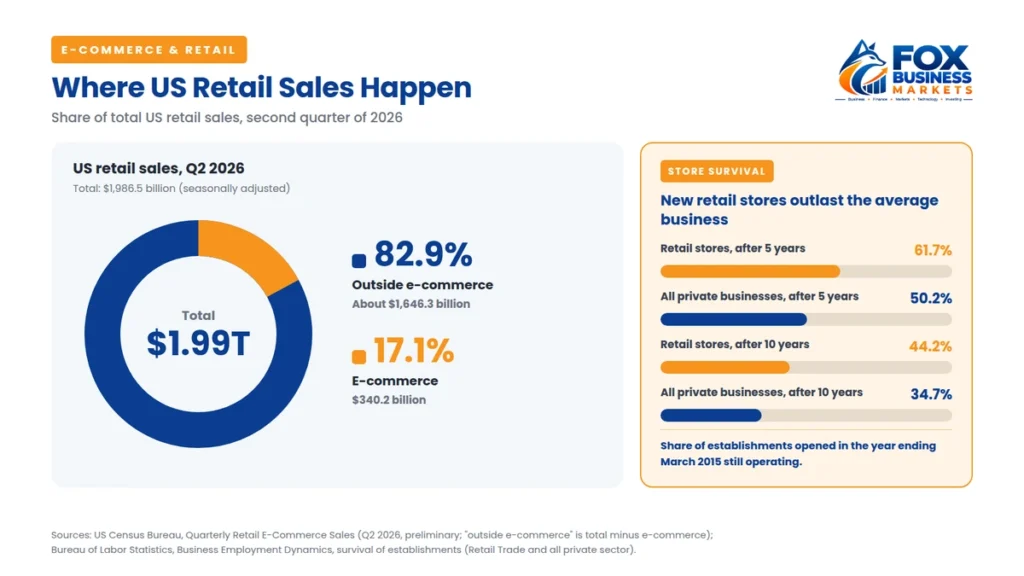
Yes, for the right concept in the right location. Before you learn how to open a retail store, it helps to see where retail sales actually happen. Online shopping gets the headlines, but physical retail still does most of the business. In the second quarter of 2026, e-commerce made up 17.1% of total US retail sales, according to the Census Bureau, which means roughly 83% happened outside e-commerce (Census Bureau).
New stores also last longer than many people assume. Among retail establishments that opened in the year ending March 2015, 61.7% were still operating five years later and 44.2% after ten years, compared with 50.2% and 34.7% across all private industries (BLS). That’s better odds than the “most businesses fail” myth suggests, but it still means more than a third close within five years.
How to Open a Retail Store in 10 Steps
1. What Kind of Store Should You Open?
The first decision in how to open a retail store is your niche. Choose a specific one, not “a little of everything.” A store that sells gear for local fly fishermen can beat a big-box store on expertise and service. A general gift shop has to beat Amazon on price, and it usually can’t.
Ask yourself who your customer is, why they would drive to you instead of clicking “buy,” and whether you know the products well enough to give advice.
2. How Do You Research Your Local Market?
Start with free government data. The Census Business Builder is a free Census Bureau tool that “assembles demographic, business, and consumer spending data” for your area (Census Bureau). Use it to check population, income levels, and how many similar businesses are nearby.
Then visit competitors at different times of day, count foot traffic outside your target location on a Saturday, and ask nearby owners how business is.
3. Do You Need a Business Plan?
If you’re borrowing money or signing a multi-year lease, yes. A plan forces you to estimate sales, costs, and how long it will take to break even before you commit. Our guide on how to write a business plan walks through each section.
4. How Will You Pay for It?
Most new stores need money for the lease deposit, build-out, fixtures, inventory, and several months of operating costs before sales pick up. Common sources include savings, family, a bank loan, and SBA-backed loans.
The SBA’s 7(a) loan goes up to $5 million and can be used for working capital, equipment, and furniture and fixtures. Its microloan program offers loans up to $50,000, with an average of about $13,000 (SBA). See our guide to small business loans for how to qualify.
5. How Do You Register the Business?
Choose a structure, such as a sole proprietorship or LLC, and register with your state if needed. Many store owners choose an LLC because it can protect personal assets. Then get an Employer Identification Number (EIN) from the IRS, which is free. You’ll need one to hire employees. Our guide on how to start a small business covers each step.
6. What Licenses and Permits Does a Retail Store Need?
Usually several. The SBA says “Most small businesses need a combination of licenses and permits from both federal and state agencies,” and it lists retail among the activities commonly regulated at the local level (SBA). Expect a general business license, a certificate of occupancy for your space, and signage permits.
Most states also require a seller’s permit, which lets you collect sales tax. In California, for example, you need one if you plan to sell items that would ordinarily be subject to sales tax, and the permit itself is free (CDTFA). Check your state’s revenue department.
7. How Do You Choose a Location and Negotiate a Lease?
This is the most important step in learning how to open a retail store, and the one where new owners lose the most money. First, check zoning. The SBA warns that “zoning ordinances can restrict or entirely ban specific kinds of businesses from operating in an area” (SBA).
Then understand the type of lease:
Lease type | What you pay |
| Gross lease | A fixed rent; the landlord covers property taxes, insurance, and maintenance |
| Modified gross lease | Rent plus a share of some costs, often future increases |
| Triple-net (NNN) lease | Base rent plus your share of property taxes, insurance, and common-area maintenance (CAM) |
CAM charges are the costs of maintaining shared areas, such as parking lots, landscaping, and hallways (ICSC). A triple-net lease is the most common net lease for retail space.
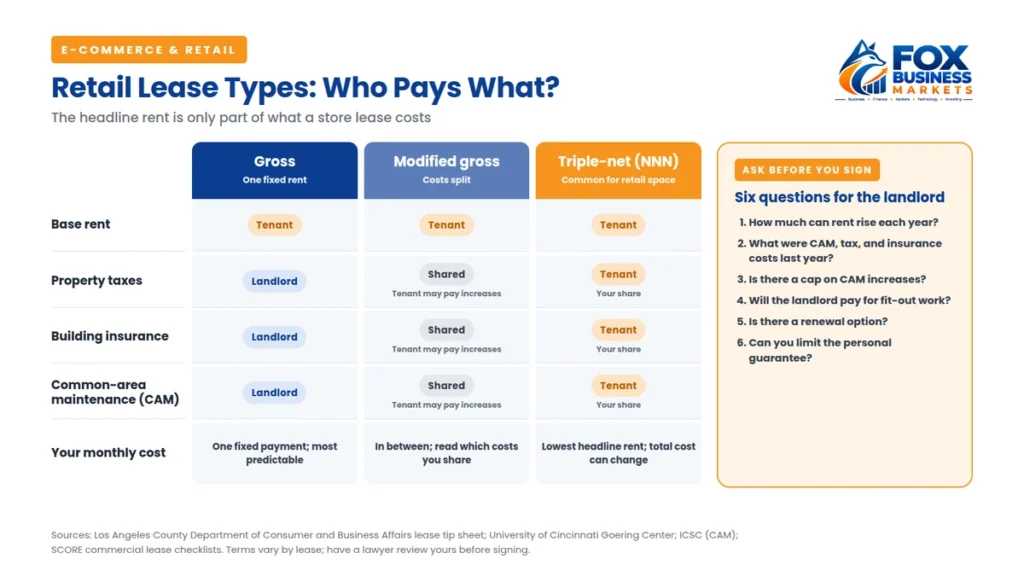
Before you sign, ask the questions SCORE recommends: “How often can the rent increase and how much?” and “Will the landlord pay for fit-up changes to the space?” (SCORE). Ask for a cap on CAM increases, an option to renew, and a limit on any personal guarantee. Have a lawyer review the lease. It’s the cheapest insurance you’ll buy.
8. How Should You Set Up the Store?
Plan your layout so customers walk past your best products, keep the checkout near the door, and leave room for people to browse without feeling crowded.
You’ll also need a point-of-sale (POS) system to take payments and track inventory. Square’s free plan costs $0 a month and charges 2.6% + 15¢ per in-person card payment (Square). Shopify’s plans include in-person selling at 2.6% + 10¢ on the Basic plan, which helps if you also sell online (Shopify).
Get insured before opening day. The SBA describes general liability insurance as protection “against financial loss as the result of bodily injury, property damage, medical expenses,” and notes that businesses with employees must carry workers’ compensation, unemployment, and disability insurance, with rules that vary by state (SBA).
9. How Much Inventory Should You Buy?
Less than you think. New owners often spend most of their cash filling every shelf and then can’t afford to reorder what sells. Start with your core best-sellers, order small quantities from several suppliers, and keep cash in reserve for reorders.
Ask suppliers about minimum order quantities and payment terms, track what sells every week, and reorder winners quickly.
10. How Do You Hire Staff and Launch?
Budget realistically for staff. The median wage for US retail salespersons was $17.03 an hour in May 2025, according to the Bureau of Labor Statistics (BLS). One part-time employee working 25 hours a week at that rate costs about $1,845 a month before payroll taxes.
For launch, set up your Google Business Profile weeks before you open, plan a grand opening event, and partner with nearby businesses. Our guide to digital marketing for small business covers the free basics.
How Much Does It Cost to Open a Retail Store?
There’s no reliable national average, because costs depend heavily on your city, store size, and what you sell. Build your own budget from these categories:
Cost category | What to include |
| Lease | Security deposit, first month’s rent, and for NNN leases, taxes, insurance, and CAM |
| Build-out | Paint, lighting, flooring, and any work the landlord doesn’t cover |
| Fixtures and equipment | Shelving, displays, counter, POS hardware |
| Opening inventory | Enough for your core products, plus reorder cash |
| Licenses, permits, and registration | Fees vary by state and city |
| Insurance | General liability, property, and workers’ comp if you have employees |
| Staff | Wages plus payroll taxes |
| Marketing | Signage, grand opening, local ads |
| Cash reserve | Several months of operating costs |
That last line matters most. When owners research how to open a retail store, they usually budget for opening day and forget the months after it, when sales are still building.
Should You Open a Store, Sell Online, or Both?
Many retailers now do both. In NRF’s survey about the last Saturday before Christmas 2025, 29% of expected shoppers planned to shop only in stores, 26% only online, and 45% both (NRF). A simple online store can extend your reach beyond your street. See our guides on how to start an ecommerce business and the best ecommerce platforms.
Common Mistakes When Opening a Retail Store
When people figure out how to open a retail store on their own, the biggest mistake is the one from the opening story: signing a lease without understanding the full cost. Others include choosing a location because the rent is cheap rather than because customers walk by, overbuying inventory, underestimating payroll, and opening without a cash reserve.
Post your refund policy clearly. Some states require it. New York, for example, requires retailers to “conspicuously post” their refund policy (New York State Senate).
Frequently Asked Questions
How much does it cost to open a retail store?
It depends on your location, store size, and products. Main costs include the lease deposit and rent, build-out, fixtures, opening inventory, licenses, insurance, staff, marketing, and a cash reserve covering several months of expenses. Build a line-by-line budget based on real quotes from your area.
Do I need a license to open a retail store?
Usually, yes. Most retail stores need a general business license, a certificate of occupancy, and a seller’s permit to collect sales tax. Requirements vary by state, county, and city, so check your Secretary of State and state revenue department.
What is a triple-net lease?
A triple-net (NNN) lease means you pay base rent plus your share of the property’s taxes, insurance, and common-area maintenance. It’s the most common type of net lease for retail space, so ask for estimates of these extra costs and a cap on increases.
How long do retail stores usually last?
According to BLS data, 61.7% of retail establishments opened in the year ending March 2015 were still operating five years later, and 44.2% after ten years. That’s higher than the average across all private industries.
Can I get an SBA loan to open a retail store?
Yes. SBA 7(a) loans of up to $5 million can cover working capital, equipment, and fixtures, and SBA microloans offer up to $50,000. You’ll typically need a business plan, good credit, and some of your own money invested.
Should I open a physical store or sell online first?
If you’re still deciding how to open a retail store and unsure about demand, testing online or at local markets first is cheaper. A physical store makes sense when your product benefits from seeing, touching, or expert advice, and when you’ve found a location with steady foot traffic.
The Bottom Line
Knowing how to open a retail store is mostly about avoiding a few expensive commitments made too quickly. The outdoor gear shop owner didn’t walk away from his corner space. He negotiated a cap on CAM increases, a shorter first term with a renewal option, and a limited personal guarantee. Same store, same trailhead, far less risk.