A woman makes soy candles in her kitchen and sells them to friends. They keep asking for more, and their friends start asking too. One night she decides to open an online store, types “how to start an ecommerce business” into Google, and within ten minutes she’s buried in questions. Shopify or Etsy? Does she need an LLC? Does she have to charge sales tax in every state? Who pays for shipping?
Most guides make it sound like the hard part is building the website. It isn’t. The hard parts are picking a product people will pay for, pricing it so you actually make money, and staying on the right side of tax and shipping rules. This guide walks through all of it in order.
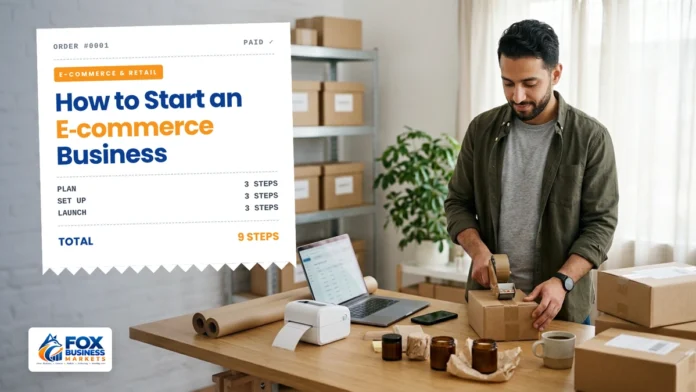
Quick answer: Here’s how to start an ecommerce business: test a product with real buyers, choose a business model, price for profit, register your business and get a free EIN from the IRS, learn your sales tax duties, pick a platform, set up shipping and policies, then launch and market to your first customers. Most people can start for a few hundred dollars.
Is E-commerce Still Worth Starting?
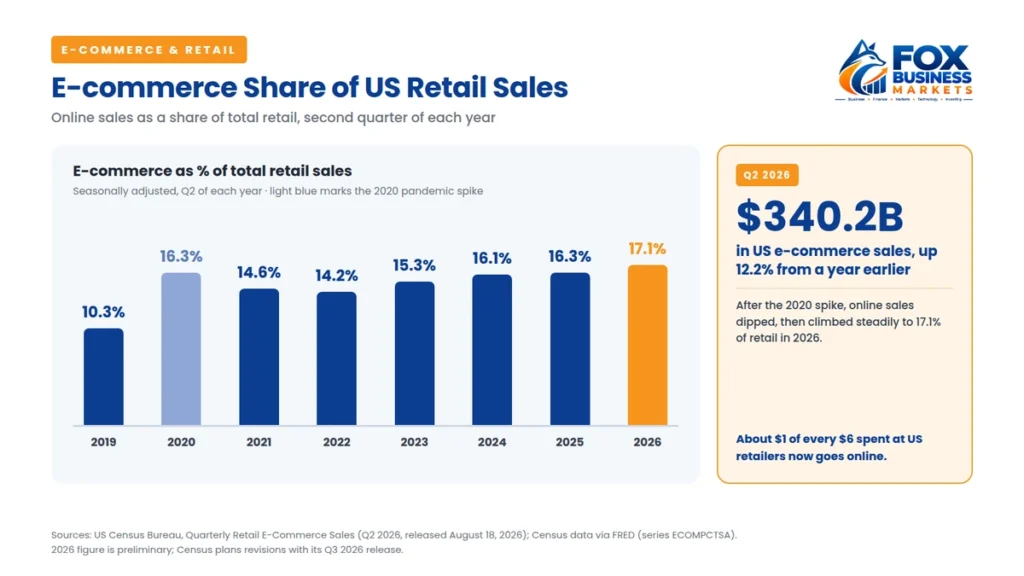
Yes, if you go in with realistic expectations. Before you learn how to start an ecommerce business, it helps to know the market is still growing. Online shopping keeps growing faster than retail overall. US e-commerce sales reached $340.2 billion in the second quarter of 2026, up 12.2% from a year earlier, and made up 17.1% of all retail sales, according to the US Census Bureau (Census Bureau). In the second quarter of 2019, that share was 10.3% (FRED, Census data).
But growth doesn’t mean easy money. You’re competing with Amazon, Walmart, and thousands of small sellers. The businesses that last usually sell something specific to a specific group of people, not “a bit of everything.”
How to Start an Ecommerce Business in 9 Steps
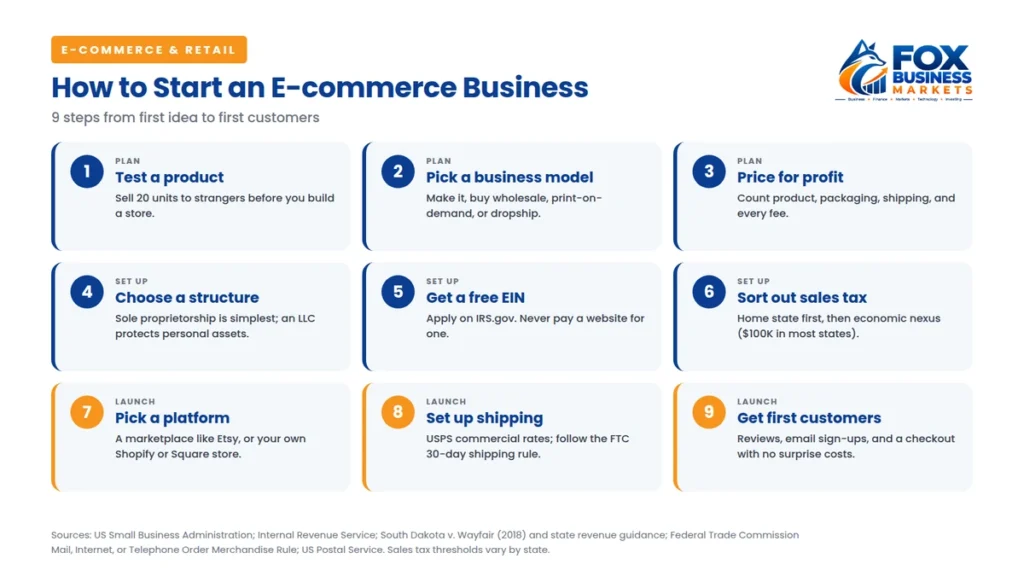
1. How Do You Find a Product That Will Sell?
Start with something you can test cheaply. Before you build a store, sell 20 units to people who aren’t your friends or family, through a local market, a Facebook group, or a simple Etsy listing. If strangers buy and come back, you have a product. If only your friends buy, you have a hobby.
Good first products are easy to ship, hard to find in big stores, and something people buy more than once. Candles, specialty foods, pet accessories, and niche hobby supplies fit that pattern.
2. Which Business Model Should You Choose?
There are four common ways to run an online store:
Model | How it works | Main upside | Main downside |
| Make it yourself | You create the product | Unique, higher margins | Hard to scale |
| Wholesale | You buy in bulk and resell | Proven products | Upfront inventory cost |
| Print-on-demand | A partner prints and ships your designs | No inventory | Thin margins, less control |
| Dropshipping | A supplier ships directly to your customer | Low startup cost | Low margins, slow shipping, crowded market |
Here’s an honest opinion: dropshipping is the most advertised model and often the hardest to profit from. You control neither the product quality nor the shipping time, and the same products are sold by hundreds of other stores. It can work, but not as a shortcut.
3. How Should You Price Your Products?
Price from your costs up, not from your competitors down. The basic formula:
Profit per sale = Price − (product cost + packaging + shipping + platform and payment fees)
Here’s the candle maker’s math for a $35 candle with free shipping, sold on Etsy:
Item | Cost |
| Wax, wick, jar, and scent | $7.00 |
| Box and packing material | $2.00 |
| USPS Ground Advantage (commercial rate, starting price) | $7.33 |
| Etsy fees (listing, 6.5% transaction, 3% + $0.25 processing) | $3.78 |
| Profit | $14.89 (about 43%) |
Pricing is the step most guides on how to start an ecommerce business skip. Run this math for every product before you list it. Many new sellers discover that “free shipping” quietly ate their whole profit.
4. Do You Need an LLC to Sell Online?
No, but it’s worth considering. A sole proprietorship is the simplest option. As the Small Business Administration puts it, “A sole proprietorship is easy to form and gives you complete control of your business,” but it doesn’t create a separate legal entity, so your personal assets aren’t protected.
An LLC adds that protection. The SBA says “LLCs protect you from personal liability in most instances,” and profits can pass through to your personal income “without facing corporate taxes” (SBA). Filing fees vary by state. Check your Secretary of State’s website for local licenses too, since the SBA notes that most small businesses need a mix of federal, state, and local licenses and permits.
Our guide on how to start a small business covers registration in more detail.
5. Do You Need an EIN?
An EIN is a federal tax ID number for your business. You need one if you have employees or operate as a partnership or corporation, and many banks ask for one to open a business account. It’s free. The IRS says plainly: “You never have to pay a fee for an EIN,” and warns, “Beware of websites that charge for an EIN” (IRS). You can apply online in minutes, but the session expires after 15 minutes of inactivity, so have your details ready.
6. Do You Have to Charge Sales Tax When Selling Online?
Probably, at least in your home state. Forty-five states and Washington, DC, have a statewide sales tax (Tax Foundation).
Since the Supreme Court’s 2018 decision in South Dakota v. Wayfair, states can require out-of-state sellers to collect tax once they pass an “economic nexus” threshold (Supreme Court). Economic nexus means you owe a state’s sales tax because of how much you sell there, even with no physical presence. Most states set the threshold at $100,000 in annual sales, while California, Texas, and New York use $500,000 (Streamlined Sales Tax).
Marketplaces help. Etsy calculates, collects, and sends sales tax for orders shipped to 44 states plus DC and Puerto Rico (Etsy). On your own website, you’re usually responsible yourself. Rules change often, so confirm with your state’s revenue department or an accountant.
7. Which Ecommerce Platform Should You Use?
Choose between a marketplace, where customers already shop, and your own store, where you control the brand. Here’s what the major options charge, from their official US pricing pages (as of October 2026):
Platform | Monthly cost | Selling or payment fees |
| Etsy | No monthly fee | $0.20 per listing, 6.5% transaction fee, 3% + $0.25 processing |
| Amazon | $0.99 per item sold (Individual) or $39.99 (Professional) | Referral fees, mostly 8% to 15% |
| Shopify | $39 (Basic, billed monthly) | 2.9% + 30¢ per online card payment |
| Square Online | $0 (Free plan) | 3.3% + 30¢ per online card payment |
| WooCommerce | Free plugin; hosting extra | Depends on your payment processor |
Sources: Etsy, Amazon, Shopify, Square, WooCommerce.
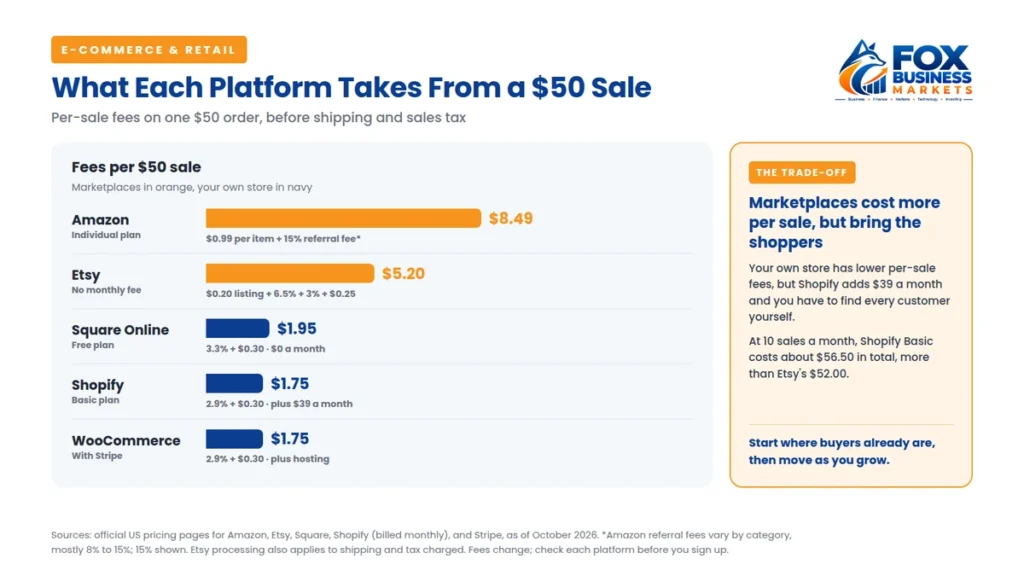
A practical path: start on a marketplace like Etsy to prove demand, then add your own Shopify or Square store once you have repeat customers.
8. How Do You Handle Shipping?
Most small sellers start with USPS. Ground Advantage delivers in two to five days, includes tracking and $100 of insurance, and handles packages up to 70 pounds. Commercial prices start at $7.33, and Priority Mail at $9.44 (USPS). Those October 2026 prices include temporary increases that run through January 17, 2027. Buying labels online through Click-N-Ship automatically gets you commercial pricing, and Priority Mail boxes are free.
Know the shipping law. Under the FTC’s Mail, Internet, or Telephone Order Merchandise Rule, you must have “a reasonable basis” for any shipping time you promise. If you don’t state one, you must be able to ship within 30 days. If you can’t ship on time, you have to ask the customer to agree to the delay or let them cancel for a full refund (FTC).
9. How Do You Get Your First Customers?
Launch to the people who already know you, then widen the circle. Post your products where your buyers spend time, ask every early customer for a review, and collect email addresses from day one.
Fix your checkout before you spend on ads. Across 50 studies, the Baymard Institute found an average cart abandonment rate of about 70%, and the top reason was extra costs, such as shipping, tax, and fees, that were “too high” (Baymard Institute). Show the full price early.
For a deeper plan, see our guides to digital marketing for small business and how much advertising costs.
How Much Does It Cost to Start an Ecommerce Business?
If you’re working out how to start an ecommerce business on a tight budget, you can start for a few hundred dollars if you make the product yourself and sell on a marketplace. Costs rise with inventory, your own website, and paid ads.
Cost | Lean start (Etsy) | Own store (Shopify) |
| Platform | $0.20 per listing | $39 a month |
| EIN | Free | Free |
| Business registration | Varies by state | Varies by state |
| First inventory or materials | Your choice; start small | Your choice; start small |
| Shipping supplies | Free Priority Mail boxes; buy others as needed | Same |
| Payment fees | 3% + $0.25 per sale | 2.9% + 30¢ per sale |
The biggest cost for most new sellers is inventory they can’t sell. Order small, sell out, then reorder. If you need funding, our guide to small business loans covers your options, and a short business plan will help you set a budget.
Common Mistakes to Avoid
When people figure out how to start an ecommerce business on their own, the most common mistake is pricing without counting every cost, especially shipping and fees. Others include ordering too much inventory before testing demand, ignoring sales tax until a state sends a letter, and writing vague return policies.
Plan for returns. The National Retail Federation estimated that 19.3% of online sales would be returned in 2025 (NRF). Decide your policy before your first sale, and build that cost into your prices.
Frequently Asked Questions
How do I start an ecommerce business with no money?
Start with a product you can make or source in small batches, and sell on a marketplace with no monthly fee, like Etsy, or Square Online’s free plan. Get a free EIN from the IRS, use free USPS Priority Mail boxes, and reinvest early profits into inventory.
Do I need a business license to sell online?
Often, yes. Requirements depend on your state, county, and city, and on what you sell. The SBA recommends checking your Secretary of State’s website to find which licenses and permits apply to your business.
Do I need an LLC to start an ecommerce business?
No. You can start as a sole proprietor. An LLC is optional but protects your personal assets from business debts and lawsuits in most cases. Filing fees vary by state.
Is Shopify or Etsy better for beginners?
Etsy is often easier for beginners because it has built-in shoppers and no monthly fee. Shopify gives you your own brand and more control, but you have to bring your own traffic. Many sellers start on Etsy and add Shopify later.
Do I have to collect sales tax on online sales?
Usually in your home state if it has a sales tax, and in other states once you pass their economic nexus threshold, most often $100,000 in annual sales. Marketplaces like Etsy collect and remit tax for you in most states.
How long does it take to start an ecommerce business?
You can set up a store and get an EIN in a day. Testing a product, sorting out taxes, and getting your first steady customers usually takes a few months.
The Bottom Line
Learning how to start an ecommerce business is less about building a website and more about building a business that makes money on every order. The candle maker didn’t need the fanciest platform. She needed a product strangers wanted, a price that covered every cost, and a clear plan for tax and shipping. Get those right, and the store is the easy part.