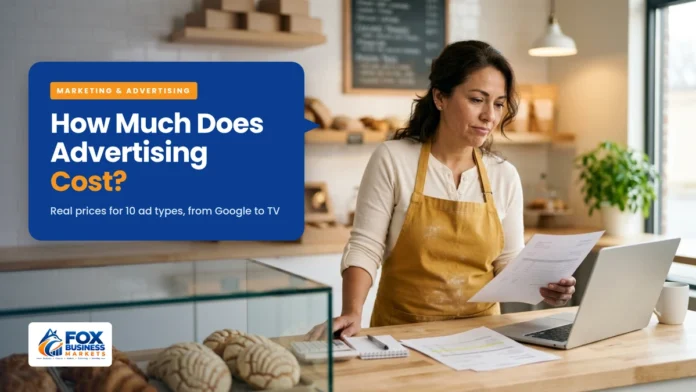
A new bakery owner asks three companies for advertising quotes. The radio station says $1,200 a month. The billboard company says $3,000. Google says there’s no fixed price at all. She stares at the numbers trying to figure out which one is cheapest, and that’s where she goes wrong. The cheapest ad isn’t the one with the lowest price. It’s the one that brings in a paying customer for the least money.
So how much does advertising cost? It depends on how you pay: per click, per lead, per thousand views, or per piece of mail. Below are real prices for 10 common ad types, the minimum budget to start on each platform, and a simple way to figure out what a customer actually costs you. Each figure is labeled by source, because a lot of advertising data comes from vendors rather than the platforms themselves.
The Short Answer
The quick answer to how much does advertising cost is that most digital platforms don’t charge a fixed price. You set a budget and pay based on results, such as clicks or leads. Google, for example, says its search ads are “priced on a Cost-Per-Click (CPC) model” and that “Google Ads has no flat fees or monthly subscriptions” (Google).
Traditional media, such as TV, radio, billboards, and mail, usually charges by the spot, the month, or the piece. Those prices are often negotiated, and they vary widely by market.
How Much Does Advertising Cost? 10 Ad Types Compared
1. Google Ads
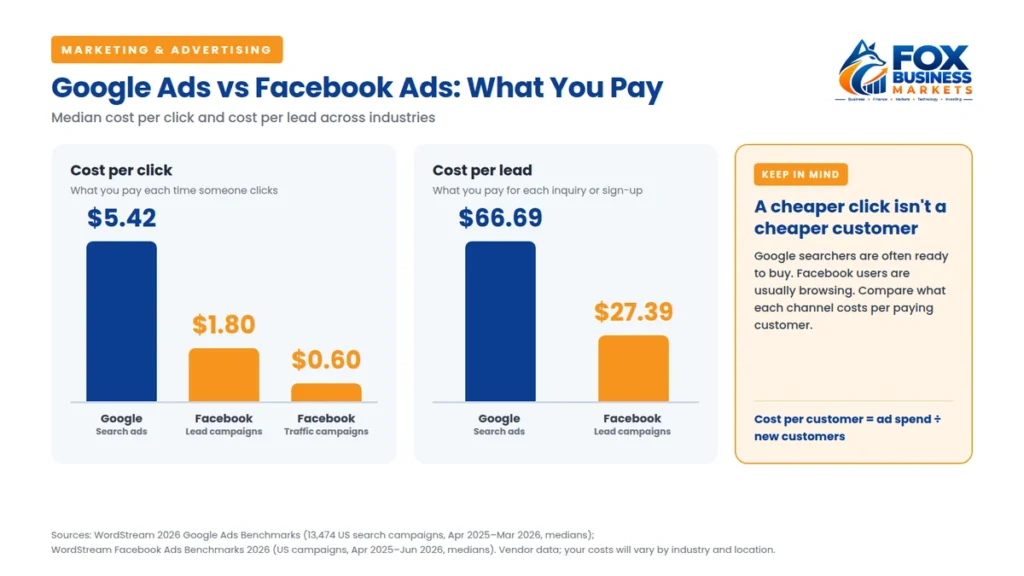
You pay when someone clicks. In WordStream’s 2026 benchmark report, which looked at 13,474 US search campaigns from April 2025 to March 2026, the median cost per click across all industries was $5.42, and the median cost per lead was $66.69. That was the first drop in cost per lead in five years (WordStream).
You control spending with an average daily budget. On a busy day, Google may spend up to twice that amount, but it won’t charge you more than 30.4 times your daily budget in a month (Google Ads Help).
Best for: customers who are actively searching, like “plumber near me.”
2. Facebook and Instagram Ads
Social ads usually cost less per click than search ads, but the people clicking are often browsing, not ready to buy. In WordStream’s 2026 Facebook benchmarks, based on US campaigns from April 2025 to June 2026, the median cost per click was $0.60 for traffic campaigns and $1.80 for lead campaigns. The median cost per lead was $27.39, down about 1% from the year before (WordStream).
Meta sets minimum budgets that vary by campaign type and currency, so check the minimum in Ads Manager when you set up a campaign.
Best for: building awareness, promoting offers, and products people don’t search for.
3. TikTok Ads
TikTok has clear official minimums. A campaign budget “must exceed $50,” and an ad group’s daily budget “must exceed $20” (TikTok Ads Help).
Best for: brands with visual, fun products and customers under 40. It’s a harder fit for a local accounting firm.
4. LinkedIn Ads
LinkedIn is among the more expensive platforms per click, but it’s the place to reach people by job title. According to LinkedIn, “the minimum daily budget amount required to start on LinkedIn is $10, for any ad format,” and new campaigns with a lifetime budget need at least $100 (LinkedIn).
Best for: business-to-business services, recruiting, and professional services.
5. Yelp Ads
Yelp says advertisers can “spend as little as $5/day on average,” and “there are no term contracts with self-serve advertisers” (Yelp).
Best for: restaurants, home services, and other local businesses that customers find through reviews.
6. Nextdoor Ads
Nextdoor targets specific neighborhoods. In a 2022 guide, Nextdoor suggested starting plans of $3, $5, or $10 a day, charged upfront for 31 days (Nextdoor). Check current pricing when you sign up, since that guide is a few years old.
Best for: neighborhood services like landscaping, cleaning, and pet care.
7. Direct Mail (Every Door Direct Mail)
The US Postal Service’s Every Door Direct Mail program lets you send postcards to every address on a mail route without buying a mailing list. Postage for EDDM Retail is currently $0.26 per piece, and you can send between 200 and 5,000 pieces per day per ZIP code (USPS). Printing and design are extra.
So 2,000 postcards cost about $520 in postage before printing.
Best for: local businesses with a clear service area, such as restaurants, dentists, and home services.
8. Influencer Marketing
Prices depend on audience size, and there’s no official rate card. Later, an influencer marketing platform, estimated in 2026 that US creators with 10,000 to 100,000 followers charge about $500 to $2,500 per post, while creators with 1,000 to 10,000 followers charge about $100 to $500 (Later). Later doesn’t publish its methodology, so treat these as rough estimates.
Follow the rules. The FTC says influencers must “disclose when you have any financial, employment, personal, or family relationship with a brand,” and the disclosure should be “hard to miss” (FTC). As the business paying them, make sure they do.
Best for: consumer products, beauty, food, fitness, and lifestyle brands.
9. Billboards and Outdoor Ads
Billboard prices depend heavily on location and traffic, and most are negotiated, so there’s no reliable national average. The market is growing: US out-of-home advertising revenue reached a record $9.46 billion in 2025, up 3.6%, according to the Out of Home Advertising Association, and digital billboards made up 36.3% of that (MediaPost).
Best for: building local name recognition, especially near your location.
10. TV and Radio
At the very top, a 30-second ad during Super Bowl LX in February 2026 cost an average of about $8 million, and a handful of slots sold for more than $10 million (TVLine). Local TV and radio cost far less, but prices depend on your market, the station, and the time slot, and there’s no reliable public average. Ask local stations for their rate cards and audience numbers, and negotiate.
Best for: businesses with a broad local customer base and a budget for repeated ads, since one spot rarely moves the needle.
Advertising Costs Vary Widely by Industry
How much does advertising cost in your industry? On Google, the gap between the cheapest and most expensive industries is about six times. In WordStream’s 2026 report, attorneys and legal services had the highest median cost per click at $9.87, followed by home improvement at $8.33 and dentists at $8.00. The lowest were arts and entertainment at $1.63, restaurants at $2.05, and travel at $2.14.
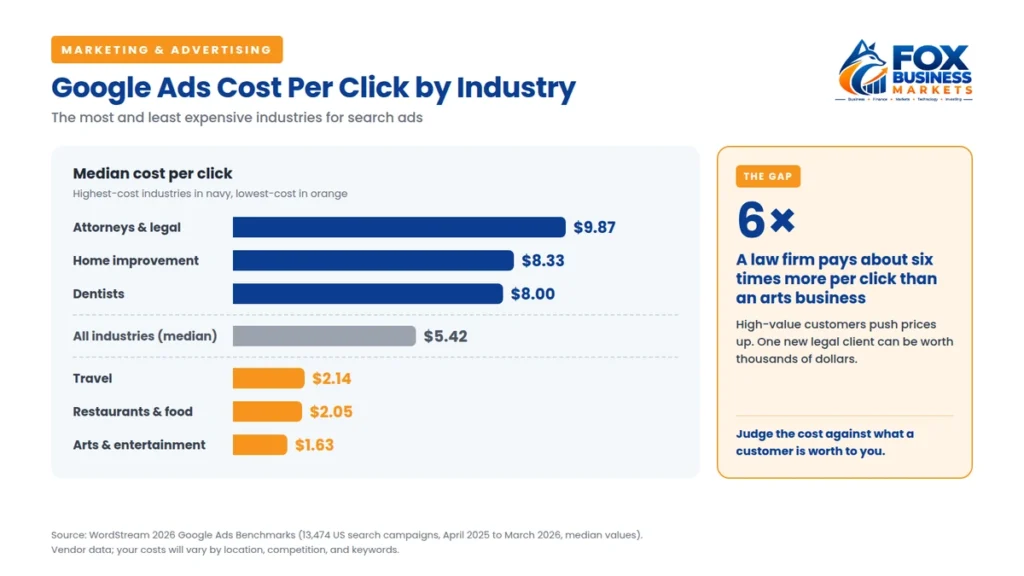
High-value customers drive up the price. A law firm can afford to pay more for a click because a single client may be worth thousands of dollars.
How to Figure Out Your Real Cost Per Customer
For your own business, the most useful way to answer how much does advertising cost is to look past the price tag. Price per click or per piece only tells you half the story. What matters is how much it costs to win a paying customer:
Cost per customer = Total ad spend ÷ Number of new customers
Say you spend $500 on Google Ads, get 90 clicks, and 6 of those people become customers. Your cost per customer is $500 ÷ 6 = $83. If each customer is worth $400 to you over the next year, that’s a good deal. If they’re worth $60, it isn’t.
Compare channels this way, not by their headline prices. A $0.26 postcard that brings in one customer for every 500 sent costs $130 per customer in postage alone. A $5 click that converts one time in ten costs $50 per customer.
See our guide on how to create a marketing plan to decide how much to set aside.
Minimum Budgets to Get Started
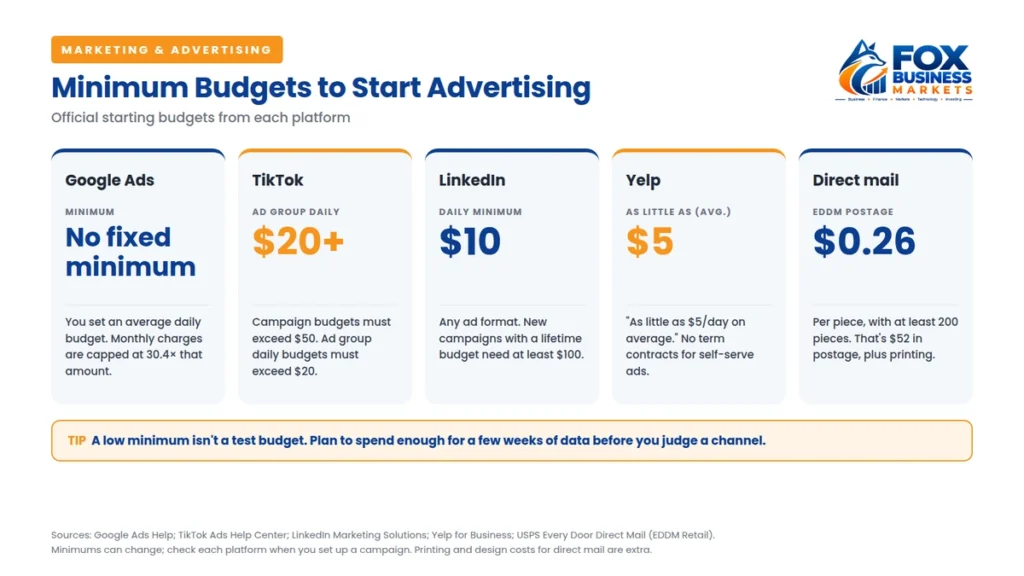
If you’re asking how much does advertising cost just to get started, the answer on most platforms is less than you might think. These are the official minimums or starting points:
Platform | Minimum or starting budget | Source |
| Google Ads | No fixed minimum; you set a daily budget | |
| TikTok | Ad group daily budget over $20; campaign budget over $50 | TikTok |
| $10 a day; $100 lifetime for new campaigns | ||
| Yelp | “As little as $5/day on average” | Yelp |
| Nextdoor | Suggested plans of $3 to $10 a day (2022) | Nextdoor |
| Direct mail (EDDM) | $0.26 per piece postage; at least 200 pieces | USPS |
Common Advertising Mistakes
The bakery owner from the opening almost made the biggest mistake: choosing a channel by its price tag instead of its cost per customer. Close behind: spreading a small budget across five platforms, sending ad clicks to a weak website, and stopping a campaign after one week. Most channels need a few weeks of data before you can judge them fairly.
Another costly one is skipping the free basics. Before you pay for ads, make sure your Google Business Profile, website, and reviews are in good shape. Our guide to digital marketing for small business explains why, and our guide to business growth strategies shows where advertising fits once the basics are working.
Frequently Asked Questions
How much does advertising cost for a small business?
It depends on the channel. You can start on Yelp at about $5 a day on average or on LinkedIn at $10 a day, while Google Ads has no fixed minimum. Direct mail postage starts at $0.26 per piece. Most small businesses start with a test budget they can afford and increase it once they know their cost per customer.
How much does a Google ad cost?
There’s no fixed price; you pay per click. WordStream’s 2026 benchmarks found a median cost per click of $5.42 across industries, ranging from about $1.63 in arts and entertainment to $9.87 for attorneys.
Are Facebook ads cheaper than Google ads?
Per click, usually yes. WordStream found a median cost per click of $0.60 for Facebook traffic campaigns, compared with $5.42 on Google. But Google searchers are often closer to buying, so compare cost per customer, not cost per click.
How much does a Super Bowl ad cost?
A 30-second ad during Super Bowl LX in 2026 cost about $8 million on average, with a few slots selling for more than $10 million.
How much does direct mail advertising cost?
USPS Every Door Direct Mail postage is $0.26 per piece for EDDM Retail, plus printing and design costs.
What is the cheapest form of advertising?
Free channels like a Google Business Profile, customer reviews, and organic social media cost nothing but time. Among paid options, the cheapest is the one with the lowest cost per customer for your business, which you’ll only know by testing.
The Bottom Line
So, how much does advertising cost? Anywhere from a few dollars a day to millions for a single TV spot. For a small business, the right question isn’t “What’s cheapest?” It’s “What brings me a customer for less than that customer is worth?” Start small, measure your cost per customer, and put more money behind whatever wins.