Every month, a bakery owner tries something new. In March it’s flyers. In May, Instagram posts. In August, a coupon in the local paper. By December, she’s spent a few thousand dollars and has no idea which of those things brought in a single customer. Nothing failed, exactly. She just never had a plan, so nothing could succeed on purpose.
That’s the real cost of skipping a marketing plan. It isn’t wasted money so much as wasted learning. You can’t repeat what worked if you never knew what worked. This guide shows how to create a marketing plan in seven practical steps, with a one-page template you can fill in this week.
Why a Marketing Plan Matters
Finding customers is the problem most owners wrestle with. In the Federal Reserve Banks’ 2026 survey of small employer firms, 73% said “reaching customers and growing sales” was an operational challenge over the prior year, the most common challenge on the list (Federal Reserve).
A plan doesn’t make that problem disappear. It gives you a way to attack it on purpose. As the SBA puts it, “One of the best ways to stay on schedule and on budget is to make a marketing plan,” and “your marketing plan turns your strategy into action” (SBA). Knowing how to create a marketing plan turns marketing from guesswork into a system you can test and improve.
What a Marketing Plan Includes
According to the SBA, most marketing plans cover six topics:
- Target market: “Describe your audience in detail.”
- Competitive advantage: what makes your product or service better than the alternatives.
- Sales plan: how you’ll actually sell to customers.
- Marketing and sales goals: what you want to achieve over the next year.
- Marketing action plan: the channels and activities you’ll use to reach those goals.
- Budget: “a complete breakdown of the costs of your marketing plan.”
That’s it. A marketing plan for a small business doesn’t need to be a 30-page document. One clear page you actually use beats a binder you never open.
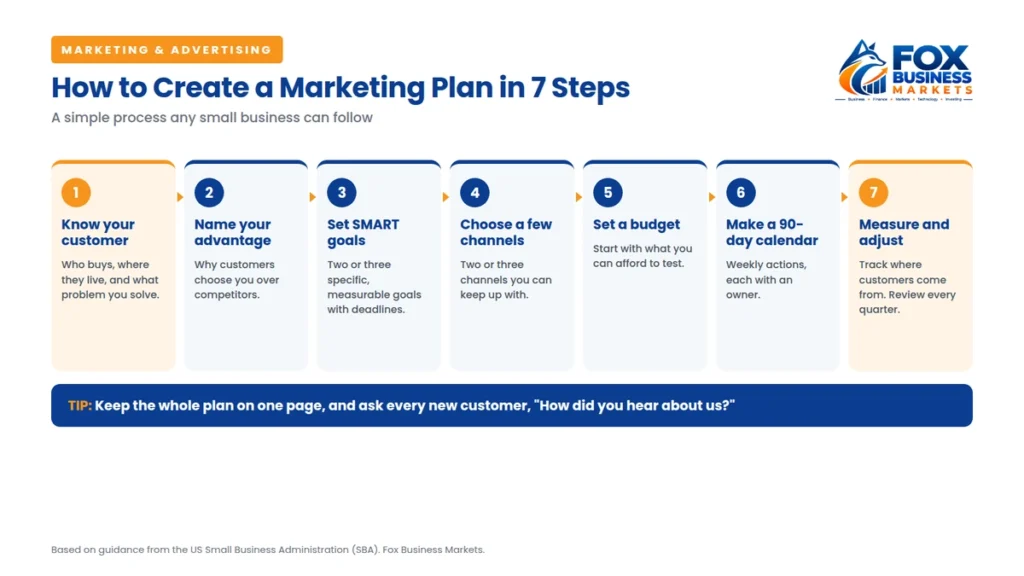
How to Create a Marketing Plan in 7 Steps
Step 1: Get Specific About Your Customer
“Everyone” isn’t a target market. The SBA suggests looking at “the market’s size, demographics, unique traits, and trends that relate to demand for your business.” Write down who buys from you most often, where they live, what problem you solve for them, and where they look for businesses like yours.
You don’t need expensive research. The Census Bureau’s free Census Business Builder lets you “view interactive maps showing demographics, income levels, competition, and consumer spending” for your area (Census Bureau). Better still, talk to your five best customers. Ask them:
- How did you first hear about us?
- What were you looking for when you found us?
- What almost stopped you from buying?
- What would you tell a friend about us?
Their answers often reveal your best message, word for word.
Bakery example: “Working parents within three miles who want custom birthday cakes with less than a week’s notice.”
Step 2: Name Your Advantage
Look at your top three competitors. What do they charge? What do their reviews praise and complain about? Then finish this sentence: “Customers choose us instead because…”
If you can’t finish it, that’s useful information too. Your marketing will struggle until you can. A clear business strategy makes this step much easier, and a quick SWOT analysis can help you spot what sets you apart.
Bakery example: “We’re the only bakery nearby that does custom cakes in 72 hours.”
Step 3: Set SMART Goals
Vague goals like “get more customers” can’t be measured, so you’ll never know if you hit them. The SMART framework, introduced by George Doran in a 1981 Management Review article, asks that each goal be specific, measurable, and time-bound, along with being realistic and clearly owned by someone.
The SBA gives examples of the kind of goals that work: “increase email subscribers, grow market share, or increase sales by a certain percent.”
Bakery example: “Book 40 custom cake orders a month by June 30, up from 25 now.”
Pick two or three goals. More than that, and you’ll end up chasing all of them halfway.
Step 4: Choose a Few Channels
Now decide how you’ll reach those customers. The SBA advises you to “list marketing channels you’ll use, like online advertising, radio ads, or billboards.” For most small businesses, the strongest starting channels are a complete Google Business Profile, a simple website, customer reviews, and email. Our guide to digital marketing for small business explains each one, including when it doesn’t work.
The key word is few. Two or three channels done consistently will beat seven done occasionally.
Bakery example: Google Business Profile, Instagram (cake photos), and a monthly email to past customers.
Step 5: Set a Budget You Can Defend
You’ve probably read that “the SBA recommends spending 7% to 8% of revenue on marketing.” It’s repeated all over the internet, but we couldn’t find that recommendation anywhere on the SBA’s website, and the articles that repeat it usually don’t cite a source. The SBA’s actual advice is simpler: include a complete cost breakdown and “try to be as accurate as possible.”
Real benchmarks do exist, but they come from much larger companies. In Gartner’s 2026 survey of chief marketing officers, mostly at companies with more than $1 billion in revenue, marketing budgets averaged 7.8% of revenue (Gartner). The Spring 2026 CMO Survey, run by Duke University’s Fuqua School of Business, found budgets at 9.0% of revenue for US companies (The CMO Survey).
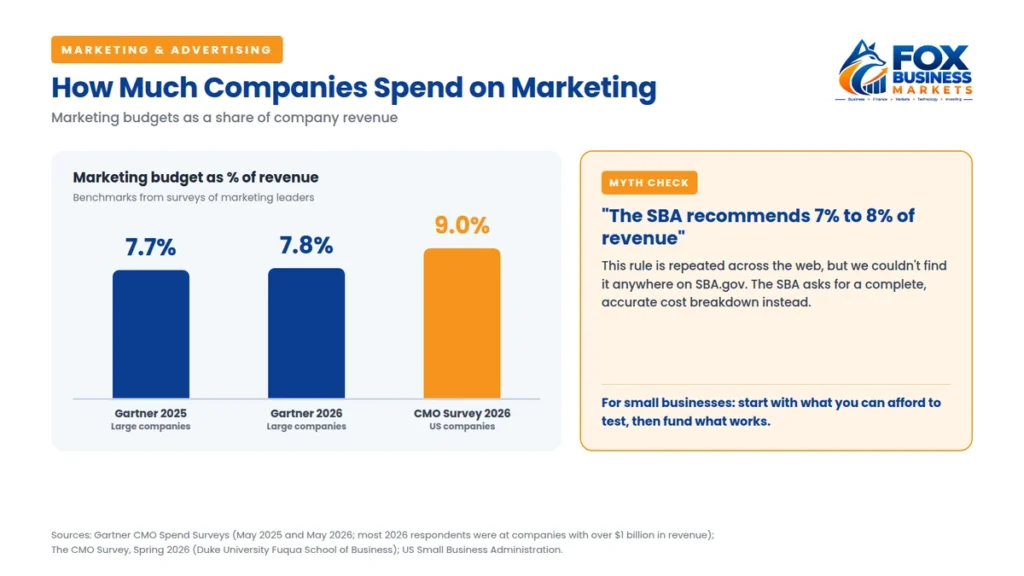
For a small business, those numbers are a reference point, not a rule. A better approach: start with what you can afford to test, then shift money toward whatever brings in paying customers. SCORE offers a free annual marketing budget template to help you lay it out.
Bakery example: $400 a month: $250 for a small local ad test, $100 for an email tool and printed cards, $50 for photo props.
Step 6: Turn It Into a 90-Day Calendar
This is where most plans die. A goal without a calendar is a wish. Break your plan into weekly actions for the next 90 days, with a name next to each one, even if every name is yours.
Bakery example:
- Weeks 1–2: Update the Google profile with 20 new cake photos; ask 30 recent customers for reviews.
- Weeks 3–8: Post three cake photos a week; send the first monthly email.
- Weeks 9–12: Run a $250 local ad test for custom cakes; compare results.
Step 7: Measure, Then Adjust
The SBA recommends that you “compare your marketing and sales costs to the revenue it generates,” and notes that “marketing plans should be maintained on an annual basis, at minimum.” In practice, check your numbers monthly and revise the plan every quarter.
Track the basics: where each new customer came from, how many inquiries became sales, and what each channel cost. Asking “How did you hear about us?” at checkout costs nothing and answers most of these questions. This last step is the part of how to create a marketing plan that most guides skip, and it’s where the real learning happens.
One-Page Marketing Plan Template
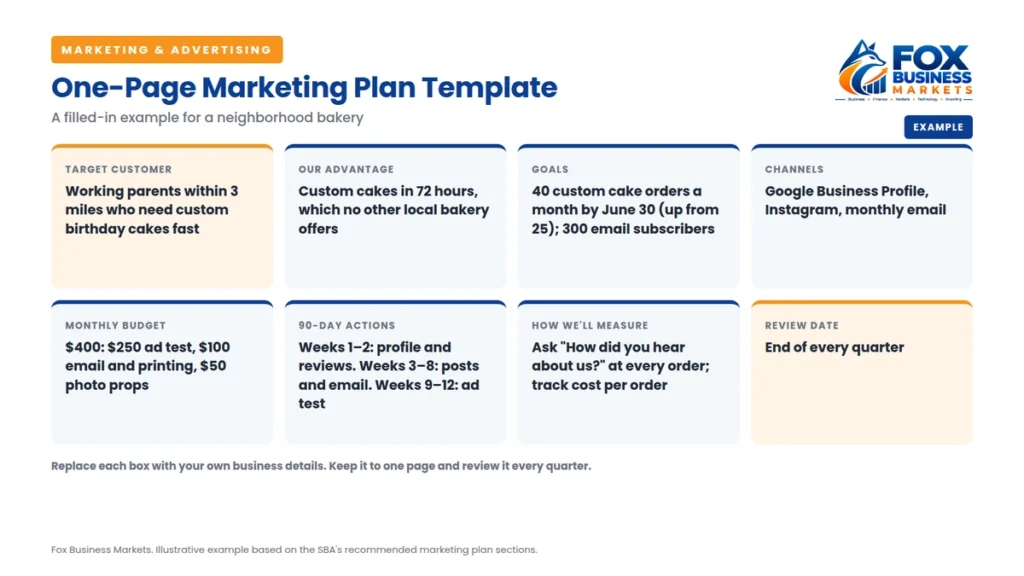
If you’re learning how to create a marketing plan for the first time, start with this one-page version. Here’s the bakery’s full plan; copy the structure and fill in your own business:
Section | Bakery example |
| Target customer | Working parents within 3 miles who need custom birthday cakes fast |
| Our advantage | Custom cakes in 72 hours; no other local bakery offers this |
| Goals | 40 custom cake orders a month by June 30 (up from 25); 300 email subscribers by June 30 |
| Channels | Google Business Profile, Instagram, monthly email |
| Monthly budget | $400 ($250 ads test, $100 email and printing, $50 props) |
| 90-day actions | Profile update and reviews (weeks 1–2), posting and email (weeks 3–8), ad test (weeks 9–12) |
| How we’ll measure | “How did you hear about us?” at every order; monthly review of orders, cost per order, and email sign-ups |
| Review date | End of each quarter |
Once your marketing plan is ready, add the key points to the marketing section of your business plan.
Common Marketing Plan Mistakes
Even owners who know how to create a marketing plan tend to make the same mistake: they write the plan and then never look at it again. Close behind: trying every channel at once, setting goals you can’t measure, and copying a competitor’s marketing without a reason customers should choose you instead.
Another trap is judging a channel too quickly. Some, like reviews and email, build slowly. Give each channel at least a full quarter before you decide it doesn’t work, unless it’s clearly losing money.
Frequently Asked Questions
How to create a marketing plan for a small business?
Define your target customer, name your competitive advantage, set two or three measurable goals, choose a few channels, set a budget, turn it into a 90-day calendar, and review the results regularly. All of it can fit on one page.
What are the main parts of a marketing plan?
The SBA lists six common sections: target market, competitive advantage, sales plan, marketing and sales goals, a marketing action plan, and a budget.
How much should a small business spend on marketing?
There’s no official rule. The often-quoted “7% to 8% of revenue” isn’t stated on the SBA’s website. Large companies spend about 8% to 9% of revenue, according to Gartner and The CMO Survey, but small businesses should start with an amount they can afford to test and adjust based on results.
How often should I update my marketing plan?
The SBA says marketing plans should be maintained at least once a year. Many small businesses check results monthly and revise the plan every quarter.
Is there a free marketing plan template?
Yes. You can use the one-page template in this guide. SCORE also offers free marketing plan and marketing budget templates.
What is the difference between a marketing plan and a business plan?
A business plan describes your whole business, including operations, management, and finances. A marketing plan focuses only on how you’ll find and win customers, and it’s usually updated more often.
The Bottom Line
Learning how to create a marketing plan isn’t about writing something impressive. It’s about deciding, on purpose, who you’re trying to reach, how you’ll reach them, and how you’ll know if it worked. The bakery owner didn’t need a bigger budget. She needed one page, a calendar, and the habit of asking every customer one simple question.