A T-shirt designer sells about 100 shirts a month on Etsy at $25 each. At the end of the month, he adds up his fees: $0.20 per listing, a 6.5% transaction fee, and 3% plus $0.25 for payment processing. That’s about $280 a month going to Etsy. A friend tells him to “just move to Shopify,” where he’d pay $39 a month plus card fees, roughly $140 in total. He’s ready to switch.
He might be about to make an expensive mistake. Etsy’s fees pay for something Shopify doesn’t give him: millions of shoppers already searching for T-shirts. On his own site, he’d save $140 a month and could lose most of his sales.
That trade-off is what choosing among the best ecommerce platforms is really about. Below is an honest comparison of eight options, with real fees from their official pricing pages and a clear answer on who each one fits.
Quick answer: For most first-time sellers, Etsy (for handmade or vintage goods) or Square Online’s free plan is the easiest start. Shopify is the best all-around choice for building your own brand. WooCommerce fits businesses that already run a WordPress site. Amazon fits products people already search for by name.
Marketplace or Your Own Store: Which Do You Need?
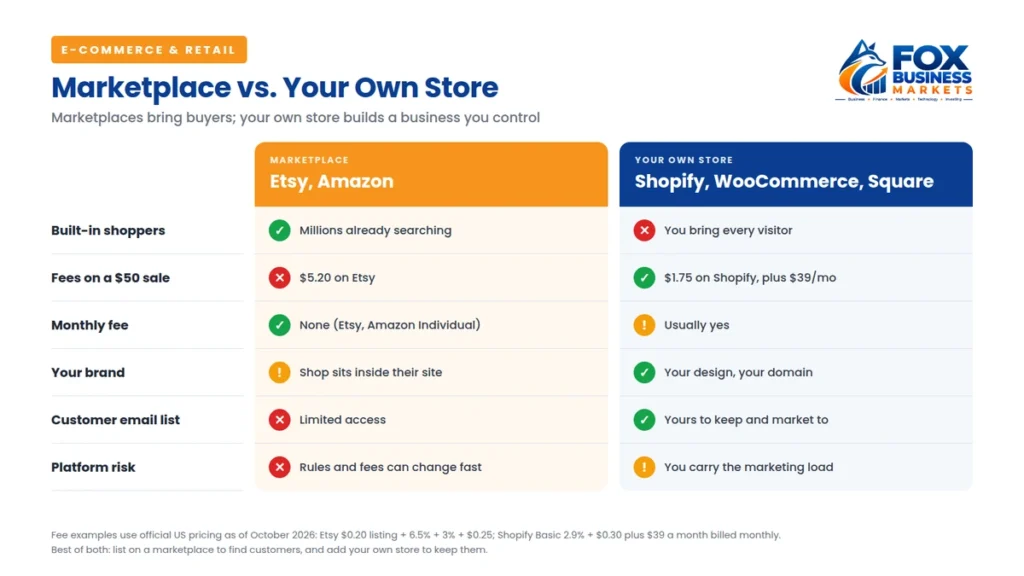
A marketplace is a site where many sellers list products and the platform brings the shoppers, like Etsy or Amazon. Your own store is a website you control, built on a platform like Shopify or WooCommerce. Marketplaces cost more per sale but come with buyers. Your own store costs less per sale, but you have to bring every customer yourself.
| Marketplace (Etsy, Amazon) | Your own store (Shopify, WooCommerce, etc.) | |
| Built-in shoppers | Yes | No |
| Fees per sale | Higher | Lower |
| Monthly fee | Low or none | Usually yes |
| Control over branding | Limited | Full |
| Customer email list | Limited | Yours |
| Risk | Platform rules can change overnight | You carry the marketing load |
Many successful sellers use both: a marketplace to find customers and their own store to keep them.
Best Ecommerce Platforms Compared
Here’s how the best ecommerce platforms for small business compare on price, based on official US pricing pages as of October 2026:
| Platform | Starting price to sell | Online card rate | Extra transaction fee | Best for |
| Shopify | $39/month ($29 billed yearly) | 2.9% + 30¢ | 2% if you don’t use Shopify Payments | Growing your own brand |
| WooCommerce | Free plugin; hosting extra | Varies (Stripe: 2.9% + 30¢) | None from WooCommerce | WordPress sites |
| Square Online | $0 (Free plan) | 3.3% + 30¢ | None | Shops that also sell in person |
| Wix | $29/month on the Core plan, billed yearly | 2.9% + $0.30 | None listed | Small catalogs, design-first sites |
| BigCommerce | $39/month ($29 billed yearly) | From 2.89% + $0.29 | 2% with outside payment providers | Larger catalogs |
| Squarespace | $25/month ($19 billed yearly) on Basic | 2.9% + $0.30 | 2% on Basic; 0% on Core and up | Creatives and service businesses |
| Etsy | No monthly fee; $0.20 per listing | 3% + $0.25 | 6.5% | Handmade, vintage, craft supplies |
| Amazon | $0.99 per item or $39.99/month | Included in referral fee | Referral fees, mostly 8% to 15% | Products people search for by name |
Fees change often, so confirm on each platform’s pricing page before you sign up.
Reviews of the Best Ecommerce Platforms
Is Shopify the Best Ecommerce Platform for Most Businesses?
For most small businesses building their own brand, yes. Shopify is easy to set up, handles payments, shipping labels, and taxes, and has thousands of apps. Shopify says it serves “millions of businesses in 175+ countries” (Shopify).
The Basic plan costs $39 a month billed monthly, or $29 billed yearly, with online card rates of 2.9% + 30¢. Grow costs $105 a month and Advanced $399 (Shopify).
Watch out for: app costs that add up quickly, and a 2% fee if you use an outside payment provider instead of Shopify Payments.
Skip it if: you sell only a handful of items and have no plan to drive traffic. You’ll pay monthly for a store nobody visits.
Is WooCommerce Really Free?
The plugin is free, but running a store isn’t. WooCommerce turns a WordPress website into a store. WooCommerce estimates hosting at “$25 – $350/month for most stores,” and paid extensions often cost $29 to $299 a year (WooCommerce). Payment processors such as Stripe charge 2.9% + 30¢ per card payment (Stripe).
Best for: businesses that already have a WordPress site and want full control.
Skip it if: you don’t want to manage updates, security, and backups yourself.
Is Square Online Good for Small Businesses?
It’s the best free starting point, especially if you also sell in person. The Free plan costs $0 a month, with online card payments at 3.3% + 30¢. The Plus plan costs $49 a month per location and lowers the online rate to 2.9% + 30¢ (Square). Your in-person and online inventory stay in sync.
Skip it if: you need advanced design or a large catalog with complex product options.
Is Wix Good for Ecommerce?
Wix is a website builder first, with solid store features. You need the Core plan or higher to accept payments. Wix lists Core at about $29 a month and Business at about $39 a month, billed yearly (Wix). Wix Payments charges 2.9% + $0.30 for US card payments (Wix).
Best for: small catalogs where the look of the site matters most.
Skip it if: you plan to grow into hundreds of products or need advanced inventory tools.
Who Should Use BigCommerce?
BigCommerce suits sellers with larger catalogs who want lots of built-in features. The Core plan costs $39 a month ($29 billed yearly), but it’s capped at $30,000 in sales over 12 months, after which you’re moved to a higher plan. Growth costs $105 a month, with a $100,000 cap (BigCommerce). BigCommerce charges no transaction fee with its built-in payment providers; processing starts at 2.89% + $0.29.
Skip it if: you’re just starting. The sales caps and plan structure make more sense once you have steady volume.
Is Squarespace Good for Selling Online?
Yes, for creatives, service businesses, and small product lines that want a beautiful site. The Basic plan costs $25 a month ($19 billed yearly) but charges a 2% transaction fee on sales. The Core plan, at $39 a month ($29 billed yearly), drops that fee to 0%. Card processing through Squarespace Payments is 2.9% + $0.30 on both (Squarespace).
Skip it if: you sell many products with lots of variations.
Should You Sell on Etsy?
If you make handmade goods, sell vintage items, or sell craft supplies, Etsy is often the best place to start. The Etsy marketplace reported 86.5 million active buyers for 2025, according to the company’s annual report (Etsy, SEC filing). Fees include $0.20 per listing, a 6.5% transaction fee on the item price and shipping, and 3% + $0.25 for payment processing in the US (Etsy).
Watch out for: Offsite Ads, which charge 15% on sales they generate, or 12% once you’ve passed $10,000 in yearly sales.
Skip it if: your products are mass-produced. Etsy is built around handmade, vintage, and craft items.
Should You Sell on Amazon?
Amazon makes sense for products people already search for by name, such as phone accessories or kitchen gadgets. The Individual plan costs $0.99 per item sold, and the Professional plan costs $39.99 a month. Most categories also charge a referral fee of 8% to 15% of the sale price (Amazon).
Skip it if: your product is unique and needs explanation. Amazon shoppers compare on price and reviews, and you control very little of the experience.
How to Choose the Right Ecommerce Platform
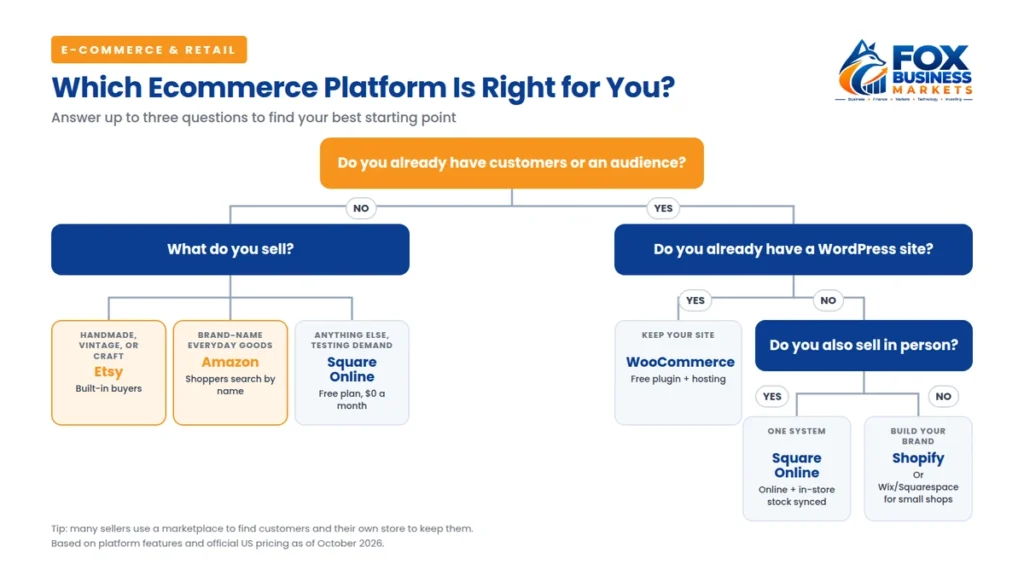
The best ecommerce platforms on paper aren’t always the right one for you. Answer five questions:
- Do you already have customers or an audience? If yes, your own store makes sense. If no, start on a marketplace.
- What do you sell? Handmade or vintage fits Etsy. Branded everyday products fit Amazon. Almost anything fits Shopify.
- Do you also sell in person? Square keeps both in sync.
- Do you already have a website? If it’s on WordPress, add WooCommerce. If it’s on Wix or Squarespace, try their store features first.
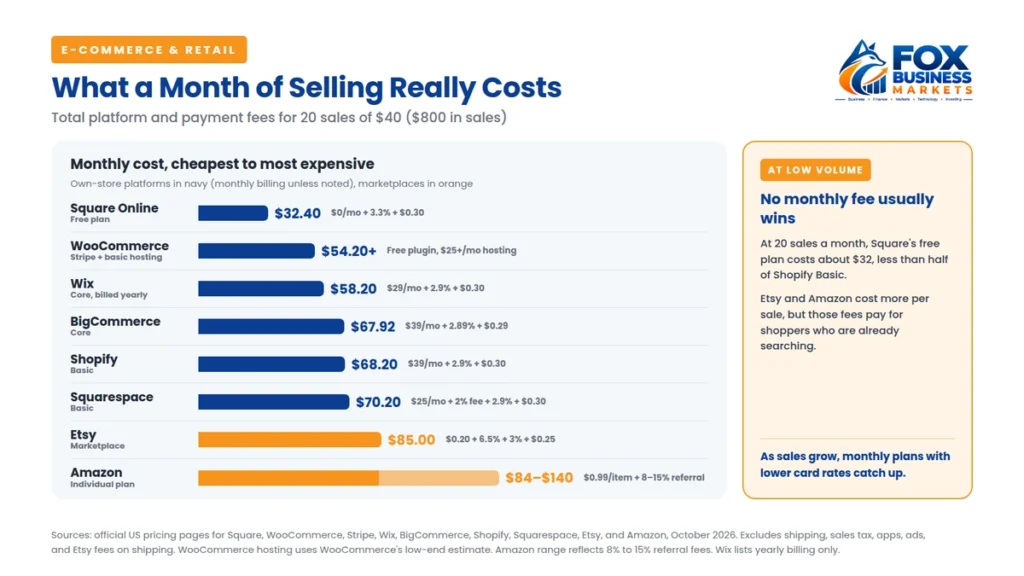
- How many sales do you expect each month? At low volume, no-monthly-fee options are cheaper. At higher volume, lower card rates and no transaction fees matter more.
Can You Switch Platforms Later?
Yes, but it takes work. You can usually export your products and customer list, but reviews and marketplace rankings don’t move with you. Buy your own domain name from the start, so your web address stays the same if you change platforms, and set up redirects from old product pages to new ones.
Common Mistakes When Choosing an Ecommerce Platform
The biggest mistake is the T-shirt designer’s: comparing only fees and ignoring where buyers come from. Others include paying for an advanced plan before you need it, installing too many paid apps, and building a store before you’ve tested whether anyone wants your product. Our guide on how to start an ecommerce business covers product testing first.
If you plan to drive traffic to your own store, budget for it. Our guide to how much advertising costs and our digital marketing guide show what that takes.
Frequently Asked Questions
What is the best ecommerce platform for beginners?
For most beginners, Etsy (for handmade or vintage goods) or Square Online’s free plan is easiest, since neither charges a monthly fee. Shopify is the best choice once you’re ready to build your own brand and drive your own traffic.
Is Shopify better than WooCommerce?
Shopify is easier because hosting, security, and updates are handled for you, for a monthly fee. WooCommerce is free and more flexible, but you pay for hosting and manage the site yourself. Choose WooCommerce if you already run a WordPress site.
What is the cheapest ecommerce platform?
Square Online’s Free plan has no monthly fee, with online card payments at 3.3% + 30¢. Etsy also has no monthly fee but charges $0.20 per listing, a 6.5% transaction fee, and payment processing. The cheapest option depends on your sales volume.
Is it better to sell on Etsy or Shopify?
Etsy brings you shoppers but charges higher fees per sale. Shopify costs less per sale but charges a monthly fee and doesn’t bring traffic. Many sellers start on Etsy, then add a Shopify store once they have repeat customers.
Which ecommerce platforms have no monthly fee?
Square Online’s Free plan, Etsy, and Amazon’s Individual plan have no monthly fee. WooCommerce is free as a plugin, but you pay for website hosting.
Can I use more than one ecommerce platform?
Yes. Many sellers list on a marketplace like Etsy or Amazon and run their own store at the same time. Use inventory tools or apps that sync stock across channels so you don’t oversell.
The Bottom Line
The best ecommerce platforms aren’t the ones with the lowest fees. They’re the ones that match where your buyers are today. The T-shirt designer shouldn’t leave Etsy yet. He should open a Shopify store alongside it, put a card with his web address in every package, and move over only when his own store can stand on its own.