
In 2001, Enron was the seventh-largest public company in the United States. It had a board stacked with accomplished directors, an audit committee, and a code of ethics. On December 2, 2001, it filed for bankruptcy. Seven months later, a US Senate investigation reached a blunt conclusion: “The Enron Board of Directors failed to safeguard Enron shareholders,” and it “witnessed numerous indications of questionable practices by Enron management over several years, but chose to ignore them” (US Senate, Permanent Subcommittee on Investigations).
Enron didn’t fail because it lacked rules. It failed because the people responsible for watching management didn’t. That’s what corporate governance is really about: not paperwork, but who holds power in a company, who checks it, and what happens when they don’t.
Quick answer: Corporate governance is the system of rules, relationships, and processes by which a company is directed and controlled. It defines how power is shared among shareholders, the board of directors, and management, what duties directors owe the company, and how they’re held accountable. Good governance protects investors, employees, and the business itself.
What Is Corporate Governance?
The most-quoted definition comes from the UK’s 1992 Cadbury Report: “Corporate governance is the system by which companies are directed and controlled” (Cambridge Judge Business School, Cadbury archive). The G20/OECD Principles of Corporate Governance, updated in 2023, add who’s involved: corporate governance “involves a set of relationships between a company’s management, board, shareholders and stakeholders” (OECD).
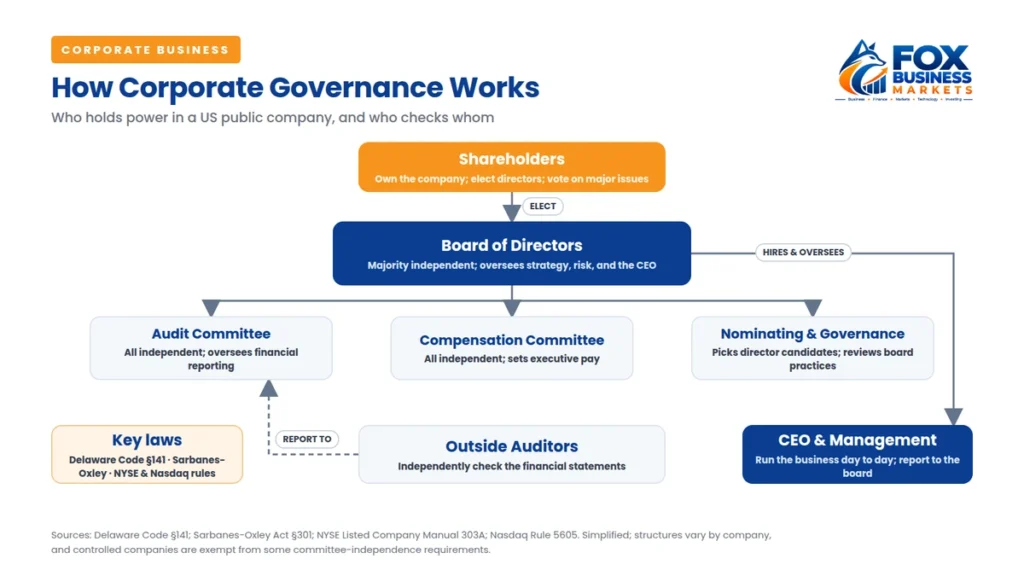
In plain terms, shareholders own the company, the board oversees it, and management runs it day to day. Governance is the set of rules that keeps those three groups pulling in the same direction.
Who’s Involved?
Group | Role | How they’re held accountable |
| Shareholders | Own the company; elect directors and vote on major decisions | Voting, lawsuits, selling shares |
| Board of directors | Hires and oversees the CEO, sets strategy, approves major deals, monitors risk | Elections, fiduciary duties, lawsuits |
| Board committees | Audit, compensation, and nominating committees handle specialized oversight | Exchange rules and SEC disclosure |
| Executive officers | Run the business and report to the board | The board, SEC certifications, fiduciary duties |
| Outside auditors | Independently check the financial statements | Professional standards and regulators |
Under Delaware law, where more than two-thirds of Fortune 500 companies are incorporated, “the business and affairs of every corporation … shall be managed by or under the direction of a board of directors” (Delaware Code §141). The key word is “direction.” Boards don’t run the company; they make sure it’s run well.
What Duties Do Directors Owe the Company?
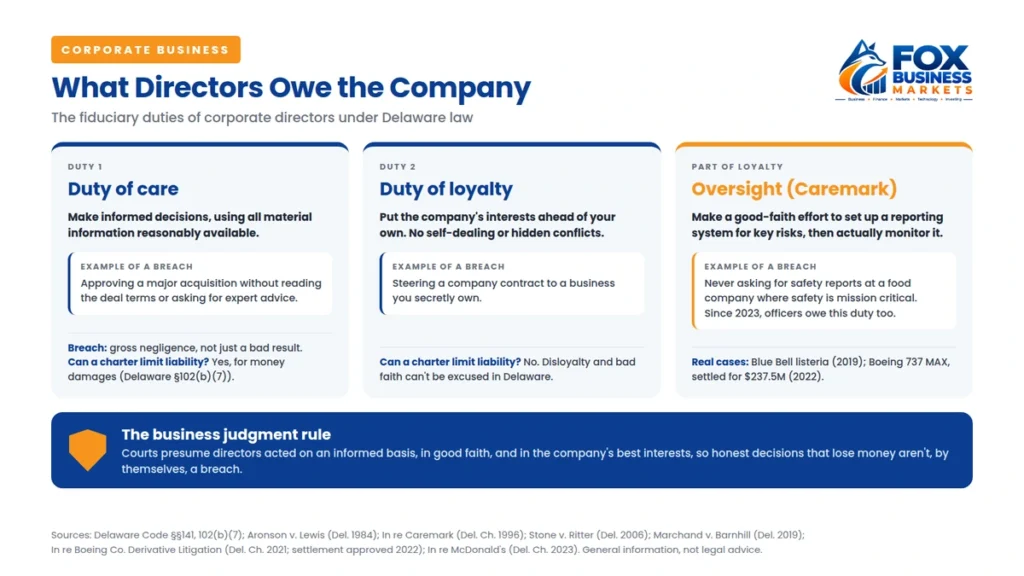
Directors are fiduciaries, meaning they must act in the company’s and shareholders’ best interests rather than their own. Their two core duties are:
- Duty of care: make informed decisions, using all material information reasonably available. In Delaware, liability requires gross negligence, not just a mistake.
- Duty of loyalty: put the company’s interests ahead of personal interests, and avoid self-dealing.
Courts don’t second-guess every bad decision. Under the business judgment rule, Delaware courts presume “that in making a business decision the directors of a corporation acted on an informed basis, in good faith and in the honest belief that the action taken was in the best interests of the company” (Aronson v. Lewis, 1984, as quoted in In re McDonald’s, Del. Ch. 2023). A decision that loses money is not, by itself, a breach of duty.
Delaware lets a company’s charter eliminate directors’ (and, since 2022, officers’) personal liability for money damages for breaching the duty of care. It can’t excuse disloyalty, bad faith, intentional misconduct, or knowing violations of law, and officers stay liable in suits brought on the company’s behalf (Delaware Code §102(b)(7)).
The Duty to Watch: Caremark Oversight
Since the 1996 Caremark case, directors in Delaware have also had a duty of oversight, which courts treat as part of the duty of loyalty. In Stone v. Ritter (2006), the Delaware Supreme Court said directors can be liable if they “utterly failed to implement any reporting or information system or controls,” or if, having one, they “consciously failed to monitor or oversee its operations.” Chancellor William Allen, who wrote Caremark, called it “possibly the most difficult theory in corporation law upon which a plaintiff might hope to win a judgment.”
That changed in practice in 2019. In Marchand v. Barnhill, after a deadly listeria outbreak at ice cream maker Blue Bell, the Delaware Supreme Court let shareholders sue the board, noting that for Blue Bell “food safety was essential and mission critical,” and that directors “must make a good faith effort to implement an oversight system and then monitor it” (Delaware Supreme Court).
Two years later, Boeing’s directors faced the same argument after the 737 MAX crashes. The court let the oversight claims proceed in 2021, and the case settled for $237.5 million, paid by directors’ insurers. Boeing also agreed to add a director with aviation, engineering, or product-safety experience, create an employee ombudsman program, and write the separation of the CEO and chair roles into its bylaws (NY State Comptroller, Lieff Cabraser). In January 2023, in a case involving McDonald’s, the Delaware Court of Chancery held for the first time that corporate officers also owe a duty of oversight, generally within their own areas of responsibility.
What Are the Core Principles of Good Corporate Governance?
Good governance is commonly summarized as four ideas, which overlap with themes in the G20/OECD Principles:
- Accountability: Management answers to the board, and the board answers to shareholders.
- Transparency: The company discloses accurate, timely information about its finances, risks, and leadership.
- Fairness: All shareholders, including minority shareholders, are treated equitably.
- Responsibility: The board oversees risk and legal compliance, not just profits.
What Rules Do US Public Companies Have to Follow?
Governance at public companies is shaped by federal law, SEC rules, and stock exchange listing standards.
The Sarbanes-Oxley Act (2002). Passed after the Enron collapse and other accounting scandals, it requires:
- The CEO and CFO to personally certify that, based on their knowledge, each annual and quarterly report contains no “untrue statement of a material fact” and that the financial statements “fairly present in all material respects” the company’s condition (Section 302).
- Management to assess the company’s internal controls over financial reporting each year, with an outside auditor’s attestation required only for larger accelerated filers; smaller companies and emerging growth companies are exempt from that part (Section 404).
- Audit committee members to be independent, a requirement carried out through SEC and exchange rules (Section 301).
- Criminal penalties of up to $5 million and 20 years in prison for willfully certifying a false report (Section 906) (Sarbanes-Oxley Act).
Stock exchange rules. Nasdaq requires that “a majority of the board of directors must be comprised of Independent Directors,” that independent directors meet regularly without management, and that the audit committee have at least three members (Nasdaq Rule 5605). NYSE rules similarly require a majority-independent board and fully independent audit, compensation, and nominating committees. “Controlled companies,” where one holder has most of the voting power, are exempt from some of these requirements.
Say-on-pay. Since the Dodd-Frank Act, shareholders of public companies vote on executive pay at least once every three years, and at least every six years on how often to hold that vote. The vote is advisory, not binding, and emerging growth companies are exempt (15 U.S.C. §78n-1).
What Do Boards Look Like Today?
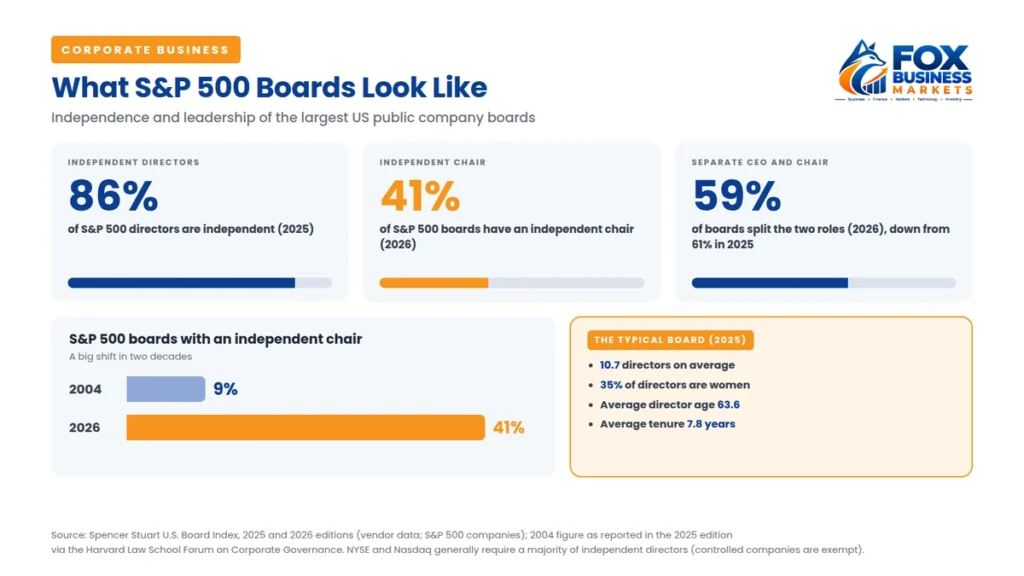
In practice, most large company boards are dominated by independent directors. According to Spencer Stuart’s 2025 board research (vendor data), the average S&P 500 board has 10.7 members, 86% of directors are independent, and 35% are women (Spencer Stuart). Its 2026 edition found that 41% of S&P 500 boards have an independent chair, and 59% separate the chair and CEO roles (Spencer Stuart).
Real Examples of Corporate Governance Failures
Enron (2001). The Senate report found the board allowed the company to engage in “high risk accounting,” approved excessive executive pay, and had independence compromised by financial ties to the company. CEO Jeffrey Skilling was convicted in 2006 of conspiracy, securities fraud, insider trading, and lying to auditors, and later resentenced to 168 months in prison (US Department of Justice).
Wells Fargo (2016 to 2025). Employees opened millions of accounts customers never asked for to hit sales targets. In 2016, regulators fined the bank $185 million. A later review found about 3.5 million potentially unauthorized accounts (Wells Fargo, SEC filing). In 2018, the Federal Reserve took the rare step of capping the bank’s growth “until it sufficiently improves its governance and controls,” and the bank agreed to replace four board members (Federal Reserve). In February 2020, the bank paid $3 billion to resolve criminal and civil investigations, including a deferred prosecution agreement. The Fed didn’t lift the asset cap until June 2025, and the rest of its 2018 order remains in place.
The lesson from both: governance failures usually aren’t one bad decision. They’re years of warning signs the board didn’t act on.
What Is Changing in 2025 and 2026?
The rules are shifting quickly:
- Shareholder proposals are under pressure. In 2025, environmental proposals filed at Russell 3000 companies fell 26% and social proposals fell 23%, according to The Conference Board (vendor data) (Harvard Law School Forum). In September 2026, the SEC went further and proposed rescinding Rule 14a-8, the rule that requires companies to include qualifying shareholder proposals in their proxy statements. It’s a proposal, not yet a final rule (SEC).
- Delaware changed its law. In March 2025, Delaware passed SB 21, adding safe harbors for deals involving conflicted directors, officers, and controlling stockholders, and narrowing shareholders’ rights to inspect company records. In February 2026, the Delaware Supreme Court upheld the new safe harbors against a constitutional challenge; it didn’t rule on the records changes (Delaware Supreme Court).
- Some companies are leaving Delaware. Tesla moved to Texas in 2024, Dropbox to Nevada in 2025, and Coinbase to Texas in December 2025, part of a trend nicknamed “DExit.”
Corporate Governance for Small and Private Businesses
Governance isn’t only for public companies. A small business with partners, investors, or family members involved faces the same basic problem: who decides, and who checks the decision-maker?
Practical steps for a small company:
- Write it down. An operating agreement or bylaws should say who can make which decisions, how disputes are resolved, and what happens if an owner leaves or dies. Our guide on LLC vs corporation explains the difference.
- Separate business and personal money. Mixing funds is one of the factors courts weigh when deciding whether to disregard an owner’s limited liability.
- Consider an advisory board. SCORE notes that an advisory board “exists primarily to provide strategic direction,” and that its members “have no fiduciary or legal liability,” which generally makes it a low-risk way to get outside perspective (SCORE).
- Hold regular reviews. Even a quarterly meeting with partners to review finances and major decisions builds accountability.
A clear business strategy also makes governance easier, because everyone knows what the company is trying to achieve.
Common Governance Mistakes
The most common mistake is treating governance as a box-checking exercise, as Enron’s board did. Others include a board too close to the CEO to challenge him or her, no system for reporting critical risks to the board, executive pay tied to short-term targets that reward bad behavior, and, in small businesses, no written agreement until partners are already fighting.
This article is for general information, not legal advice. Consult a corporate attorney for advice on your company.
Frequently Asked Questions
What is corporate governance in simple terms?
It’s the system of rules and relationships that determines how a company is directed and controlled. It sets out how power is shared among shareholders, the board of directors, and management, and how each is held accountable for their decisions.
Why is corporate governance important?
Good governance protects shareholders, employees, and customers by making sure management is overseen, risks are reported, and financial information is accurate. Failures like Enron and Wells Fargo show that weak oversight can destroy value and lead to fines, lawsuits, and prison sentences.
What are the four principles of corporate governance?
The most commonly cited principles are accountability, transparency, fairness, and responsibility. This four-part summary isn’t an official list, but the ideas overlap with major frameworks such as the G20/OECD Principles.
What is the role of the board of directors?
The board oversees management on behalf of shareholders. It hires and evaluates the CEO, approves strategy and major transactions, sets executive pay, and monitors risk and compliance. Under Delaware law, the company’s business is managed “by or under the direction of” the board.
What fiduciary duties do directors have?
Directors owe a duty of care, which means making informed decisions, and a duty of loyalty, which means putting the company ahead of personal interests. In Delaware, they also have a duty of oversight, treated as part of the duty of loyalty, to make a good-faith effort to monitor major risks.
Does a small business need corporate governance?
Yes, in a simpler form. A small business benefits from a written operating agreement or bylaws, separate business finances, regular reviews of performance, and possibly an advisory board. These steps prevent disputes and protect the owners’ liability protection.
The Bottom Line
Enron had every governance structure on paper and still collapsed, because its board saw the warning signs and looked away. Good governance isn’t about having the right committees. It’s about people with the independence, information, and courage to ask hard questions, and the systems that make sure those questions get asked before it’s too late.