Marisol runs a small kitchenware brand out of a rented warehouse unit. Last spring she opened an invoice from her customs broker and stopped at one line: thousands of dollars in “duties,” paid to U.S. Customs and Border Protection. She had always heard that tariffs were a tax on other countries. Yet the money had come out of her own business checking account, days after her container cleared customs. (Marisol is a composite example, not a real company.)
Her surprise is common. What are tariffs? A tariff is a tax on imported goods. The U.S. importer pays it to Customs and Border Protection (CBP) when the goods enter the country. The importer then absorbs that cost, passes it on, or, less often, gets a foreign supplier to cut its price.
This guide answers what are tariffs in practice: how they work, who really pays them, which laws allow them, and what the Supreme Court’s February 2026 ruling changed.
What Are Tariffs, in Plain English?
What are tariffs, stripped of politics? Customs duties charged on goods crossing the border. In the United States, the “importer,” which federal regulations define as the person “primarily liable for the payment of any duties on the merchandise” (19 CFR 101.1), owes the tariff. That is usually the importer of record.
Tariffs raise revenue, shield domestic producers from cheaper imports, and serve as bargaining chips in trade talks.
What’s the difference between a tariff, a duty, and a customs fee?
In everyday U.S. usage, “tariff” and “duty” mean the same thing. A customs fee is different: it pays for processing, not protection. The two most common are:
- Merchandise Processing Fee (MPF):3464% of the goods’ value, with a minimum of $34.58 and a maximum of $670.86 per formal entry for fiscal year 2027, which began October 1, 2026 (CBP Dec. 26-14).
- Harbor Maintenance Fee (HMF):125% of the cargo’s value, charged on commercial cargo unloaded from vessels at covered ports (19 CFR 24.24).
How Do Tariffs Work When Goods Arrive in the US?
Tariffs are paid during customs entry. The importer, or a licensed customs broker, classifies the goods, declares their value, and deposits estimated duties with CBP. Federal rules require the entry summary and estimated duties within 10 working days after entry (19 CFR 142.12), although many importers settle through CBP’s monthly statement program instead.
Here is the process for a typical commercial shipment:
- The goods arrive. Entry generally must be filed within 15 calendar days of landing (19 CFR 142.2).
- The importer files an entry, usually backed by a customs bond. CBP’s minimum continuous bond is $50,000 (CBP, February 2024).
- The goods are classified under a 10-digit Harmonized Tariff Schedule (HTS) code.
- The customs value is declared, usually the price paid plus certain additions such as packing and royalties, but excluding international freight and insurance (19 U.S.C. §1401a).
- The importer pays CBP every duty and fee that applies, then decides how much to pass along.
What are HTS codes and why do they matter?
An HTS code is the product’s legal address in the U.S. tariff system, and it decides your rate. The U.S. International Trade Commission (USITC) maintains the schedule; CBP enforces it. The first six digits follow the international Harmonized System.
A real example: cotton T-shirts fall under HTS 6109.10.00, which carries a general duty of 16.5%, zero for countries with qualifying free trade agreements, and 90% for the handful of countries in “Column 2” (USITC HTS, checked October 2026). One wrong digit can cost thousands. If unsure, request a binding ruling; phone advice from CBP is not binding (19 CFR 177.1).
What Are the Main Types of Tariffs?
Most U.S. tariffs are a percentage of value, but other structures exist, and some products face several at once. Each example below is real.
Type | How it’s charged | Real example |
| Ad valorem | Percentage of customs value | Cotton T-shirts (HTS 6109.10.00): 16.5% |
| Specific | Fixed amount per unit | Certain milk powder (HTS 0402.10.50): 86.5¢ per kg |
| Compound | Fixed amount plus a percentage | Certain sweetened milk powder (HTS 0402.29.50): $1.104/kg + 14.9% |
| Tariff-rate quota | Low rate up to a quantity limit, higher rate after | Milk powder: 3.3¢/kg inside the quota vs. 86.5¢/kg outside |
| Antidumping / countervailing | Extra duty when Commerce finds unfair pricing or subsidies and the USITC finds injury | Chinese passenger and light truck tires: 78.33% for one producer in an August 2026 review |
| Special trade actions | Extra duty added on top under Section 232, 301, or 338 | Section 232: 50% on most steel and aluminum mill products; 15–25% on many products made from them |
Who Actually Pays Tariffs?
Legally, the U.S. importer pays. Economically, research on both the 2018–2019 and 2025 tariffs finds nearly all of the cost stayed in the United States, split between importers and their customers:
- A Federal Reserve Bank of New York analysis (February 2026) found that “nearly 90 percent of the tariffs’ economic burden fell on U.S. firms and consumers” in 2025.
- A Kiel Institute study (January 2026) of more than 25 million shipment records estimated that foreign exporters absorbed about 4% of the cost, with U.S. buyers bearing about 96%.
- Studies of the 2018 tariffs, including Amiti, Redding and Weinstein (Journal of Economic Perspectives, 2019), found “the full incidence of the tariffs has fallen on domestic consumers and importers.”
What does the research say about pass-through to prices?
“Pass-through” means how much of a tariff shows up in the price a customer pays. At the border it has been close to complete. On store shelves it is slower, because retailers absorb part of the cost. A Harvard-led study (NBER, November 2025) estimated retail pass-through of about 20% in the early months, with imported goods rising roughly twice as much as domestic ones.
Small businesses report the same squeeze. In a Federal Reserve survey fielded in late 2025, about 80% of goods and retail firms facing higher import costs passed at least some to customers, while about 60% absorbed some themselves (New York Fed, July 2026).
Which Laws Let a President Impose Tariffs?
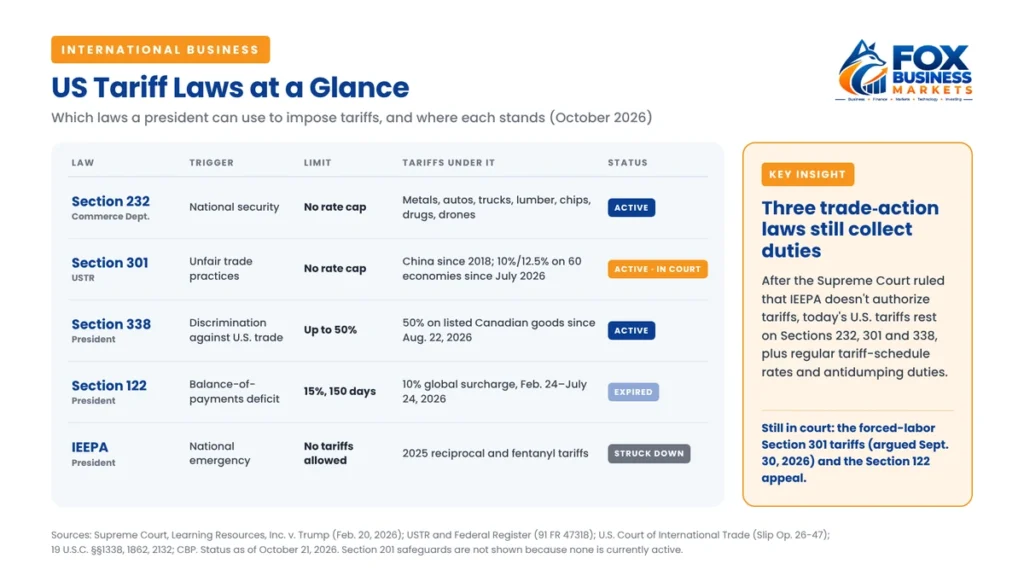
The Constitution gives Congress the power to set tariffs, but Congress has delegated limited authority to the president through specific trade laws, each with its own trigger and limits.
Law | What triggers it | Limits | Status (Oct. 2026) |
| Section 232 (Trade Expansion Act of 1962) | Commerce finds imports threaten national security | No rate cap; Commerce investigation required | Active: steel, aluminum, copper, autos and parts, trucks, lumber, some semiconductors, patented drugs, drones |
| Section 301 (Trade Act of 1974) | USTR finds unfair foreign trade practices | No rate cap; investigation required | Active: China tariffs since 2018; “forced labor” tariffs on 60 economies since July 24, 2026, mostly 10% or 12.5% on top of regular duties (argued in court Sept. 30, 2026; no ruling yet) |
| Section 201 (Trade Act of 1974) | USITC finds import surges seriously injure an industry | Temporary safeguard | None active; used for solar cells and washers in 2018 |
| Section 122 (Trade Act of 1974) | Large balance-of-payments deficits | Up to 15% for 150 days unless Congress extends | 10% global surcharge ran Feb. 24–July 24, 2026; trade court ruled it unlawful May 7, 2026 (on appeal) |
| Section 338 (Tariff Act of 1930) | Foreign discrimination against U.S. commerce | Up to 50% | 50% on listed Canadian goods (such as dairy and alcohol) since Aug. 22, 2026; no USMCA exemption |
| IEEPA (1977) | National emergency | Supreme Court: cannot be used for tariffs | Tariffs struck down Feb. 20, 2026 |
What Did the Supreme Court Decide About IEEPA Tariffs?
On February 20, 2026, the Supreme Court ruled 6–3 in Learning Resources, Inc. v. Trump, decided together with Trump v. V.O.S. Selections, that the International Emergency Economic Powers Act (IEEPA) does not authorize the president to impose tariffs. Chief Justice John Roberts wrote the opinion. The decision wiped out the 2025 “reciprocal” tariffs and the fentanyl-related tariffs on Canada, Mexico and China.
CBP stopped collecting IEEPA duties on goods entered on or after February 24, 2026 (CBP), the same day a temporary 10% global surcharge under Section 122 began. On May 7, 2026, the Court of International Trade ruled that surcharge unlawful too, but only for three plaintiffs, and an appeals court has paused that ruling. The surcharge expired July 24, 2026, when new Section 301 tariffs replaced it. There is no refund program for Section 122 duties, so importers who paid them should watch their protest deadlines.
Can importers get tariff refunds?
Yes. CBP pays refunds to the importer of record, or to a party it designates on CBP Form 4811, through a system called CAPE that opened in the ACE portal on April 20, 2026 (CBP). A Court of International Trade opinion (October 8, 2026) put IEEPA collections at roughly $166 billion from roughly 330,000 importers of record (a March 2026 estimate), with about $126 billion refunded, including interest, by October 2. The same ruling certified a class of importers who had not filed their own lawsuits; the government may still challenge it. Small importers should make sure their bank (ACH) details are set up in ACE, because refunds can’t be paid without them.
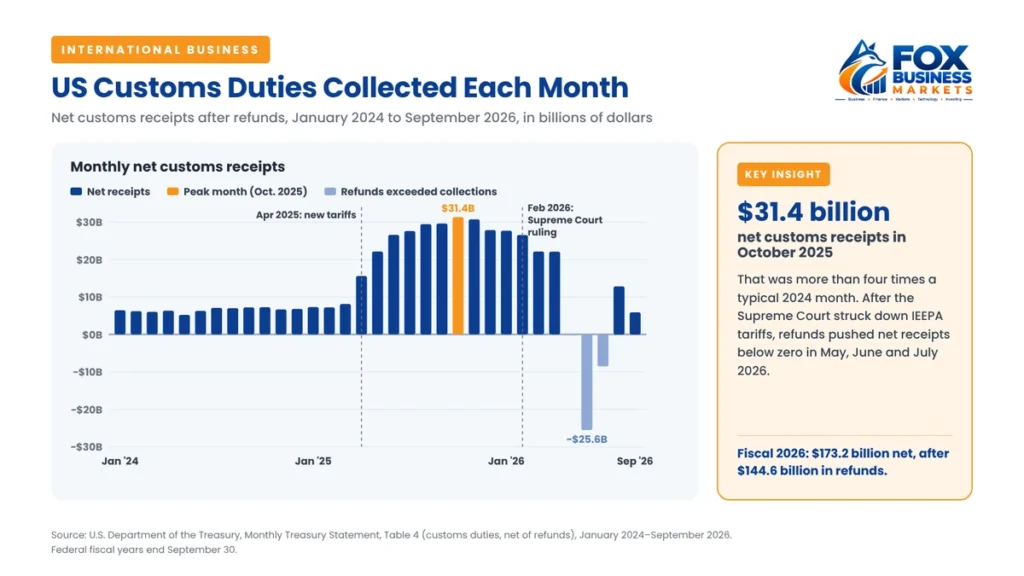
Consumers who simply paid higher prices cannot claim refunds from the government; the money goes to the importer of record. If you paid a supplier a separate tariff surcharge, check your contract. Importers with older, “finally liquidated” entries may need a court order, and deadlines are disputed, so talk to a trade attorney.
What tariffs are still in effect?
Section 232, Section 301 (China and forced-labor) and Section 338 tariffs remain, along with regular tariff-schedule rates and antidumping duties. The duty-free exemption for packages under $800, called “de minimis,” also remains suspended under a separate order and a June 2026 CBP rule, which the trade court upheld in August 2026. A statutory repeal takes effect July 1, 2027.
How Do Tariffs Affect Small Businesses?
Tariffs hit small businesses hard because small firms make up most importers but have the least negotiating power. About 97% of identified U.S. importers in 2024 were small and medium-sized businesses, though they accounted for only about 31% of import value (Census Bureau, December 2025).
Here is an illustrative calculation. Say you import $40,000 of cotton T-shirts from Vietnam by ocean, 4,000 shirts at $10 each:
Charge | Rate | Cost |
| Regular duty (HTS 6109.10.00) | 16.5% | $6,600.00 |
| Section 301 forced-labor tariff (Vietnam) | 12.5% | $5,000.00 |
| Merchandise Processing Fee | 0.3464% | $138.56 |
| Harbor Maintenance Fee | 0.125% | $50.00 |
| Total | about 29.5% | $11,788.56 |
That adds about $2.95 to a $10 shirt before freight or brokerage. Confirm real rates with your broker before setting prices.
A few legal options are worth asking your broker about:
- Duty drawback: if you export or destroy imported goods, you can often recover 99% of most duties paid (antidumping and countervailing duties excluded), with claims due within five years of import (19 U.S.C. §1313).
- Foreign-trade zones and bonded warehouses: you can delay duties until goods leave, and avoid them on goods you re-export. Most 2025–2026 tariff actions require goods in a zone to take “privileged foreign status,” so a zone delays these duties but usually doesn’t lower them.
- First sale valuation: in some multi-tier supply chains, duty can be based on the factory’s lower price to a middleman.
H
Here’s an honest opinion: if your margins are thin, quietly eating a 29% cost increase is not a strategy. Raise prices in steps and test which products can carry it. And know when the tools won’t work: drawback only helps if goods leave the country, foreign-trade zones rarely pay off for a business importing a few containers a year, and simple repackaging in another country does not change the country of origin. Apparel and textiles follow their own, stricter origin rules. If you need cash to cover a duty bill, compare options in our guide to small business loans.
Tariff Myths You Should Stop Repeating
Any honest answer to what are tariffs has to clear up three claims that don’t survive contact with the data.
“Foreign countries pay the tariffs.” The U.S. importer pays CBP, and research puts the U.S. share of the 2025 burden at roughly 90% to 96%. Foreign suppliers mostly kept prices and shipped less.
“Tariffs can replace the income tax.” In fiscal year 2025, customs duties brought in $194.9 billion in net receipts, about 7.3% of individual income tax receipts of $2.66 trillion. In fiscal 2026, after IEEPA refunds, net customs receipts were $173.2 billion, about 6.1% of individual income taxes (Treasury Monthly Treasury Statement). Even at their highest, tariffs were a small slice of federal revenue.
“Smoot-Hawley caused the Great Depression.” Economists generally reject this. As the publisher’s summary of Dartmouth economist Douglas Irwin’s Peddling Protectionism (2011) puts it, Smoot-Hawley “was hardly responsible for the Great Depression” but “contributed to a decline in world trade.” It made a bad situation worse; it did not start it.
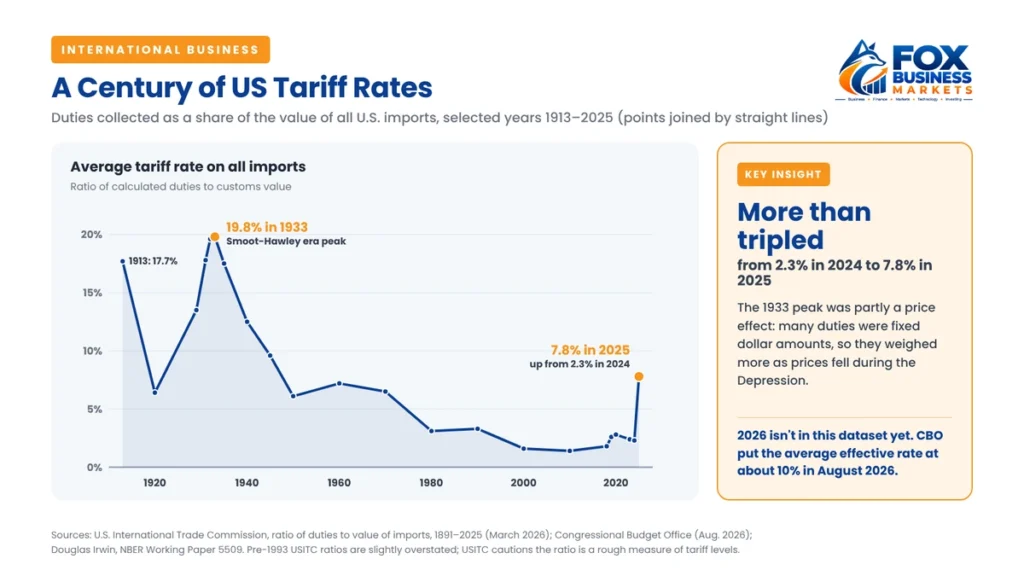
The long view is useful here. U.S. International Trade Commission data show duties collected peaked at 19.8% of the value of all imports in 1933, partly because many duties were fixed dollar amounts that grew heavier as prices fell. The ratio drifted down to 2.3% by 2024, then more than tripled to 7.8% in 2025. Annual 2026 data aren’t out yet, but the Congressional Budget Office put the average effective tariff rate at about 10% in August 2026.
Frequently Asked Questions
What are tariffs in simple terms?
Tariffs are taxes on imported goods. When a product enters the United States, the U.S. company importing it pays a percentage of its value, or a fixed amount per unit, to Customs and Border Protection. The company can then absorb that cost, raise prices for customers, or try to negotiate a lower price from the foreign supplier.
Who pays tariffs, the US or the foreign country?
The U.S. importer pays tariffs directly to CBP. Economic studies find most of the cost stays in the United States: the New York Fed estimated that nearly 90% of the 2025 tariff burden fell on U.S. firms and consumers. Foreign suppliers bear part of the cost only when they lower prices.
Are tariffs paid when goods are ordered or when they arrive?
Tariffs are paid at import, not at order. The importer or its broker files an entry when goods arrive and deposits estimated duties within 10 working days after entry, unless it uses CBP’s monthly statement. The rate is generally the one in effect at entry, though new tariff actions sometimes exempt goods already in transit.
Can I get a refund for IEEPA tariffs?
Refunds go to the importer of record, or a party it designates on CBP Form 4811. CBP pays IEEPA refunds, with interest, through its CAPE system in the ACE portal, which opened April 20, 2026. Buyers who simply paid higher prices cannot claim from the government. Check eligibility and deadlines with a broker or trade attorney.
Do tariffs apply to small online orders?
Yes, in most cases. The $800 de minimis exemption, which once let low-value packages enter duty-free, has been suspended for all countries since August 29, 2025. A CBP rule made the suspension indefinite in June 2026, and federal law repeals the exemption permanently on July 1, 2027.
How can I find the tariff rate for my product?
Start with the Harmonized Tariff Schedule search on the USITC website to find your product’s 10-digit code and base rate. Then check for extra duties under Sections 232, 301, or 338, and for antidumping orders. For certainty, request a binding ruling from CBP or ask a licensed customs broker.
The Bottom Line
So, what are tariffs? They are taxes on imports, paid by U.S. businesses like Marisol’s and, in large part, passed on to their customers. The law behind them changed dramatically in 2026: the Supreme Court ended IEEPA tariffs, a temporary global surcharge was ruled unlawful by a lower court before it expired, and new Section 301 and 338 tariffs took over.
Marisol’s lesson applies to every importer: know your HTS code, read the duty line, and price tariffs in before the container ships. Planning a new product line? Our guides on how to start a small business and how to start an ecommerce business show where landed costs fit into the plan, and our ecommerce statistics put import-heavy retail in context.