Karim had done everything he thought mattered. He found a T-shirt factory in Vietnam, approved samples, wired the deposit, and booked a container for his small wholesale business in Michigan. Then the shipment sat at the port. A security filing that should have gone in a day before the boxes were loaded overseas had never been sent, because Karim assumed the factory handled it. It didn’t. (Karim is a composite example, not a real business.)
His mistake is the most common one new importers make: treating customs as paperwork that happens after the goods ship. If you want to know how to import products into the US without surprises, start here. You’ll usually need an importer number, the correct tariff code, a customs bond, and a licensed customs broker. Most of the compliance work has to be finished before your goods leave the factory.
Below: each step, the real costs, the other agencies involved, and what changed in 2026.
Do You Need a License to Import Products into the US?
Usually not. According to USA.gov (February 2026), “In most cases, you will not need a license to import goods into the U.S.” But some products need a permit, registration, or certificate from another federal agency, such as food, cosmetics, children’s products, electronics that emit radio signals, alcohol, and firearms.
What you do need is an identity with U.S. Customs and Border Protection (CBP). Every importer files CBP Form 5106 with its first formal entry, using an IRS employer identification number (EIN) or, if it has none, a Social Security number (19 CFR 24.5).
Get the details right. Starting September 18, 2026, CBP began immediately voiding importer numbers with inaccurate Form 5106 information. The address must be your actual business location (a home address is fine if that’s where you operate), not a P.O. box, registered agent, virtual office, freight forwarder, or broker, and the email and phone must be yours (CBP General Notice, August 2026).
What is an importer of record?
The importer of record is the business legally responsible for an import: filing the entry, paying duties, and following every rule that applies. Federal law requires the importer of record to use “reasonable care” when declaring classification and value (19 U.S.C. §1484). That responsibility stays with you even when a broker does the filing.
How to Import Products: A Step-by-Step Process
Here is how to import products from start to finish. Steps 1 through 6 happen before your goods ship.
- Confirm the product is allowed. Check whether another agency regulates it (see the table below) and whether it is restricted or banned.
- Find the HTS code and duty rate. Look up the 10-digit Harmonized Tariff Schedule (HTS) code on the U.S. International Trade Commission website and note every extra tariff that applies. Our guide to what tariffs are explains how they stack.
- Vet your supplier. Order samples, check the supplier against the government’s screening lists, and confirm none of its materials come from China’s Xinjiang region.
- Agree on shipping terms (Incoterms). Decide who pays for freight, insurance, and risk at each stage.
- Set up your broker, importer number, and bond. Sign a power of attorney (CBP Form 5291) with a licensed broker, file CBP Form 5106, and set up your customs bond. Open an ACE portal account too, so CBP can pay you refunds.
- File the ISF for ocean shipments. Your broker files most of it at least 24 hours before loading.
- Clear customs and pay duties. Your broker usually files the entry before the goods arrive, and no later than 15 days after. Duties and the entry summary are due within 10 working days after entry (19 CFR 142.12).
- Keep records. Store entry records, invoices, and correspondence for five years.
Where do most US imports come from?
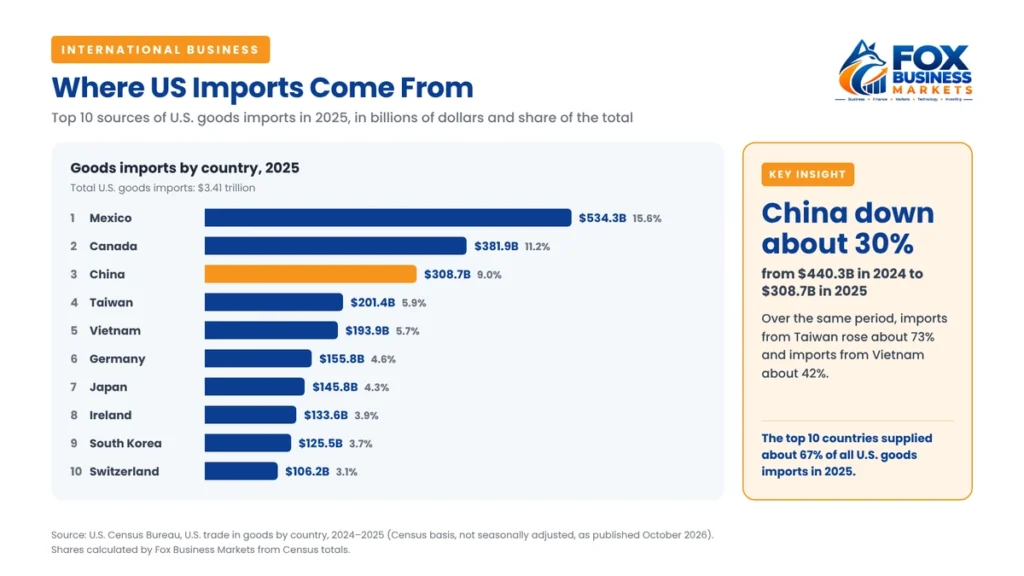
The U.S. imported $3.41 trillion in goods in 2025, according to the Census Bureau. Mexico was the largest source at $534.3 billion (15.6%), followed by Canada ($381.9 billion) and China ($308.7 billion). The top 10 countries supplied about 67% of the total. The bigger story for sourcing is the shift: imports from China fell about 30% from $440.3 billion in 2024, while imports from Taiwan rose about 73% and imports from Vietnam about 42%. Our US trade statistics page tracks these shifts.
What are Incoterms, and which one should a beginner choose?
Incoterms are 11 standard trade terms published by the International Chamber of Commerce that define who pays for and bears risk on each leg of a shipment. The U.S. International Trade Administration recommends that contracts reference the Incoterms 2020 rules.
The four you’ll see most are EXW (Ex Works), FOB (Free on Board), CIF (Cost, Insurance and Freight), and DDP (Delivered Duty Paid). Many first-time importers buy FOB: the supplier gets the goods onto the ship at its port, and you control freight and customs from there. But for container freight, the ICC itself recommends FCA (Free Carrier), because containers are handed over at the terminal, often days before loading. Here’s an honest opinion: pick FCA or FOB so you control the shipment, and ask your forwarder which fits. EXW leaves you handling export paperwork in a foreign country. DDP sounds easy, but it makes the seller your importer of record, and a June 2026 executive order (EO 14411) directs CBP to tighten requirements for foreign importers of record; some of those measures are still being rolled out.
What is an ISF filing and when is it due?
An Importer Security Filing, often called “10+2,” is a set of 10 data elements an importer must send CBP for ocean cargo, including the seller, buyer, manufacturer, country of origin, and HTS code. Most elements are due “no later than 24 hours before the cargo is laden aboard the vessel at the foreign port”; the container stuffing location and consolidator can follow up to 24 hours before U.S. arrival (19 CFR 149.2). Violations can trigger $5,000 in liquidated damages each (19 CFR 113.62), plus inspections and delays. Air shipments don’t need an ISF, though air carriers file their own advance cargo data.
Do You Need a Customs Broker?
You aren’t legally required to hire one. An importer can file its own entries through CBP’s Automated Broker Interface, but that requires approved software and a formal application (19 CFR 143). For almost every small business learning how to import products, a licensed customs broker is worth the fee.
Brokers classify goods, file entries and the ISF, handle other agencies, and pay duties for you. One national broker’s published price was $149.95 per ocean entry, plus extra for added product lines and agency filings (vendor data, April 2026). Get two or three quotes, and ask what’s included.
Self-filing only makes sense for a frequent importer of one simple, unregulated product, and even then, use a broker for your first few shipments.
What Is a Customs Bond and How Much Does It Cost?
A customs bond is a surety company’s guarantee that you’ll pay duties, fees, and penalties owed to CBP. Formal entries generally require one, either a single-entry bond or a continuous bond covering a year of imports.
CBP’s minimum continuous bond is $50,000, or 10% of your estimated duties, taxes, and fees over 12 months if that’s higher (CBP, February 2024). New importers base it on what they expect to pay. A $50,000 bond typically costs about $400 to $600 a year in premiums (vendor data). If you plan more than a few shipments a year, a continuous bond is usually cheaper.
Watch this space. A June 2026 executive order directed CBP to raise minimum bond coverage, with a deadline of late November 2026. As of October 21, 2026, we found no CBP rule changing the $50,000 minimum. Separately, an October 2026 CBP proposal on low-value shipments would require a bond for informal entries too; comments are due December 7, 2026.
How Much Does It Cost to Import Products?
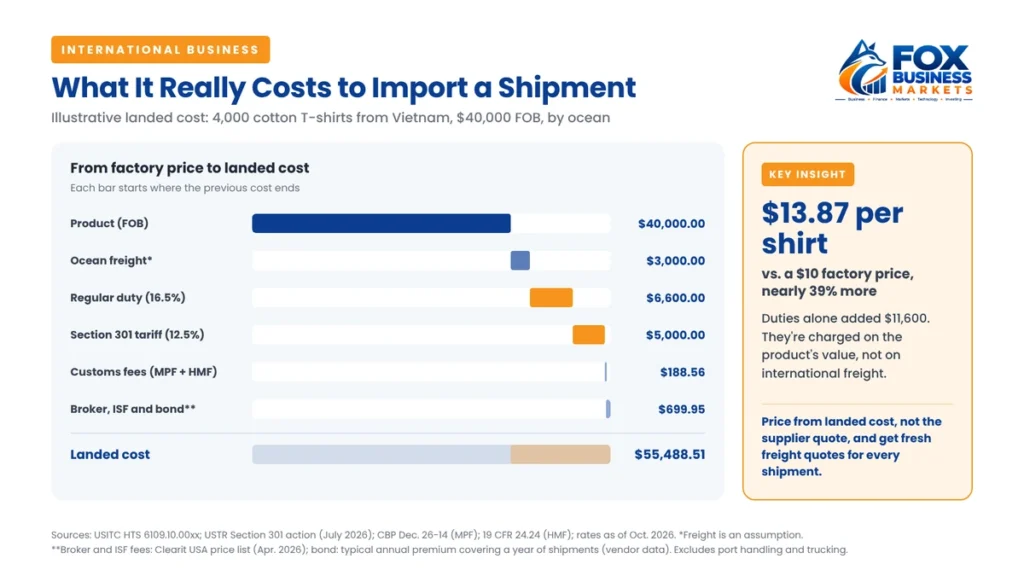
When you work out how to import products profitably, the number that matters is “landed cost,” the factory price plus freight, duties, fees, and brokerage. Beginners often price from the factory quote alone and lose their margin. Here is an illustrative example for $40,000 of cotton T-shirts from Vietnam, 4,000 shirts at $10 each, bought FOB:
Cost | Basis | Amount |
| Product (FOB) | Supplier invoice | $40,000.00 |
| Ocean freight | Assumed for a shared container; get real quotes | $3,000.00 |
| Regular duty (HTS 6109.10.00xx) | 16.5% of value | $6,600.00 |
| Section 301 forced-labor tariff (Vietnam, as of Oct. 2026) | 12.5% of value | $5,000.00 |
| Merchandise Processing Fee | 0.3464% of value | $138.56 |
| Harbor Maintenance Fee | 0.125% of value | $50.00 |
| Customs broker fee | One published ocean-entry price (vendor) | $149.95 |
| ISF filing | One published price (vendor) | $50.00 |
| Continuous bond | Typical annual premium, which covers a year of shipments (vendor) | $500.00 |
| Landed cost | $55,488.51 |
That works out to about $13.87 per shirt, nearly 39% above the factory price. Duties alone add $11,600. And this still leaves out port handling, trucking, any customs exam fees, and your markup. The last two digits of the HTS code depend on the shirt’s style and gender, and tariff rates change, so confirm both on your entry date. Duties are calculated on the product’s value, not on freight, which is why the freight line doesn’t change the tariff (19 U.S.C. §1401a).
For context on freight, the Drewry World Container Index put a 40-foot container from Shanghai to Los Angeles at $7,884 on October 15, 2026 (vendor data). Rates swing widely, so quote every shipment fresh. If you need working capital to cover duties and freight before you sell, our small business loans guide compares options.
Which Products Need Approval from Other Agencies?
Many imports must also satisfy a “partner government agency.” Missing these rules is one of the fastest ways to get a shipment held or refused.
Product type | Agency | Key requirement |
| Food and beverages | FDA | Foreign facility registration; Prior Notice before arrival (as little as 2 hours by road, 8 hours by water) |
| Cosmetics | FDA | Facility registration and product listing under MoCRA, with small-business exemptions |
| Medical devices | FDA | Establishment registration and device listing; some need premarket clearance |
| Children’s products (12 and under) | CPSC | Children’s Product Certificate based on third-party lab testing; electronic filing with entries since July 8, 2026 |
| Other consumer products | CPSC | General Certificate of Conformity where a safety rule applies; also electronic filing since July 8, 2026 |
| Wood, plants, and plant products | USDA APHIS | ISPM 15-marked wood packaging; Lacey Act declarations, electronic only since January 1, 2026 |
| Wireless and radio-frequency electronics | FCC | Equipment authorization before marketing or import |
| Engines, pesticides, and chemicals | EPA | Import declaration forms; certification for chemical substances |
| Alcohol | TTB (plus FDA and states) | Importer’s permit, label approval, FDA Prior Notice, and state licenses |
What Happens After Your Goods Clear Customs?
Clearing customs isn’t the end. CBP finalizes each entry through “liquidation,” and its system automatically liquidates entries 314 days after entry unless that is extended or suspended (CBP declaration, March 2026). By law, entries not liquidated within a year are deemed liquidated. Until then, CBP can still change the duty you owe. After liquidation, you have 180 days to file a protest if you disagree (19 U.S.C. §1514).
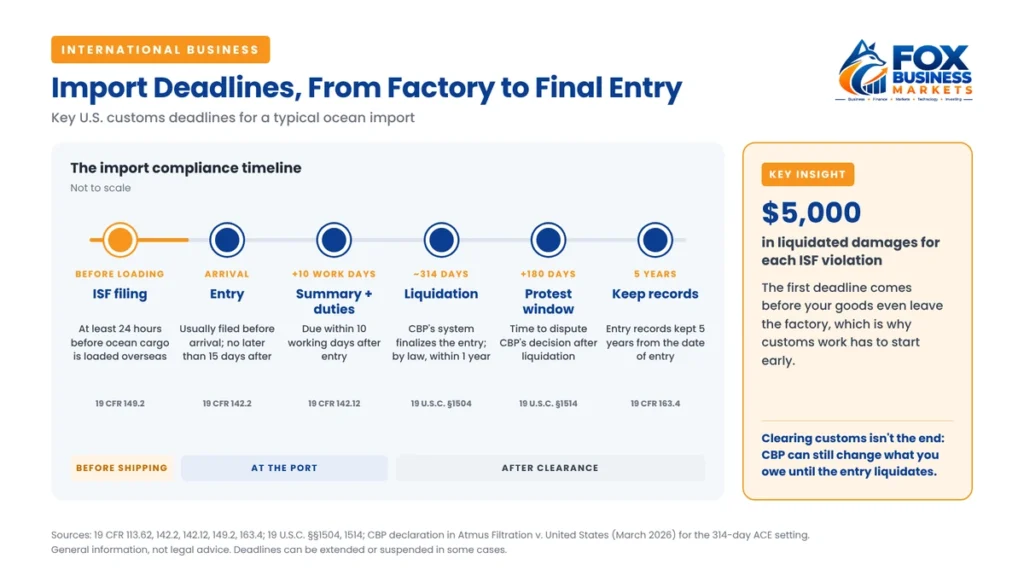
Keep records for five years from the date of entry (19 CFR 163.4). If CBP finds errors, penalties can reach two times the lost duties, taxes, and fees for negligence, four times for gross negligence, and up to the goods’ full value for fraud (19 U.S.C. §1592). Imported goods must also be marked with their country of origin, or face an extra 10% duty unless they are properly marked, exported, or destroyed under CBP supervision before liquidation (19 U.S.C. §1304).
Two other 2026 changes matter. CBP stopped issuing refunds by paper check on February 6, 2026, so open an ACE portal account and enroll for ACH refunds. And the forced labor rules got stricter: the Department of Homeland Security added 43 companies to the Uyghur Forced Labor Prevention Act Entity List on August 3, 2026, bringing it to 187. Goods tied to that list or to Xinjiang can be detained unless you meet a strict test, including proving with clear and convincing evidence that no forced labor was involved. Cotton apparel is a priority enforcement sector, so ask suppliers for cotton traceability documents.
Importing Mistakes You Should Avoid
Learning how to import products also means unlearning a few myths that cost new importers money.
“Small packages under $800 are duty-free.” Not anymore. The de minimis exemption has been suspended for all countries since August 29, 2025, a June 2026 CBP rule made that suspension indefinite, and federal law repeals it permanently on July 1, 2027. If you plan to import inventory in small parcels for an online store, budget for duties on every package. Our guide on how to start an ecommerce business covers the rest of that model.
“My supplier’s HS code is good enough.” Suppliers usually give a 6-digit international code. The U.S. requires a 10-digit HTS number, and the importer of record, not the supplier, is responsible for getting it right. For certainty, request a CBP binding ruling.
“The factory price is my cost.” As the table shows, duties, fees, and freight can add a third or more. Price from landed cost.
Frequently Asked Questions
Do I need a license to import products into the US?
In most cases, no. USA.gov says most goods don’t need an import license. You do need an importer number on CBP Form 5106, usually your EIN, and some products require permits or certifications from agencies such as the FDA, CPSC, USDA, FCC, TTB, or ATF before they can enter the country.
Can I import products without a customs broker?
Yes, legally. An importer can file its own entries through CBP’s Automated Broker Interface, but that requires approved software, a letter of intent to CBP, and real expertise. Most small businesses use a licensed customs broker, which typically charges a per-entry fee plus extras for additional product lines and agency filings.
How much does a customs bond cost?
CBP’s minimum continuous bond is $50,000, or 10% of a year’s duties, taxes, and fees if that is higher. Surety companies typically charge about $400 to $600 a year for a $50,000 bond, according to vendor data. Single-entry bonds cover one shipment and are priced on its value plus duties.
How long does it take to import products from China?
Ocean freight from China to the U.S. West Coast typically takes about two to four weeks port to port, and the East Coast takes longer, according to freight forwarder estimates. Air freight takes a few days. Add time for customs clearance, any agency review, and trucking from the port to your warehouse.
What documents do I need to import goods?
You typically need a commercial invoice, a packing list, and a bill of lading or air waybill. Your broker files the entry and entry summary (CBP Forms 3461 and 7501) against your bond. Add any agency certificates, such as a Children’s Product Certificate, and an origin certificate if you claim a free trade agreement.
Can I import products for my Amazon or online store?
Yes, but you, not the marketplace, are the importer of record and responsible for duties and compliance. Since the $800 de minimis exemption was suspended in 2025, small parcels owe duties too. Many sellers import in bulk through a broker, then ship to their own warehouse or a fulfillment center.
The Bottom Line
Karim’s shipment eventually cleared, but the delay cost him storage fees and a missed delivery to his biggest customer. When you learn how to import products, treat customs as the first step, not the last.
Before you order, confirm your product’s HTS code and agency rules, hire a broker, set up your bond and importer number, and calculate landed cost. If you are still building the business around your imports, start with our guide on how to start a small business, and compare sales channels in our review of the best ecommerce platforms. Selling overseas too? See how to start an export business.