
On January 10, 2000, AOL announced it would buy Time Warner for about $165 billion in stock. Executives called it a historic merger of the internet and media. The deal closed in January 2001. Two years later, the combined company reported a loss of $98.7 billion for 2002, a corporate record at the time, driven largely by write-downs of the goodwill it had paid for (CNN Money). In 2009, Time Warner spun AOL off as a separate company again (Time Warner, SEC filing).
AOL and Time Warner had smart people, good lawyers, and plenty of money. What went wrong is what goes wrong in many mergers and acquisitions: the buyer paid for a future that never arrived, and the two companies never really became one. This guide explains how M&A deals work, from the first conversation to integration, and how to avoid the most expensive mistakes, whether you’re buying a corner store or a competitor.
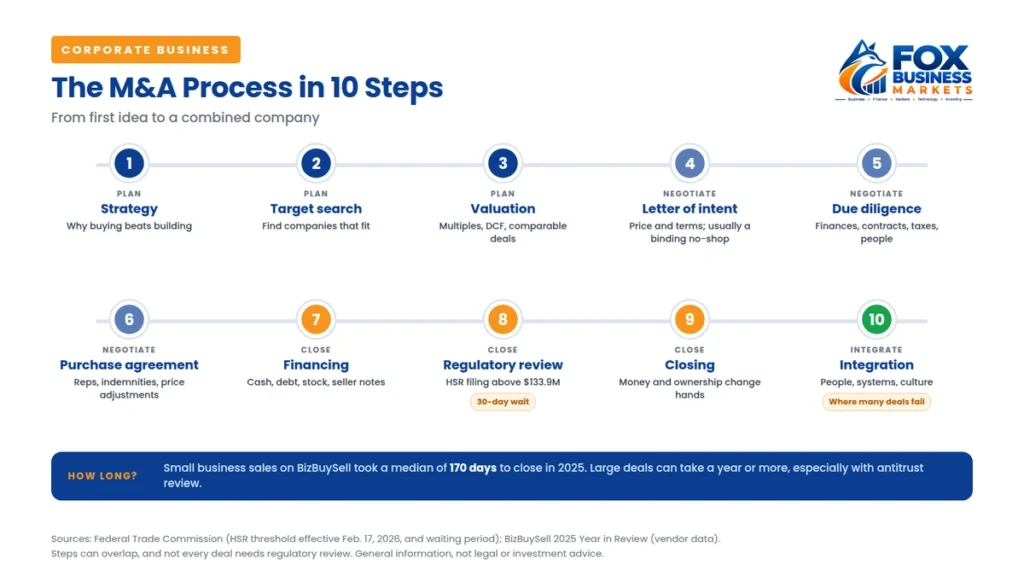
Quick answer: Mergers and acquisitions (M&A) are transactions in which companies combine or one company buys another. In a merger, two companies join into one; in an acquisition, one company takes control of another. A typical deal moves through strategy, valuation, a letter of intent, due diligence, a purchase agreement, financing, regulatory review, closing, and integration.
What’s the Difference Between a Merger and an Acquisition?
The two words in mergers and acquisitions describe different deals. In a merger, two companies combine into a single legal entity, usually with one surviving. In an acquisition, one company buys control of another, which may continue as a subsidiary. In practice, the line blurs: many “mergers” are really acquisitions in which one side is clearly in charge.
Deals are structured in three main ways:
Structure | What the buyer gets | Typical use |
| Merger | The whole target by operation of law, often merged into a buyer subsidiary so it survives as a subsidiary; holders who don’t sell are cashed out | Public and larger private deals |
| Stock purchase | The target’s shares; the company keeps all its assets and liabilities | Deals where contracts and licenses should stay in place (change-of-control clauses can still apply) |
| Asset purchase | Only the assets and liabilities the buyer chooses | Most small business sales |
Under Delaware law, a merger generally needs the board to adopt “a resolution approving an agreement of merger or consolidation and declaring its advisability,” then approval by “a majority of the outstanding stock of the corporation entitled to vote thereon,” with some exceptions, such as certain mergers after a tender offer (Delaware Code §251). Stockholders who object can sometimes, if they follow strict procedures and aren’t covered by the “market-out” exception, ask the Court of Chancery for an appraisal of the “fair value” of their shares (§262).
What Are the Main Types of Mergers?
Type | What it means | Example |
| Horizontal | Competitors in the same market combine | Exxon and Mobil (1999) |
| Vertical | Companies at different stages of the same supply chain combine | AT&T and Time Warner (2018) |
| Conglomerate | Unrelated businesses combine | A manufacturer buying a media company |
| Market extension | Similar products, different geographic markets | A regional bank buying a bank in another state |
| Product extension | Related products sold to the same customers | A software company adding a complementary tool |
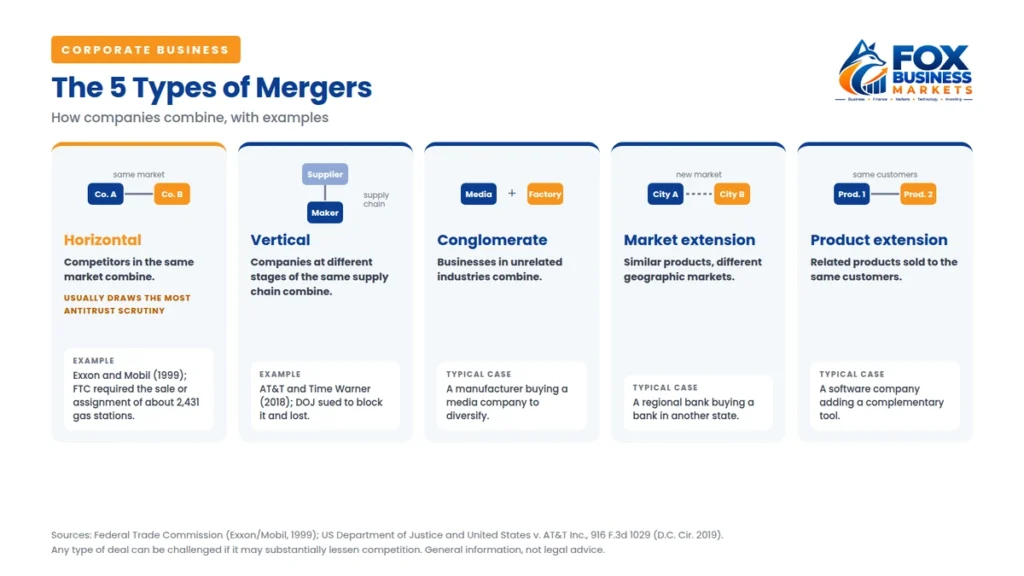
Horizontal deals draw the most antitrust scrutiny. When Exxon bought Mobil, the FTC noted that the two were “each other’s principal competitors in many of these markets,” and required the sale or assignment of about 2,431 gas stations (FTC). Vertical deals can be challenged too: the Justice Department sued to block AT&T’s purchase of Time Warner, but lost at trial in 2018 and on appeal in 2019 (US Department of Justice; United States v. AT&T Inc., 916 F.3d 1029 (D.C. Cir. 2019)).
Why Do Companies Merge, and Why Do So Many Deals Fail?
Companies pursue mergers and acquisitions to grow faster than they could on their own: to gain market share, enter new markets, buy technology or talent, or cut costs by combining operations (often called “synergies”).
The results are mixed. A widely cited 2011 Harvard Business Review article put the failure rate of acquisitions “between 70% and 90%” (Harvard Business School). Treat that as a rough estimate, not a precise statistic, since studies define failure differently. More useful is what separates the winners. McKinsey’s study of the world’s 2,000 largest companies found that those making many small, regular acquisitions, a “programmatic” approach, earned a median excess shareholder return of 2.1% over ten years, while other M&A approaches were “zero or negative” (McKinsey).
In other words, deals rarely fail because of one bad decision. They fail because buyers overpay, overestimate synergies, or underestimate how hard it is to combine two cultures, systems, and teams.
The Mergers and Acquisitions Process, Step by Step
- Define what you want to achieve and why buying beats building.
- Target search. Identify companies that fit, often with help from a broker or banker.
- Estimate what the business is worth (see below).
- Letter of intent (LOI). Sets out price, structure, and key terms. It’s usually nonbinding on price and terms, but its exclusivity (“no-shop”), confidentiality, and expense provisions are typically binding.
- Due diligence. The buyer examines the target’s finances, contracts, customers, employees, legal risks, and taxes.
- Purchase agreement. The binding contract, including representations and warranties, indemnities, price adjustments, and closing conditions. Diligence usually continues until closing.
- Cash, debt, stock, or a mix.
- Regulatory review. Larger deals may need antitrust clearance; regulated industries may need other approvals.
- Money and ownership change hands.
- Combining people, systems, and operations, where many deals succeed or fail.
How long do mergers and acquisitions take? For small businesses sold through BizBuySell, the median time to close was 170 days in 2025 (vendor data) (BizBuySell). Large public-company deals often take longer, especially with regulatory review.
How Are Deals Valued and Paid For?
Valuation. The most common methods are:
- Earnings multiples: price as a multiple of cash flow or EBITDA (earnings before interest, taxes, depreciation, and amortization).
- Discounted cash flow (DCF): the present value of expected future cash flows.
- Comparable deals: what similar businesses have sold for.
For small businesses, the multiples are modest. In 2025, businesses sold through BizBuySell went for an average of 2.61 times cash flow (BizBuySell’s “cash flow” is seller’s discretionary earnings, which includes the owner’s pay), with a median sale price of $350,000 (vendor data). In the third quarter of 2026, businesses selling for more than $1 million averaged 3.73 times cash flow, compared with 2.30 times for smaller deals (BizBuySell).
Payment. Deals can be paid in cash, the buyer’s stock, or a combination. Many small deals also use seller financing, in which the seller is paid part of the price over time, or an earnout, in which part of the price depends on the business hitting future targets. Earnouts are a common source of disputes, so define exactly how results will be measured.
Other key deal terms. Most purchase agreements adjust the price at closing for working capital and assume the business is delivered cash-free and debt-free. Part of the price is often held in escrow to cover breaches. In middle-market deals, representations and warranties insurance increasingly takes the place of large seller indemnities, and a “material adverse change” clause can let a buyer walk away if the business deteriorates before closing.
Taxes: asset sale vs. stock sale. Buyers usually prefer asset purchases, because they can choose which liabilities to take on (though some, such as certain tax and employment claims, can follow the assets) and generally get a tax basis equal to the price paid, often a “step-up” they can depreciate or amortize, including goodwill over 15 years. Sellers, especially C corporations, often prefer stock sales, because an asset sale by a C corporation can be taxed at both the corporate and shareholder levels. In an asset sale, the IRS treats the price as paid for each asset separately, and both buyer and seller must allocate it across seven asset classes on Form 8594, with goodwill last (IRS). If the target is an S corporation or a subsidiary in a consolidated group, a corporate buyer acquiring at least 80% and the seller can jointly elect under Section 338(h)(10) to treat a stock purchase as an asset purchase for tax; Section 336(e) offers a similar election for non-corporate buyers (IRS).
What Rules Apply to Mergers and Acquisitions?
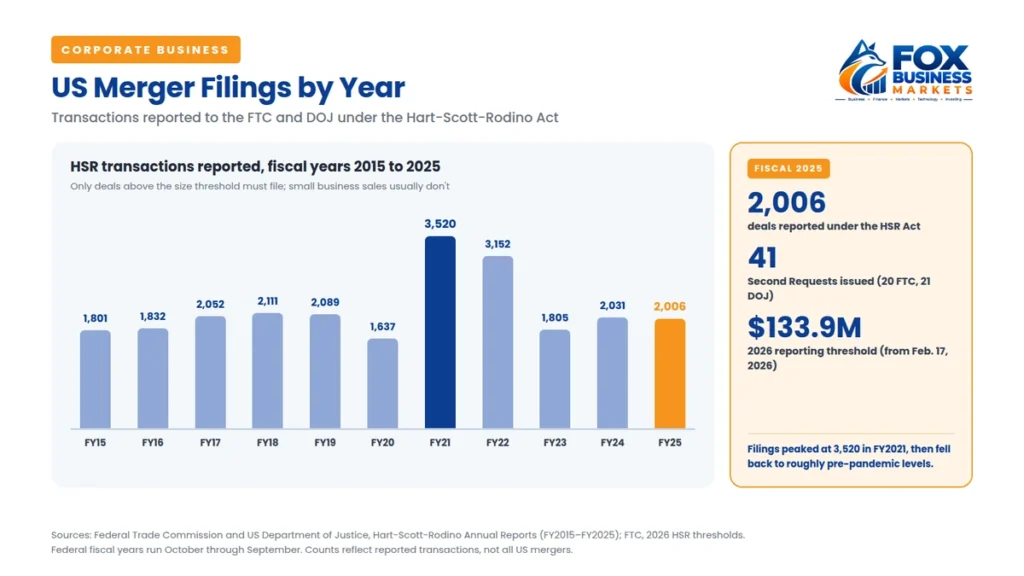
Antitrust review (HSR Act). Under the Hart-Scott-Rodino Act, deals above a size threshold, subject to exemptions and, for mid-sized deals, a size-of-person test, must be reported to the FTC and Justice Department before closing. For 2026, the threshold is $133.9 million, effective February 17, 2026, and filing fees range from $35,000 to $2.46 million depending on deal size (FTC). After filing, the parties “must wait 30 days (15 days in the case of a cash tender offer or a bankruptcy)” before closing. The agency can end the wait early, or issue a “Second Request” for more information, which extends it (FTC).
In fiscal 2025, companies reported 2,006 deals under the HSR Act, and the agencies issued 41 Second Requests (FTC and DOJ). A more detailed HSR filing form took effect in February 2025, but a federal district court vacated it on February 12, 2026. After the appeals court refused to stay that ruling in March 2026, the FTC began accepting the pre-2025 form again while the appeal continues (FTC). In February 2025, FTC Chairman Andrew Ferguson confirmed that the 2023 Merger Guidelines remain the agencies’ framework for evaluating deals (FTC).
Regulators do block deals. In December 2024, a federal court halted Kroger’s $24.6 billion purchase of Albertsons at the FTC’s request, and the companies abandoned the deal (FTC), and in August 2026, a court blocked Henkel’s $725 million purchase of Liquid Nails after a trial (FTC).
Securities rules. Public companies must disclose signed material deal agreements on Form 8-K, generally within four business days (SEC), and a tender offer must stay open for at least 20 business days, plus 10 business days after any price change (17 CFR 240.14e-1).
Mergers and Acquisitions for Small Businesses
Most mergers and acquisitions aren’t billion-dollar deals. BizBuySell counted 9,586 small business sales on its platform in 2025 (vendor data), with a median revenue of $703,000.
If you’re buying: SBA 7(a) loans, which go up to $5 million in most cases, can finance a change of ownership “provided the business benefits from the change” (SBA). The SBA’s lending rules set specific requirements for buyer equity and seller notes, and an updated version (SOP 50 10 8.1) took effect on October 1, 2026, so ask your lender for the current terms. Our guide to small business loans covers the basics.
If you’re selling: Clean up your financial records at least a year ahead, reduce how much the business depends on you personally, and decide early whether you’d accept seller financing or an earnout. Your business structure affects how the sale is taxed, so talk to a CPA before you sign a letter of intent.
Either way: Don’t skip due diligence because the deal is small. Surprises in a small deal, such as an unpaid tax bill, a lost key customer, or an unassignable lease, can wipe out years of profit.
How Active Is the M&A Market in 2026?
Very. Global deal value reached about $4.5 trillion in 2025, up nearly 50% and the second-highest year on record after 2021, according to LSEG data (vendor) (Finance Magnates). In the first nine months of 2026, global M&A totaled $3.9 trillion, up 28% from a year earlier, even though the number of deals fell 8% (Investment Executive, LSEG data). In short, fewer but much bigger deals. One example: Union Pacific’s proposed $85 billion (enterprise value) purchase of Norfolk Southern, announced in July 2025, is under review by the Surface Transportation Board, with closing now expected in mid-2027, later than the original early-2027 target (Union Pacific).
Common M&A Mistakes
The biggest mistake is overpaying for synergies that never materialize, the AOL–Time Warner problem. Others include rushing or skipping due diligence, ignoring culture until after closing, failing to plan integration before the deal closes, losing key employees and customers during the transition, and underestimating regulatory timelines.
Good corporate governance helps: boards that challenge the price and the assumptions behind it are the best defense against a bad deal.
This article is for general information, not legal, tax, or investment advice. Consult qualified advisors before buying or selling a business.
Frequently Asked Questions
What is the difference between a merger and an acquisition?
In a merger, two companies combine into one legal entity. In an acquisition, one company buys control of another, which may keep operating as a subsidiary. Many deals called mergers are really acquisitions, because one company clearly controls the combined business.
What are the 5 types of mergers?
The five commonly cited types are horizontal (competitors combine), vertical (companies in the same supply chain combine), conglomerate (unrelated businesses combine), market extension (same products, new markets), and product extension (related products, same customers).
How long does an M&A deal take?
It varies widely. Small business sales on BizBuySell took a median of 170 days to close in 2025. Large deals can take a year or more, especially if they need antitrust review, which starts with a 30-day waiting period after filing under the HSR Act.
Why do most mergers fail?
Common reasons include overpaying, overestimating cost savings or growth, poor integration, culture clashes, and losing key employees or customers. Estimates that 70% to 90% of deals fail are widely repeated, but studies define failure differently.
What is due diligence in M&A?
Due diligence is the buyer’s investigation of the target before signing the final agreement. It covers financial statements, taxes, contracts, customers, employees, legal disputes, and regulatory issues, so the buyer can confirm the price and spot risks.
Can I use an SBA loan to buy a business?
Yes. SBA 7(a) loans, which go up to $5 million in most cases, can be used for a change of ownership if the business benefits. Lenders follow SBA rules on the buyer’s equity contribution and any seller financing, so ask for current requirements.
The Bottom Line
Mergers and acquisitions can transform a business, but the price you pay is only the start. AOL–Time Warner had the money, the advisors, and the headlines. What it didn’t have was a realistic view of what the combined company would earn, or a plan to make two very different businesses work as one. Whether you’re buying a small competitor or selling your life’s work, those are the questions to answer before you sign.