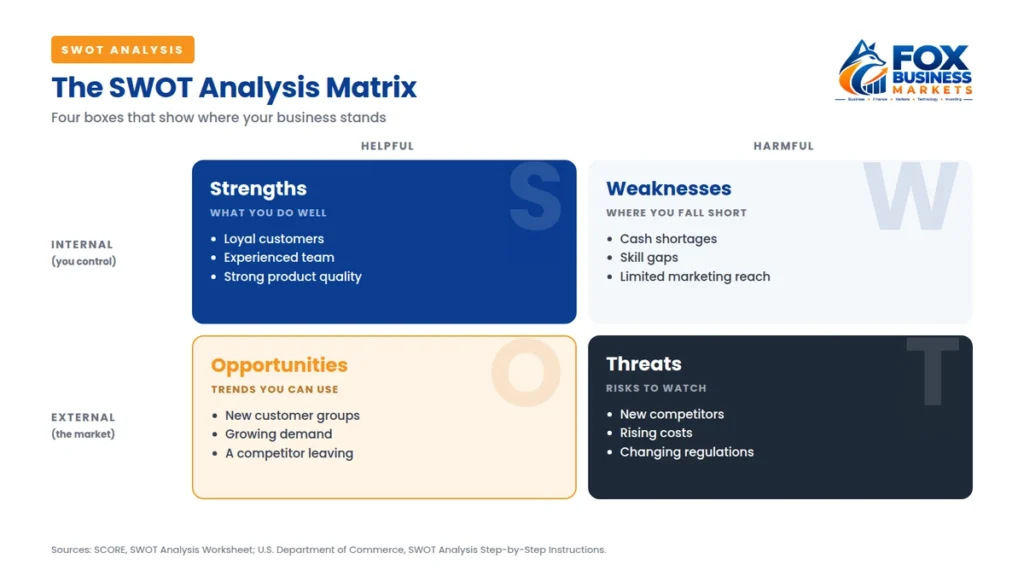
A SWOT analysis is a simple planning tool that looks at four things: your business’s Strengths, Weaknesses, Opportunities, and Threats. Strengths and weaknesses are internal, things you control. Opportunities and threats are external, things happening in your market. Put together in a four-box grid, they give you a clear picture of where your business stands and where it could go.
The tool is popular because it’s quick and needs nothing more than a sheet of paper. But many businesses stop at the list and never act on it. This guide explains what a SWOT analysis is, how to do one step by step, two examples, and how to turn your findings into real strategy using the TOWS matrix.
Key Takeaways
- Strengths and weaknesses are internal factors. Opportunities and threats are external.
- SWOT grew out of the “SOFT” planning approach developed at the Stanford Research Institute in the 1960s, according to recent historical research.
- A classic study found that companies’ SWOT lists averaged more than 40 factors, and “no-one subsequently used the outputs.”
- The TOWS matrix turns a SWOT into four types of strategy: SO, ST, WO, and WT.
How We Researched This
We based this guide on peer-reviewed research on the history and use of SWOT, published in Long Range Planning and the Journal of Management History, along with guidance from SCORE, the SBA, and the US Department of Commerce. Our real-company example uses only facts from Costco’s fiscal 2026 annual report (10-K). Every quote and figure links to its source.
What Is a SWOT Analysis?
SCORE, the SBA’s mentoring partner, describes it as “a planning tool that helps you evaluate your business from four perspectives” (SCORE). The US Department of Commerce defines each part this way (US Department of Commerce):
Helpful | Harmful | |
| Internal (you control) | Strengths: “Internal capabilities that give advantage” | Weaknesses: “Internal limitations that hinder success” |
| External (the market) | Opportunities: “External trends or factors that could be leveraged” | Threats: “External risks or challenges that could impact success” |
Common strengths include experienced staff, loyal customers, and strong product quality. Weaknesses might be “skill gaps, cash shortages, limited marketing reach or inefficient operations,” as SCORE puts it. Opportunities can include new customer groups, trends, or a competitor’s exit. Threats can include new competitors, rising costs, or changing regulations.
Where Did SWOT Come From?
Many websites credit Harvard Business School or consultant Albert Humphrey with inventing SWOT. Recent research tells a different story. In a 2023 study in Long Range Planning, researchers Richard Puyt, Finn Birger Lie, and Celeste Wilderom used archival records and expert interviews to trace SWOT to a planning approach called SOFT, developed by Robert F. Stewart’s team at the Stanford Research Institute. Managers graded issues as “Satisfactory,” “Opportunities,” “Faults,” or “Threats,” and SOFT was “later merely relabeled to Strengths, Weaknesses, Opportunities and Threats, or SWOT” (University of Twente).
A 2025 follow-up paper in the Journal of Management History concluded that SWOT’s prototype “took shape in 1966,” and rejected the claim that Harvard’s Business Policy faculty developed it (Emerald). Harvard’s Kenneth Andrews did help popularize the idea of matching a firm’s strengths and weaknesses with its opportunities and threats in his 1971 book The Concept of Corporate Strategy.
How to Do a SWOT Analysis in 6 Steps
Step 1: Set a Clear Goal
Decide what the SWOT is for: launching a product, entering a new market, applying for a loan, or reviewing the year. A focused question leads to useful answers.
Step 2: Gather Information
Collect real data before you start: sales numbers, customer reviews, competitor prices, and industry trends. The SBA’s competitive analysis tool suggests using the information you’ve gathered “to consider your competitive position by filling out the SWOT table” (SBA).
Step 3: List Internal Strengths and Weaknesses
Ask what you do better than competitors, what customers praise, and where you struggle. Be honest. Compare yourself with competitors, not with your own past. It helps to involve employees, a mentor, or even a few trusted customers, since owners often overlook their own weak spots.
Step 4: List External Opportunities and Threats
Look outside your business: customer trends, new technology, regulations, the economy, and competitors’ moves. If you can’t control it, it belongs here. Our roundup of small business statistics can help you spot trends such as rising costs, hiring challenges, and AI adoption that may affect your business.
Step 5: Prioritize
Keep only the three to five most important points in each box. Support each one with evidence, such as a number, a review, or a trend.
Step 6: Turn It Into Actions
This is the step most people skip. Use the TOWS matrix, explained below, to match your strengths and weaknesses with your opportunities and threats. Assign an owner and a deadline to each action, and revisit your SWOT regularly. As SCORE advises, “Revisit your analysis as your business and market change.”
SWOT Analysis Example for a Small Business
Here’s an illustrative example for a neighborhood bakery:
| Strengths | Loyal local customers; strong online reviews; owner is a trained pastry chef; unique sourdough recipes |
| Weaknesses | Small kitchen limits output; no online ordering; owner handles all marketing alone |
| Opportunities | New office building opening nearby; growing demand for catering; local farmers market looking for vendors |
| Threats | Rising flour and butter costs; a chain bakery opening two miles away; staffing shortages |
The bakery’s next step would be to turn these points into actions. For example, it could use its strong reputation (a strength) to win catering orders from the new office building (an opportunity). It could also guard against the new chain bakery (a threat) by promoting the recipes that customers can’t get anywhere else.
Real Company Example: Costco SWOT
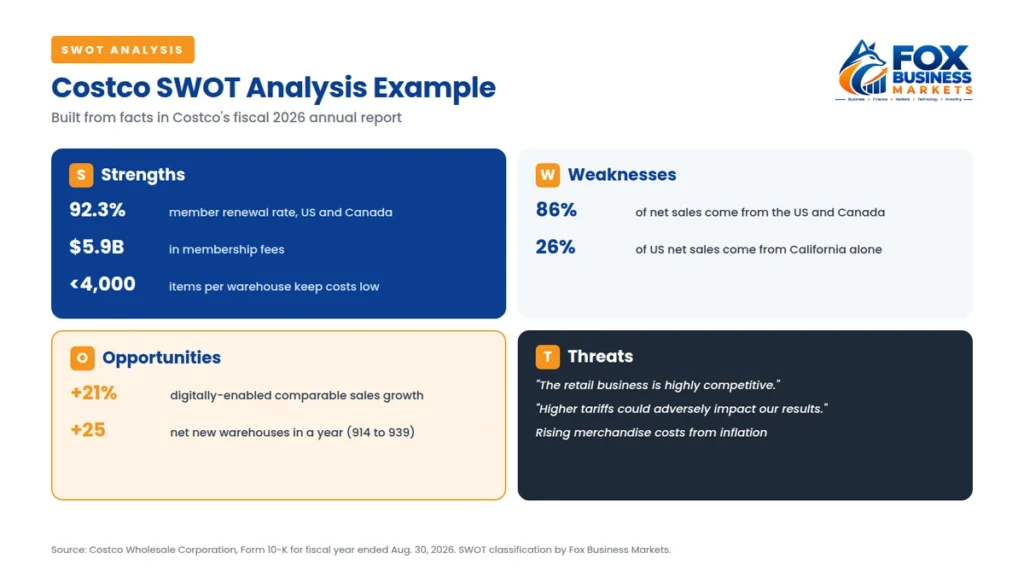
This SWOT analysis of Costco is our own, built only from facts in Costco’s fiscal 2026 annual report (Costco 10-K):
Strengths
- Loyal members: the renewal rate was 92.3% in the US and Canada and 89.8% worldwide.
- A recurring income stream: membership fees reached $5.9 billion.
- A focused selection: Costco carries “less than 4,000 active stock keeping units (SKUs) per warehouse,” which helps keep costs low.
- Its own Kirkland Signature brand.
Weaknesses
- Heavy reliance on the US and Canada, which made up 86% of net sales. Within the US, California alone accounted for 26% of net sales.
Opportunities
- Digital growth: “Digitally-enabled comparable sales increased 21% during 2026.”
- Continued expansion: Costco grew from 914 to 939 warehouses in a year.
Threats
- Competition: “The retail business is highly competitive.”
- Trade costs: “Higher tariffs could adversely impact our results.”
- Inflation in merchandise costs.
Turn Your SWOT Into Strategy: The TOWS Matrix
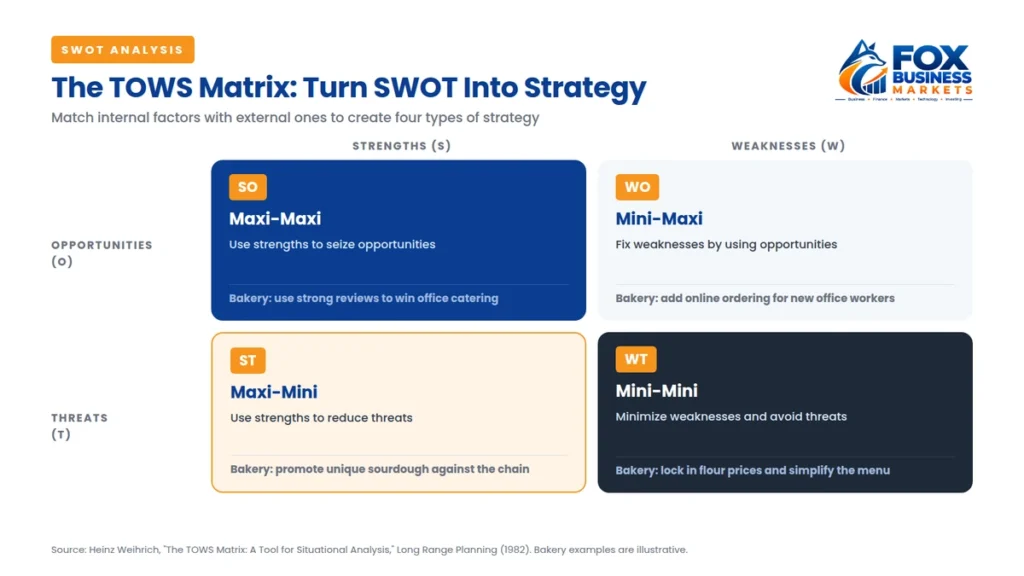
In 1982, management professor Heinz Weihrich introduced the TOWS matrix in Long Range Planning to connect the four boxes into strategies (Academia.edu):
Strategy | What it means | Bakery example |
| SO (maxi-maxi) | Use strengths to seize opportunities | Use strong reviews to win office catering contracts |
| ST (maxi-mini) | Use strengths to reduce threats | Promote unique sourdough to stand out from the chain bakery |
| WO (mini-maxi) | Fix weaknesses by using opportunities | Add online ordering to serve the new office workers |
| WT (mini-mini) | Minimize weaknesses and avoid threats | Lock in flour prices and simplify the menu to cut costs |
Weihrich wrote that “any company would like to be in a position where it can maximize both, strengths and opportunities.” In practice, most businesses need a mix of all four. Your chosen strategies then feed into your overall business strategy.
Common SWOT Mistakes
In a well-known 1997 study in Long Range Planning, Terry Hill and Roy Westbrook reviewed 50 companies, more than 20 of which used a SWOT. They found “long lists (over 40 factors on average),” “general (often meaningless) descriptions, a failure to prioritize and no attempt to verify any points.” Most worrying, “no-one subsequently used the outputs” (University of Oxford).
Avoid these common mistakes:
- Listing too much. Focus on the few factors that really matter.
- Being vague. “Good service” is weak. “4.8-star rating from 300 reviews” is strong.
- Mixing up internal and external. A competitor’s new store is a threat, not a weakness.
- Skipping the evidence. Back up each point with data.
- Stopping at the list. A SWOT is only useful when it leads to action.
SWOT vs. Other Strategy Tools
SWOT is a starting point, not a complete strategy. It works well alongside other tools:
- TOWS matrix: turns SWOT findings into specific strategies.
- PESTLE analysis: looks deeper at external factors: political, economic, social, technological, legal, and environmental. It can feed the opportunities and threats boxes.
- Porter’s generic strategies: help you choose whether to compete on cost, uniqueness, or a niche.
- Business plan: your SWOT findings belong in the market analysis section. See our guide on how to write a business plan.
How common is SWOT? In one survey of 158 firms in China, it was the most-used strategy tool, applied by 58.46% of companies, and the authors note it has been “consistently reported as the most used tool” in earlier studies (He, António, and Rosa, 2012).
Frequently Asked Questions
What is a SWOT analysis in simple terms?
A SWOT is a four-box review of a business’s strengths, weaknesses, opportunities, and threats. Strengths and weaknesses are internal, while opportunities and threats come from the outside market.
What is an example of a SWOT analysis?
A bakery might list loyal customers as a strength, a small kitchen as a weakness, a new office building nearby as an opportunity, and rising ingredient costs as a threat. It would then use those points to plan actions.
Who invented SWOT?
Recent research traces SWOT to the “SOFT” approach developed by Robert F. Stewart’s team at the Stanford Research Institute in the 1960s. The popular claim that Harvard invented it has been rejected by historians.
What is the difference between SWOT and TOWS?
SWOT lists your strengths, weaknesses, opportunities, and threats. The TOWS matrix connects them to create four types of strategy: SO, ST, WO, and WT.
How often should you do a SWOT?
Do one at least once a year, and whenever you face a big decision, such as launching a product, seeking a loan, or responding to a new competitor.
What are the limitations of SWOT?
SWOT can produce long, vague lists that are never used. To avoid this, keep each box short, support each point with evidence, and turn the results into specific actions.
Final Takeaway
A SWOT analysis is one of the simplest and most widely used ways to understand where your business stands. Keep it short, back every point with evidence, and don’t stop at the list. Use the TOWS matrix to turn your findings into strategies, assign actions, and revisit it as your business and market change.