Salary Increase Calculator: Calculate Percentage Raise & New Pay Free Tool
This free salary increase calculator calculates your updated compensation following a percentage raise, merit adjustment, promotion, or cost-of-living adjustment (COLA). It allows HR compensation teams, department managers, and individual professionals to break down annual wage increases into exact monthly, bi-weekly, and hourly paycheck increments instantly.
Who it's for: Human resource professionals structuring annual merit compensation pools, department managers preparing performance reviews, small business employers, and employees preparing for compensation negotiations.
Why use it:
- Visualize Exact Paycheck Changes: Discover how an annual percentage raise translates into take-home pay per bi-weekly or monthly pay cycle.
- Distinguish Merit Raises from Inflation (COLA): Ensure proposed wage increases outpace inflation rather than simply maintaining baseline purchasing power.
- Budget Annual Departmental Payroll: Model collective compensation pool increases to project corporate cash flow impacts before finalizing performance cycles.
How to Use the Salary Increase Calculator
- Select Calculation Mode:
- Choose Percentage Raise (%) Mode if you are given a specific merit or COLA increase percentage (e.g., 5.0%).
- Choose Fixed Dollar Raise Mode if you are awarded a lump-sum compensation adjustment (e.g., +$5,000/year).
- Enter Current Base Salary: Input your baseline annual gross wage prior to the raise.
- Specify the Raise Value: Enter either the percentage adjustment or the gross annual cash addition.
- Select Paycheck Frequency: Choose between bi-weekly (26 pay periods), semi-monthly (24 pay periods), monthly (12 pay periods), or weekly (52 pay periods).
- Review Updated Compensation Breakdown: Inspect your new gross annual salary, monthly increase, per-paycheck gross addition, and updated hourly rate.
How It Works & Salary Increase Formulas
Calculating wage adjustments involves basic percentage progression and payroll frequency divisions:
Understanding your effective hourly wage increase is essential for evaluating whether a promotion's added working hours, travel obligations, and managerial responsibilities compensate you fairly on an hourly basis.
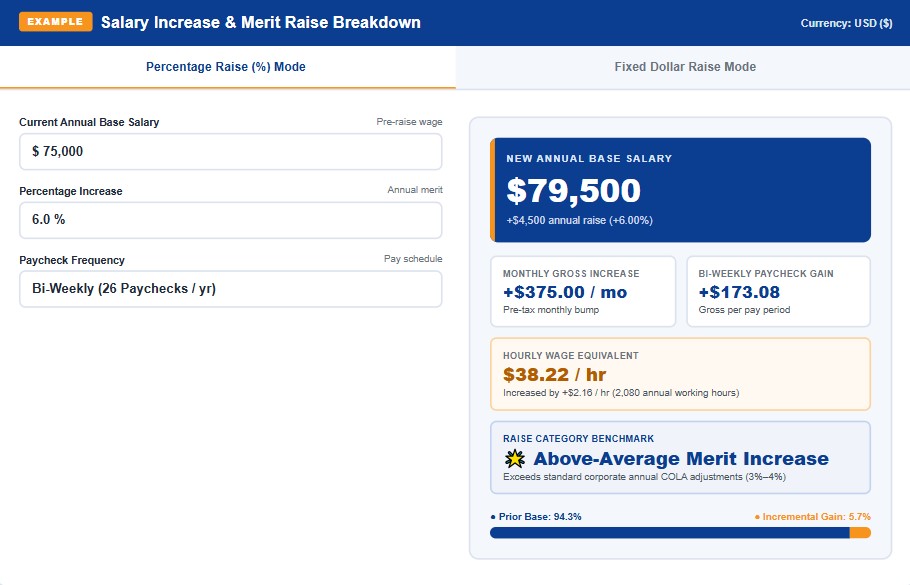
Worked Example: $75,000 Professional Merit Increase
A software quality engineer earning $75,000 annually receives a 6.0% merit raise paid on a standard bi-weekly schedule (26 pay periods):
- Current Annual Salary: $75,000.
- Raise Percentage: 6.00% annual merit increase.
- Total Annual Cash Increase: $75,000 × 0.06 = +$4,500 per year.
Calculated Compensation Breakdown:
- New Annual Base Salary: $75,000 + $4,500 = $79,500 per year.
- Monthly Gross Addition: $4,500 ÷ 12 = +$375.00 per month.
- Bi-Weekly Paycheck Addition: $4,500 ÷ 26 = +$173.08 per paycheck.
- Updated Hourly Rate: $79,500 ÷ 2,080 hours = $38.22 per hour (an increase of +$2.16/hr).
Corporate Salary Increase Tiers: Merit vs. COLA
Corporate compensation committees categorize annual pay adjustments into distinct performance tiers:
| Increase Category | Typical Range | Primary Business Driver | Strategic Purpose |
|---|---|---|---|
| Cost-of-Living Adjustment (COLA) | 2.5% – 3.5% | Consumer Price Index (CPI) inflation. | Preserves employee purchasing power. |
| Standard Merit Raise | 4.0% – 6.0% | Individual performance & goal achievement. | Rewards consistent high-quality execution. |
| Top-Performer Retention Raise | 7.0% – 10.0% | Critical specialized skills & poaching risk. | Prevents voluntary exit of key contributors. |
| Title Promotion / Level Upgrade | 10.0% – 20.0%+ | Increased managerial scope & responsibility. | Aligns compensation with market benchmarks. |
Where to Find Your Numbers
To evaluate wage adjustments alongside total corporate labor costs and profitability, integrate verified operational models:
- For Fully Loaded Headcount Liabilities: Calculate how wage increases impact employer payroll taxes and benefits with our Cost per Employee Calculator.
- For Staff Retention & Replacement Costs: Evaluate the cost of granting merit raises versus the expense of replacing departed staff with our Employee Turnover Calculator.
- For Revenue Output Benchmarking: Compare updated compensation against top-line output using our Employee Productivity Calculator.
- For Workload & Delivery Management: Align compensated hours with available project bandwidth using our Team Capacity Calculator.
- For Company Cash Runway Protection: Model how collective departmental raises impact monthly operational burn with our Burn Rate Calculator.
What This Calculator Can and Cannot Tell You
What it tells you:
- Exact gross annual salary, monthly bump, and per-paycheck addition.
- Equivalent hourly wage conversion across standard full-time working hours.
- How your wage adjustment compares against national corporate merit and COLA tiers.
What it cannot tell you:
- Net After-Tax Take-Home Pay: The calculator outputs gross compensation. Federal income tax brackets, state taxes, FICA withholding (7.65%), and pre-tax health insurance deductions will reduce net cash deposited into your bank account.
- Marginal Tax Bracket Jumps: A salary increase will never decrease your total net income, but income earned above a tax bracket threshold will be taxed at the higher marginal rate.
- Total Rewards & Equity Compensation: The formula evaluates cash salary; it does not model non-cash incentives like stock options, restricted stock units (RSUs), or expanded PTO days.
Related Guides and Calculators
Master corporate workforce budgeting, team capacity, and operational finance with our founder suite:
Frequently Asked Questions
The Bottom Line
Clear compensation math empowers both employers and team members during performance review cycles. Model the loaded employer cost of your salary pool with our Cost per Employee Calculator, monitor staff retention with our Employee Turnover Calculator, and evaluate team delivery output with our Team Capacity Calculator.
- WorldatWork: Salary Budget Survey & Merit Increase Guidelines
- Society for Human Resource Management (SHRM): Managing Employee Compensation & Performance Reviews
- U.S. Bureau of Labor Statistics (BLS): Employment Cost Index (ECI) & Inflation Data
- Corporate Finance Institute (CFI): Compensation Modeling & Payroll Budgeting Methods
Disclaimer: This calculator is provided for strategic planning and educational modeling purposes only. It does not constitute formal tax advice, guaranteed payroll withholding estimates, or legal wage compliance. Verify individualized tax deductions with your certified payroll department or CPA.