
For years, the answer to “What’s the biggest company in America?” was simple: Walmart. That changed in 2026. When Fortune published its annual Fortune 500 list in June, Amazon took the No. 1 spot, ending Walmart’s 13-year reign at the top (Fortune). The margin was thin: Amazon reported $716.9 billion in revenue for 2025, while Walmart reported $713.2 billion for its fiscal year ended January 2026.
But “biggest” depends on what you measure. By stock market value, neither Amazon nor Walmart is No. 1. That title belongs to Nvidia, a chipmaker that ranks only 15th by revenue in our list (No. 16 on the Fortune 500). Below are the largest companies in the US ranked three ways, by revenue, market value, and employees, built from the companies’ own SEC filings wherever possible.
Quick answer: By revenue, the largest companies in the US are Amazon ($716.9 billion), Walmart ($713.2 billion), and UnitedHealth Group ($447.6 billion). By market value as of October 19, 2026, the largest are Nvidia (about $5.2 trillion), Apple (about $5.0 trillion), and Alphabet (about $4.2 trillion). Walmart is the largest employer, with about 2.1 million workers.
How We Ranked These Companies
To build these rankings, we used each company’s most recent annual report filed with the Securities and Exchange Commission (Form 10-K) or its official full-year earnings release. A few things to know:
- Revenue is total revenue for each company’s latest completed fiscal year. Fiscal years differ: Walmart’s ended January 31, 2026, Microsoft’s June 30, 2026, and Apple’s September 27, 2025. So these figures don’t cover exactly the same 12 months, and because we used the newest filings, Microsoft, McKesson, Cardinal Health, and Costco appear with later results than Fortune used. Apple and Cencora report their next annual results in November 2026.
- Banks are ranked by the “total net revenue” they report, which is lower than the gross figure Fortune uses. On a gross basis, JPMorgan Chase (roughly $280 billion) and Bank of America would both be in the top 20.
- Oil companies are ranked by total revenues and other income, as reported.
- Market value is a snapshot from market data at the October 19, 2026 close. It changes every trading day.
- Only US-headquartered public companies are included.
The 20 Largest Companies in the US by Revenue
Here are the largest companies in the US by revenue, based on each company’s latest annual filing:
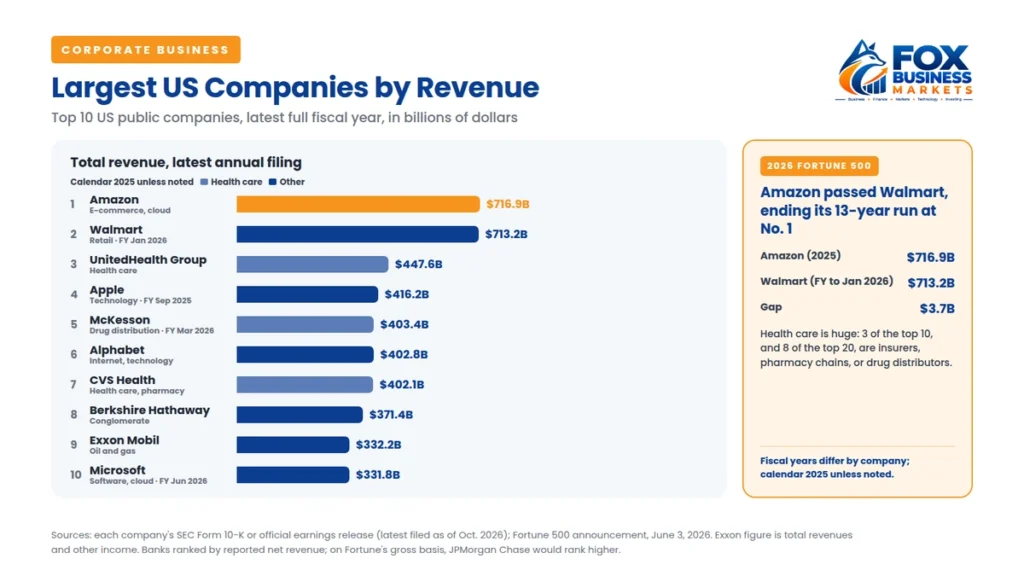
Rank | Company | Industry | Fiscal year ended | Revenue | Employees |
| 1 | Amazon | E-commerce and cloud | Dec 31, 2025 | $716.9B | ~1.58M |
| 2 | Walmart | Retail | Jan 31, 2026 | $713.2B | ~2.1M |
| 3 | UnitedHealth Group | Health insurance and services | Dec 31, 2025 | $447.6B | >390,000 |
| 4 | Apple | Technology | Sep 27, 2025 | $416.2B | ~166,000 |
| 5 | McKesson | Drug distribution | Mar 31, 2026 | $403.4B | >43,000 |
| 6 | Alphabet | Internet and technology | Dec 31, 2025 | $402.8B | 190,820 |
| 7 | CVS Health | Health care and pharmacy | Dec 31, 2025 | $402.1B | >300,000 |
| 8 | Berkshire Hathaway | Conglomerate | Dec 31, 2025 | $371.4B | ~387,800 |
| 9 | Exxon Mobil | Oil and gas | Dec 31, 2025 | $332.2B | ~58,000 |
| 10 | Microsoft | Software and cloud | Jun 30, 2026 | $331.8B | ~223,000 |
| 11 | Cencora | Drug distribution | Sep 30, 2025 | $321.3B | >51,000 |
| 12 | Costco | Retail | Aug 30, 2026 | $303.2B | 355,000 |
| 13 | The Cigna Group | Health insurance and pharmacy benefits | Dec 31, 2025 | $274.9B | ~67,700 |
| 14 | Cardinal Health | Drug distribution | Jun 30, 2026 | $254.2B | ~63,900 |
| 15 | Nvidia | Semiconductors | Jan 25, 2026 | $215.9B | ~42,000 |
| 16 | Meta Platforms | Internet and social media | Dec 31, 2025 | $201.0B | 78,865 |
| 17 | Elevance Health | Health insurance | Dec 31, 2025 | $199.1B | ~97,100 |
| 18 | Centene | Health insurance | Dec 31, 2025 | $194.8B | 61,100 |
| 19 | Chevron | Oil and gas | Dec 31, 2025 | $189.0B | 43,039 |
| 20 | Ford Motor | Automotive | Dec 31, 2025 | $187.3B | ~169,000 |
Just outside the top 20 are General Motors ($185.0 billion), JPMorgan Chase ($182.4 billion in reported net revenue), Home Depot ($164.7 billion), and Kroger ($147.6 billion).
The Largest Companies in the US by Market Value
Market value, or market capitalization, is a company’s share price times its number of shares. It reflects what investors think a company will earn in the future, not what it sells today. As of the October 19, 2026 close, the largest US companies by market value were (market data, rounded):
Rank | Company | Market value |
| 1 | Nvidia | ~$5.2 trillion |
| 2 | Apple | ~$5.0 trillion |
| 3 | Alphabet | ~$4.2 trillion |
| 4 | Microsoft | ~$4.0 trillion |
| 5 | Amazon | ~$2.8 trillion |
| 6 | SpaceX | ~$1.9 trillion |
| 7 | Meta Platforms | ~$1.8 trillion |
| 8 | Broadcom | ~$1.6 trillion |
| 9 | Tesla | ~$1.5 trillion |
| 10 | Eli Lilly | ~$1.2 trillion |
Source: Finhacker, cross-checked with StockTitan (vendor market data, October 19, 2026 close). Berkshire Hathaway, at about $1.1 trillion, was close behind Eli Lilly, and sources differed on the order.
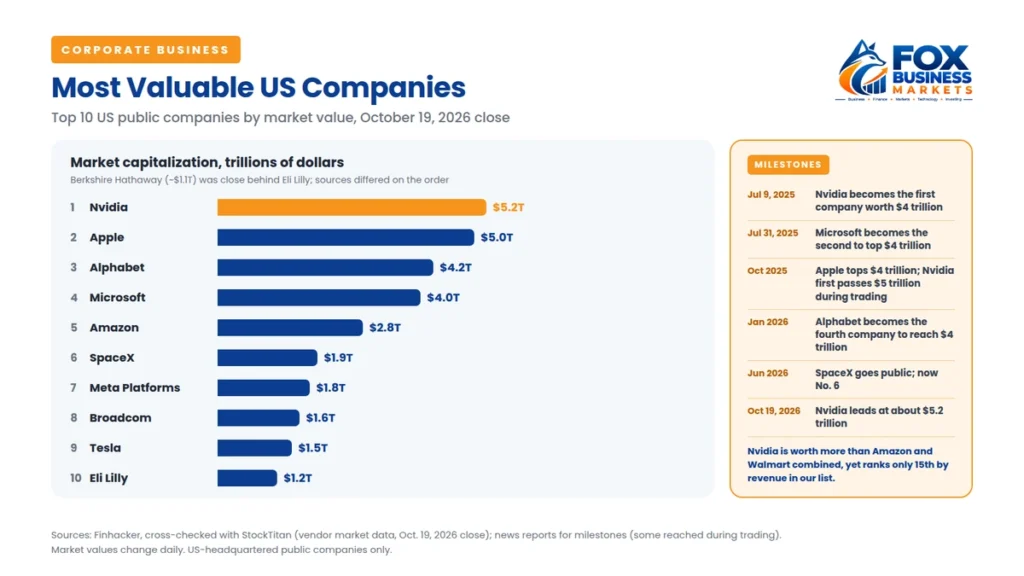
The milestones have come fast. Nvidia became the first company to reach $4 trillion in market value on July 9, 2025 (Bloomberg Law), and the first to pass $5 trillion during trading that October. SpaceX joined the list after going public in June 2026.
To put these numbers in context: the total value of the S&P 500 was about $67 trillion at the end of July 2026, and the 10 largest index constituents (nine companies, since Alphabet has two share classes) made up 37.6% of it (S&P Dow Jones Indices factsheet).
The Largest Employers in the US
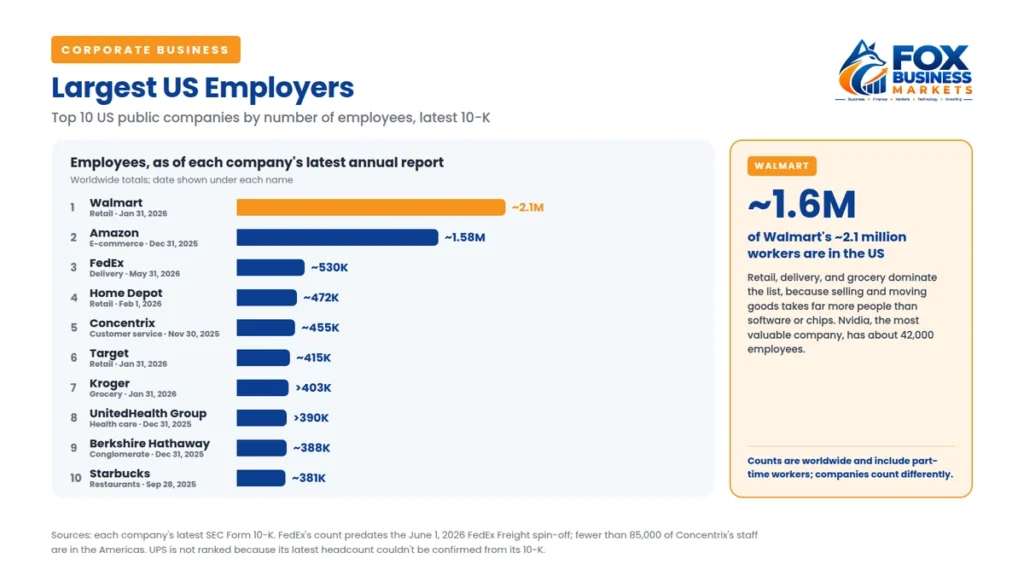
Measured by headcount, the largest companies in the US look different again, with retailers and delivery companies near the top:
Rank | Company | Employees | As of |
| 1 | Walmart | ~2.1 million (about 1.6 million in the US) | Jan 31, 2026 |
| 2 | Amazon | ~1.58 million | Dec 31, 2025 |
| 3 | FedEx | ~530,000 | May 31, 2026 |
| 4 | Home Depot | ~472,400 | Feb 1, 2026 |
| 5 | Concentrix | ~455,000 (fewer than 85,000 in the Americas) | Nov 30, 2025 |
| 6 | Target | ~415,000 | Jan 31, 2026 |
| 7 | Kroger | >403,000 | Jan 31, 2026 |
| 8 | UnitedHealth Group | >390,000 | Dec 31, 2025 |
| 9 | Berkshire Hathaway | ~387,800 | Dec 31, 2025 |
| 10 | Starbucks | ~381,000 | Sep 28, 2025 |
Source: each company’s latest Form 10-K. Counts are worldwide unless noted, and companies count part-time and seasonal workers differently. FedEx’s count predates the June 1, 2026 spin-off of FedEx Freight, so it includes Freight employees. UPS isn’t ranked because we couldn’t confirm its latest headcount from its 10-K.
What the Rankings Tell Us
Revenue and value tell different stories. Walmart sells more than almost any company on Earth, but its market value is a fraction of Nvidia’s, because investors are paying for Nvidia’s expected future profits from artificial intelligence. Nvidia reported $120.1 billion in net income on $215.9 billion of revenue for the year ended January 2026, while Walmart earned about $22 billion on $713.2 billion.
Health care is enormous. Eight of the 20 largest companies in the US by revenue are health insurers, pharmacy chains, or drug distributors. Distributors like McKesson and Cencora have huge revenue but thin profits, because they pass most of the money through to drugmakers.
Big isn’t always profitable. Ford and Centene both reported net losses for 2025 despite revenue above $185 billion.
Size is concentrated. Fortune reported that the combined revenue of the Fortune 500 reached $21.0 trillion, and the top 10 companies alone accounted for $4.5 trillion of it.
Revenue vs. Profit vs. Market Value
These three numbers are often confused:
- Revenue: the total money a company takes in from sales before expenses. It shows size.
- Net income (profit): what’s left after all costs and taxes. It shows how efficient the business is.
- Market value: what investors would pay for the whole company today. It shows expectations about the future.
A company can be huge on one measure and modest on another. That’s why lists of the largest companies in the US can look so different depending on the source.
What the Biggest Companies Mean for Small Businesses
Giant companies are competitors, but they’re also customers and sales channels. Amazon and Walmart run marketplaces where many small sellers reach customers, and large companies buy from thousands of small suppliers. If you’re thinking about selling through a big platform, our guide to the best ecommerce platforms compares the fees. And if you’re curious how these companies are run and overseen, see our explainers on corporate governance and mergers and acquisitions.
Frequently Asked Questions
What is the largest company in the US by revenue?
Amazon, with $716.9 billion in revenue for 2025, narrowly ahead of Walmart’s $713.2 billion for its fiscal year ended January 2026. Amazon ranked No. 1 on the 2026 Fortune 500, ending Walmart’s 13-year run at the top.
What is the most valuable company in the US?
As of the October 19, 2026 market close, Nvidia was the most valuable US company, worth about $5.2 trillion, followed by Apple at about $5.0 trillion. Market values change daily, so the order can shift.
Which US company has the most employees?
Walmart, with about 2.1 million employees worldwide, including about 1.6 million in the US, as of January 31, 2026. Amazon is second, with about 1.58 million.
How many companies are in the Fortune 500?
The Fortune 500 ranks the 500 largest US companies by revenue, including some private companies that publish their financial results. In 2026, a company needed at least $7.5 billion in revenue to make the list, according to Fortune.
Why is Nvidia worth more than Walmart?
Market value reflects expected future profits, not current sales. Nvidia earned $120.1 billion in its latest fiscal year on $215.9 billion of revenue, and investors expect strong growth from AI chips. Walmart has much higher revenue but lower profit margins.
Where does this ranking’s data come from?
Revenue and employee figures come from each company’s latest SEC Form 10-K or official earnings release. Market values are vendor market data at the October 19, 2026 close. Fortune 500 facts come from Fortune’s June 2026 announcement.
The Bottom Line
Amazon’s move past Walmart in 2026 is a fitting snapshot of the US economy: a company that started as an online bookstore now brings in more total revenue than the world’s biggest retailer, while a chipmaker most consumers never buy from directly is worth more than both combined. The largest companies in the US will keep changing places. What’s worth watching isn’t just who’s on top, but which kinds of businesses are growing fastest.