Business Growth Rate Calculator: Calculate CAGR, YoY & MoM Velocity
This free business growth rate calculator calculates compound annual growth rate (CAGR), year-over-year (YoY), and month-over-month (MoM) revenue velocity. It enables corporate founders, executive leaders, and financial analysts to accurately evaluate business expansion, benchmark performance against industry peers, and present verified growth metrics to board members and venture investors.
Who it's for: Startup entrepreneurs, corporate strategists, marketing directors, and private equity investors needing exact annualized compound metrics rather than misleading linear percentage averages.
Why use it:
- Smooth Out Revenue Volatility: Use CAGR to eliminate cyclical highs and lows across multiple operating years, revealing your true geometric growth baseline.
- Track Short-Term Momentum: Measure MoM and YoY periodic performance to identify seasonal slumps or accelerating sales momentum early.
- Prepare Defensible Pitch Decks: Present institutional-grade compound metrics to venture capital and bank underwriting committees.
How to Use the Growth Rate Calculator
- Select Growth Mode:
- Choose Compound Annual Growth Rate (CAGR) to evaluate multi-year performance across 1 to 10+ fiscal years, eliminating annual revenue spikes or dips.
- Choose Periodic Growth (YoY / MoM) to calculate direct variance between two consecutive periods (such as Year-over-Year, Quarter-over-Quarter, or Month-over-Month).
- Input Starting Value: Enter initial top-line revenue, customer volume, or unit sales recorded at the beginning of the evaluation period.
- Input Ending Value: Enter current or ending revenue achieved at the close of the period.
- Specify Timeframe Horizon: For CAGR calculations, input the elapsed number of years (fractions allowed, e.g., 2.5 years). For periodic mode, select whether the interval is YoY, QoQ, or MoM.
- Review Compound Outputs: Instantly inspect annualized growth velocity, absolute revenue gains, overall expansion multiples, and baseline-to-growth visual ratios.
How It Works & Growth Rate Mathematics
Simple arithmetic percentage averages produce mathematically inaccurate representations of business growth over multiple years. Instead, corporate finance uses geometric compound formulas:
CAGR reflects the constant annual rate at which an investment or company would have grown if it had expanded at a steady, compound rate every year. It represents the gold standard metric used by institutional investors to compare businesses of different sizes.
Worked Example: 3-Year Enterprise SaaS Scaling Trajectory
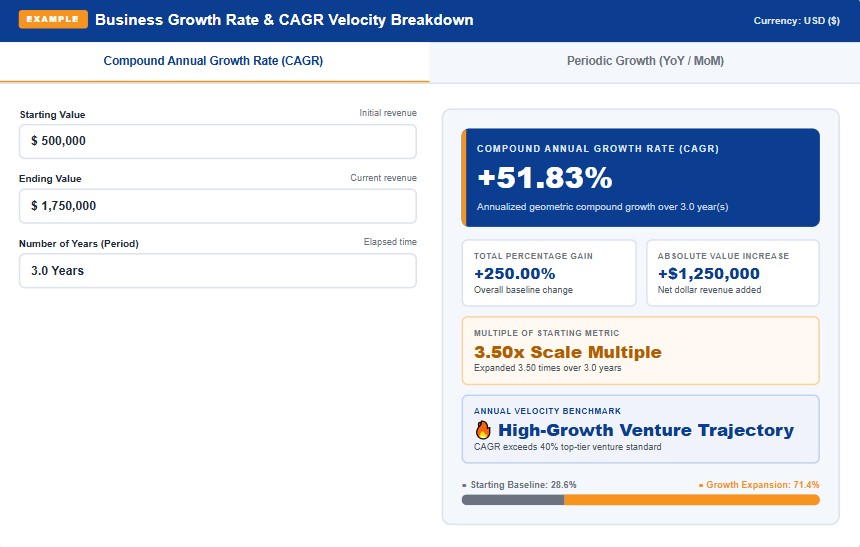
A B2B cloud software company achieved explosive commercial adoption over a 3-year operating period:
- Year 0 (Starting Revenue): $500,000 ARR.
- Year 3 (Ending Revenue): $1,750,000 ARR.
- Elapsed Time: Exactly 3.0 fiscal years.
The Mathematical Breakdown:
- Scale Multiple: $1,750,000 ÷ $500,000 = 3.50x Scale Multiple.
- Total Percentage Expansion: ($1,250,000 ÷ $500,000) × 100 = +250.00% total gain.
- CAGR Calculation: (3.50 ^ [1 ÷ 3] − 1) × 100 = 51.83% Compound Annual Growth Rate.
Key Strategic Takeaway: If the founders had calculated simple arithmetic average growth, they would have incorrectly claimed 83.3% annual growth ($250% ÷ 3). Institutional venture funds immediately recalculate this to the true compound rate of 51.83% CAGR.
Institutional Growth Velocity Benchmarks
Venture capital firms and corporate lenders evaluate revenue velocity against established growth hurdles across various company stages:
| Company Stage | Top-Quartile CAGR | Median Growth CAGR | Strategic Priority |
|---|---|---|---|
| Seed to Series A ($1M–$3M ARR) | > 100% (Triple / Double) | 50% – 80% | Product-market fit validation & sales repeatability. |
| Series B Growth ($5M–$15M ARR) | 60% – 100% | 35% – 50% | Go-to-market scaling & customer acquisition efficiency. |
| Mid-Market Corporate ($20M–$50M) | 30% – 50% | 15% – 25% | Operating margin expansion & market share protection. |
| Mature Commercial Enterprise ($100M+) | 12% – 20% | 5% – 10% | Dividend yield, free cash flow generation & M&A. |
Where to Find Your Numbers
To produce verifiable growth calculations for board updates, audit filings, or pitch decks, draw from verified corporate records:
- For Forward Pipeline & Conversion Projections: Project forward revenue based on deal closing rates using our Revenue Forecast Calculator.
- For Unit Pricing Optimization: Ensure rapid top-line growth protects healthy contribution margins with our Pricing Strategy Calculator.
- For Market Share Benchmarking: Discover if your growth rate is capturing market share from incumbents using our Market Share Calculator.
- For Cash Burn Governance: Fast revenue expansion often demands aggressive working capital investment. Monitor your runway with our Burn Rate Calculator.
- For Valuation Multiples: Model how your CAGR impacts enterprise valuation using our Startup Valuation Estimator.
What This Calculator Can and Cannot Tell You
What it tells you:
- Exact annualized compound rate of growth (CAGR) across single or multi-year horizons.
- Direct period-over-period percentage expansion (YoY, QoQ, MoM) and absolute dollar increases.
- The precise multiple of expansion achieved relative to starting baseline capital.
What it cannot tell you:
- Underlying Profitability & Cash Flow: A company can post a 100% CAGR while burning massive amounts of cash and generating negative operating margins. Growth must always be evaluated alongside unit economics.
- Internal Volatility: CAGR assumes smooth, uninterrupted linear growth between starting and ending values. It hides intermediate fluctuations, such as a catastrophic dip in Year 2 followed by a recovery in Year 3.
- Organic vs. Inorganic Expansion: The formula does not distinguish between organic customer acquisition growth and revenue acquired through debt-funded acquisitions.
Related Guides and Calculators
Strengthen your corporate strategy, valuation modeling, and financial planning with our founder suite:
Frequently Asked Questions
The Bottom Line
Sustainable enterprise value is built on verifiable compound growth. Track your multi-year CAGR accurately, ground future milestones with our Revenue Forecast Calculator, and preserve high gross margins with our Pricing Strategy Calculator to build long-term shareholder equity.
- Corporate Finance Institute (CFI): Compound Annual Growth Rate (CAGR) Formula & Analysis
- McKinsey & Company: The Granularity of Growth: How to Drive Sustainable Expansion
- SEC Division of Corporation Finance: Non-GAAP Financial Measures & Growth Disclosures
- Harvard Business Review: Why Growth Stalls and How to Reignite Compounding
Disclaimer: This calculator is provided for strategic analysis and educational planning purposes only. It does not constitute formal securities reporting, auditing appraisal, or financial investment advice. Verify historical metrics against audited balance sheets.