SAFE Valuation Calculator: Cap, Discount & Conversion Modeling
This free SAFE valuation calculator models how Simple Agreements for Future Equity (SAFEs) convert into equity during priced funding rounds. Whether you are using Y Combinator's standard Post-Money SAFE or a legacy Pre-Money SAFE, this tool calculates investor share ownership, effective share price, valuation caps, discount mechanisms, and resulting founder dilution.
Who it's for: Early-stage startup founders, angel investors, venture syndicates, and startup attorneys structuring pre-seed or seed fundraising rounds using convertible SAFE instruments.
Why use it:
- Uncover SAFE Conversion Pricing: Compare whether the Valuation Cap or the Discount Rate produces the better conversion share price for incoming seed investors.
- Master Post-Money vs. Pre-Money Mechanics: See how YC Post-Money SAFEs fix investor equity upfront versus how Pre-Money SAFEs dilute existing shareholders.
- Prevent Series A Dilution Shocks: Forecast exactly how multiple unpriced SAFEs convert together when an institutional Series A venture fund sets a priced lead term sheet.
How to Use the SAFE Valuation Calculator
- Select Your SAFE Template Standard: Toggle between the YC Post-Money SAFE (Standard) (the industry-standard open-source document introduced by Y Combinator in 2018) and the Legacy Pre-Money SAFE.
- Enter the SAFE Capital Invested: Input the check size wired by your angel investor or seed syndicate.
- Set the Agreed Valuation Cap & Discount Rate: Input the valuation cap (e.g., $5,000,000) and discount rate (commonly 20%, or 0% if using a cap-only SAFE).
- Input Next Priced Financing Round Terms: Enter the anticipated Pre-Money valuation and new investment capital for your future Series A priced equity round.
- Analyze Ownership Stakes & Dilution: Instantly inspect the effective share price mechanism, SAFE investor equity percentage, and your retained founder stake post-financing.
How It Works & SAFE Conversion Math
A SAFE (Simple Agreement for Future Equity) is not a debt instrument; it carries no maturity date and accrues no interest. Instead, it represents a contractual right to receive preferred stock when a priced equity round closes:
Under standard terms, SAFE investors receive the lower effective valuation between the Valuation Cap and the Discount Price, maximizing the number of preferred shares issued per dollar invested.
Worked Example: $250K Seed SAFE Converting at Series A
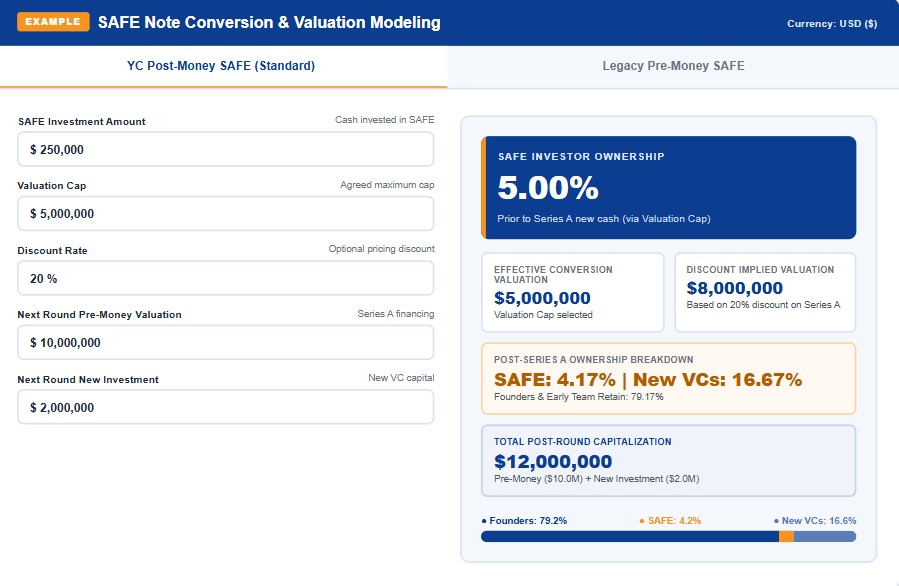
Consider an AI startup raising $250,000 on a standard YC Post-Money SAFE with a $5,000,000 Valuation Cap and a 20% Discount:
- Pre-Series A Ownership: $250,000 ÷ $5,000,000 = 5.00% ownership locked in immediately.
- Series A Event: Eighteen months later, a venture fund leads a Series A with $10,000,000 Pre-Money and $2,000,000 in new cash ($12M Post-Money).
- Conversion Price Evaluation: The 20% discount on $10M equals an $8.0M valuation. Because the $5.0M Valuation Cap is lower than $8.0M, the SAFE converts via the Cap.
- Final Post-Series A Cap Table: New Series A investors own 16.67% ($2M / $12M). The SAFE holder dilutes to 4.17%, and founders retain 79.16%.
Post-Money SAFE vs. Pre-Money SAFE: Direct Comparison
| Key Characteristic | YC Post-Money SAFE (2018–Present) | Legacy Pre-Money SAFE (2013–2018) |
|---|---|---|
| Ownership Calculation | Fixed percentage immediately (Investment ÷ Cap) | Floats depending on other SAFEs issued |
| Dilution Stacking | New SAFEs dilute founders, not prior SAFE holders | Multiple SAFEs dilute each other unpredictably |
| Founder Visibility | Clear cap table tracking after every check | High risk of unexpected "Series A dilution shock" |
| Venture Standard | Universal standard used across 90%+ of seed deals | Rarely accepted by institutional seed investors |
Where to Find Your Numbers
Before negotiating terms with early-stage business angels, verify your operational runway and capitalization data:
- For Cash Burn & Sizing: Run your monthly overhead through our Burn Rate Calculator to ensure your SAFE round provides at least 18 months of runway.
- For Direct Equity Round Valuation: If your investors prefer a priced equity round instead of a convertible note, model your cap table using our Startup Valuation Estimator[cite: 2].
- For Cap Table Splits: Structure co-founder share issuances and vesting schedules using our Business Ownership Calculator[cite: 2].
What This Calculator Can and Cannot Tell You
What it tells you:
- Whether your investor converts under the Valuation Cap or the Discount Rate.
- Exact post-closing ownership percentages for SAFE holders, new venture investors, and founders.
- The dilution impact of YC Post-Money versus Pre-Money SAFE conventions.
What it cannot tell you:
- Complex Multi-Note SAFE Stacking: If you issue 10 different SAFEs with varying caps ($4M, $6M, $8M), each SAFE must be modeled simultaneously on a comprehensive capitalization spreadsheet.
- Mandatory Option Pool Reshuffles: Priced round lead investors frequently mandate a 10%–15% post-closing unallocated option pool, which increases dilution on common shareholders.
- Most Favored Nation (MFN) Clauses: If early SAFEs include MFN provisions, they automatically adopt better terms granted to later investors.
Related Guides and Calculators
Model your startup capitalization, runway, and corporate valuation with our founder suite:
Frequently Asked Questions
The Bottom Line
SAFEs are the fastest way to close early angel capital, but unmonitored valuation caps can result in massive dilution at Series A. Always model your conversion math before signing term sheets. Cross-reference your capital runway with our Burn Rate Calculator and evaluate priced equity alternatives using our Startup Valuation Estimator[cite: 2].
- Y Combinator: Standard Post-Money SAFE Documents & User Guide
- National Venture Capital Association (NVCA): Early-Stage Convertible Financing Guidelines
- SEC Regulation D: Private Securities Offering Rules (Rule 506(b) / 506(c))
- Carta Research: State of Pre-Seed & Seed SAFE Financing Benchmarks
Disclaimer: This calculator is provided for educational and strategic modeling purposes only. It does not constitute formal legal or securities advisory. Always review investor documents with qualified startup legal counsel.