Small Business Profit Calculator: Find Your Gross, Operating, and Net Profit
This free small business profit calculator turns your revenue, cost of goods sold, and expenses into a simple income statement. It shows your gross profit, operating profit, and net profit, the margin at each level, and an annualized estimate, plus a visual breakdown of where your money goes.
Who it's for: Small business owners, freelancers, and startup founders who want a quick monthly, quarterly, or annual profit check without opening their accounting software.
Why use it:
- Every profit level: See gross, operating, and net profit with margins in one view.
- Spot cost problems: The breakdown bar shows which costs take the biggest share of revenue.
- Plan ahead: Switch periods and see your annualized net profit instantly.
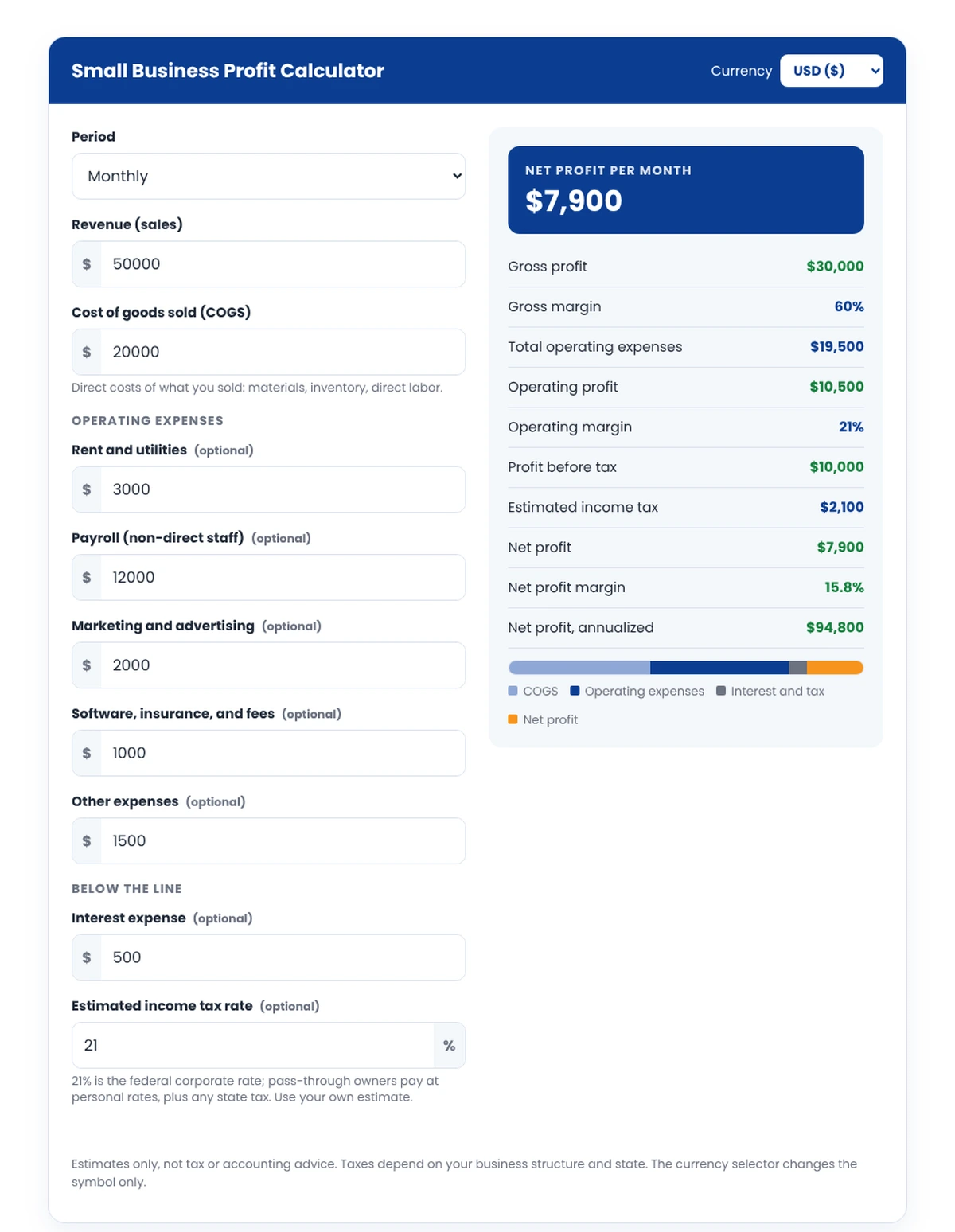
Small Business Profit Calculator
Estimates only, not tax or accounting advice. Taxes depend on your business structure and state. The currency selector changes the symbol only.
How to Use the Small Business Profit Calculator
- Choose a period: monthly, quarterly, or annual. Use the same period for every number.
- Enter revenue (total sales before expenses).
- Enter cost of goods sold, the direct cost of what you sold.
- Add operating expenses such as rent, payroll, marketing, and software.
- Add interest and an estimated tax rate to see net profit.
How It Works
The calculator works down a simple income statement, from revenue to net profit, and shows your margin at each level.
Gross profit = Revenue − Cost of goods sold
Operating profit = Gross profit − Operating expenses
Profit before tax = Operating profit − Interest
Estimated tax = Profit before tax × Tax rate (if positive)
Net profit = Profit before tax − Estimated tax
Net margin = Net profit ÷ Revenue × 100
Tax is estimated only when profit is positive. The default 21% is the federal corporate rate under 26 U.S.C. §11(b); owners of LLCs, S corporations, and sole proprietorships usually pay tax on profit at personal rates instead.
Worked Example
A small business has $50,000 in monthly revenue and $20,000 in cost of goods sold.
- Gross profit: $30,000 (60% gross margin)
- Operating expenses: rent $3,000, payroll $12,000, marketing $2,000, software $1,000, other $1,500, for $19,500 total
- Operating profit: $10,500 (21%); after $500 interest, profit before tax is $10,000
- At a 21% estimated tax rate, net profit is $7,900, a 15.8% net margin, or about $94,800 a year
Of every dollar in sales, this business keeps about 16 cents after all costs.
Gross, Operating, and Net Profit Compared
| Profit measure | What it shows | Use it to |
|---|---|---|
| Gross profit | Revenue left after direct product costs | Judge pricing and supplier costs |
| Operating profit | Profit from running the business, before interest and tax | Compare performance month to month |
| Net profit | What's left after every cost, including interest and tax | See what you can reinvest or pay yourself |
| Net margin | Net profit as a share of revenue | Compare with past periods and similar businesses |
Where to Find Your Numbers
- Revenue and COGS: your profit and loss (P&L) statement in your accounting software.
- Operating expenses: the expense section of your P&L, or bank and card statements.
- Interest: your loan statements. Our business loan calculator shows interest by year.
- Tax rate: your accountant's estimate for your business structure and state.
What the Calculator Can and Cannot Tell You
It can tell you
- Your gross, operating, and net profit
- Margins at each level of the income statement
- Which costs take the biggest share of revenue
- An annualized profit estimate
It cannot tell you
- Your exact tax bill or deductions
- Cash flow timing, such as unpaid invoices
- One-time costs or asset depreciation unless you add them
- How your margins compare with your industry
Frequently Asked Questions
What is a good profit margin for a small business?
It depends heavily on the industry. Service businesses often have higher margins than retailers or restaurants, which run on thin margins and high volume. The most useful comparison is your own margin over time: if it's shrinking, find out whether prices, costs, or expenses are the cause.
What is the difference between gross profit and net profit?
Gross profit is revenue minus the direct cost of what you sold. Net profit subtracts everything else too: rent, payroll, marketing, interest, and taxes. A business can have a healthy gross profit and still lose money if its operating expenses are too high.
Should I pay myself before calculating profit?
If you take a regular salary through payroll, include it in operating expenses. If you take owner draws from a sole proprietorship or partnership, those usually come out of net profit instead. Either way, make sure the business earns enough to pay you a fair wage.
Why is my tax rate estimate important?
Taxes can take a large share of profit, and the right rate depends on your structure. C corporations pay a 21% federal rate, while LLC, S corporation, and sole proprietor profits usually flow to the owner's personal return. Ask an accountant for a realistic estimate.
How can I increase my small business profit?
You can raise prices, lower the cost of goods sold, cut operating expenses, or sell more at the same margin. Use the calculator to test each lever: a small price increase or supplier discount often lifts net profit more than you might expect.
Final Takeaway
Revenue is vanity; profit is what keeps the business alive. Check your gross, operating, and net margins every month, and act early when they slip. If you're choosing a business structure for tax reasons, read our guide to LLC vs. corporation, and see our small business statistics for context.
Sources: 26 U.S.C. §11(b), corporate tax rate (Cornell Law School). Estimates only, not tax or accounting advice. Example figures are illustrative.