Keisha kept her credit card statements in a kitchen drawer, unopened, for most of a year. She’s a school office manager in Charlotte, and the debt had built up slowly: a store card from furnishing her apartment, a credit card that covered a dental emergency and two holiday seasons, and a personal loan she’d taken to “clean it all up” and then added to anyway. When she finally spread the statements across the table, the total was $13,500. The number that stopped her was smaller, printed in a box on her credit card statement: if she paid only the minimum, it would take years to pay off. (Keisha is a composite example, but her pile of statements will look familiar to millions of households.)
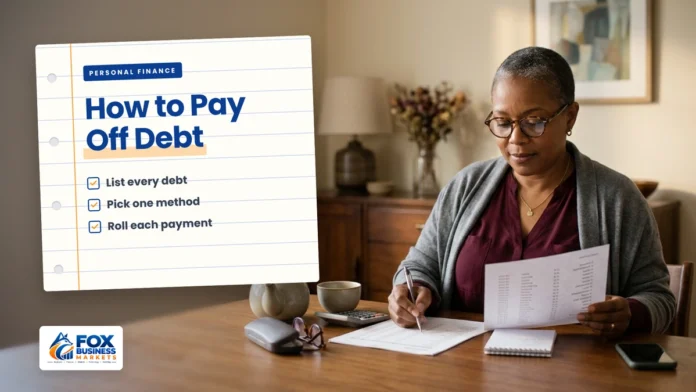
This guide shows you how to pay off debt the way that finally worked for her: list everything, pick one method, find extra money each month, and stop new balances from piling on while you pay down the old ones.
Quick answer: To pay off debt, list every balance with its interest rate and minimum payment, keep paying all the minimums, and put every extra dollar toward one debt at a time. Target either the highest interest rate first (the avalanche method, which saves the most) or the smallest balance first (the snowball method, which builds momentum). Then roll each freed-up payment into the next debt.
How Much Debt Do Americans Have in 2026?
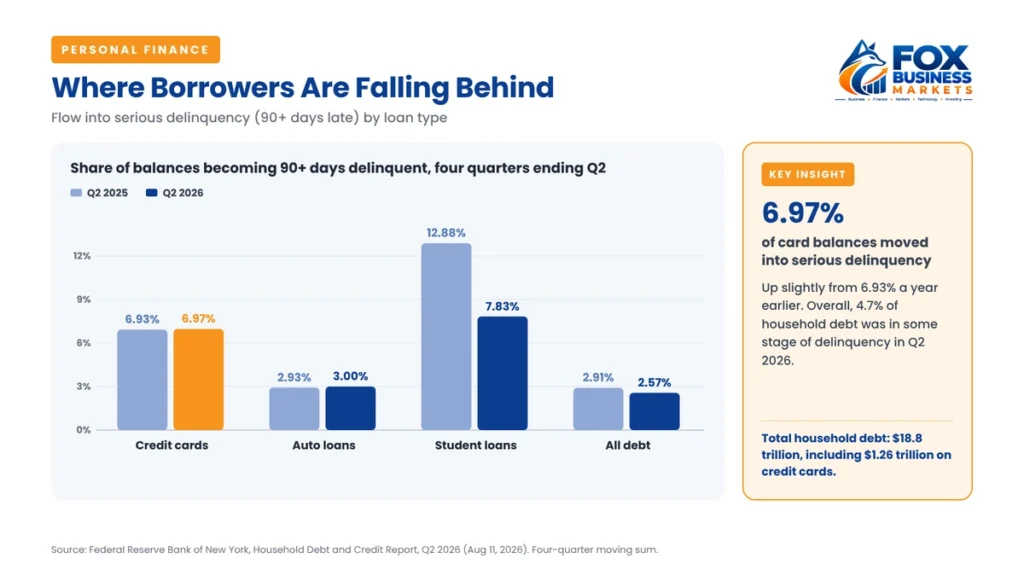
American households owed $18.8 trillion in the second quarter of 2026, according to the Federal Reserve Bank of New York’s Household Debt and Credit Report. Credit card balances rose by $21 billion in the quarter to $1.26 trillion.
Delinquencies are a warning sign. The New York Fed reported that 4.7% of outstanding household debt was in some stage of delinquency. In the second quarter of 2026, credit card balances moved into serious delinquency (90 or more days late) at an annualized rate of 6.97%, up slightly from 6.93% a year earlier. “[N]ew delinquencies for auto loans and credit cards remain at elevated levels, a trend we’ll continue to monitor,” said Joelle Scally, Economic Policy Advisor at the New York Fed.
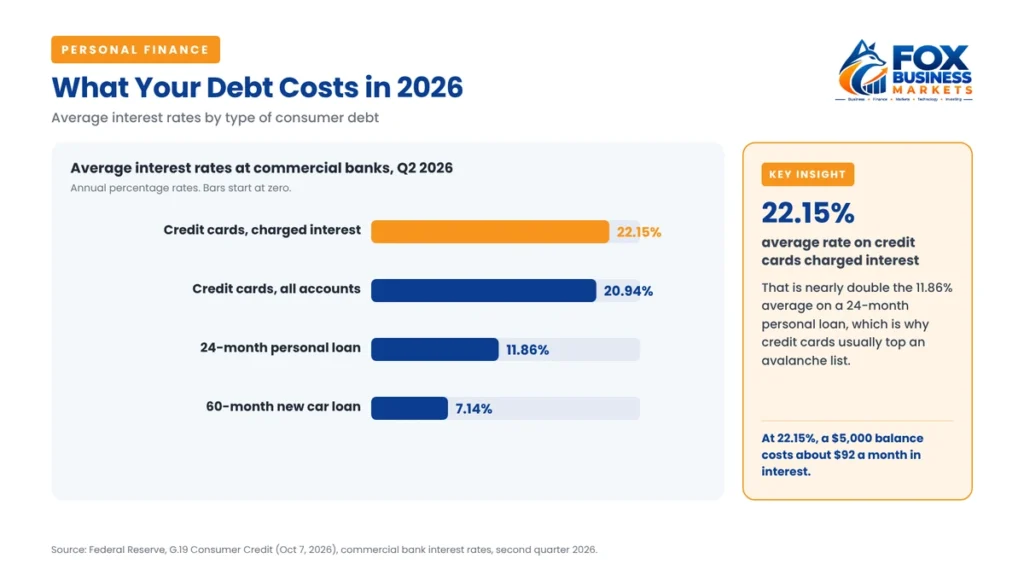
Credit card debt is also the most expensive kind most people carry. The Federal Reserve’s G.19 report put the average rate at commercial banks on credit card accounts assessed interest at 22.15% in the second quarter of 2026. By comparison, a 24-month personal loan averaged 11.86%, and a 60-month new car loan averaged 7.14%. These are rates at commercial banks; online lenders often charge more to borrowers with fair credit.
How to Pay Off Debt Step by Step
Here’s how to pay off debt in seven steps. The method matters less than doing all seven consistently.
Step 1: List Every Debt
Write down each debt with four details: the lender, the current balance, the interest rate (APR), and the minimum payment. Include credit cards, store cards, personal loans, car loans, student loans, medical bills, and buy now, pay later plans. Pull your free credit reports at AnnualCreditReport.com to catch anything you’ve forgotten (some medical bills and buy now, pay later loans won’t appear).
This list is usually the hardest step emotionally. It’s also the one that turns a vague fear into a plan with a finish date.
Step 2: Stop Adding New Debt
You can’t empty a bathtub with the faucet running. Take the cards out of your wallet and remove saved cards from shopping sites. If you don’t have savings, build a small cushion of a few hundred dollars to $1,000 first, so a flat tire doesn’t go straight back on a card. Our guide to building an emergency fund shows how.
Step 3: Pay Every Minimum, Every Month
Missing payments makes everything worse. Late fees pile up, your credit score drops, and according to the Consumer Financial Protection Bureau (CFPB), if you’re more than 60 days late on a payment, “the credit card company can increase your interest rate on all balances.” Set up autopay for at least the minimum on every account, and keep enough in checking to avoid overdraft fees. While you’re at it, call your card issuers and ask about a hardship program or a lower APR. Many offer temporary rate cuts or reduced payments if you ask.
Step 4: Choose Avalanche or Snowball
Pick one debt to attack with all your extra money. The two classic methods are explained in the next section. Either one works far better than spreading small extra payments across everything.
Step 5: Find Extra Money Every Month
The speed of your payoff depends almost entirely on how much extra you can add. Look for it in three places: cut recurring expenses (subscriptions, insurance, phone plans), redirect windfalls (tax refunds, bonuses, the third paycheck in some months if you’re paid every two weeks), and add income if you can. Our guide on how to make a budget helps you find the money.
Step 6: Roll Each Payment Into the Next Debt
When one debt is paid off, don’t absorb that payment into your spending. Add it to the payment on the next debt on your list. This “rolling” is what makes both methods speed up over time.
Step 7: Track Progress and Celebrate Milestones
Update your list every month. Watching the total drop keeps you going through the long middle months. Celebrate each paid-off account with something small that doesn’t involve a credit card.
Avalanche vs. Snowball: Which Debt Payoff Method Is Better?
When you’re deciding how to pay off debt, the avalanche method saves the most money, and the snowball method gives you faster wins. If you’ll stick with either, choose avalanche. If you’ve tried and quit before, the snowball’s early wins may be worth the extra interest.
With the avalanche method, you put extra money toward the debt with the highest interest rate first. With the snowball method, you pay off the smallest balance first, regardless of rate.
Here’s how they compare in an example. Keisha’s three debts are a $1,100 store card at 19.99% APR, a $5,400 credit card at 26.99%, and a $7,000 personal loan at 11.86%. Her minimum payments total $400 a month, and she can put $600 a month toward debt.
| Avalanche | Snowball | |
| First debt targeted | Credit card (26.99%) | Store card ($1,100) |
| First debt paid off | Month 21 | Month 5 |
| All debt paid off | Month 28 | Month 28 |
| Total interest paid | About $2,940 | About $3,069 |
Illustrative example calculated by Fox Business Markets, assuming fixed minimum payments and monthly interest.
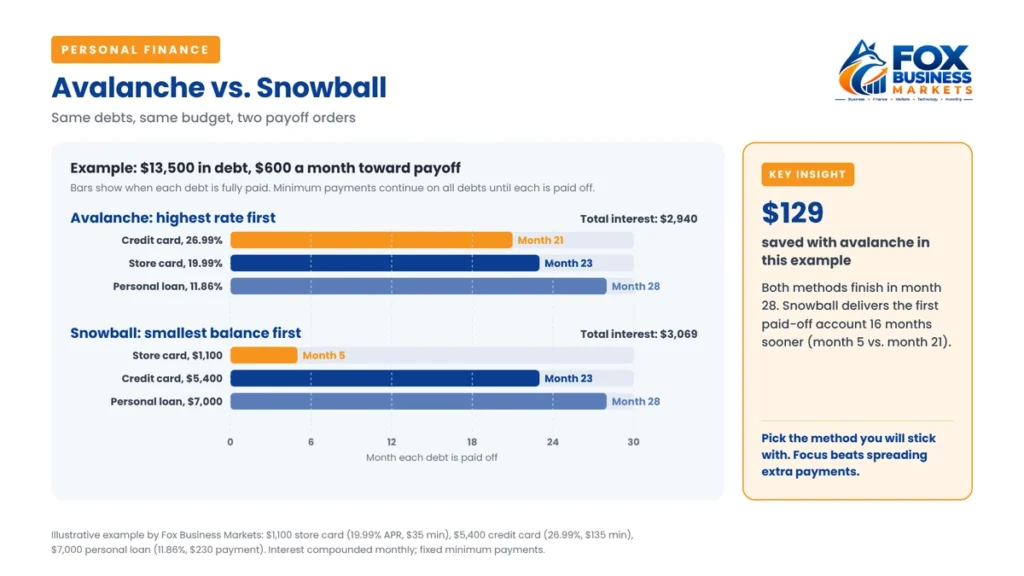
The avalanche saves her about $129 in this example. The snowball gets her first win 16 months sooner. In many real cases, especially when your smallest debt also has a low rate and your largest has a very high one, the gap in interest is much bigger.
Research suggests the snowball’s psychology is real. A 2012 study by David Gal and Blakeley McShane in the Journal of Marketing Research looked at people in a debt settlement program. As Kellogg School of Management summarized it, the researchers found that consumers who pursued the “small victories” strategy “were more likely to eliminate their entire debt balance.” Separately, researchers at the University of Alberta and colleagues found that people who concentrated payments on one account at a time paid down their credit card debt about 15% faster than those who spread payments out.
Here’s an honest opinion: the best method is the one that keeps you paying. If you’re disciplined and motivated by numbers, use the avalanche. If you need to see accounts disappear to stay motivated, use the snowball and don’t feel bad about it.
Why Is Paying Only the Minimum So Expensive?
Paying only the minimum keeps you in debt for years because most of each payment goes to interest. Federal rules under the Credit CARD Act require credit card statements to show a “Minimum Payment Warning”: “If you make only the minimum payment each period, you will pay more in interest and it will take you longer to pay off your balance.” Your statement must also show how long payoff would take and the total cost if you pay only the minimum, plus the monthly payment needed to pay it off in three years.
In Keisha’s example, if she paid only $135 a month on her $5,400 credit card at 26.99%, it would take 104 months, nearly nine years, and cost about $8,556 in interest. Real minimum payments usually shrink as your balance falls, which can stretch the timeline even further. Check the box on your own statement. It’s one of the most motivating numbers you’ll ever read, and it’s why any plan for how to pay off debt starts with paying more than the minimum.
Should You Consolidate Debt or Use a Balance Transfer?
Consolidation can be part of how to pay off debt if it lowers your interest rate and you stop adding new debt. It doesn’t help if you just move balances and then run your cards back up, which is what Keisha did the first time.
There are two common options:
- Balance transfer credit card. You move high-interest balances to a card with a low or 0% promotional rate. The CFPB notes that a card company is permitted to charge a balance transfer fee even on a 0% offer. Transfer fees are typically 3% to 5% of the amount moved. By law, a promotional rate must generally last at least six months, but paying more than 60 days late can end it early. Divide the balance by the number of promo months to see whether you can realistically pay it off before the rate jumps.
- Debt consolidation loan. A debt consolidation loan is money you borrow to repay your separate debts so you make just one payment. With personal loans averaging 11.86% versus about 22% on credit cards, the savings can be real if you qualify for a good rate. But the CFPB warns that “although your monthly payment might be lower, it may be because you’re paying over a longer time.”
The CFPB also cautions that “many companies that advertise consolidation services may actually be debt settlement companies.” Read the terms carefully. And watch store-card “no interest if paid in full” deals: they’re deferred interest, so if you miss the deadline, you owe all the back interest.
Is Debt Settlement or Credit Counseling a Good Idea?
Nonprofit credit counseling is often worth trying before anything else. Debt settlement is risky and should be a last resort before bankruptcy.
Credit counseling. A nonprofit credit counselor can review your budget and may set up a debt management plan. According to the CFPB, “under a debt management plan, you make a single payment to the credit counseling organization each month or pay period,” and the counselor pays your creditors. The FTC says these plans “can take 48 months or more to complete,” and warns that “just because an organization is a non-profit doesn’t guarantee its services are free or affordable, or that it’s legitimate.” Look for agencies affiliated with the National Foundation for Credit Counseling or on the Justice Department’s list of agencies approved for pre-bankruptcy counseling (that approval doesn’t cover their debt management plans).
Debt settlement. Settlement companies negotiate to pay creditors less than you owe, usually after you stop paying them and save money in a separate account. The FTC states plainly that “debt settlement programs can be risky,” you “might not be able to settle all your debts,” and your credit can suffer. Creditors can also sue you while you’re saving up, and interest and late fees keep piling up. Under the FTC’s Telemarketing Sales Rule, for-profit debt relief companies that sell by phone generally can’t charge fees until they’ve settled, reduced, or otherwise changed at least one of your debts, you’ve agreed to that deal, and you’ve made at least one payment under it. A settlement company asking for money up front is a red flag. If you’re considering settlement, talk to a bankruptcy attorney too, because bankruptcy is sometimes the better option.
Forgiven debt can also come with a tax bill. The IRS says canceled debt is generally taxable, and you may receive a Form 1099-C. There are exceptions, including bankruptcy and being insolvent when the debt was canceled (claimed on Form 982).
How Do You Handle Student Loans and Old Debts?
Federal student loans have their own rules, so check your options before you prepay them. Older collection debts have rules too, so be careful before you pay anything.
Federal student loans. A court ended the SAVE repayment plan in March 2026, according to StudentAid.gov, and servicers are notifying former SAVE borrowers through the end of 2026. You have 90 days from your notice to choose a plan, or you’ll be placed in a standard plan. A new Repayment Assistance Plan (RAP) opened for applications on July 1, 2026, according to the Department of Education. If you’re working toward Public Service Loan Forgiveness or income-driven forgiveness, prepaying usually doesn’t help you. If your payment changed this year, log in to StudentAid.gov to confirm your plan before you decide how much extra to put toward student loans versus credit cards. Because most federal student loans carry lower rates than credit cards, they usually come after high-interest debt on an avalanche list.
Old collection debts. Every state has a statute of limitations for suing over debts. Once a debt is “time-barred,” collectors can’t sue or threaten to sue you. But the CFPB warns that “making a partial payment or acknowledging you owe an old debt, even after the statute of limitations expired, may restart the time period.” If you’re sued anyway, you must raise the statute of limitations as a defense in court. Before paying an old debt, get it validated in writing and check your state’s rules.
What Mistakes Slow Down Debt Payoff?
When people learn how to pay off debt, the most common mistakes are the ones that quietly add new debt while you pay off the old:
- No emergency cushion, so every surprise lands back on a card.
- Closing all your paid-off cards at once, which can raise your credit utilization. Consider keeping old no-fee cards open but unused.
- Consolidating without changing habits, then running balances back up.
- Spreading extra money across every debt instead of focusing on one.
- Ignoring the interest rate on new “deals,” like deferred-interest store promotions that charge back interest if you don’t pay in full.
- Paying a debt settlement company before it has settled any of your debts.
Frequently Asked Questions
What is the fastest way to pay off debt?
The fastest way to pay off debt is to put as much extra money as possible toward one debt at a time while paying minimums on the rest. The avalanche method, which targets the highest interest rate first, is usually fastest and cheapest. Cutting expenses, adding income, and sending windfalls to debt make the biggest difference.
Is it better to pay off debt or save money?
Do both in a set order. Build a small emergency cushion of a few hundred dollars to $1,000 first, then get any employer 401(k) match, then attack high-interest debt like credit cards. Once that debt is gone, build a full emergency fund of three to six months of expenses and increase retirement savings.
Does paying off debt improve your credit score?
Usually, yes. Paying down credit card balances lowers your credit utilization, and amounts owed make up about 30% of a FICO score. Paying every bill on time also helps, since payment history makes up about 35%. Closing paid-off cards can lower your score slightly, so consider keeping old no-fee accounts open.
How long does it take to pay off $10,000 in credit card debt?
It depends on your interest rate and payment. At a 22% APR, paying $300 a month would take about four years, while paying $500 a month would take a little over two years. Paying only a shrinking minimum could take well over a decade. Check the minimum payment estimate printed on your credit card statement.
Should I use a debt settlement company?
Usually only as a last resort. The FTC warns that debt settlement can be risky, may not settle all your debts, and can hurt your credit. Forgiven debt may also be taxable. Legally, these companies generally can’t charge fees before they settle a debt. Try a nonprofit credit counselor first.
What debt should I pay off first?
With the avalanche method, pay off the debt with the highest interest rate first, usually credit cards. With the snowball method, pay off the smallest balance first for a quick win. Either way, keep paying all minimums, avoid new debt, and roll each paid-off payment into the next debt on your list.
The Bottom Line
Keisha chose the snowball. Her store card was gone by the end of her fifth month, and she taped the final statement to her refrigerator. She kept going, rolled each payment into the next debt, and stopped using her cards for everyday spending. The drawer of unopened statements is empty now.
That’s how to pay off debt for good: list everything, stop adding new balances, pay every minimum, and pour every extra dollar into one target at a time. The method matters less than the momentum. For the bigger picture, see our personal finance guide, and check our personal finance statistics for the latest data on household debt.