Greg had worked at the same parts plant outside Dayton for eleven years when the email came: his whole shift was being cut, effective in two weeks. He was 52, and he had been through a layoff before, in his thirties, when he’d covered rent with a credit card and spent three years paying it off. This time he opened a savings account he’d quietly fed $250 every two weeks for three years. It held a little under $20,000. He felt sick about the job. He didn’t feel scared about the mortgage. (Greg is a composite example, but his situation plays out in thousands of households every month.)
That difference is what an emergency fund buys you. It doesn’t stop bad things from happening. It stops them from turning into debt.
Quick answer: An emergency fund is cash set aside for unexpected costs like a job loss, car repair, or medical bill. Start with a goal of about $1,000, then build toward three to six months of essential expenses. Keep it in a separate, FDIC- or NCUA-insured savings account and add to it automatically every payday.
What Is an Emergency Fund?
An emergency fund is money you keep set aside, in cash or something just as safe and easy to reach, to cover expenses you didn’t plan for. It’s not a vacation fund, a down payment fund, or an investment account. Its only job is to be there, at full value, on the worst day of your year.
That job matters because surprises are normal. The Federal Reserve’s Economic Well-Being of U.S. Households in 2025 survey found that 59% of adults had at least one major, unexpected expense in the prior 12 months. The most common were a major vehicle repair or replacement (30%), a major house or appliance repair (22%), and an unexpected major medical expense (21%).
How Many Americans Have an Emergency Fund?
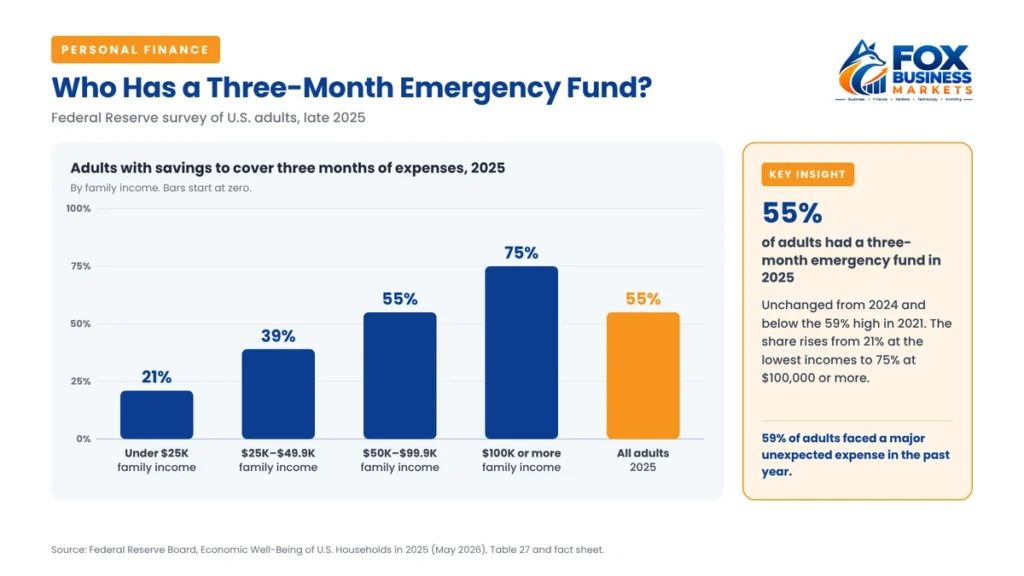
Just over half of American adults have savings big enough to cover three months of expenses. In 2025, 55% said they had set aside money for three months of expenses, according to the Fed’s savings and investments data. That’s unchanged from 2024 but down from a high of 59% in 2021.
Income makes a huge difference. Only 21% of adults with family income under $25,000 had three months of savings, compared with 39% at $25,000 to $49,999, 55% at $50,000 to $99,999, and 75% at $100,000 or more.
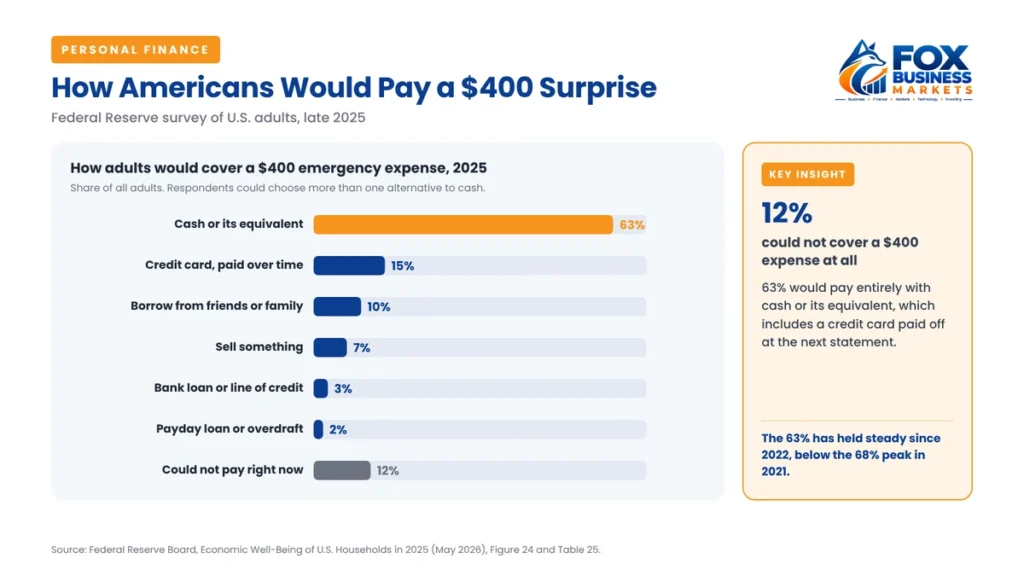
Smaller shocks show the same gap. Sixty-three percent of adults said they would cover a hypothetical $400 emergency expense entirely with cash or its equivalent (which includes a credit card paid off at the next statement). Others said they’d use one or more alternatives: 15% would put it on a credit card and pay it off over time, 10% would borrow from a friend or family member, 7% would sell something, 3% would use a bank loan or line of credit, and 2% would use a payday loan, deposit advance, or overdraft. Twelve percent said they wouldn’t be able to pay for it right now.
How Much Should You Have in an Emergency Fund?
Most people should aim for an emergency fund that covers three to six months of essential living expenses. The Financial Industry Regulatory Authority (FINRA) says that ideally it should “eventually equal about three to six months’ worth of living expenses.” Essential expenses means the bills you’d still pay if you lost your income: housing, utilities, groceries, insurance, transportation, and minimum debt payments.
Why three to six months? Because a job loss is the most expensive emergency most people face. The Bureau of Labor Statistics’ September 2026 jobs report showed that the median unemployed person had been jobless 11.5 weeks; the average, 24.8 weeks. And 27.1% of unemployed people had been looking for work for 27 weeks or more. Unemployment insurance helps, but it typically replaces only part of your paycheck.
Where you should land in that range depends on how fragile your income is:
Your situation | Suggested target | Why |
| Two steady incomes, no dependents | 3 months | One job loss doesn’t stop all income |
| Single income, or kids at home | 6 months | One job loss stops everything |
| Freelance, gig, or commission pay | 6 to 12 months | Income swings even in good years |
| Older worker or specialized field | 6 months or more | Job searches can take longer |
| Homeowner or older car | Add a repair cushion | Big repairs are likely, not just possible |
If three months of expenses sounds impossible right now, that’s normal. Don’t skip the goal. Shrink the first step.
How Do You Build an Emergency Fund Step by Step?
You build one the same way Greg did: small, automatic deposits that you stop noticing. Here’s the process in eight steps.
- Set a starter goal of about $1,000. It’s big enough to cover many common car repairs or appliance breakdowns and small enough to reach in a few months.
- Calculate your essential monthly expenses. Add up rent or mortgage, utilities, groceries, insurance, transportation, and minimum debt payments. Multiply by three and six to get your long-term targets. If you don’t know these numbers yet, start with our guide on how to make a budget.
- Open a separate savings account. Keep it apart from checking so you don’t spend it by accident. Some people deliberately choose a different bank so the money is one step harder to reach.
- Automate a transfer on payday. Even $25 or $50 per paycheck adds up, and it happens before you can talk yourself out of it. The Consumer Financial Protection Bureau (CFPB) has put it simply: “any amount can make a difference and it’s never too late to start.”
- Send windfalls straight to the fund. Tax refunds, bonuses, rebates, and the extra paycheck in months with three pay dates can each make a big jump.
- Cut one recurring expense and redirect it. Cancel a subscription you don’t use, then set up an automatic transfer for the same amount.
- Check your workplace plan. Some employers now offer emergency savings accounts linked to the retirement plan (more on these below).
- Refill it after you use it. Spending the money on an emergency isn’t failure; it’s the point. Restart the automatic transfers as soon as the crisis passes.
Where Should You Keep Your Emergency Fund?
Keep your emergency fund somewhere safe, easy to reach within a day or two, and separate from everyday spending. For most people, that means an FDIC-insured savings or money market account at a bank, or an NCUA-insured account at a credit union. (A money market account at a bank is insured; a money market fund at a brokerage is not.) Both protect up to $250,000 per depositor, per institution, for each ownership category.
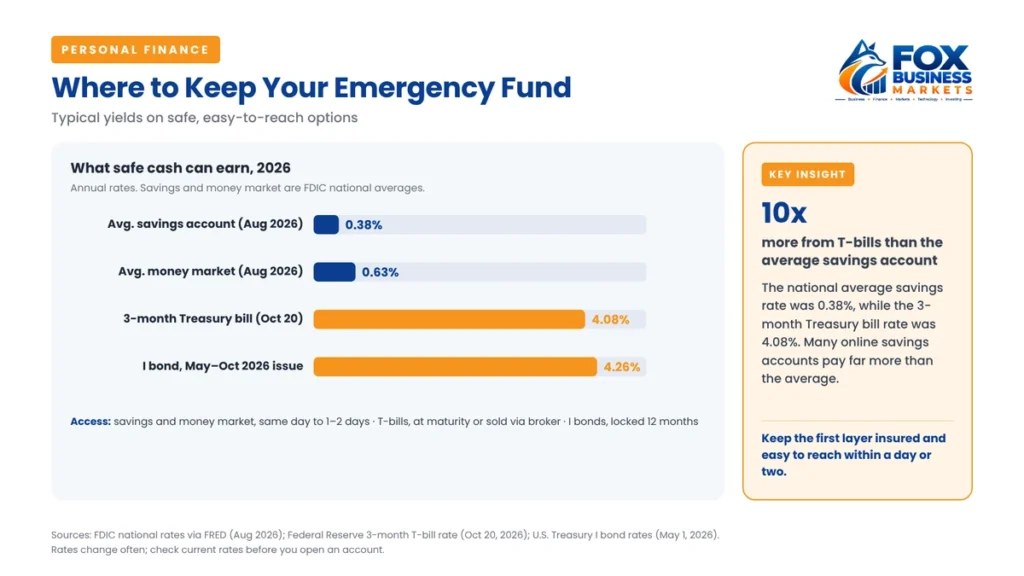
Where you keep it makes a real difference in what it earns. The FDIC’s national average savings rate was just 0.38% in August 2026, and the average money market rate was 0.63%, according to FDIC data published on the St. Louis Fed’s FRED database (savings, money market). Meanwhile, the three-month Treasury bill rate was 4.08% on October 20, 2026, according to Federal Reserve data on FRED. That gap is why it’s worth comparing online savings accounts, which often pay far more than the national average.
Option | Typical access | Insured or guaranteed | Good for |
| Savings or money market account | Same day to 1–2 business days | FDIC or NCUA insured up to $250,000 | Most or all of your fund |
| Treasury bills | When they mature (4 to 52 weeks), or sell early through a broker (TreasuryDirect bills must be transferred first) | Backed by the U.S. government | Larger funds beyond the first few months |
| I bonds | Locked for 12 months; lose 3 months of interest if cashed before 5 years | Backed by the U.S. government | Only money you won’t need for a year |
| Checking account | Instant | FDIC or NCUA insured | A small buffer only; too easy to spend |
| Stocks or stock funds | 1–2 business days | Not insured; can fall in value | Not emergency money |
Series I savings bonds issued from May through October 2026 earn a composite rate of 4.26%, according to Treasury’s I bond rates page. The rate resets every May and November. That’s attractive, but the 12-month lockup means I bonds can’t be the first layer of your savings cushion.
Here’s an honest opinion: don’t invest this money in the stock market to chase higher returns. Stocks tend to fall in exactly the kind of recession that also causes layoffs, so the money could shrink at the moment you need it most.
Should You Build an Emergency Fund or Pay Off Debt First?
Build a small emergency fund first, then attack high-interest debt, then finish building your cushion. Without any cushion, the next surprise goes straight onto a credit card, and the debt you just paid down comes right back.
A common order is:
- Save a starter emergency fund of about $1,000.
- Contribute enough to your 401(k) to get any employer match.
- Pay off credit cards and other high-interest debt.
- Build your savings to three to six months of expenses.
When does this order not work? If your job feels shaky, keep building cash before paying extra on debt, because a layoff with no savings is far more dangerous than a few more months of interest. Our guide on how to pay off debt covers the debt side in detail.
What Counts as an Emergency?
A true emergency is an expense that’s unexpected, necessary, and urgent. Losing your job, a car repair you need to get to work, an urgent medical or dental bill, a broken furnace in winter, or a last-minute flight for a family emergency all qualify.
Things that usually don’t qualify: holiday gifts, a planned vacation, a sale, annual insurance premiums, or car registration. Those are predictable, so they belong in separate savings goals called sinking funds. Ask yourself three questions before you withdraw: Is it unexpected? Is it necessary? Is it urgent? If the answer to any of them is no, find the money somewhere else.
Can You Use Retirement Savings in an Emergency?
You can, but it should be a last resort. Two changes from the SECURE 2.0 Act made retirement plans more useful in small emergencies.
First, many retirement plans can now allow one emergency personal expense distribution per calendar year. According to IRS Notice 2024-55, it can’t exceed the lesser of $1,000 or your vested balance above $1,000, it’s exempt from the 10% early-withdrawal tax, and you can repay it within three years. It’s still taxable income if you don’t repay it. If you don’t repay it, or contribute at least that much again, you can’t take another from that plan for the next three calendar years. Plans aren’t required to offer it, but if yours doesn’t, you may still be able to treat an otherwise allowed distribution, including one from an IRA, as an emergency personal expense distribution on Form 5329.
Second, some employers now offer pension-linked emergency savings accounts (PLESAs). These are Roth accounts tied to a workplace retirement plan, available to employees who aren’t highly compensated. The Department of Labor says withdrawals must be allowed at least once a month, with no fees on the first four each plan year. For 2026, the part of the account balance that comes from your contributions is capped at $2,600, according to IRS Notice 2025-67, and plans can set a lower cap. If your employer offers one, it’s an easy way to automate your first $1,000 or so of savings.
Taking larger amounts out of a 401(k) or IRA early is different. You’ll generally owe income tax plus a 10% additional tax if you’re under 59½ unless an exception applies, and you’ll lose years of growth. Treat it as a true last resort, not a backup plan.
Frequently Asked Questions
How much should I have in my emergency fund?
Aim for three to six months of essential expenses, the range FINRA suggests. Start with about $1,000, then build from there. Households with one income, kids, freelance or commission pay, or a specialized job that’s hard to replace should aim for six months or more, because their income is either less steady or slower to replace.
Where is the best place to keep an emergency fund?
The best place is a separate, FDIC-insured savings or money market account at a bank, or an NCUA-insured account at a credit union. You want safety, quick access, and some interest. Compare rates, because the national average savings rate was just 0.38% in August 2026, while many online accounts pay much more.
Is $1,000 enough for an emergency fund?
A $1,000 emergency fund is a good starting point, not a finish line. It covers many car repairs and small medical bills, so it keeps minor surprises off your credit card. But it won’t carry you through a layoff: the typical unemployed worker had been out of work 11.5 weeks as of September 2026. Keep building toward three to six months.
Should I save for an emergency fund or pay off debt first?
Do both, in order. Save a starter fund of about $1,000 first so new emergencies don’t create new debt. Then focus on paying off high-interest credit cards. Once that’s done, build your savings up to three to six months of expenses. If your job feels insecure, prioritize cash a little longer.
Should my emergency fund be invested?
No. Emergency savings should be in cash or cash-like accounts, not stocks. Stocks can drop sharply during recessions, which is when layoffs are most likely. If your fund is larger than you need for the next few months, you can keep part of it in Treasury bills, but keep the first layer in an insured savings account.
How long does it take to build an emergency fund?
It depends on your income and how much you can save. Saving $100 a week builds a $1,000 starter fund in 10 weeks and about $5,200 in a year. Automating transfers, adding tax refunds and bonuses, and cutting one recurring bill can shorten the timeline. Reaching six months of expenses can take a year or more.
The Bottom Line
Greg found a new job in 14 weeks. He used about $9,000 of his savings to cover the gap after unemployment benefits, and he didn’t put a single bill on a credit card. The week he started his new job, he turned the $250 transfer back on.
That’s the real value of an emergency fund. It turns a layoff, a blown transmission, or a surprise hospital bill from a financial crisis into a hard month. Start with $1,000, automate the deposits, keep the money insured and separate, and build toward three to six months of essential expenses. For the bigger picture on how this fits with budgeting, debt, and investing, see our personal finance guide and the latest personal finance statistics.