Quick answer: A robo-advisor is an online service that builds and manages an investment portfolio for you using algorithms instead of a human advisor. You answer questions about your goals and risk tolerance, and it invests your money in low-cost index funds, rebalances automatically, and usually charges 0.35% a year or less.
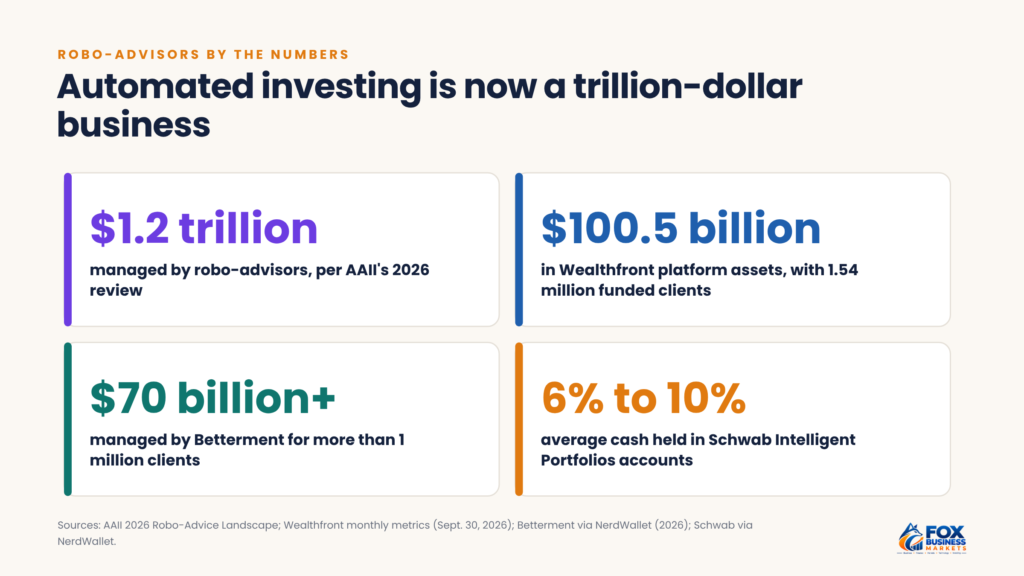
Robo-advisors now manage more than $1.2 trillion, according to the American Association of Individual Investors’ 2026 robo-advice review. The two largest independent players, Wealthfront and Betterment, each serve more than 1 million clients.
Yet the field is shrinking at the edges. UBS, U.S. Bank, JPMorgan, and BlackRock have all closed their robo services in recent years, and Schwab retired its premium hybrid tier in 2026. Low fees attract investors. But they make small accounts hard to profit from, so pricing and features keep changing.
This guide explains how a robo-advisor works, what it costs, how it compares with a human financial advisor, whether your money is safe, and how to pick the right one for your goals.
What Is a Robo-Advisor?
A robo-advisor is a digital investment management service. It uses software to choose an asset mix, buy investments, and keep your portfolio on track, with little or no human involvement.
Most robo-advisors invest in exchange-traded funds (ETFs) that track broad market indexes, such as U.S. stocks, international stocks, and bonds. That approach follows the same principles as index fund investing: diversify widely, keep costs low, and hold for the long term.
Robo-advisors are one corner of fintech, the broader shift of financial services onto apps and websites. The first major U.S. robo-advisors, Betterment and Wealthfront, launched around 2008 to 2011. Large firms such as Vanguard, Schwab, and Fidelity followed with their own versions.
A robo-advisor can manage several account types:
- Individual and joint taxable brokerage accounts
- Traditional, Roth, and SEP IRAs
- Rollover IRAs from old 401(k) plans
- Trust accounts at some providers
- Cash management accounts that hold savings alongside investments
How Does a Robo-Advisor Work?
Most robo-advisors follow the same basic process:
- You answer a questionnaire. The service asks about your age, income, goals, time horizon, and how you’d react if your portfolio dropped 20%.
- It recommends a portfolio. Based on your answers, the algorithm assigns a risk level and a mix of stock and bond funds. A younger investor saving for retirement might get 90% stocks, while someone saving for a home in three years might get mostly bonds.
- You fund the account. You can make a one-time deposit, set up recurring transfers, or roll over an old retirement account.
- It invests and rebalances. As markets move, your mix drifts. The robo-advisor sells what has grown too large and buys what has fallen behind to keep your target allocation. Learn more in our guide on how often to rebalance your portfolio.
- It manages taxes. Many robo-advisors offer tax-loss harvesting in taxable accounts, which sells investments at a loss to offset gains and lower your tax bill.
- It tracks your goals. Dashboards show whether you’re on pace to reach your target and suggest changes if you fall behind.
You can usually change your risk level, add goals, or withdraw money at any time. The software handles the trades.
How Much Does a Robo-Advisor Cost?
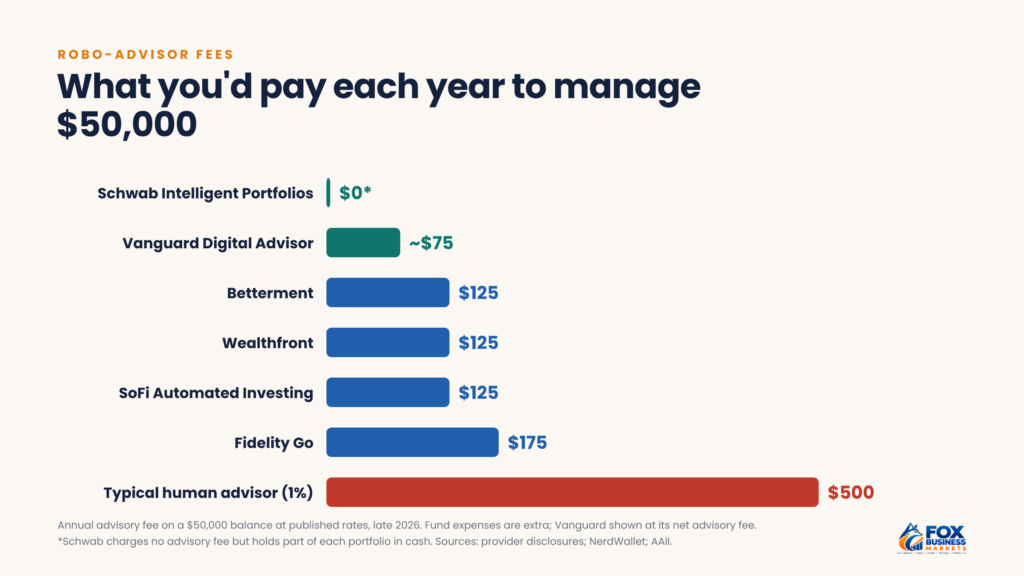
Robo-advisors are much cheaper than most human advisors, but costs vary more than the headline fee suggests. You’ll pay two layers of cost: the advisory fee and the expense ratios of the funds inside your portfolio.
Robo-advisor | Advisory fee | Minimum | Notes |
| Fidelity Go | 0% under $25,000; 0.35% above | $0 | Higher tier adds access to advisors |
| Schwab Intelligent Portfolios | 0% | $5,000 | Holds part of your portfolio in cash |
| Vanguard Digital Advisor | About 0.15% net | $100 | Fund expenses add about 0.05%, for roughly 0.20% total |
| Betterment | 0.25%, or $5 a month under $24,000 unless you deposit $200 a month | $0 | Premium tier adds certified financial planners |
| Wealthfront | 0.25% | $500 | Clients paid 0.22% on average, per its latest earnings |
| SoFi Automated Investing | 0.25% | $50 | Part of the SoFi app |
Fees and minimums as of late 2026. Check each provider’s current pricing before you sign up.
Watch for these hidden costs:
- Flat monthly fees. Betterment’s $5 monthly fee on small balances works out to 0.6% a year on a $10,000 account, according to NerdWallet, more than double its standard rate.
- Cash allocations. A “free” robo-advisor may keep part of your money in cash, where the provider earns interest. Schwab’s portfolios hold roughly 6% to 10% cash for the average client. In 2022, Schwab paid $187 million to settle Securities and Exchange Commission (SEC) charges that it didn’t properly disclose how this cash affected returns.
- Fund expenses. Index ETFs are cheap, often under 0.15%, but they add to the advisory fee.
- Premium tiers. Access to a human planner usually costs more and requires a higher balance.
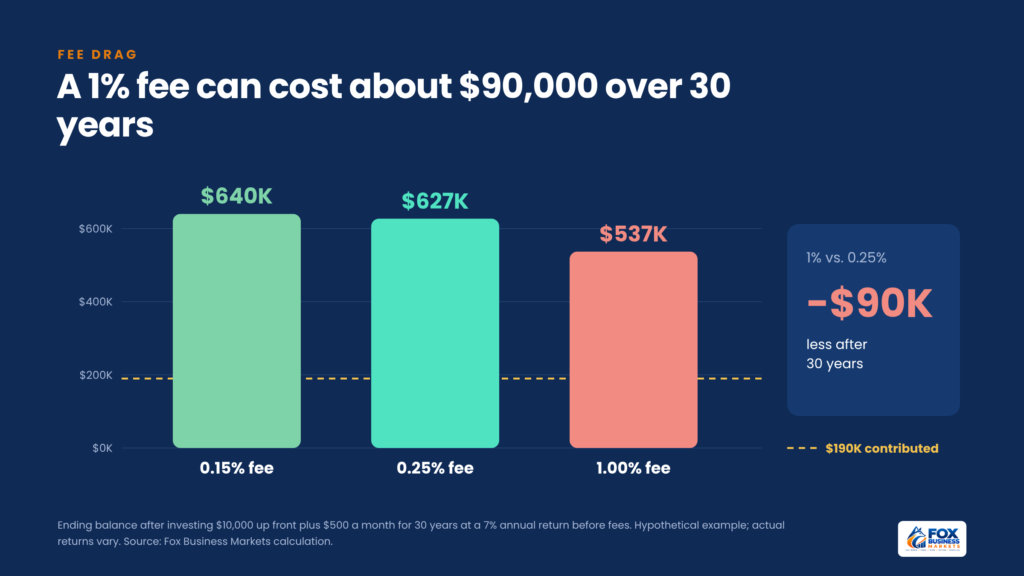
Small fee differences grow over decades. If you invest $10,000 and add $500 a month for 30 years at a 7% annual return before fees, a 0.25% fee leaves you with about $627,000. A 1% fee, common among human advisors, leaves you with about $537,000, a difference of roughly $90,000.
Which Robo-Advisors Are the Biggest?
The largest robo-advisors are a mix of independent fintechs and units of big investment firms.
- Wealthfront reported $99.0 billion in total platform assets and 1.51 million funded clients for the quarter ended July 31, 2026, according to its earnings release. Its monthly update showed $100.5 billion and 1.54 million clients as of Sept. 30, 2026. Platform assets include cash accounts as well as managed investments.
- Betterment reports more than $70 billion in assets under management and more than 1 million clients. It bought Goldman Sachs’ Marcus Invest accounts in 2024.
- Vanguard runs Digital Advisor for smaller accounts and Personal Advisor, a hybrid service with human advisors, for balances of $50,000 or more.
- Schwab Intelligent Portfolios remains one of the few large robo-advisors with no advisory fee.
- Fidelity Go offers free management under $25,000 and added tax-loss harvesting for larger taxable accounts in late 2025.
Newer players are also entering. Robinhood Strategies uses an AI-driven recommendation engine, and several neobanks, including SoFi, offer automated investing inside their banking apps. For more on app-based banks, see our guide to neobanks.
How Does a Robo-Advisor Compare With a Financial Advisor?
The right choice depends on how complicated your finances are and how much guidance you want.
| Robo-advisor | Human financial advisor | |
| Typical cost | 0% to 0.35% a year | Often around 1% of assets, or flat or hourly fees |
| Minimum | $0 to $5,000 | Often $100,000 or more for ongoing management |
| What it handles | Portfolio building, rebalancing, tax-loss harvesting | Investments plus taxes, estate plans, insurance, and retirement income |
| Personal advice | Limited or none | Tailored to your full situation |
| Behavior coaching | Automated nudges | A person who can talk you through market drops |
| Best for | Beginners and hands-off investors with simple goals | People with complex finances, business income, or large estates |
A hybrid option sits in the middle. Services such as Vanguard Personal Advisor and Betterment Premium combine automated portfolios with access to human planners for a higher fee.
If you’re weighing a human advisor, our guide to choosing a financial advisor explains fee structures and how to check credentials.
What Are the Pros and Cons of Robo-Advisors?
Pros
- Low cost. Fees are a fraction of what many human advisors charge.
- Low minimums. You can start with little or no money.
- Automatic discipline. Recurring deposits and rebalancing happen without you having to remember.
- Tax tools. Tax-loss harvesting can add value in taxable accounts.
- Even small accounts get exposure to thousands of stocks and bonds.
- Less emotional investing. The software doesn’t panic-sell during a downturn, though you still can.
Cons
- Limited personalization. A questionnaire can’t capture everything about your life, such as an inheritance, stock options, or a family business.
- Little planning help. Most robo-advisors won’t advise on insurance, estate planning, or Social Security timing.
- Fewer choices. You usually can’t pick individual stocks or change the fund lineup.
- Cash drag on “free” plans. A large cash allocation can lower long-term returns.
- Provider risk. Robo-advisors close, merge, or change pricing, which can force you to move or accept new terms.
Is It a Myth That Robo-Advisors Use AI to Pick Stocks?
Mostly, yes. The name suggests a smart machine trading stocks all day, but most robo-advisors follow simple, fixed rules.
The typical robo-advisor follows fixed rules set by an investment team. It places you in one of a set number of model portfolios, made up of index ETFs, and rebalances when your mix drifts past a threshold. It doesn’t try to predict which stocks will rise or time the market. That approach works in your favor. Decades of research show that most actively managed funds trail their index benchmarks over long periods, largely because of higher costs.
Some providers have started adding AI. Robinhood Strategies is built on an AI recommendation engine, and others use machine learning for customer service, goal forecasting, or tax optimization. But adoption is still limited. Robo-advisors owe clients a fiduciary duty and must be able to explain their recommendations, which may slow the shift to AI.
If a service promises AI that beats the market, treat that as a red flag. Look for clear explanations of how portfolios are built and what you pay.
Are Robo-Advisors Safe?
Robo-advisors are regulated, but your investments can still lose value.
Regulation. Robo-advisors register as investment advisers with the SEC or state regulators. That means they owe you a fiduciary duty to act in your best interest and must disclose fees and conflicts in a document called Form ADV. You can look up any adviser on the SEC’s Investment Adviser Public Disclosure website.
Custody. Your investments are held by a brokerage firm, not mixed with the company’s own money. If the brokerage fails, the Securities Investor Protection Corporation (SIPC) protects up to $500,000 per customer, including $250,000 in cash. If the robo-advisor itself shuts down, your investments typically move to another provider or you can transfer them out.
Market risk. None of these protections covers losses from falling markets. A portfolio with 90% stocks could drop 30% or more in a bad year. Choose a risk level you can stick with, and keep your short-term savings out of the stock market.
Cash sweeps. Cash held in a robo-advisor’s cash account is often swept to partner banks for FDIC insurance. Check how many banks the provider uses, since coverage is limited to $250,000 per bank per ownership category.
What Is Tax-Loss Harvesting, and Do You Need It?
Tax-loss harvesting is one of the main selling points of robo-advisors. When an investment falls below what you paid, the software sells it to lock in a loss and buys a similar fund to keep your allocation. You can use those losses to offset capital gains and up to $3,000 a year of ordinary income, and carry unused losses forward.
It’s most useful if you:
- Invest in a taxable brokerage account, not an IRA or 401(k)
- Are in a higher tax bracket
- Have capital gains from other investments or a business
It adds little value inside retirement accounts, where gains and losses aren’t taxed each year. It also delays taxes rather than eliminating them. The replacement fund has a lower cost basis, so you’ll owe more tax when you eventually sell it.
Watch the wash-sale rule. If you or your spouse buy the same or a substantially identical investment within 30 days before or after the sale in another account, the loss is disallowed. Tell your robo-advisor about outside accounts, or avoid buying the same funds elsewhere.
What Should You Do When the Market Drops?
A robo-advisor can rebalance your portfolio, but it can’t stop you from selling at the wrong time. That’s the biggest risk for many automated investors.
When stocks fall, the software usually sells some bonds and buys more stocks to restore your target mix. That means it’s buying at lower prices, which can help when markets recover. If you withdraw your money or switch to a cash-heavy portfolio during the drop, you lock in the loss and may miss the rebound.
To stay on track during a downturn:
- Check your time horizon. Money you won’t need for 10 or more years has time to recover.
- Keep your emergency savings separate. A cash cushion means you won’t have to sell investments to cover a surprise bill.
- Keep your automatic deposits running. Buying during a dip lowers your average cost over time.
- Revisit your risk level only after things calm down. If a drop kept you up at night, choose a slightly more conservative mix for the future rather than reacting in the middle of the decline.
- Look at the long-term chart, not the daily one. Most robo-advisor apps let you switch to an all-time view of your returns.
Some robo-advisors send messages during market drops explaining what’s happening and encouraging you to stay invested. Those nudges can help you avoid a costly mistake.
Who Should Use a Robo-Advisor?
A robo-advisor is a strong fit if you:
- Are new to investing and want a simple, diversified start
- Prefer to set up automatic deposits and check in a few times a year
- Have a long time horizon, such as retirement or a child’s education
- Want low fees and don’t need help with taxes, insurance, or estate planning
- Have an old 401(k) to roll into an IRA
A human or hybrid advisor may be better if you:
- Own a business, rental properties, or concentrated stock positions
- Are within a few years of retirement and need a withdrawal plan
- Have complex tax situations or estate planning needs
- Know you’ll want a person to talk to during market drops
If you’re just getting started, our guide on how to start investing covers account types and first steps, and our breakdown of Roth vs. traditional IRAs can help you pick the right retirement account to open with a robo-advisor.
How Do You Choose a Robo-Advisor?
Compare providers on these points before you transfer money:
- Total cost. Add the advisory fee, fund expense ratios, and any monthly fee. Check how much of the portfolio sits in cash.
- Confirm the minimum to open and to qualify for features such as tax-loss harvesting or human advice.
- Account types. Make sure the provider supports the accounts you need, such as Roth IRAs, rollover IRAs, joint accounts, or trusts.
- Portfolio options. Look at the funds used and whether you can adjust the mix.
- Tax features. Check whether tax-loss harvesting is included and at what balance.
- Human access. Decide whether you want an option to talk to a planner.
- Regulatory record. Review the provider’s Form ADV and any disciplinary history on the SEC’s adviser search.
Frequently Asked Questions
Can you use more than one robo-advisor?
Yes. Some investors split money between two services to compare results or use different strengths, such as one for an IRA and another for a taxable account. Keep track of your overall asset mix and avoid wash sales across providers. Tip: Track all your accounts together when you calculate your net worth.
How fast can you withdraw money from a robo-advisor?
Most robo-advisors let you request a withdrawal at any time. The service sells investments, and the cash typically reaches your bank in about two to five business days. Selling in a taxable account may trigger capital gains, and IRA withdrawals before age 59½ can bring taxes and penalties. Tip: Request withdrawals about a week before you need the cash, and ask your provider how it picks which shares to sell.
Can a robo-advisor manage your 401(k)?
Not directly in most cases, because your employer’s plan controls the investment options. Some plans offer a managed account service that works like a robo-advisor, and a few robo-advisors give investment suggestions for your 401(k) balance. Once you leave a job, you can roll an old 401(k) into an IRA at a robo-advisor. Tip: Ask your plan administrator whether a managed account option exists and what it costs.
Do robo-advisors offer socially responsible portfolios?
Many do. Betterment, Wealthfront, Vanguard, and others offer portfolios that screen for environmental, social, and governance (ESG) factors or focus on specific themes. These funds can carry slightly higher expense ratios than standard index funds. Tip: Compare the expense ratios and holdings of the ESG portfolio with the standard one before you switch.
Start With One Goal and Let the Software Do the Work
Pick one goal, such as retirement or a home down payment, and open a robo-advisor account for it this week. Set up an automatic monthly deposit, choose a risk level you could live with in a bad year, and leave the rebalancing to the software. Review your progress twice a year, and as your balance grows, compare your total costs with other options. For a wider look at how your accounts fit together, see our guide to building an investment portfolio.
This article is for general information only and isn’t financial, tax, legal, or investment advice. Consider your own situation or talk to a qualified professional before making decisions.

