Quick answer: A neobank is a digital-only financial company that offers checking, savings, and debit cards through a mobile app, with no physical branches. Most U.S. neobanks, such as Chime, aren’t banks themselves. They partner with FDIC-insured banks to hold your money, while a few, such as SoFi and Varo, hold their own bank charters.
Chime opened 12.8% of all new checking accounts among mass-market customers in the second quarter of 2026, more mass-market openings than any other U.S. institution, according to J.D. Power data reported by eMarketer. An app with no branches now opens more new checking accounts for everyday customers than any of the country’s biggest banks.
But most neobanks aren’t actually banks. Their deposits sit at partner banks, and that setup can leave customers exposed when a middle layer fails, as thousands of users learned when banking-as-a-service firm Synapse collapsed in 2024. Some neobanks also earn much of their revenue from fees on cash advances and instant transfers, which can cost more than a “no fees” headline suggests.
This guide explains what a neobank is, how it differs from a traditional bank, which neobanks are the largest in the U.S., how they make money, and how to tell whether your money is protected before you move your paycheck.
What Is a Neobank?
A neobank is a financial technology company that delivers banking services entirely through an app or website. The word “neo” means new, and the model was built to replace the branch with a smartphone.
Most neobanks offer a core set of products:
- A checking or spending account with a debit card
- A savings account
- Early access to direct deposit, sometimes up to two days early
- Fee-free or low-cost overdraft coverage
- Peer-to-peer transfers and bill pay
- Credit-building cards or small cash advances
Neobanks are one type of fintech. They focus on everyday banking, while other fintechs handle payments, investing, or lending.
You’ll also hear terms like “digital bank,” “online bank,” and “challenger bank.” People use these words loosely. In this guide, a neobank means an app-first brand that was built without branches, whether or not it holds a bank charter. An online bank such as Ally also has no branches, but it’s a long-established chartered bank rather than an app-first startup.
How Do Neobanks Work?
Neobanks follow one of two models. The model decides who holds your money and which regulators oversee the company.
| Partner-bank model | Chartered model | |
| Who holds your deposits | One or more partner banks | The neobank’s own bank |
| Is the company a bank? | No, it’s a technology company | Yes, it holds a bank charter |
| FDIC insurance | Pass-through coverage through the partner bank, if records are accurate | Direct coverage, like any insured bank |
| Main regulators | Partner bank’s regulators, plus CFPB and state regulators | OCC or state regulators, FDIC, Federal Reserve, and CFPB (for banks over $10 billion) |
| Examples | Chime, Dave, Current | SoFi Bank, Varo Bank |
Partner-bank neobanks design the app, the brand, and the customer experience. A licensed bank holds the deposits, issues the debit cards, and connects to payment networks. Chime, for example, says its banking services are provided by The Bancorp Bank and Stride Bank, both FDIC members. Your money typically sits in a pooled account at the partner bank, and the neobank or its technology provider tracks how much belongs to you.
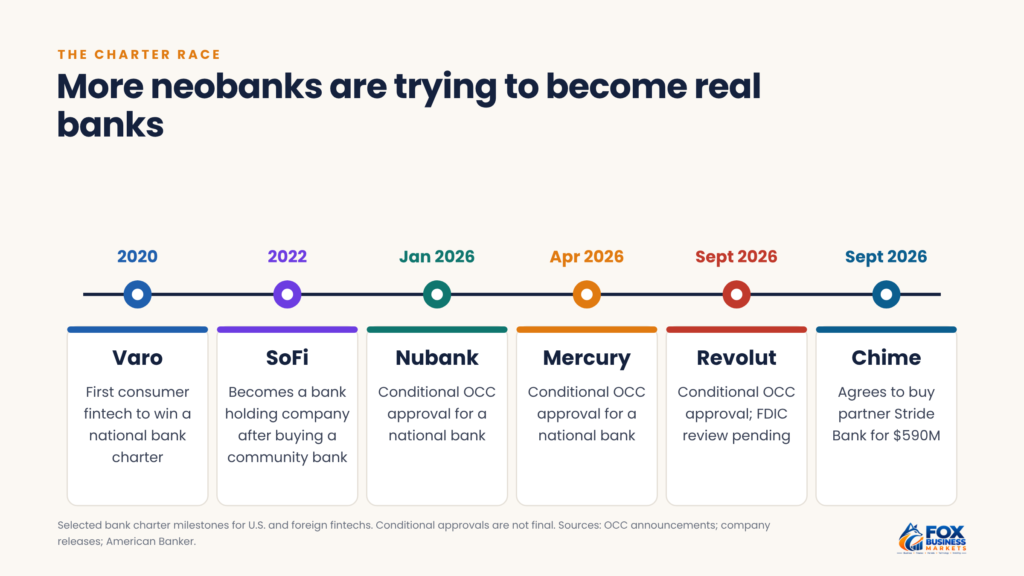
Chartered neobanks have gone through the full process of becoming a bank. Varo received a national bank charter from the Office of the Comptroller of the Currency (OCC) in 2020, and SoFi became a bank holding company in 2022 after buying a small community bank. They hold deposits directly and face the same examinations, capital rules, and liquidity rules as other banks.
Neither model is automatically better. A partner bank can be a well-run, regulated institution. The difference is that a partner-bank setup adds another company, and another set of records, between you and your money.
What’s the Difference Between a Neobank and a Traditional Bank?
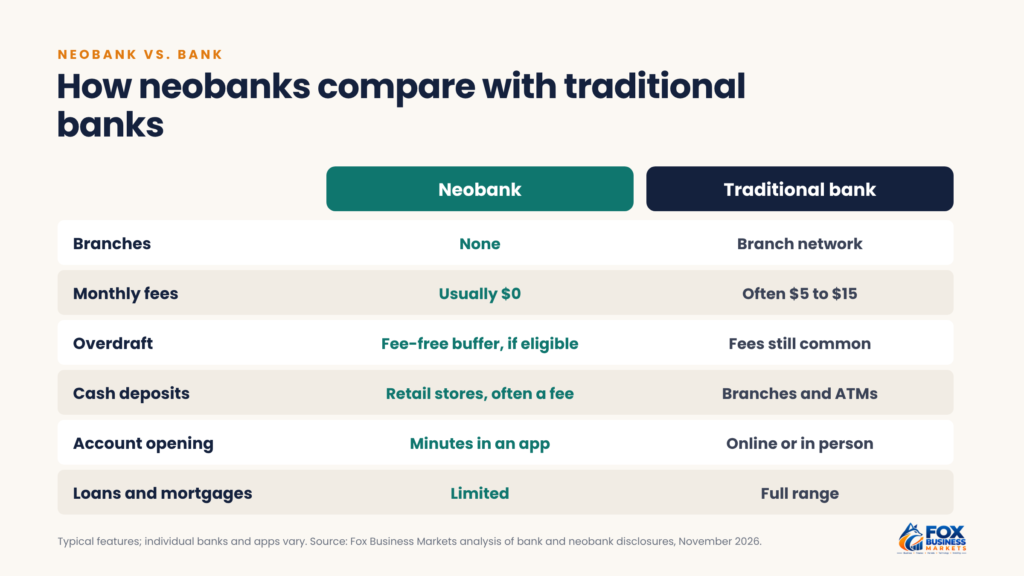
Neobanks and traditional banks offer similar basic accounts. They differ most on fees, cash, and service.
Feature | Neobank | Traditional bank |
| Branches | None | Branch network, sometimes nationwide |
| Account opening | Minutes on a phone | Online or in person |
| Monthly fees | Usually none | Often $5 to $15, waived with conditions |
| Overdraft | Often fee-free coverage up to a set limit | Fees are common, though many banks have cut them |
| Savings rates | Often higher | Often lower at big banks |
| Cash deposits | Through retail stores, often for a fee | At branches and ATMs |
| Product range | Checking, savings, small loans, credit-builder cards | Full range, including mortgages, business accounts, and wealth management |
| Customer service | App chat, email, and sometimes phone | Branch staff, phone, and app |
If you deal with cash regularly, need a mortgage or business banking, or want to sit down with someone when something goes wrong, a traditional bank may still serve you better.
For a refresher on account types, see our guide to banking basics and the difference between checking and savings accounts.
Which Neobanks Are the Biggest in the U.S.?
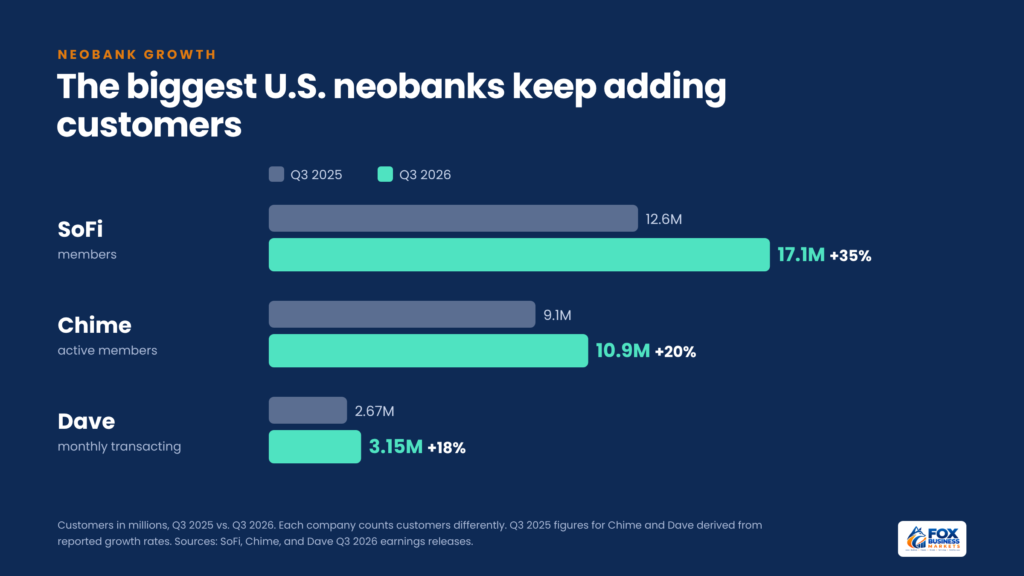
A handful of companies dominate U.S. neobanking. These are the largest after the third quarter of 2026:
- SoFi reported 17.1 million members, up 35% from a year earlier, and $51.3 billion in deposits, according to its third-quarter 2026 earnings release. SoFi is a chartered bank that also offers loans, investing, and credit cards.
- Chime reported 10.9 million active members, up 20%, and $718 million in quarterly revenue, according to its third-quarter 2026 results. Chime works through partner banks and focuses on people who live paycheck to paycheck. In September 2026, it agreed to buy its partner Stride Bank for $590 million, a deal expected to close in the first half of 2027, pending regulatory approval.
- Dave reported 3.15 million monthly transacting members, up 18%, and $198 million in quarterly revenue. Dave is best known for ExtraCash advances of up to $500, though few users qualify for the maximum.
- Varo is a nationally chartered digital bank. It raised $123.9 million in early 2026 but reported a net loss of $20.8 million in the fourth quarter of 2025.
- Current is a partner-bank neobank aimed at younger and lower-income users, with fee-free overdraft and early pay.
Note that each company counts customers differently. SoFi counts all members, Chime counts active members, and Dave counts members who make a transaction each month. Compare the trends, not the raw totals.
How Do Neobanks Make Money?
Our fintech guide covers fintech business models in general. For neobanks, these revenue sources show where costs can reach your account.
- Interchange fees. When you use a debit card, the merchant pays a fee. Partner banks with less than $10 billion in assets are exempt from the federal cap on debit fees, so neobanks that use them can earn more per swipe than large banks. For Chime, card-driven payments revenue, mostly interchange, made up about 62% of third-quarter 2026 revenue.
- Interest on deposits and loans. Chartered neobanks such as SoFi lend out deposits and earn interest on personal loans, student loans, and mortgages.
- Cash advance and instant transfer fees. Some apps charge a fee to get an advance or to receive money right away rather than in a few days. These fees can be high when compared with the size of the advance.
- Premium tiers add perks such as higher savings rates, larger overdraft limits, or extra cash back.
- Optional tips. Some apps ask for a voluntary tip when you take an advance. Tips are optional, but the app may make them the default.
A $5 fee on a $100 advance repaid in a week works out to an annual percentage rate of about 260%. Before you use an advance, compare the total cost with a small personal loan or a credit union’s short-term loan.
What Are the Pros and Cons of a Neobank?
Pros
- Lower fees. Most neobanks charge no monthly maintenance fee and no minimum balance.
- Early direct deposit. Many release your paycheck up to two days early once your employer sends the payroll file.
- Fee-free overdraft buffers. Eligible users can overdraw by a set amount, often between $20 and $200, without a fee.
- Higher savings rates. Neobanks often pay more on savings than large branch banks, similar to a high-yield savings account.
- Easier approval. Many don’t run a hard credit check or use ChexSystems to deny accounts, which helps people who’ve been turned away by traditional banks.
- Strong app tools. Instant alerts, card locking, automatic savings, and spending insights are standard.
Cons
- Limited cash handling. Depositing cash usually means visiting a retailer and paying a fee.
- Account freezes and slow support. Automated fraud systems may lock your account with little warning, and chat-only support can make it slow to fix.
- Fewer products. Few neobanks offer mortgages or business checking.
- Partner-bank risk. If a neobank works through partner banks, your protection depends on accurate records you can’t see.
Is It a Myth That Neobanks Are Riskier Than Traditional Banks?
Partly. The belief that every neobank is risky is a myth, but the risk does depend on the model.
A chartered neobank such as SoFi or Varo is a regulated bank. Your deposits are FDIC-insured directly up to $250,000 per depositor, per bank, per ownership category, just as they would be at a large national bank. Regulators examine these banks the same way they examine any other bank.
A partner-bank neobank adds a layer. Your deposits are covered by pass-through FDIC insurance if the partner bank fails, but only if the records show exactly how much belongs to you. FDIC insurance doesn’t apply if the neobank itself or a technology middleman fails.
That gap became real in 2024, when the collapse of middleman Synapse froze customer funds for months. Because no bank failed, deposit insurance didn’t apply. Our fintech guide covers the case in detail. The episode showed why you should know exactly where your money sits.
The FDIC proposed stronger recordkeeping rules for these pooled accounts in 2024, but a final rule still has no set date.
Why Are Neobanks Applying for Bank Charters?
A wave of fintechs is trying to become banks. In 2026, the OCC granted conditional charters to Brazil’s Nubank (January), business banking app Mercury (April), and the U.K.’s Revolut (September), and other fintechs have applied. Chime is taking a different route: buying its partner, Stride Bank, which would become Chime Bank if regulators approve.
A charter gives a neobank several advantages:
- Control of deposits. It can hold customer money directly instead of paying a partner bank.
- Lower funding costs. Deposits become a cheap source of money for lending.
- More products. It can offer credit cards, loans, and other services directly.
- Fewer middlemen. It removes the partner bank and the recordkeeping risk that comes with it.
The trade-off is tougher oversight. Revolut’s conditional approval, for example, requires at least $95 million in starting capital and a high capital ratio for its first three years, and four products need separate approval before launch. A conditional approval also isn’t final. Each company still needs FDIC deposit insurance approval, and in most cases Federal Reserve approval for its holding company, and must open within a set time.
For customers, more chartered neobanks should mean simpler protection and fewer surprises if a technology partner fails.
How Do Neobanks Protect You From Fraud?
Neobanks face the same fraud threats as traditional banks, and app-only accounts are a common target for scammers. Most neobanks use automated systems that score each login and transaction for risk. That’s why accounts sometimes get frozen without warning.
Your legal protections are the same as at any bank. Under federal rules, if someone uses your debit card or account without permission, your liability is limited if you report it quickly, generally $50 if you report within two business days. Those protections don’t cover payments you authorize yourself, such as sending money to a scammer posing as your bank or a seller.
To protect your account:
- Turn on two-factor authentication and biometric login.
- Set alerts for every transaction, not just large ones.
- Lock your debit card in the app when you’re not using it.
- Never share one-time passcodes. Real neobank staff won’t ask for them.
- Contact support only through the app, not through a phone number in a text or social media post.
If you spot fraud, report it in the app right away and file a written dispute. Keep screenshots and notes of every conversation.
Who Should Use a Neobank?
A neobank is a good fit if you:
- Get paid by direct deposit and want access to your money sooner
- Have been charged repeated overdraft or maintenance fees at a traditional bank
- Have been denied a checking account because of past banking problems
- Want to build credit with a secured or credit-builder card
- Do most of your banking on your phone
- Want a separate account for savings goals or side income
A traditional bank or credit union may be better if you:
- Deposit cash often, such as tips or small-business sales
- Need a mortgage, auto loan, or business account from the same institution
- Want in-person help with disputes, notarizations, or cashier’s checks
- Keep large balances that exceed FDIC limits and need multiple ownership categories
Many people use both. A common setup is a neobank for daily spending and early pay, plus a traditional bank or credit union for larger savings and loans. Keep your emergency fund somewhere you can reach even if one app freezes your account.
How Do You Open a Neobank Account?
Opening a neobank account usually takes 5 to 10 minutes:
- Download the app from the official App Store or Google Play listing, not from a link in a text or ad.
- Enter your personal details, including your name, address, date of birth, and Social Security number. Federal law requires identity checks for every bank account.
- Verify your identity, often by photographing your driver’s license and taking a selfie.
- Read the account agreement, especially the sections on fees, overdraft limits, and account closures.
- Fund the account by linking another bank account, setting up direct deposit, or using a debit card transfer.
- Turn on security features, as described in the fraud section above.
If you’re opening your first account, our guide on how to open a bank account covers the documents you’ll need.
How Do You Choose the Right Neobank?
Run through these checks before you switch your direct deposit:
- Find the bank behind the app. Look for “Member FDIC” and the bank’s name in the app’s disclosures, then confirm the bank on the FDIC’s BankFind tool. If the bank’s name differs from the app’s, the app uses the partner-bank model.
- Compare the full fee schedule. Look beyond monthly fees to out-of-network ATM fees, cash deposit fees, instant transfer fees, and subscription costs.
- Read the overdraft and advance terms. Note eligibility rules, limits, repayment timing, and any tips or express fees.
- Test customer support. See whether you can reach a person by phone, and read recent complaints in the CFPB’s consumer complaint database.
- Check the savings rate and its conditions. Some rates require direct deposit or a paid tier.
- Look at ATM access. Confirm there are fee-free ATMs near where you live and work.
For context on how Americans bank today, see our roundup of banking statistics.
Frequently Asked Questions
Do neobank accounts have routing and account numbers?
Yes. You need them for direct deposit and bank transfers, and you’ll find them in the app’s account settings. At a partner-bank neobank, the routing number usually belongs to the partner bank, not the app. Few neobanks issue paper checkbooks, though some will mail a check for you. Tip: Copy the numbers straight from the app when you set up direct deposit, and update them if the app switches partner banks.
Do neobanks offer joint accounts?
Few do. Most neobanks offer individual accounts only, though some chartered digital banks offer joint checking and savings. A joint account can also raise your FDIC coverage, because joint accounts are a separate ownership category. Tip: If you share bills with a partner, check the joint account option before you move both paychecks.
Can a neobank help you build credit?
Yes. Several neobanks offer secured or credit-builder cards that report to the three credit bureaus. With many of these cards, you spend money you’ve already moved into the account, so you can’t overspend, and some charge no interest. On-time payments can help you build toward a good credit score. Tip: Confirm that the card reports to Equifax, Experian, and TransUnion before you sign up.
Are neobanks good for traveling abroad?
It depends on the app. Some neobanks charge no foreign transaction fee on card purchases, while others charge around 1% to 3%. Out-of-network ATM fees abroad can add up quickly. Tip: Turn on travel notifications and carry a backup card from a different bank in case your neobank card gets blocked.
Test a Neobank Before You Move Your Paycheck
Open a neobank account alongside your current bank, send part of your paycheck there for one or two pay cycles, and see how deposits, transfers, and customer support hold up. Confirm which bank holds your money and whether it’s FDIC-insured. If the app meets your needs, move more of your direct deposit, but keep a second account at a bank or credit union so a frozen app never leaves you without access to cash.
This article is for general information only and isn’t financial, tax, legal, or investment advice. Consider your own situation or talk to a qualified professional before making decisions.

