Quick answer: Buy now, pay later (BNPL) is a short-term loan that splits a purchase into smaller payments, often four interest-free installments every two weeks. Providers such as Affirm, Klarna, and Afterpay pay the merchant up front. Longer plans can charge interest, and missed payments can bring late fees and credit damage.
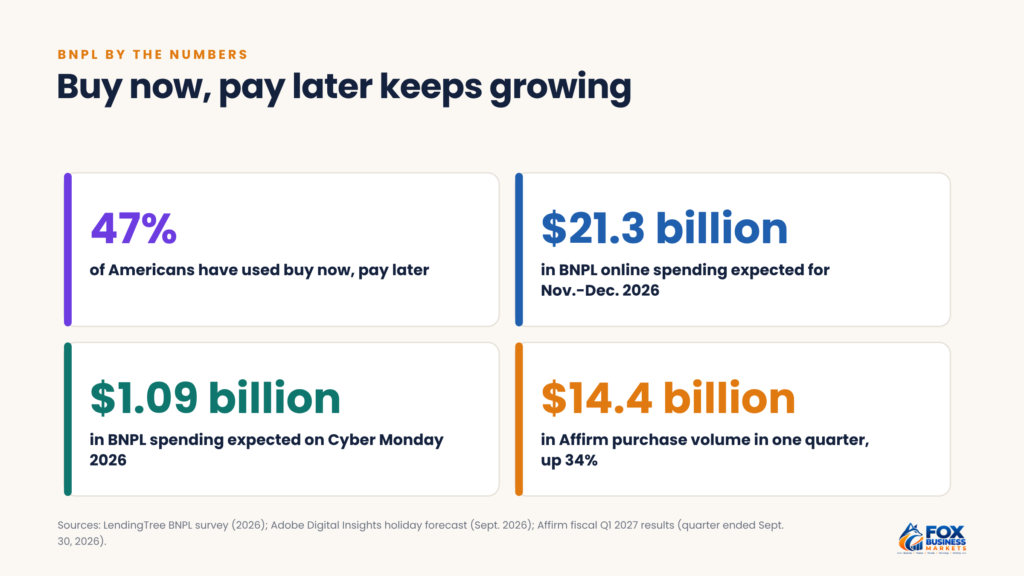
Nearly half of Americans, 47%, have used buy now, pay later, according to a 2026 LendingTree survey. BNPL is expected to drive $21.3 billion in U.S. online spending this November and December alone, up 6.6% from last year, according to Adobe’s holiday forecast.
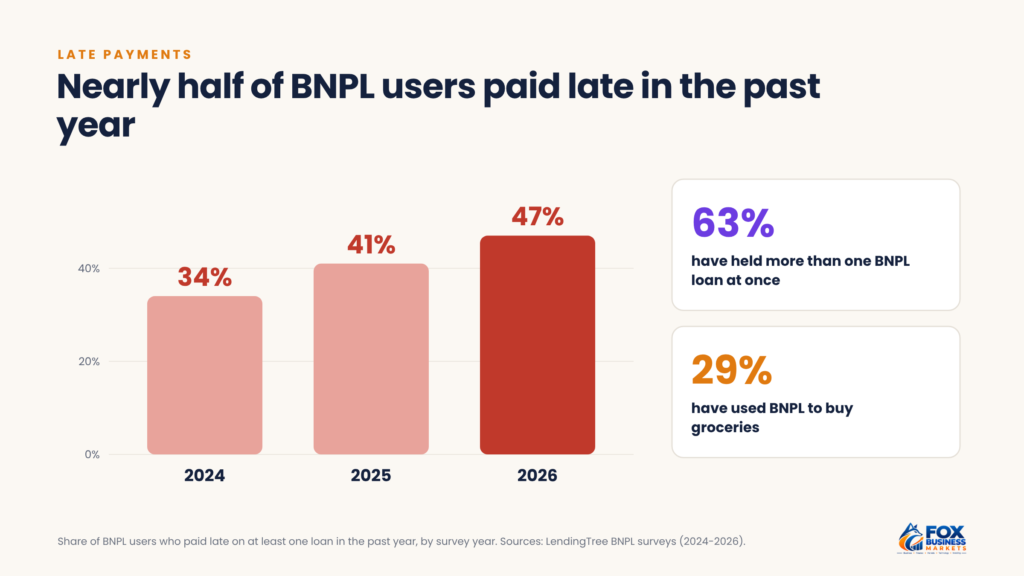
But more users are falling behind. Among BNPL users, 47% paid late at least once in the past year, up from 34% two years earlier. And 29% have used it to buy groceries.
This guide explains how buy now, pay later works, what it really costs, how it affects your credit, how it compares with a credit card, and how to use it without falling behind.
What Is Buy Now, Pay Later?
Buy now, pay later is a type of installment loan offered at checkout. Instead of paying the full price today, you pay a portion up front and the rest over a set schedule. The BNPL company pays the merchant in full and collects the remaining payments from you.
BNPL is part of the broader fintech movement that moved lending from bank branches to apps. It grew quickly during the pandemic as online shopping surged, and it’s now offered by many major retailers.
You’ll find BNPL in several places:
- As a payment option on a retailer’s checkout page
- Inside a BNPL company’s own app, which lets you shop at partner stores
- Through virtual or physical cards that let you split purchases almost anywhere
- In digital wallets and payment services such as PayPal
How Does Buy Now, Pay Later Work?
Most BNPL loans fall into two types:
Pay-in-4 | Monthly installments | |
| Typical purchase size | Under about $1,000 | Larger purchases, often $500 to $10,000 or more |
| Payment schedule | Four payments every two weeks | Monthly, over 3 to 60 months |
| Interest | Usually 0% | 0% promotional or up to about 36% APR |
| Credit check | Usually a soft check | Soft check to prequalify; some report the loan |
| Common uses | Clothing, electronics, everyday items | Furniture, travel, medical bills, large electronics |
A typical pay-in-4 purchase works like this:
- You choose BNPL at checkout and enter basic information, such as your name, phone number, and date of birth.
- The provider makes a quick decision, usually within seconds, based on a soft credit check and your history with the app.
- You pay 25% up front, often with a debit card or bank account.
- The remaining three payments are charged automatically every two weeks.
- The loan is paid off in six weeks, as long as each payment goes through.
For example, a $200 pair of shoes becomes four $50 payments: one today, then one every two weeks. If you pay on time, you pay $200, the same as paying in full.
How Do BNPL Companies Make Money?
If the loan is interest-free, the provider earns money elsewhere:
- Merchant fees. Retailers pay BNPL companies a fee on each sale, often higher than card processing fees. They’re willing to pay because BNPL tends to raise conversion rates and order sizes.
- Longer-term loans can carry interest rates of up to about 36% APR.
- Late fees. Some providers charge fees when a payment is missed.
- Card and subscription products. Providers such as Affirm and Klarna now offer debit cards, savings accounts, and paid memberships.
Because merchants pay the provider, BNPL is pushed hard at checkout, often with messages like “only $25 today.” Small installment amounts can make a purchase feel cheaper than it is.
What Are the Most Popular BNPL Apps?
A handful of companies dominate U.S. buy now, pay later:
Provider | Main products | Late fees | Credit reporting |
| Affirm | Pay in 4 and monthly loans, Affirm Card | None | Reports many loans to Experian and TransUnion |
| Klarna | Pay in 4, pay in 30 days, monthly financing | Up to $7 per missed payment | Reports some loans to credit bureaus |
| Afterpay | Pay in 4, longer-term Pay Monthly | Up to $8 per missed payment, capped at 25% of the order | Doesn’t currently report to U.S. credit bureaus |
| PayPal Pay in 4 | Pay in 4 for purchases from $10 to $2,000 | None | Doesn’t currently report Pay in 4 |
| Zip | Pay in 4 at most online stores | Up to $7, or less in some states | Varies |
Fees and reporting policies change often, so check each provider’s current terms before you borrow.
Affirm, one of the largest U.S. BNPL lenders, reported $14.4 billion in gross merchandise volume for the quarter ended Sept. 30, 2026, up 34% from a year earlier. Its Affirm Card alone handled $3.3 billion, more than double the prior year. Klarna, which went public in 2025, and Afterpay, owned by Block, also process billions of dollars each quarter.
BNPL is also spreading beyond retail checkout. Providers now offer loans for travel, medical and dental bills, car repairs, and even rent and utility payments through partner services. Banks and card issuers have responded with their own installment features, letting cardholders split a past purchase into fixed monthly payments for a fee.
How Much Does Buy Now, Pay Later Really Cost?
BNPL can cost nothing, or it can cost more than a credit card. It depends on the loan type and whether you pay on time.
- Pay in 4, paid on time: You pay only the purchase price.
- Pay in 4, paid late: Late fees can add several dollars per missed payment. On a $100 purchase, an $8 fee is like paying an extra 8%.
- Monthly loans at 0% APR: You pay only the purchase price if every payment is made on schedule.
- Monthly loans with interest: Rates can reach about 36% APR, higher than most credit cards.
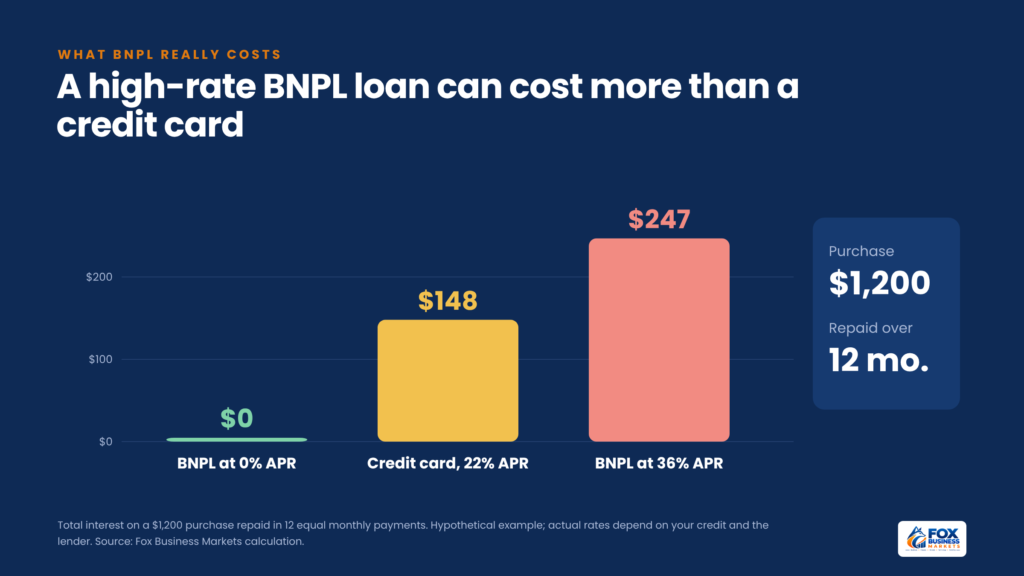
Consider a $1,200 laptop paid off over 12 months:
Option | Interest rate | Total interest |
| BNPL at 0% APR | 0% | $0 |
| Credit card | 22% APR | About $148 |
| BNPL with interest | 36% APR | About $247 |
The 0% option is the cheapest if you qualify and pay on time. But a BNPL loan at 36% APR costs about $100 more than carrying the same balance on a typical credit card.
There are also less obvious costs. Overdraft fees can hit if an automatic payment pulls from a checking account with too little money. Returns can also be slow to process, so you may need to keep making payments until the refund posts.
Does Buy Now, Pay Later Affect Your Credit Score?
It can, in both directions.
Applying. Most pay-in-4 plans use a soft credit check, which doesn’t affect your score. Some longer-term loans use a hard inquiry, which can lower your score by a few points.
Paying. More BNPL loans now appear on credit reports. Affirm reports payment history on its pay-over-time loans to Experian and TransUnion, and Klarna reports its monthly financing loans. On-time payments on reported loans can help your credit history. Late or missed payments can hurt it.
Credit scores. FICO has introduced FICO Score 10 BNPL and FICO Score 10 T BNPL, which factor in BNPL loans. Few lenders use these scores yet, but their arrival means BNPL behavior will likely count more over time.
Collections. If you stop paying, the provider may send your account to a collection agency. A collection account can stay on your credit report for up to seven years and do serious damage to your score.
To protect your credit, read our tips on how to improve your credit score and check your free credit reports for any BNPL accounts you don’t recognize.
Is It a Myth That Buy Now, Pay Later Is Always Interest-Free?
Yes, it’s a myth. Pay-in-4 plans are usually interest-free, but many longer BNPL loans aren’t.
Longer-term BNPL loans, especially for larger purchases, often charge interest. Rates depend on your credit and the merchant’s promotion, and can run as high as about 36% APR. The checkout page may advertise “as low as $45 a month,” without showing the interest rate until you click through.
Some 0% offers also come with conditions. A promotional rate may apply only to certain products or terms, and missing a payment can bring fees even when no interest is charged. Unlike some store credit cards, most BNPL loans don’t use deferred interest, which charges back interest for the whole promotional period if you don’t pay in full. But terms vary, so read the loan agreement before you accept.
Before you choose BNPL, look for three numbers: the APR, the total amount you’ll repay, and the fee for a late payment.
Why Are More People Paying BNPL Loans Late?
LendingTree’s surveys show late payments climbing for two straight years. In 2026, 47% of BNPL users said they had paid late at least once in the past year, compared with 41% in 2025 and 34% in 2024.
Several patterns help explain the rise:
- Loan stacking. Sixty-three percent of BNPL users have held more than one loan at a time, and 25% have held three or more. Each loan has its own schedule and app, so it’s easy to miss one.
- Everyday spending. Twenty-nine percent of users have used BNPL for groceries, up from 14% two years earlier. Using credit for basic needs can signal a stretched budget.
- Fifty-four percent of users said they regretted a BNPL purchase.
- Automatic payments. Autopay is convenient, but a payment that lands before payday can overdraw your account.
If you rely on BNPL for groceries or bills, that’s a sign to revisit your spending plan. Our guide on how to make a budget can help you find room, and our emergency fund guide shows how to build a cushion for surprise costs.
How Is Buy Now, Pay Later Regulated?
BNPL rules are still taking shape, and the action has shifted from Washington to the states.
Federal level. In 2024, the Consumer Financial Protection Bureau (CFPB) said BNPL lenders should give consumers the same dispute and refund rights that credit card users get. In 2025, the CFPB withdrew that guidance and said it would focus its resources elsewhere. Federal consumer lending laws still apply in general, but no federal rule targets BNPL specifically.
New York. New York passed a law in 2025 requiring BNPL lenders to obtain a state license. The state’s Department of Financial Services released draft rules in February 2026 and formally proposed them in July 2026. The rules would cap late and other penalty fees at $8 unless the state approves more, limit interest-bearing BNPL loans to 16% interest, and require lenders to check borrowers’ income and debts. As of November 2026, the rules hadn’t been finalized. They take effect 180 days after final adoption.
Other states. Several states, including California, already license BNPL lenders under existing lending laws, and consumer groups are pushing others to follow New York.
For now, your protections depend largely on your state and your provider’s own policies. Keep receipts and records of every payment, and know how to file a dispute with the provider.
What Should You Do If You Can’t Make a BNPL Payment?
Missing a payment is common, but how you handle it shapes what happens next. Act before the due date if you can.
- Check the app right away. Many providers let you reschedule a payment by a few days, sometimes once per loan, at no cost.
- Contact customer support. Explain what happened and ask about hardship options, a new due date, or a waived late fee. Some providers will work with you, especially on a first missed payment.
- Update your payment method. If an autopay failed because your account was short, switch to a card or account with enough money and pay manually.
- Pause new BNPL purchases. Most providers block new loans while you’re behind, and adding loans in other apps will only make catching up harder.
- Prioritize carefully. Housing, utilities, insurance, and food come first. If several debts are past due, a nonprofit credit counselor can help you build a plan for free or at low cost.
- Watch your credit reports. If the loan is reported, a payment 30 days or more late can appear on your credit report. Check your reports for errors and dispute anything that’s wrong.
Don’t ignore the account. Unpaid BNPL debt can be sold or sent to a collection agency, which adds stress and can damage your credit score for years.
Is BNPL Better Than a Credit Card?
It depends on the purchase and how you pay.
| Buy now, pay later | Credit card | |
| Interest | 0% on pay-in-4; up to about 36% on longer loans | Average rates above 20% if you carry a balance |
| Approval | Soft check, quick decisions | Hard inquiry for new cards |
| Spending limit | Set per purchase | Revolving credit line |
| Rewards | Rare | Cash back, points, or miles on many cards |
| Fraud and dispute protections | Vary by provider | Strong federal protections |
| Credit building | Only if the provider reports | Most issuers report to all three bureaus |
| Best for | A planned purchase you can repay in weeks | Everyday spending you pay off in full each month |
If you pay your credit card in full every month, a card is often the better choice. You get rewards, stronger protections, and a grace period with no interest. BNPL fits better when you want a short, fixed payment plan instead of revolving debt. For more on how Americans use cards and other payment methods, see our credit card statistics and payment statistics.
When Does Buy Now, Pay Later Make Sense?
BNPL can work well when:
- You need a planned purchase now, such as a replacement laptop for work, and can afford the payments.
- The loan is 0% APR with no fees if you pay on time.
- The payments fit within your monthly budget even if an unexpected bill comes up.
It’s a poor choice when:
- You’re using it for groceries, gas, or other everyday needs.
- You already have two or more BNPL loans open.
- The loan charges a high interest rate and you have cheaper options.
- You’re buying something you wouldn’t buy if you had to pay in full today.
How Can You Use BNPL Safely?
Follow these steps before you tap “pay later”:
- Read the terms. Check the APR, total repayment amount, late fees, and whether the loan is reported to credit bureaus.
- Track every loan in one place. Write down each due date and amount, or use a calendar reminder.
- Set autopay from an account with a cushion. Make sure enough money is there a day before each payment.
- Limit yourself to one open loan. Pay it off before you start another.
- Keep receipts for returns. Report a return to the BNPL provider right away so it can pause or adjust payments.
- Don’t use BNPL to cover debt. If you’re behind on other bills, start with a plan to pay off debt
Frequently Asked Questions
Why was I denied for buy now, pay later?
Providers decide each purchase separately. They look at the order size, how you’ve repaid that app before, how many loans you have open, and sometimes a soft credit check. You can be approved one day and declined the next. Tip: Pay down an open loan or try a smaller order, then apply again.
Can you pay off a BNPL loan early?
Yes. Most BNPL providers let you pay off a loan early with no prepayment penalty. On an interest-bearing loan, paying early can save you money because you stop accruing interest. Tip: Check the app for a “pay in full” option and confirm the loan shows a zero balance afterward.
Can you use buy now, pay later in physical stores?
Often, yes. Many providers offer virtual cards you can add to Apple Pay or Google Pay, and some issue physical cards. Some retailers also show a QR code at the register that starts a BNPL application on your phone. Tip: Set up the card in the provider’s app before you get to the store so checkout goes smoothly.
Can businesses use buy now, pay later?
Yes. Business-to-business BNPL lets companies buy supplies or inventory now and pay over 30 to 90 days, similar to net payment terms on an invoice. Some providers also let sellers offer BNPL to their business customers. Tip: Compare the fees with your supplier’s own payment terms and see our guide on how to invoice for setting terms with your clients.
Set a BNPL Limit Before Your Next Checkout
Decide now how much buy now, pay later debt you’re willing to carry, ideally no more than one loan at a time. Open each BNPL app on your phone, list every outstanding balance and due date, and pay off any loan you can before taking a new one. Then make BNPL a deliberate choice for planned purchases, not a reflex at checkout.
This article is for general information only and isn’t financial, tax, legal, or investment advice. Consider your own situation or talk to a qualified professional before making decisions.

