Quick answer: To start a digital marketing business, pick one or two services you can deliver well, such as SEO, paid ads, or social media, and focus on a specific type of client. Form an LLC, use written contracts, price your work as monthly retainers, build a small portfolio, and win your first clients through outreach and referrals.
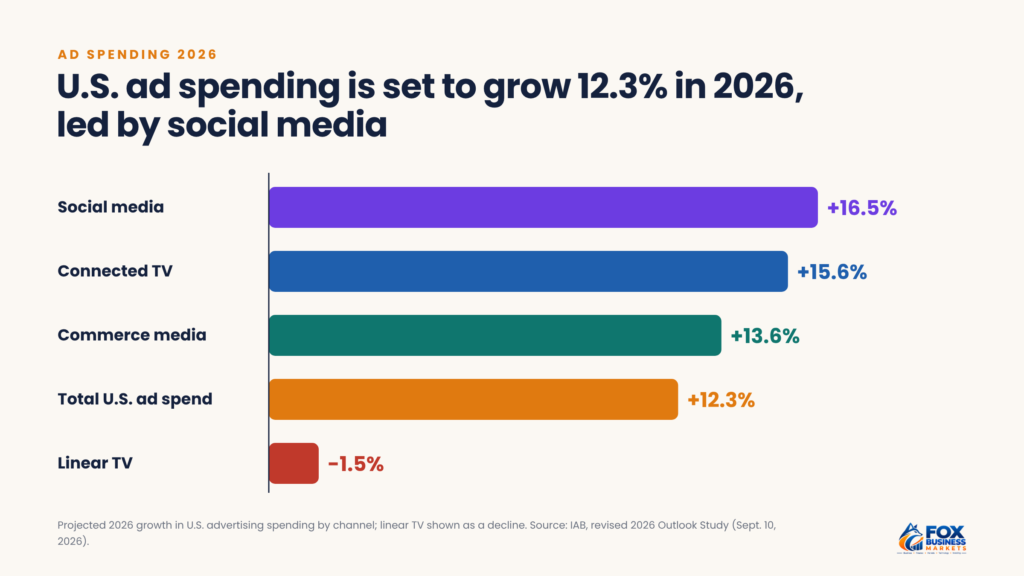
The Interactive Advertising Bureau (IAB) now expects U.S. ad spending to grow 12.3% in 2026, up from the 9.5% it projected in January, with social media leading at 16.5%, according to its revised 2026 forecast. Businesses are putting more money into digital channels, and many of them need outside help to spend it well.
That demand doesn’t make a digital marketing business easy to build. Startup costs are low, which means competition is high: freelancers, agencies, and AI tools all chase the same small-business budgets. The businesses that last pick a clear niche, deliver measurable results, and run the operation like a real company rather than a side gig.
This guide covers how to choose your services and niche, what it costs to get started, how to price your work, the legal setup you’ll need, how to land your first clients, and how to grow from a one-person freelance shop into an agency.
What Is a Digital Marketing Business?
A digital marketing business helps other companies attract and keep customers online. That can include search engine optimization (SEO), paid search and social ads, social media management, content marketing, email marketing, and website design.
There’s more than one way to run one. The model you choose shapes your income, workload, and how easily the business can grow:
Model | How it works | Best for |
| Freelancer | You deliver the work yourself for a handful of clients | Testing the business with low risk |
| Consultant | You advise on strategy; the client’s team or other vendors do the work | Experienced marketers with deep expertise |
| Niche agency | A small team serves one industry or one service | Building a business that can grow beyond you |
| Full-service agency | A larger team offers most marketing services | Founders with management experience and capital |
| Productized service | A fixed package at a fixed price, such as “8 blog posts a month” | Founders who want predictable delivery and easier sales |
Many founders start as freelancers or productized-service providers, then add contractors and employees once demand outgrows their own hours.
Is a Digital Marketing Business Worth Starting in 2026?
For the right person, yes. Demand for marketing skills is growing. Employment of market research analysts and marketing specialists is projected to grow 7% from 2025 to 2035, much faster than average, according to the Bureau of Labor Statistics. The median salary for the occupation was $78,760 in May 2025, which gives you a useful benchmark when you set your own income goals.
Advantages: – Low startup costs. You can begin with a laptop, a few software subscriptions, and a website. – Recurring revenue. Monthly retainers create predictable income once you have steady clients. – Location flexibility. Most work can be done remotely. – Clear path to scale. You can add contractors and services as you grow.
Challenges: – Heavy competition, because the barrier to entry is low. – Client churn, since small businesses often cut marketing budgets first when sales slow. – Constant change in search algorithms, ad platforms, and AI tools. – Results pressure. Clients judge you on leads and sales, not effort.
If you enjoy both the creative and analytical sides of marketing, and you’re comfortable selling your services, the business can grow steadily. If you’d rather only do the marketing work, a full-time marketing job may suit you better.
Which Services Should You Offer First?
Start narrow: one or two services, not a long menu. A focused offer is easier to sell, easier to deliver, and easier to prove results with. Common starting services:
Service | What clients get | Skills you’ll need |
| SEO | More organic search traffic and local visibility | Keyword research, on-page and technical SEO, content planning |
| Paid search and social ads | Leads or sales from Google, Meta, and other ad platforms | Campaign setup, tracking, testing, budget management |
| Social media management | Consistent posting, community management, and growth | Content creation, scheduling, platform know-how |
| Content marketing | Blog posts, guides, and other content that attract buyers | Writing, editing, SEO basics |
| Email marketing | Newsletters and automated sequences that drive repeat sales | Copywriting, list segmentation, automation tools |
| Website design | A fast, conversion-focused site | Design, a website builder or CMS, basic analytics |
Choose services that work together. SEO pairs naturally with content marketing, and paid ads pair with landing-page design. Bundles like these raise the value of each client without spreading your skills too thin. Our guide to digital marketing for small business shows how your future clients think about these channels, which helps you pitch them.
Plan for AI in your delivery, too. Clients can draft posts and ad copy with free tools, so they pay you for strategy, judgment, and results rather than volume. Use AI to speed up research, first drafts, and reporting, then spend the saved hours on testing and client communication. Tell clients how you use it, and have a person edit everything you publish.
How Do You Choose a Niche for Your Digital Marketing Business?
A niche simplifies the business: your marketing speaks to one audience, your case studies are relevant to every prospect, and you learn what works faster. You can niche by industry, by service, or both.
- Industry niches: dentists, law firms, home services such as HVAC and roofing, restaurants, real estate agents, e-commerce brands, or software companies.
- Service niches: Google Ads only, local SEO only, or email marketing for online stores.
- Combined niches: “Google Ads for plumbing companies” or “SEO for personal injury lawyers.”
Use four questions to pick one:
- Do businesses in this niche have marketing budgets? Industries with high customer value, such as legal, dental, and home services, can afford ongoing help.
- Can you reach decision-makers? Owners of local service businesses are easier to contact than marketing teams at large companies.
- Do you have an edge? Past work, industry experience, or personal connections give you credibility.
- Can you show measurable results? Leads, booked calls, and sales are easier to prove than brand awareness.
You can always widen your niche later. It’s much harder to stand out if you start by serving everyone.
How Much Does It Cost to Start a Digital Marketing Business?
It’s one of the cheaper businesses to start. Typical first-year costs for a solo founder:
Cost | Typical range | Notes |
| Business formation (LLC) | $35 to $500 to file | Some states add annual fees; California charges an $800 minimum annual tax |
| Website and domain | $100 to $500 a year | Your site is your first portfolio piece |
| Marketing software | $100 to $500 a month | SEO tools, scheduling, email, design, reporting |
| Business insurance | Varies | Get quotes for professional liability (errors and omissions) |
| Contracts and legal templates | $0 to $1,000 | Templates or a one-time attorney review |
| Accounting and invoicing | $0 to $50 a month | Many invoicing tools have free tiers |
Using the ranges above, first-year costs run from roughly $1,300 to $8,600 before insurance, and most of that is software. Start with free or entry-level plans and upgrade only when client work requires it. Our startup cost calculator helps you total your own estimate, and our guide on how to start a small business covers the general setup steps.
How Should You Price Digital Marketing Services?
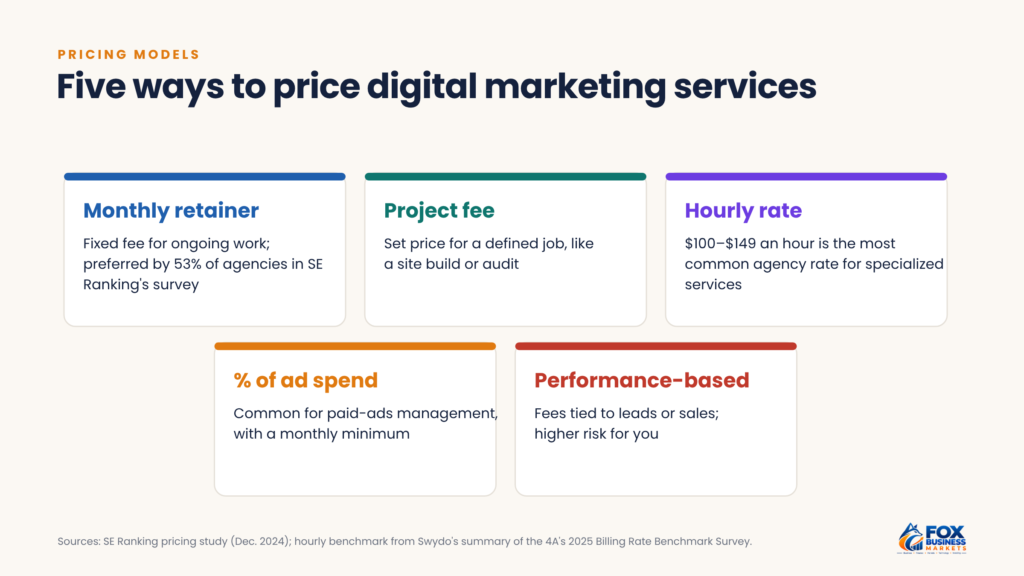
Pricing is where many new digital marketing businesses go wrong, usually by charging too little. The main pricing models:
- Monthly retainer: a fixed monthly fee for ongoing work that gives you predictable revenue. In SE Ranking’s survey of SEO and marketing agencies, 53% of participants said they prefer monthly retainers over other pricing models.
- Project fee: a set price for a defined project, such as a website build or SEO audit.
- Hourly rate: common for consulting and small tasks. The most common rate for specialized agency services fell between $100 and $149 an hour, according to Swydo’s summary of the American Association of Advertising Agencies (4A’s) 2025 Billing Rate Benchmark Survey.
- Percentage of ad spend: often used for paid-ads management, usually alongside a monthly minimum. Pricing guides such as Swydo’s put management fees at roughly 10% to 30% of spend, with smaller budgets paying the higher percentages.
- Performance-based: fees tied to leads or sales. It can be attractive to clients, but it’s risky for you if tracking or the client’s sales process is weak.
Small-business budgets are often modest. In SE Ranking’s December 2024 pricing study of 260 agencies, the most popular SEO price range was $500 to $1,000 a month, and most of the agencies surveyed serve small or local businesses. As your results and case studies grow, raise prices for new clients.
To set a retainer, work from your hours. Estimate the hours each client needs per month, multiply by your target hourly rate, add that client’s share of your software, then add 20% on top to cover sales and admin time you can’t bill. For example, 12 hours at $100 is $1,200. Add $150 for tools to reach $1,350, and the 20% markup brings the fee to about $1,620, which you might round to $1,600.
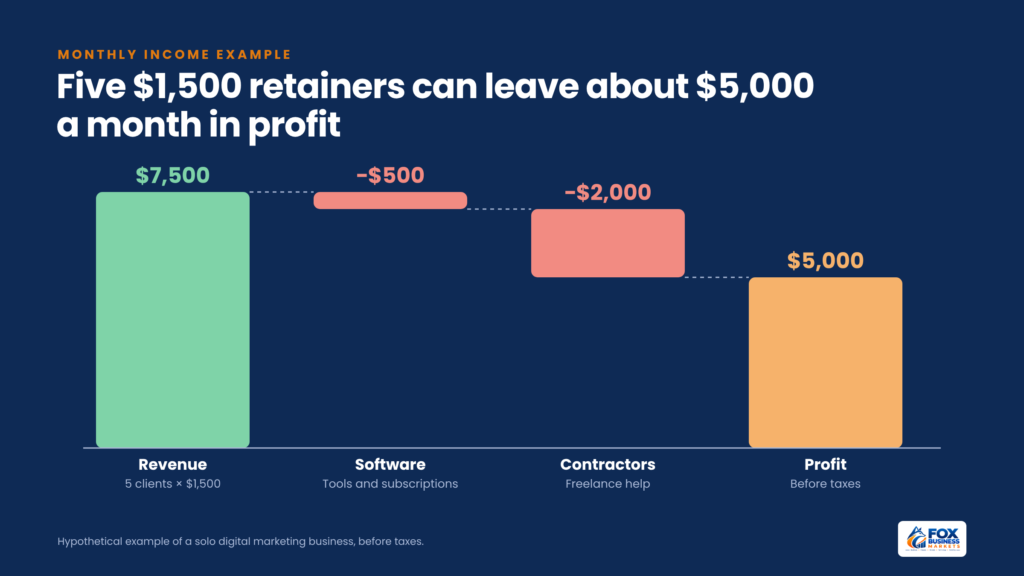
A simple income example: five clients paying $1,500 a month bring in $7,500 in monthly revenue. If you spend $500 a month on software and $2,000 on a freelance writer or ad specialist, you keep about $5,000 before taxes, or $60,000 a year. Adding three more clients at the same price, with one more $2,000 contractor, brings revenue to $12,000 a month and take-home to about $7,500, or $90,000 a year. Compare either figure with the $78,760 BLS median salary above, and remember that you’ll pay for your own health insurance and retirement, plus self-employment tax. Our business revenue calculator lets you test your own numbers. Our marketing statistics roundup and guide to how much advertising costs give you data to share with prospects when you explain budgets.
How Do You Set Up the Business Legally?
A clean legal setup protects you and makes clients more comfortable signing.
- Choose a business structure. Many solo founders form a limited liability company (LLC) to separate business and personal liability. Our comparison of LLC vs. corporation explains the trade-offs.
- Get an EIN and a business bank account. An employer identification number from the IRS is free, and a separate account keeps your books clean.
- Use written contracts. Every client should sign an agreement covering scope of work, deliverables, fees, payment terms, ownership of ad accounts and content, and how either side can end the relationship.
- Get insurance. Professional liability coverage can help if a client claims your work caused them a loss.
- Plan for taxes. As a self-employed owner, you’ll generally make quarterly estimated tax payments if you expect to owe $1,000 or more. Self-employment tax for Social Security and Medicare is 15.3%, applied to 92.35% of net earnings, before any income tax. Set aside a fixed share of every payment, often 25% to 30%.
- Follow marketing rules. The Federal Trade Commission requires clear disclosure of paid endorsements and influencer posts, and the CAN-SPAM Act sets rules for commercial email, including a working unsubscribe option and honoring opt-out requests within 10 business days.
How Do You Get Your First Digital Marketing Clients?
Your first clients will usually come from direct effort, not inbound leads. Proven ways to land them:
- Build proof first. Grow your own website’s traffic, run a small ad test for a friend’s business, or do one discounted project in exchange for a detailed case study and testimonial.
- Start with your network. Tell former employers, colleagues, and local business owners what you offer and who you help.
- Do targeted outreach. Pick 50 businesses in your niche, review their website, search rankings, or ads, and send each one a short note with one specific improvement.
- Partner with complementary businesses. Web designers, developers, accountants, and business coaches often refer clients who need marketing help.
- Use freelance platforms carefully. They can help you win early projects, but fees and price competition make them a weak long-term channel.
- Publish what you know. Short posts on LinkedIn or your own blog showing real results build trust with prospects in your niche.
Once you land a client, focus on retention. Send a clear monthly report that ties your work to leads or sales, and schedule a regular review call. At $1,500 a month, a client who stays two years brings in $36,000, while three clients who each leave after three months bring in $13,500 combined.
Start every client with structured onboarding. In the first week, get admin access to their website, analytics, ad accounts, and Google Business Profile. Record baseline numbers such as monthly leads, traffic, and cost per lead, and agree in writing on the two or three metrics you’ll report. That baseline lets your month-three report show progress instead of activity, and it protects you if results are slow to arrive.
Is a Digital Marketing Business Easy Passive Income?
No. Online ads often pitch “agency in a box” courses that promise passive income from clients you’ll never talk to, but that’s not how successful marketing businesses work.
Client work is active. You need to sell, deliver results, report on performance, and handle feedback, often across several accounts at once. Even agencies that use white-label partners or contractors still own the client relationship and the results.
The business can become more hands-off over time, but only after you build systems: documented processes, reliable contractors or employees, and a steady flow of new clients. Plan on several years of active work before that point. Treat any program that promises easy, passive agency income as a sales pitch, not a business plan.
How Do You Grow From Freelancer to Agency?
Once you’re turning away work or your hours are maxed out, it’s time to build a team:
- Document your processes. Write step-by-step checklists for onboarding, monthly delivery, and reporting so someone else can follow them.
- Add contractors before employees. Freelance writers, designers, and ad specialists let you add capacity without fixed payroll.
- Raise prices as you add staff. Your rates need to cover other people’s time plus profit.
- Hire for your weakest area first, often delivery, so you can spend more time on sales and client relationships.
- Track the numbers. Watch monthly recurring revenue, client retention, and profit margin per client. Our guide to cash flow management shows how to avoid cash crunches as payroll grows.
A written business plan becomes more useful at this stage, especially if you seek a loan or partner.
What Mistakes Sink New Digital Marketing Businesses?
- Serving everyone. A generic “we do all marketing for all businesses” pitch blends into the crowd.
- Low prices attract difficult clients and leave no room to hire help.
- Skipping contracts. Without clear scope, projects grow while your fee stays the same.
- Holding client ad accounts in your name. Set up ad and analytics accounts in the client’s name so ownership is never in dispute.
- Promising guaranteed results. No one can guarantee search rankings or ad performance. Promise a process and transparent reporting instead.
- Ignoring your own marketing. Your website, case studies, and content are your best sales tools. ## Frequently Asked Questions
Do you need a certification to start a digital marketing business?
No license or certification is legally required in the U.S. Credentials can still help, because they show prospects you understand the platforms. Google (through Skillshop) and HubSpot Academy offer free certifications. Meta’s Blueprint training is free, but its Meta Certified exams carry a fee, about $99 for the associate-level exam in the U.S. Earn the certification for each platform you’ll manage and list it on your website and proposals.
Can you run a digital marketing business from home?
Yes, most solo founders do. If you use part of your home regularly and exclusively for the business, you may qualify for the home office deduction on your federal taxes. Check your city’s zoning and home-business permit rules before you register your home address as your business location.
Who should pay for a client’s ad spend?
The client should pay the ad platforms directly with their own card, while you bill only your management fee. This keeps large ad charges off your books and avoids cash-flow problems if a client pays late. Write this arrangement into every paid-ads contract.
How do you get paid by digital marketing clients?
Most agencies send monthly invoices through accounting or invoicing software and accept bank transfers or card payments. Bill retainers at the start of each month, and ask for a deposit of 25% to 50% on projects before work begins. Set payment terms such as net 15 in your contract, and pause work when invoices go unpaid.
Sign Your First Client in the Next 30 Days
Choose one service and one niche, build a simple website with a clear offer, and create one case study, even if it comes from your own site or a discounted project. Then contact 50 businesses in your niche with a specific idea for each. Set up your LLC, contract, and invoicing so you’re ready to sign the moment a prospect says yes. Our guide on how to create a marketing plan works as a template for your own business and your clients’, and our marketing budget calculator gives prospects a starting budget.
This article is for general information only and isn’t financial, tax, legal, or investment advice. Consider your own situation or talk to a qualified professional before making decisions.


