Quick answer: Hidden water damage is moisture that builds up behind walls, under floors, or above ceilings before you can see it. Watch for stains, bubbling paint, warped flooring, a musty smell, soft drywall, and a rising water bill. Confirm a leak with a water meter test, then trace it room by room with a flashlight and a moisture meter.
The average home can waste more than 9,000 gallons of water a year from leaks, and about 10% of homes have leaks that waste 90 gallons or more every day, according to the EPA’s WaterSense program. Not every leak shows up as a puddle or a drip you can hear.

A burst pipe announces itself. A slow drip behind a dishwasher, a worn wax ring under a toilet, or a pinhole leak inside a wall can run for weeks before a stain or smell gives it away. By then, subfloors, drywall, insulation, and cabinets may already be soaked, and mold may have started.
This guide covers the signs of hidden water damage, where it usually starts in each room, how to confirm a leak with a few at-home tests, how to trace damage back to its source, and a seasonal checklist to catch the next one early.
What Is Hidden Water Damage?
Hidden water damage is any moisture damage that develops out of sight, usually from a slow, steady source rather than a sudden flood. Common culprits include:
- Small leaks in supply lines, drain pipes, and fittings inside walls or cabinets
- Failing seals around toilets, tubs, showers, and sinks
- Appliance leaks under dishwashers, refrigerators, and washing machines
- Roof and flashing leaks that soak attic insulation before reaching the ceiling
- Condensation from air conditioners, ductwork, and cold pipes
- Groundwater seeping through basement walls and slabs
Because the water is slow and out of sight, it can travel along framing and pipes and show up feet away from where it started. That’s why the stain on your ceiling isn’t always directly below the leak.
What Are the Signs of Hidden Water Damage?
Look, smell, touch, and listen. These are the 10 most common warning signs:
| Sign | What it can mean | Where to check |
| Yellow or brown stains | Water seeping through drywall or plaster | Ceilings under bathrooms, around windows, near exterior walls |
| Bubbling, peeling, or cracked paint | Moisture trapped behind the paint | Bathroom walls, behind sinks, near tubs |
| Warped, cupped, or buckling floors | Water under hardwood, laminate, or vinyl | Kitchens, laundry rooms, near dishwashers and toilets |
| Soft or spongy drywall | Prolonged moisture weakening the gypsum | Around tubs, showers, and toilets |
| Musty or earthy smell | Mold or mildew growing out of sight | Under sinks, closets, basements |
| Visible mold spots | Ongoing moisture at or behind the surface | Corners, grout lines, behind furniture |
| Rising water bill | A leak somewhere in the system | Compare bills month to month and year over year |
| Sound of running or dripping water | Water moving when no fixture is on | Walls, ceilings, under floors at night |
| Loose tiles or crumbling grout | Water getting under the tile | Showers, tub surrounds, backsplashes |
| White, chalky residue on concrete | Minerals left by water seeping through | Basement walls and floors |
One sign alone may have another explanation, such as a stain from a past, already-repaired leak. Two or more signs in the same area are a strong reason to investigate.
Where Does Hidden Water Damage Usually Start?
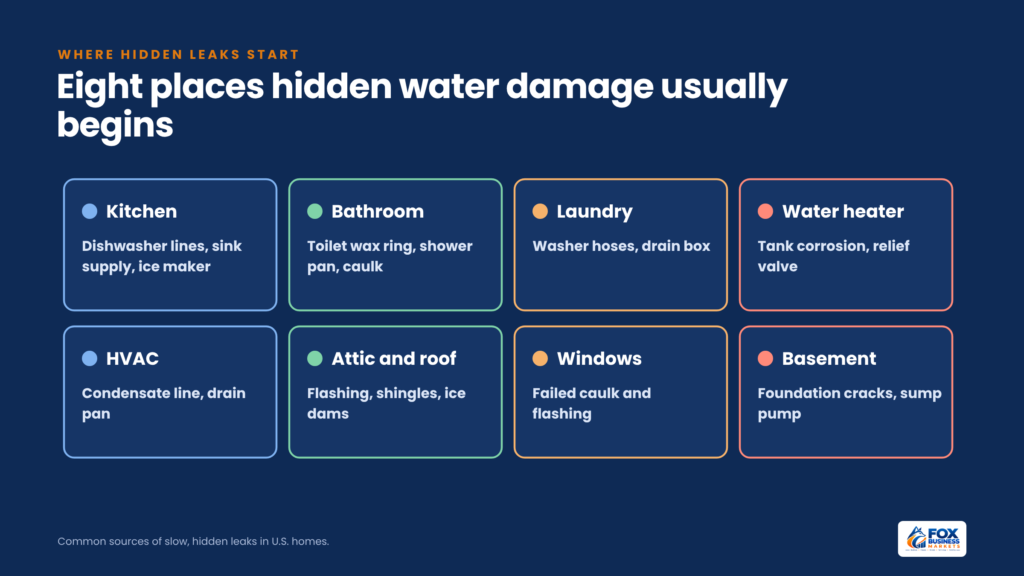
Most hidden leaks start at a handful of predictable spots:
| Area | Common sources | Quick check |
| Kitchen | Dishwasher supply and drain lines, sink supply lines, garbage disposal, refrigerator ice maker line | Look under the sink with a flashlight; pull out the dishwasher kick plate; check behind the refrigerator |
| Bathroom | Toilet wax ring, supply line, shower pan, failed caulk or grout, tub drain | Rock the toilet gently; press on the floor around it; inspect caulk lines |
| Laundry room | Washing machine hoses, drain box, utility sink | Feel hoses for bulges; check the floor behind the washer |
| Water heater | Tank corrosion, relief valve, fittings | Look for rust, puddles, or moisture in the drain pan |
| HVAC | Clogged condensate line, rusted drain pan, sweating ducts | Check the drain pan and nearby ceiling during cooling season |
| Attic and roof | Damaged shingles, flashing around chimneys and vents, ice dams | Look for damp insulation and stained roof decking after storms |
| Windows and exterior walls | Failed caulk, poor flashing, clogged gutters | Look for stains below windows and soft trim |
| Basement and crawl space | Foundation cracks, failed sump pump, poor drainage | Check for damp spots, residue, and puddles after heavy rain |
| Outdoor faucets | Cracked pipe inside the wall behind a hose bib, often after a freeze | Run the faucet and check the inside wall or basement ceiling behind it |
| Under a concrete slab | Pinhole leaks in supply lines below the floor | Feel for warm spots (from a hot-water line); run the water meter test |
Older homes with original plumbing, and any home with fixtures on an upper floor, deserve extra attention.
How Do You Check for a Hidden Leak?
You can confirm most leaks yourself with a flashlight, your water meter, and a few drops of food coloring.
- Do a water meter test. – Turn off every faucet, appliance, and irrigation system that uses water. – Write down the reading on your water meter, or take a photo of it. – Wait one to two hours without using any water. – Check the meter again. If the reading changed, water is leaking somewhere.

- Narrow it down. If your home has a shutoff valve where the main line enters the house, close it and repeat the test. If the meter still moves, the leak may be in the underground line between the meter and the house.
- Test your toilets. Put a few drops of food coloring in each toilet tank and wait 10 to 15 minutes without flushing. Color in the bowl means the flapper is leaking.
- Use a moisture meter. An inexpensive pin or pinless moisture meter lets you compare suspect areas with dry areas nearby. Readings vary by material, so compare drywall to drywall and wood to wood.
- Check your water bill. EPA WaterSense says a family of four that uses more than 12,000 gallons a month in winter probably has a serious leak.
- Consider a thermal camera. Wet areas often show up cooler than surrounding surfaces. Thermal cameras show temperature differences, not water, so professionals confirm cool spots with a moisture meter before opening a wall.
If It Doesn’t Look or Smell Wet, Is It Dry?
Not necessarily. It’s a common belief that once a surface looks and smells normal, the water problem is over. In reality, the surface can dry within a day while the material underneath stays wet for weeks.
Drywall can feel dry on the room side while the back of the panel, the insulation, and the framing are still damp. Hardwood can look flat while the subfloor below it holds moisture. Carpet can feel dry on top while the pad underneath stays wet.
Moisture readings, not appearance, should decide when an area is truly dry. If you’ve had a leak, check the area again a week or two later. A returning stain, a musty odor, or a moisture reading higher than nearby dry areas means the problem isn’t fixed.
How Do You Trace a Stain Back to the Leak?
A stain shows where water ended up, not always where it started. Water runs along joists, pipes, and the top of drywall before it soaks through, so the source can be several feet away.
- Start above and uphill. Check the fixtures directly above the stain first, such as a toilet, tub, shower, or sink on the floor above, then look for pipes or ducts that slope toward the wet spot.
- Mark the edge. Outline the stain lightly with a pencil or painter’s tape and date it. Check again in 24 hours. A stain that grows means an active leak; one that stays the same may be old.
- Run one fixture at a time. Ask someone to run the shower, then the tub, then flush the toilet, then run the sink, while you watch the stain or listen at the wall or ceiling below. The fixture that makes the spot darker or louder is your likely source.
- Test the shower pan. Plug the shower drain, fill the base with about 2 inches of water, mark the waterline, and wait up to 24 hours while checking the ceiling or wall below for damp spots. Tile and grout absorb a little water at first, but a steadily dropping waterline points to a failed pan or liner.
- Use your moisture meter as a map. Take readings in a grid around the stain. The highest readings usually lead toward the source.
- Open a small inspection hole if needed. If the source is still unclear, turn off power to that circuit, check for wires and pipes, and cut a small, shallow, square hole in drywall where the patch will be hidden, such as behind a toilet, inside a vanity, or in a closet. A flashlight and phone camera can show the inside of the wall.
- Fix the source before anything else. Once you know where the water comes from, repair it or call a plumber.
After you’ve found and fixed the source, dry wet areas within 24 to 48 hours, as the EPA recommends to help prevent mold. Never touch outlets, switches, or the electrical panel while standing in water, and call a professional for contaminated water or large affected areas.
Who Can Find a Leak You Can’t?
Some leaks need specialized tools to locate:
| Professional | What they use | When to call |
| Plumber with leak detection equipment | Acoustic listening devices, pressure tests, pipe cameras | The meter test fails but you can’t find the leak |
| Slab leak specialist | Electronic and acoustic locators for pipes under concrete | Warm spots on the floor or the sound of running water under a slab |
| Roofer | Hose tests on sections of the roof, attic inspections | Ceiling stains that appear only after rain |
| Home inspector or moisture specialist | Moisture meters and thermal cameras | You’re buying a home or want a whole-house moisture check |
Ask for a written report of what they found, with photos, so you have records for repairs and any future sale.
How Do You Read a Moisture Meter?
A moisture meter turns a hunch into a number, but the numbers only make sense in context.
- Take a baseline first. Measure a spot of the same material in a dry area of the same room, such as drywall on an interior wall far from plumbing. That’s your “dry” number.
- Compare like with like. Drywall, wood, and concrete read on different scales. Many meters have settings for each material; use the right one.
- Look for the pattern, not one number. A reading noticeably higher than your baseline, especially one that rises as you move toward a fixture or wall, points to moisture.
- Know the two types. Pin meters push two small probes into the material and read moisture at that depth. Pinless meters scan below the surface without leaving holes, which is handy on finished walls and floors.
- Re-check over time. A reading that drops back toward the baseline over several days suggests the area is drying. One that stays high or rises means water is still getting in.
Wood framing and subfloors are generally considered dry when readings fall back to the level of similar, unaffected wood in the home. If you’re unsure, a restoration professional can confirm with commercial meters before you close up a wall or reinstall flooring.
How Much Can Hidden Water Damage Cost?
Slow leaks cost money twice: once in wasted water, and again in repairs.
- Wasted water. A faucet that drips once per second can waste more than 3,000 gallons a year, and a running toilet can waste 200 gallons a day, according to EPA WaterSense.
- Water damage and freezing claims averaged about $15,400 from 2019 to 2023, according to the Insurance Information Institute.
- Insurance gaps. Most homeowners policies cover sudden, accidental water damage, but often exclude slow leaks and long-term seepage, which is exactly what hidden damage tends to be.
Because gradual leaks are often excluded, homeowners typically pay for these repairs themselves. Setting aside money for home repairs in your budget and keeping an emergency fund makes an unexpected repair far less painful. Our overview of types of insurance explains what homeowners coverage usually includes.
How Can You Prevent Hidden Water Damage?
A simple schedule catches most leaks before they cause real damage:
| How often | Task |
| Monthly | Look under sinks and around toilets; check the water heater and HVAC drain pans; compare your water bill |
| Every 3 months | Run a water meter test; check washing machine and dishwasher hoses; test toilets with food coloring |
| Every spring and fall | Clean gutters and downspouts; inspect caulk around tubs, showers, and windows; check the attic after storms; test the sump pump |
| Every year | Inspect the roof and flashing; flush the water heater; check exterior grading so water drains away from the foundation |
| Every 3 to 5 years | Replace washing machine hoses, including braided stainless steel ones, and inspect them for bulges or corrosion in between |
A few upgrades make prevention easier:
- Water leak sensors placed near the water heater, washing machine, dishwasher, and sinks send an alert when they detect water.
- Automatic shutoff valves can close the main water line when a leak is detected.
- A hygrometer shows whether a basement or bathroom stays damp enough to hide condensation problems; readings that stay above 60% are a reason to look for a moisture source.
- Pipe insulation on exposed pipes in garages, crawl spaces, and exterior walls reduces condensation and freezing.
Frequently Asked Questions
Can hidden water damage make you sick?
It can contribute to health problems if it leads to mold. Mold exposure can cause stuffy noses, eye irritation, coughing, and wheezing, and it’s more serious for people with asthma, allergies, or weakened immune systems. If anyone in your home has symptoms that improve when they leave the house, have the home checked for moisture and mold.
Will a home inspection find hidden water damage?
A standard home inspection is visual, so inspectors look for stains, soft spots, and other signs, and many use moisture meters. They usually won’t open walls or move furniture. If you’re buying a home with signs of past leaks, ask for a separate moisture or mold inspection before closing.
Do you have to disclose past water damage when selling a house?
Most states require sellers to disclose known material defects, and water damage and mold are commonly listed on disclosure forms. Rules vary by state. Keep records of repairs, invoices, and moisture readings so you can show the problem was fixed.
Can a slab leak cause hidden water damage?
Yes. A leak in a water line under a concrete slab can soak flooring and the soil beneath the house for months. Signs include warm spots on the floor if a hot-water line is leaking, the sound of running water with every fixture off, damp carpet or warped flooring with no obvious source, and a rising water bill. If the meter test fails and you can’t find a leak inside, ask a plumber for electronic slab-leak detection before anyone breaks concrete.
Do a Quick Leak Check This Weekend
Grab a flashlight and walk through your kitchen, bathrooms, laundry area, and basement. Look under every sink, around every toilet, and behind the washer and dishwasher, then write down your meter reading before bed and check it first thing in the morning, before anyone runs water. If anything turns up, photograph it, mark the edge of any stain with painter’s tape, and call a plumber if you can’t reach the source.
This article is for general information only. For electrical hazards, contaminated water, structural damage, or widespread mold, consult a qualified professional.


