
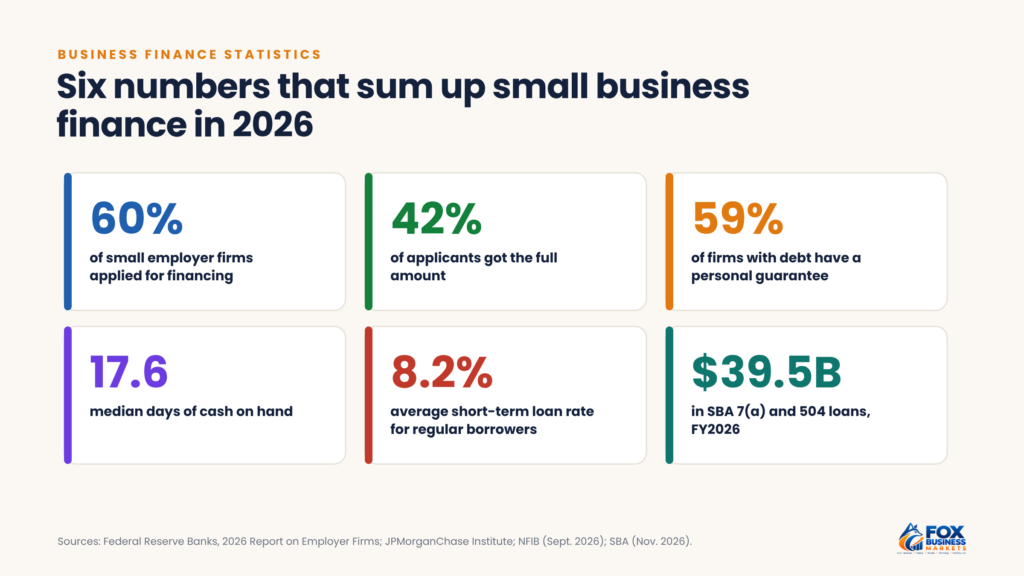
Quick answer: Sixty percent of small employer firms applied for financing in the latest Federal Reserve survey, and 42% of applicants got the full amount they sought. The SBA backed $39.5 billion in 7(a) and 504 loans in fiscal 2026. The typical small business holds about 18 days of cash, and 59% of firms with debt have personal guarantees.
Fifty-six percent of small employers that applied for financing in the latest Federal Reserve survey needed the money to cover operating expenses, not to grow. In the Fed’s 2026 Report on Employer Firms, 77% said rising costs or tariffs hurt them over the prior 12 months.
Credit stayed open for many owners anyway. The SBA reported its third-highest lending year on record, 78% of applicants got at least some of the financing they sought, and Americans filed 534,947 business applications in September 2026 alone.
This roundup collects the latest business finance statistics from the Federal Reserve, the SBA, the Census Bureau, the National Federation of Independent Business (NFIB), and other primary sources, with the release date for each figure.
Business Finance Statistics at a Glance
Statistic | Latest figure | Source and date |
| Small employer firms that applied for financing | 60% | Federal Reserve SBCS, published March 2026 |
| Applicants that received the full amount | 42% | Federal Reserve SBCS, published March 2026 |
| Small-bank applicants that received the full amount | 57% | Federal Reserve SBCS, published March 2026 |
| Firms with debt that have a personal guarantee | 59% | Federal Reserve SBCS, published March 2026 |
| Firms operating at a profit at the end of 2024 | 47% | Federal Reserve SBCS, published March 2026 |
| SBA 7(a) and 504 loans, fiscal 2026 | 62,205 loans, $39.5 billion | SBA, Nov. 2, 2026 |
| Net share of banks tightening standards on small-firm C&I loans | 5.1% | Federal Reserve SLOOS, October 2026 |
| Average rate on short-term loans for regular borrowers | 8.2% | NFIB, September 2026 |
| Median cash buffer days (Chase business customers, 25 metros) | 17.6 days | JPMorganChase Institute, 2025 data |
| New business applications | 534,947 in September 2026 | Census Bureau, Oct. 14, 2026 |
| U.S. small businesses | About 36.2 million | SBA Office of Advocacy, February 2026 |
Our small business finance guide explains how to apply these business finance statistics to your own company.
How Many Small Businesses Seek Financing?
Sixty percent of small employer firms (those with 1 to 499 employees) applied for financing in the 12 months before the Federal Reserve’s 2025 Small Business Credit Survey, which was fielded from September to November 2025 and published in March 2026.
Borrowing is routine for some owners and rare for others. In NFIB’s September 2026 survey, 22% of small business owners said they borrow regularly, meaning at least once every three months.
Among firms that didn’t apply, 63% said they didn’t need financing or already had enough, 17% said credit was too costly, 10% said they avoid debt, and 7% were discouraged borrowers who expected to be turned down, according to the Fed.
Why Do Small Businesses Borrow?
Most small firms borrow to keep the business running rather than to grow it. Among applicants in the Fed survey, 56% sought financing to cover operating expenses, the most common reason. Expansion and new opportunities came next, cited by 46%.
That pattern lines up with the cost pressures firms reported. More than four in 10 small employer firms cited tariff-related costs specifically, according to the same survey.
Thin cash cushions add to the need. The JPMorganChase Institute found that the typical small business in its sample of about 2.1 million Chase business customers across 25 metro areas held 17.6 cash buffer days in 2025, meaning it could cover less than three weeks of normal outflows from cash on hand. Our guide to cash flow management covers ways to build that cushion.
How Much Do Small Businesses Try to Borrow?
Most small business financing requests are modest. Among applicants in the Fed survey, 37% sought $50,000 or less, and nearly six in 10 sought $100,000 or less.
Amount sought | Share of applicants |
| $25,000 or less | 21% |
| $25,001 to $50,000 | 16% |
| $50,001 to $100,000 | 22% |
| $100,001 to $250,000 | 19% |
| $250,001 to $1 million | 14% |
| More than $1 million | 8% |
Small requests often fit products such as business credit cards, lines of credit, and SBA 7(a) small loans, while larger amounts usually involve term loans, equipment financing, or SBA 504 loans for real estate.
What Types of Financing Do Small Businesses Seek?
Loans and lines of credit lead, but credit cards and supplier credit are close behind. Across all small employer firms in the Fed survey, the share seeking each type of financing was:
Financing type | Share of all small employer firms |
| Loan, line of credit, or merchant cash advance | 38% |
| Loan | 26% |
| Line of credit | 24% |
| Credit card | 29% |
| Trade credit from suppliers | 17% |
| Lease | 11% |
| Merchant cash advance | 8% |
| Factoring | 3% |
Firms could seek more than one type, so the shares add to more than the 60% who applied. Trade credit, at 17%, is one of the easiest ways to start building a business credit file, because many suppliers report payments to the business bureaus.
How Often Are Small Business Loan Applications Approved?
Among small employer firms that applied for financing, the Fed found:
Outcome | Share of applicants |
| Received the full amount sought | 42% |
| Received some of it | 36% |
| Received none | 22% |
Approval also varied by lender. Small banks had the highest full-approval rate: 57% of firms that applied to a small bank for a loan, line of credit, or cash advance received the full amount, compared with 50% at finance companies and 44% at credit unions.
Are Banks Turning Down Most Small Business Loan Applications?
No. It’s a common belief that lenders reject most small business borrowers, but across all lender types, 78% of applicants got at least some of the financing they sought, and 22% got none.
The real gap is between getting approved and getting enough. More than a third of applicants received only part of what they asked for, which can leave a business short of the cash it planned around. Applying for a realistic amount, backed by clean financial statements and a cash flow forecast, improves the odds of getting the full request.
Which Lenders Do Small Businesses Use?
Large banks were the most common choice: among firms that applied for a loan, line of credit, or cash advance, 41% applied at a large bank and 28% at a small bank, and firms could apply at more than one lender.
Online lenders, often called fintech lenders, have grown into a major source. In the Fed survey, 29% of loan, line of credit, and cash advance applicants sought financing from an online lender, up from 17% in the 2020 survey. Their loans and cash advances can cost more than bank credit once fees are included.
Our guide to small business loans compares lender types, rates, and terms.
Why Are Small Business Applications Denied?
Among applicants turned down for at least some of the financing they sought, the Fed survey found these reasons were most common, with firms able to cite more than one:
Reason | Share of firms citing it |
| Lender requirements too strict | 46% |
| Too much existing debt | 37% |
| Low credit score | 30% |
| Insufficient collateral | 29% |
| Weak sales | 29% |
| Lender doesn’t finance businesses like theirs | 29% |
Several of these, such as existing debt, collateral, and sales, show up directly on a business’s own financial statements. A low credit score points to both personal and business credit; our guide to business credit explains how to build a separate file for your company.
How Much SBA Lending Happened in Fiscal 2026?
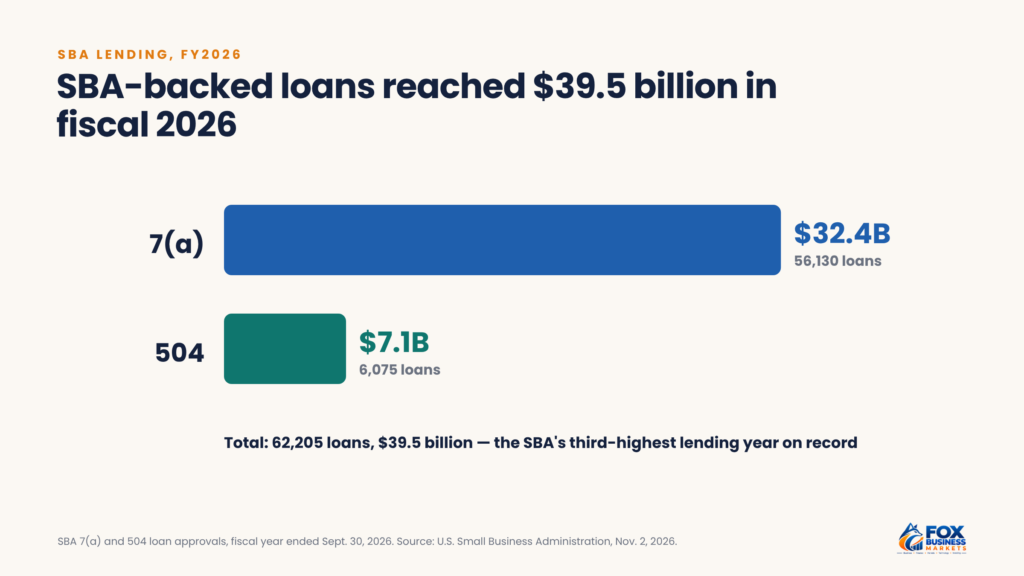
The SBA backed 62,205 loans totaling $39.5 billion through its 7(a) and 504 programs in fiscal 2026, which ended Sept. 30, 2026, according to an SBA release on Nov. 2, 2026. The agency called it the third-highest lending volume in its history.
Program | Loans | Dollars |
| 7(a) | 56,130 | $32.4 billion |
| 504 | 6,075 | $7.1 billion |
| Total | 62,205 | $39.5 billion |
The SBA said it delivered $100 billion in capital and related assistance across its programs in fiscal 2026. The agency’s lending rules also changed during the year: SBA 7(a) small loans given loan numbers on or after March 1, 2026, no longer required the FICO SBSS prescreen, and the updated rulebook, SOP 50 10 8.1, took effect for loans numbered on or after Oct. 1, 2026.
Are Banks Tightening Credit for Small Businesses?
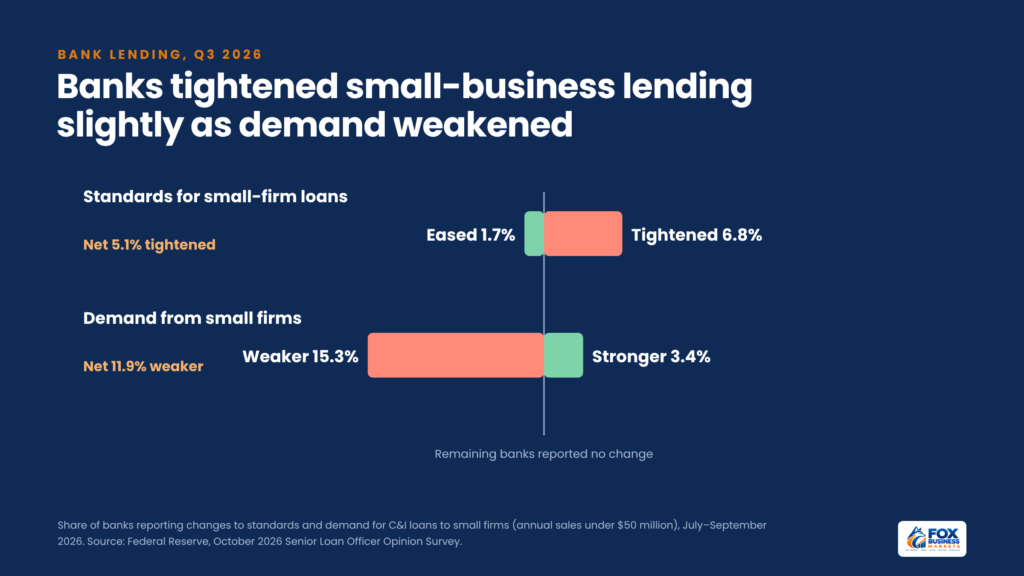
Slightly. In the Federal Reserve’s October 2026 Senior Loan Officer Opinion Survey, which covers the third quarter, a net 5.1% of banks reported tightening standards for commercial and industrial loans to small firms, defined as businesses with annual sales under $50 million.
Most banks left standards unchanged: 91.5% reported no change, 6.8% tightened somewhat, and 1.7% eased somewhat.
Demand weakened. A net 11.9% of banks reported weaker demand for C&I loans from small firms, with 15.3% seeing weaker demand and 3.4% stronger demand. Banks also reported tightening collateral requirements and interest rate floors for small firms.
What Do Small Businesses Pay to Borrow?
Small business owners who borrow regularly paid an average of 8.2% on short-term loans in NFIB’s September 2026 Small Business Economic Trends survey.
Financing costs aren’t owners’ biggest worry, though. Only 3% named financing and interest rates as their single most important problem, compared with 26% who cited the quality or availability of labor.
Rates vary widely by product. SBA 7(a) loans carry maximum rates tied to the prime rate, bank lines of credit are usually variable, and online lenders and merchant cash advances can cost far more once fees are included. Always compare the annual percentage rate (APR) or total cost of capital, not just the stated rate.
How Do Owners Fund Their Businesses?
Most small business funding still starts with the owner. NORC at the University of Chicago’s Entrepreneurship in the Population survey found that 83% of business owners used personal assets to cover startup costs. Personal assets and credit cards together made up 63% of startup funding, compared with 19% from bank or government loans.
Lenders and investors often ask how much money you’ve invested in your business, so keep records of every contribution.
How Many Small Businesses Carry Debt?
About 70% of small employer firms had outstanding debt, and about 31% had none, according to the Fed’s 2026 report. Debt is normal for small firms, but its size and terms decide whether it helps or strains the business.
Personal guarantees remain the rule rather than the exception: 59% of firms with debt had at least one. That ties the owner’s personal finances to the company’s obligations, which is one reason lenders often ask about both business and personal credit when you apply.
How Profitable Are Small Businesses?
At the end of 2024, 47% of small employer firms were operating at a profit, 19% were breaking even, and 34% were operating at a loss, according to the Fed’s 2026 report.
Weak results also keep some owners from applying. Among the small group of discouraged firms that didn’t seek financing because they expected to be turned down, 63% cited weak business financials.
How Many New Businesses Are Starting?
Americans filed 534,947 business applications in September 2026, seasonally adjusted, up 0.5% from August, according to the Census Bureau’s Business Formation Statistics released Oct. 14, 2026. Of those, 147,331 were high-propensity applications, the ones the Census Bureau considers most likely to become businesses with payroll.
The next release is scheduled for Nov. 12, 2026. Our startup statistics roundup tracks new-business and venture funding trends in more detail.
How Long Do Small Businesses Survive?
About 79.6% of private-sector establishments born in the year ending March 2013 were still operating a year later, 50.6% after five years, and 34.7% after 10 years, according to the Bureau of Labor Statistics. Those figures were published in January 2024. Looking further back, 15.7% of establishments born in 2000 were still operating in 2026, a 26-year span, according to a BLS analysis published Oct. 30, 2026.
Our small business statistics roundup covers survival, jobs, and owner data in more depth.
How Many Small Businesses Are There?
The United States has about 36.2 million small businesses, making up 99.9% of all U.S. businesses, according to the SBA Office of Advocacy’s February 2026 profile. Small businesses employ about 62.3 million people, or 45.9% of private-sector workers.
How Has Small Business Lending Changed Since 2020?
Several shifts stand out when the latest figures are compared with earlier years:
- Online lenders gained ground. The share of loan, line of credit, and cash advance applicants that applied to an online lender rose from 17% in the Fed’s 2020 survey to 29% in the latest one.
- SBA lending stayed near record levels. Fiscal 2026 was the agency’s third-highest lending year, following a record-setting fiscal 2025, according to the SBA.
- SBA underwriting changed. The SBA stopped requiring the FICO SBSS prescreen for 7(a) small loans in March 2026 and updated its lending rules again with SOP 50 10 8.1 in October 2026.
- Banks turned slightly more cautious. In the October 2026 loan officer survey, more banks tightened than eased standards for small-firm loans, and they reported weaker demand.
- Costs became the dominant pressure. Rising costs and tariffs topped the list of challenges in the Fed’s survey, and most applicants borrowed to cover operating expenses.
For owners, the practical takeaway is to apply before cash gets tight, compare lender types, and keep financial records ready, since approval odds and terms vary widely by lender.
Frequently Asked Questions
Where can I find business finance statistics for my state?
The SBA Office of Advocacy publishes annual small business profiles for every state, and the Federal Reserve’s Small Business Credit Survey releases state and regional findings. The Census Bureau’s Business Formation Statistics also break out applications by state. Start with your state’s Advocacy profile, which pulls several sources into one document.
How often are these statistics updated?
Release schedules vary. The Census Bureau updates business applications monthly, NFIB publishes its survey monthly, the Fed’s loan officer survey comes out quarterly, and the Fed’s Small Business Credit Survey and the SBA’s lending totals are annual. Check the publication date on any figure before you rely on it in a business plan.
What is the average SBA 7(a) loan size?
Based on the SBA’s fiscal 2026 totals, the average 7(a) loan was about $577,000, and the average 504 loan was about $1.17 million. Averages are pulled up by large loans, so many SBA loans are much smaller. Ask your lender about its typical loan size for businesses like yours.
How can I use these statistics in a loan application?
Use them to show you understand your market and your risk. Comparing your cash buffer, profitability, or debt level with national figures can strengthen a business plan or loan request. Cite the source and date for every number you use, as lenders may check them.
Benchmark Your Business Against These Numbers
Pull your latest financial statements and check three things: your cash buffer days (compared with 17.6), whether you ran a profit last year (47% of small employers did), and whether your debt carries a personal guarantee (59% does). Compare your results with the national numbers above, note where you’re stronger or weaker, and pick one figure to improve before you next apply for financing.
This article is for general information only and isn’t financial, tax, legal, or investment advice. Consider your own situation or talk to a qualified professional before making decisions.