Quick answer: The main difference between a Roth and a traditional IRA is when you pay tax. A Roth uses after-tax money, and qualified withdrawals are tax-free. A traditional IRA may give you a deduction now but taxes withdrawals. Pick a Roth if you expect a higher tax rate later, traditional if lower; at the same rate, they come out even.
About 44% of U.S. households own an individual retirement account, according to the Investment Company Institute’s 2025 IRA report. Most of them have to choose between two types, and that choice affects their taxes for decades.
The two types look almost identical at first. They share a contribution limit, deadline, and investment menu; the difference is how withdrawals are taxed.
This guide compares the two side by side with the 2026 rules, shows the math behind the choice, and explains the details that often decide it: withdrawals, Social Security, Medicare, and what your heirs inherit.
Which IRA Should You Choose?
Both accounts let your investments grow without yearly taxes on gains, dividends, or interest. The core difference is timing: do you want to pay income tax on this money now, or later?
- Roth IRA: You pay tax today. Your contributions aren’t deductible, but qualified withdrawals, including all the growth, are tax-free.
- Traditional IRA: You may deduct your contribution today. Every dollar you withdraw from deductible contributions and earnings is taxed later as ordinary income (the same rate as wages).
The decision depends on one prediction: will your tax rate be higher or lower when you withdraw the money?
Roth IRA vs. Traditional IRA: How Do They Compare in 2026?
Feature | Roth IRA | Traditional IRA |
| Tax break | None now; tax-free qualified withdrawals later | Possible deduction now; withdrawals taxed later |
| 2026 contribution limit | $7,500 ($8,600 if 50 or older) | $7,500 ($8,600 if 50 or older) |
| Income limit to contribute | Yes (see below) | None |
| Income limit for the deduction | Not applicable | Yes, if you or your spouse have a workplace retirement plan |
| Required minimum distributions | None during the original owner’s lifetime | Start at 73 (75 if born in 1960 or later) |
| Early access to contributions | Contributions can come out anytime, tax- and penalty-free | Withdrawals before 59½ are generally taxed plus a 10% penalty |
| Contribution deadline for 2026 | April 15, 2027 | April 15, 2027 |
Limits and ranges from the IRS for 2026. Income limits use modified adjusted gross income (MAGI).
The contribution limit is shared, not per account. If you split money between a Roth and a traditional IRA, your total for 2026 can’t exceed $7,500, or $8,600 with the $1,100 catch-up for people 50 and older. You also need earned income at least equal to what you contribute. A non-working spouse can still contribute based on a working spouse’s income when you file a joint return.
You don’t have to put in the full amount, and an automatic monthly transfer makes it easier to stay consistent. If finding the money is the hard part, our guide on how to make a budget shows how to carve out a monthly savings amount.
Who Can Contribute to a Roth IRA?
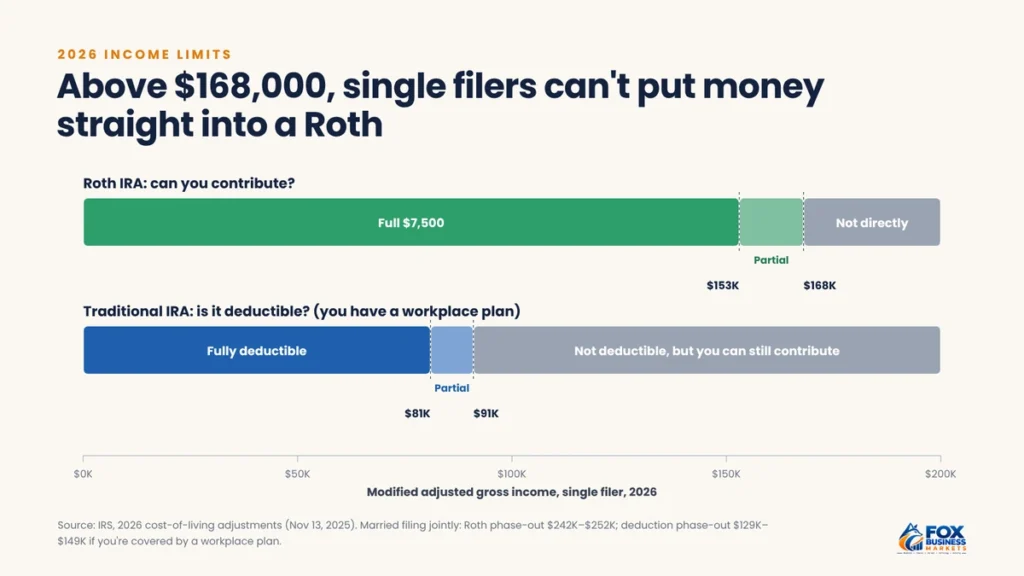
Anyone with earned income can open a Roth IRA, unless their income is too high. In 2026, the amount you can contribute starts to shrink (“phases out”) once your modified adjusted gross income reaches $153,000 if you’re single or head of household. You can’t contribute directly at $168,000 or more. For married couples filing jointly, the phase-out runs from $242,000 to $252,000, according to the IRS.
Married people who file separately and lived with their spouse at any time during the year face a much tighter range: $0 to $10,000, which isn’t adjusted for inflation. If you lived apart all year, the single range applies.
There’s no age limit. You can open and fund a Roth IRA as a teenager with a summer job or at 76 with part-time wages, as long as you have earned income. Investment income, Social Security, and pension payments don’t count as earned income.
When Can You Deduct a Traditional IRA Contribution?
Anyone with earned income can put money into a traditional IRA, at any age. Whether you can deduct it depends on two things: your income, and whether you or your spouse are covered by a retirement plan at work.
If neither of you has a workplace plan, the full contribution is deductible at any income. If you do, the 2026 deduction phases out at these MAGI ranges:
Your situation | 2026 deduction phase-out |
| Single, covered by a workplace plan | $81,000–$91,000 |
| Married filing jointly, you’re covered | $129,000–$149,000 |
| Married filing jointly, only your spouse is covered | $242,000–$252,000 |
| Married filing separately, covered | $0–$10,000 |
Source: IRS, 2026 cost-of-living adjustments.
If your income is above these ranges, you can still make a nondeductible traditional IRA contribution. It grows tax-deferred, but you’ll need to track your basis (the after-tax money you put in) on IRS Form 8606 so you aren’t taxed twice when you withdraw it. For many people in that situation, a nondeductible contribution only makes sense as the first step of a backdoor Roth, covered in the FAQ below.
How Do Taxes Now and Later Change the Result?
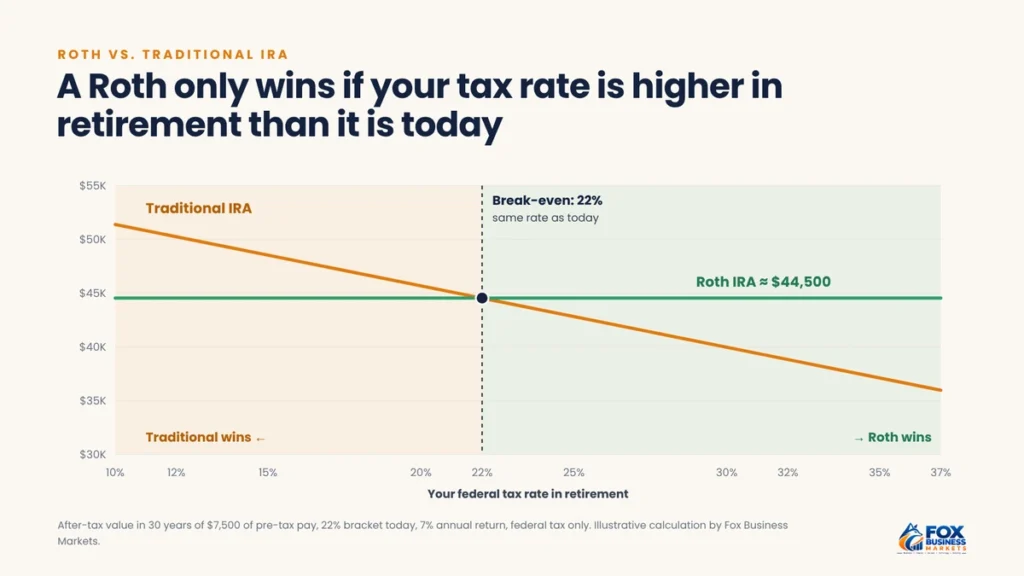
Suppose you’re in the 22% federal tax bracket and you have $7,500 of pre-tax pay to save either way, so both options cost you the same today. The money earns 7% a year for 30 years.
- Traditional IRA: The full $7,500 goes in, thanks to the deduction. It grows to about $57,100, all of which is taxable when you withdraw it.
- Roth IRA: You pay 22% tax first, so $5,850 goes in. It grows to about $44,500, and that’s yours tax-free.
What the traditional IRA is worth after tax depends on your tax rate in retirement:
Your tax rate in retirement | Traditional IRA after tax | Roth IRA after tax | Better choice |
| 12% (lower than today) | About $50,200 | About $44,500 | Traditional |
| 22% (same as today) | About $44,500 | About $44,500 | Tie |
| 32% (higher than today) | About $38,800 | About $44,500 | Roth |
Illustrative calculation by Fox Business Markets. Assumes a single $7,500 pre-tax amount, a 7% annual return, federal tax only, and a qualified Roth withdrawal. State taxes, other income in retirement, and future tax law changes can shift the result. Returns aren’t guaranteed.
The table shows why there’s no universal winner. A ten-point drop in your tax rate favors the traditional IRA by about $5,700 on this one contribution; a ten-point rise favors the Roth by the same amount. No one can predict future tax rates with certainty, which is why the clues in the next section carry so much weight.
The limit is the same $7,500 for both accounts, but $7,500 in a Roth is all yours after tax, while $7,500 in a traditional IRA still carries a tax bill. If you can afford to max out either account, a full Roth contribution shelters more after-tax money.
What Else Affects the Choice Besides Your Tax Bracket?
State income tax. If you live in a high-tax state now and plan to retire in a state with no income tax, the traditional IRA’s deduction saves you state tax today that you may never pay later. The reverse is also true: moving from a no-tax state to a high-tax one in retirement favors the Roth.
Social Security taxes. Up to 85% of your Social Security benefits can become taxable once your other income passes certain thresholds, according to IRS Publication 915. Withdrawals from a traditional IRA count toward that income. Qualified Roth withdrawals don’t, so they can keep more of your benefits tax-free.
Medicare premiums. Higher-income retirees pay more for Medicare Part B and Part D through income-related surcharges, generally based on their tax return from two years earlier, according to the Social Security Administration. Large traditional IRA withdrawals, including required ones, can push you over those thresholds. Qualified Roth withdrawals don’t count, though the income from a Roth conversion does.
Required minimum distributions. A traditional IRA forces you to start withdrawing at 73, or 75 if you were born in 1960 or later, whether you need the money or not. Those forced withdrawals add to your taxable income every year. A Roth IRA has no required withdrawals while you’re alive, so you control the timing.
What your heirs inherit. Most non-spouse beneficiaries, such as adult children, must empty an inherited IRA within 10 years if the owner died after 2019, and some must also take yearly withdrawals along the way. Withdrawals from an inherited traditional IRA are taxable to them, often during their peak earning years. Withdrawals from an inherited Roth are generally tax-free if the account met the five-year rule.
Tax diversification. Having money in both pre-tax and after-tax accounts gives you choices in retirement. In a year with large medical bills or a big purchase, you can draw from the Roth to avoid jumping into a higher bracket.
When Is a Roth IRA the Better Choice?
- You’re early in your career. If your income, and your tax bracket, will likely rise, paying tax now at a lower rate can pay off.
- You’re in the 10% or 12% bracket. The deduction from a traditional IRA is worth less to you today.
- You want access to your contributions before retirement. A Roth gives you that without tax or penalty.
- You want to leave money to heirs. No required withdrawals for you, and generally tax-free withdrawals for them.
- Most of your savings are already pre-tax. A Roth balances a 401(k) that’s all traditional money.
When Is a Traditional IRA the Better Choice?
- You’re in a high bracket now and expect a lower one in retirement.
- You need a lower AGI to qualify for other tax breaks. A deduction can help you qualify for credits such as the Saver’s Credit, which isn’t available above $40,250 of AGI for single (and married-filing-separately) filers, $60,375 for heads of household, and $80,500 for joint filers in 2026, according to IRS Notice 2025-67.
- You earn too much for a Roth but neither you nor your spouse has a workplace plan, so your traditional contribution is fully deductible.
- You’ll invest the tax savings. The deduction only beats a Roth if you save the tax you didn’t pay.
When Can You Take Money Out Without Penalty?
Roth IRA. Your regular contributions come out first, and they’re never taxed or penalized. Earnings are tax-free and penalty-free only in a qualified distribution. That generally means the withdrawal happens at least five years after the first year you contributed to any Roth IRA, and on or after age 59½, after your death, because of disability, or for up to $10,000 (lifetime) of qualified first-time homebuyer expenses.
Traditional IRA. Withdrawals of deductible contributions and earnings are taxed as ordinary income. Before 59½, you’ll generally owe an extra 10% tax too, according to IRS Publication 590-B.
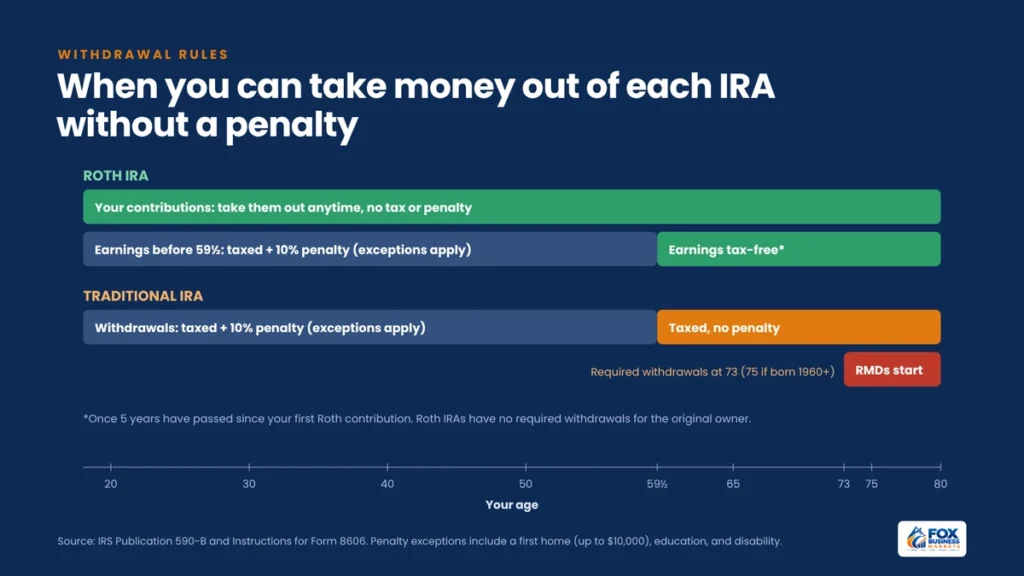
The 10% additional tax has exceptions for both account types. The main ones include:
- Up to $10,000 (lifetime) for a first-time home purchase
- Qualified higher education expenses for you, your spouse, children, or grandchildren
- Up to $5,000 per child for a birth or adoption
- Unreimbursed medical expenses above 7.5% of your adjusted gross income
- Health insurance premiums while you’re unemployed
- Total and permanent disability
- One emergency personal expense withdrawal of up to $1,000 a year (no further one for three years unless it’s repaid)
An exception removes the penalty, not the income tax. Traditional IRA withdrawals, and the earnings part of a non-qualified Roth withdrawal, are still taxable. Because of these rules, neither account should double as your emergency savings. Keep that money in an emergency fund in a high-yield savings account instead.
Can You Lose Money by Picking the Wrong IRA?
Not much, and the mistake is usually fixable. If you contribute to one type and later decide you wanted the other, you can recharacterize the contribution, moving it and its earnings to the other IRA type as if you’d made it there from the start. You generally have until your tax filing deadline, including extensions, to do this.
You can also convert traditional IRA money to a Roth later (see the FAQ below), but since 2018 a conversion can’t be undone.
Can You Have Both?
Yes. You can own a Roth IRA and a traditional IRA at the same time and split each year’s contribution between them, as long as the combined total stays within the annual limit. Splitting is a reasonable choice if you can’t predict your future tax rate.
You can also have an IRA and a workplace plan like a 401(k). A common order is to get your full employer match first, then fund an IRA, then go back to the 401(k). Our guide on how to start investing walks through that order step by step.
How Do You Open and Fund an IRA?
- Pick a provider. Most brokerage firms, robo-advisors, banks, and credit unions offer both IRA types. A brokerage gives you the widest choice of investments; a bank IRA is often limited to savings accounts or CDs.
- Choose the account type. Select Roth or traditional when you open it. You can open both if you plan to split contributions.
- Fund it. Link a bank account and contribute a lump sum or set up automatic monthly transfers. When contributing between January 1 and April 15, tell the provider which tax year the money is for.
- Invest the money. This step is often skipped. Many IRAs park new deposits in a cash or money market fund until you choose investments. Low-cost index funds or a single target-date fund are simple options.
- Name a beneficiary. A beneficiary form decides who inherits the account, and it usually overrides your will.
Frequently Asked Questions
Can I convert a traditional IRA to a Roth IRA?
Yes. A Roth conversion moves money from a traditional IRA into a Roth IRA, and there’s no income limit. You’ll owe income tax on any pre-tax amount converted that year, and each conversion starts its own five-year clock for the 10% penalty if you’re under 59½. If you convert, consider doing it in a low-income year and paying the tax from savings, not from the IRA.
What is a backdoor Roth IRA?
It’s a two-step strategy for people whose income is too high to contribute to a Roth directly. You make a nondeductible traditional IRA contribution, then convert it to a Roth. It’s legal, but if you have other pre-tax IRA money, the pro-rata rule (which treats all your traditional IRA money as one pool) may make part of the conversion taxable. Check with a tax professional before you try it.
What happens if I contribute more than the limit?
Excess IRA contributions are charged a 6% excise tax for each year they stay in the account. You can avoid it by withdrawing the excess, plus any earnings on it, by your tax filing deadline, including extensions. The withdrawn earnings are taxable and may face the 10% early-withdrawal tax. If you spot an excess, contact your IRA provider right away and ask for a “removal of excess contribution.”
Can I borrow from my IRA?
No. Unlike many 401(k) plans, IRAs don’t allow loans. You can withdraw money and put it back within 60 days without tax as an indirect rollover, but you’re allowed only one such rollover across all your IRAs in any 12-month period. Treat that as a last resort, and plan on not needing short-term cash from your IRA.
Open the IRA That Fits Your Tax Bracket This Year
The Roth IRA vs. traditional IRA choice comes down to taxes now versus taxes later. If you expect your tax rate to rise, or you value flexible access, no required withdrawals, and tax-free money for your heirs, the Roth usually wins. If you’re in a high bracket now and expect a lower one in retirement, the traditional IRA’s deduction is worth more.
When you can’t tell, split your contributions, or start with a Roth and revisit the decision each year as your income changes. The important step is to open the account, fund it before the April 15, 2027 deadline for 2026, and invest the money.
This article is for general information only and isn’t financial, tax, legal, or investment advice. Consider your own situation or talk to a qualified professional before making decisions.

