Quick answer: To start an import business, choose a product with healthy margins and few regulations, vet an overseas supplier, form a business entity, get a sales tax permit and resale certificate, and hire a customs broker. Then calculate your full landed cost, including 2026 tariffs, before you place your first order.Illustrative example. Duty rates depend on the product’s tariff classification
About 239,000 U.S. companies imported goods in 2024, and 97% of them were small and medium-sized businesses with fewer than 500 employees, according to a December 2025 Census Bureau report. Those smaller firms brought in about $914 billion worth of goods.
Importing has also become more complicated. The Supreme Court struck down tariffs imposed under the International Emergency Economic Powers Act (IEEPA) in February 2026, new Section 301 “forced labor” tariffs of 10% to 12.5% replaced a temporary 150-day global tariff in July, and the $800 duty-free exemption for small shipments remains suspended. For a new importer, those rules can decide whether a product makes money.
This guide shows how to start an import business step by step, from choosing products and suppliers to handling sales tax as a reseller, calculating landed cost, and protecting your margins.
What Is an Import Business?
An import business buys goods from foreign suppliers and resells them in the United States. You pay for the goods, bring them through customs, and sell them at a markup.
Most small import businesses follow one of these models:
- Online seller: Imports products to sell on Amazon, Walmart Marketplace, Etsy, or your own website.
- Private label brand: Has a factory add your brand name and packaging to an existing product.
- Wholesaler or distributor: Imports in bulk and sells to retailers, restaurants, or other businesses.
- Retail store: Imports goods to sell in a physical shop.
- Niche specialist: Focuses on one category, such as specialty foods, handmade goods, or equipment parts.
Each model uses the same customs process. What differs is how you price, market, and deliver the goods. If you want the step-by-step customs process, including bonds and filings, see our guide to how to import products.
Is an Import Business Worth Starting in 2026?
It can be, but the math is tighter than a few years ago. Three changes have raised costs for small importers:
- New tariffs: Since July 24, 2026, imports from about 60 economies face Section 301 tariffs of 10% to 12.5%. For most countries, including China and Vietnam, these come on top of regular duties, though some goods are exempt. Many Chinese goods also still carry older Section 301 tariffs.
- No duty-free small shipments: The $800 de minimis exemption has been suspended since August 2025, and Customs and Border Protection (CBP) rules issued in June 2026 keep it suspended indefinitely, so even small orders now owe duties and fees. A 2025 federal law ends it permanently on July 1, 2027.
- Forced labor rules: CBP can detain goods linked to forced labor under the Uyghur Forced Labor Prevention Act (UFLPA), which can hold up shipments.
If you’re buying an existing import business, ask whether it paid IEEPA tariffs before CBP stopped collecting them on Feb. 24, 2026. Those importers may be eligible for refunds, though the administration is still contesting whether importers who didn’t sue should be repaid, according to Fortune.
For a full explanation of how duties are set, see our guide to what tariffs are.
How Do You Choose Products to Import?
Look for products that check most of these boxes:
- Healthy margins: Aim for a selling price at least two to three times your landed cost, so you can cover marketing, returns, and overhead.
- Small and light: Smaller items cost less to ship and store.
- Low regulation: Food, cosmetics, medical devices, children’s products, and electronics often need approval from agencies such as the Food and Drug Administration (FDA), the Consumer Product Safety Commission (CPSC), or the Federal Communications Commission (FCC).
- Low tariff exposure: Check the product’s tariff classification code and current duty rates before you commit.
- Low forced labor risk: Products in sectors such as cotton, polysilicon, aluminum, and tomatoes face extra CBP scrutiny.
- Steady demand: Check marketplace sales rankings, search trends, and competitor reviews before ordering.
- No intellectual property problems: Avoid products that copy someone else’s brand or patent.
You can look up a product’s duty rate in the Harmonized Tariff Schedule maintained by the U.S. International Trade Commission. A customs broker can confirm the right classification.
How Do You Find and Vet Overseas Suppliers?
Suppliers are easy to find online, but vetting them takes time.
Where to look:
- Online marketplaces: Alibaba, Global Sources, and Made-in-China list thousands of manufacturers and trading companies.
- Trade shows: Events such as the Canton Fair in China let you meet suppliers and inspect samples in person.
- Sourcing agents: Local agents can find factories, negotiate, and inspect goods for a fee, often a percentage of the order.
- Industry directories and trade offices: Many countries’ trade promotion agencies list exporters.
How to vet them:
- Check the business license and confirm whether you’re dealing with a factory or a middleman.
- Order samples and test them for quality and safety before placing a bulk order.
- Ask for references from other U.S. buyers.
- Ask where raw materials come from, especially for cotton, metals, and electronics.
- Hire a third-party inspection firm to check goods before they ship.
- Use safer payment terms. A common setup is a 30% deposit and 70% after inspection. Escrow services or letters of credit offer more protection for larger orders.
Start with a small order, even if the unit price is higher. Losing a small first order to a bad supplier costs far less than losing a big one.
How Do You Start an Import Business Legally?
You don’t need a federal import license for most products, but you do need several registrations:
- Business entity: Many importers form a limited liability company (LLC) to separate business and personal assets. Our guide to LLC vs. corporation compares the options.
- Employer Identification Number (EIN): You’ll use it as your importer number with CBP.
- Customs bond: Required for most commercial shipments over $2,500. Our guide to how to import products explains the bond types.
- Sales tax permit: Required in states where you have sales tax nexus, meaning a physical presence or enough sales there.
- Resale certificate: Lets you buy inventory tax-free from domestic suppliers when you plan to resell it.
- Agency approvals: Some products need FDA, CPSC, FCC, or U.S. Department of Agriculture registrations or testing.
Most new importers also hire a licensed customs broker, who files entries with CBP on your behalf and helps classify products correctly.
How Do Resale Certificates and Sales Tax Work for Importers?
When you import goods to resell, you generally don’t pay sales tax on the inventory itself. Instead, you collect sales tax from your customers when you sell, then send it to the state.
A resale certificate proves to a domestic supplier, such as a U.S. wholesaler or warehouse that sells you packaging, that you’re buying for resale. Key points:
- It’s state-specific. Each state sets its own rules, though Avalara’s state-by-state guide shows about 39 states accepting the Multistate Tax Commission’s uniform resale certificate and about 24 accepting the Streamlined Sales Tax certificate.
- Some states have no sales tax. Delaware, Montana, New Hampshire, and Oregon have no statewide sales tax. Alaska has none at the state level, but some local governments charge one.
- Certificates can expire. Some states require renewal every year, while others don’t.
- Misuse is risky. Using a resale certificate for items you keep for your own use can lead to back taxes and penalties.
- Marketplaces may collect for you. Amazon, Walmart, and other large marketplaces collect and send sales tax for you in every state with a sales tax under marketplace facilitator laws. If you sell on your own website, you’re usually responsible.
Sales tax is separate from customs duties. Duties are paid to CBP when goods enter the country, while sales tax applies when you sell to customers. A tax professional can help you figure out where you owe it.
How Much Does It Cost to Import a Shipment?
The price your supplier quotes is only part of the cost. Your landed cost includes everything it takes to get the goods to your door.
We built an example for a small first order: 2,000 units of a consumer product bought from a supplier in Vietnam for $5 each, shipped by sea.
| Cost | Amount | Share of total |
| Product cost (free on board) | $10,000 | 73.1% |
| Section 301 forced labor tariff (12.5%) | $1,250 | 9.1% |
| Ocean freight and insurance | $1,200 | 8.8% |
| Regular duty (5%, assumed) | $500 | 3.7% |
| Delivery from port to your warehouse | $400 | 2.9% |
| Customs broker fee | $175 | 1.3% |
| Single-entry customs bond | $70 | 0.5% |
| Importer Security Filing (ISF) | $35 | 0.3% |
| Merchandise processing fee (0.3464%) | $34.64 | 0.3% |
| Harbor maintenance fee (0.125%) | $12.50 | 0.1% |
| Total landed cost | $13,677 | 100% |
| Landed cost per unit | $6.84 |
Illustrative example. Duty rates depend on the product’s tariff classification and country of origin, and freight and service fees vary widely. Fee rates from CBP. Fox Business Markets analysis.
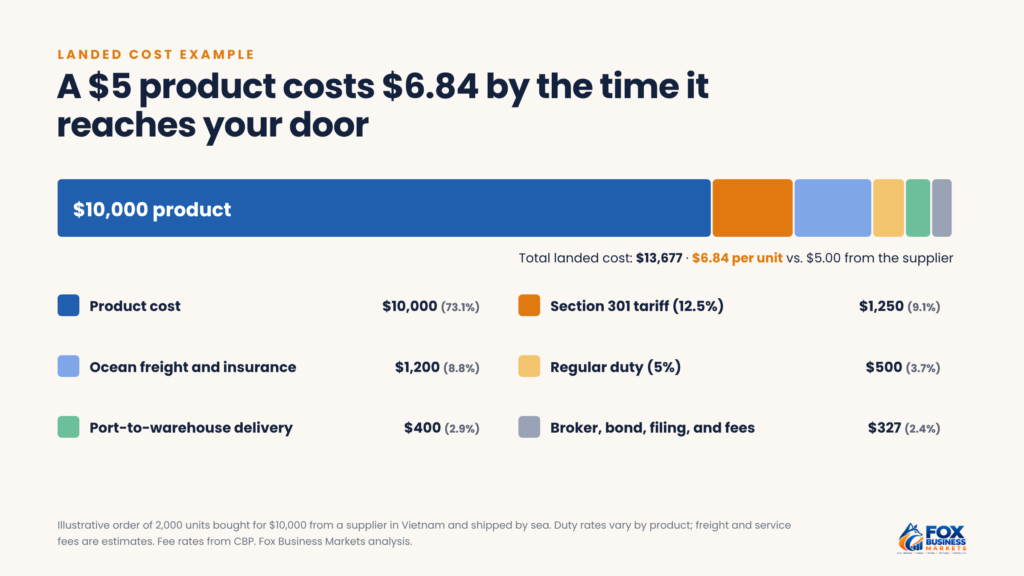
Breakdown of landed cost for a $10,000 import order
In this example, the goods cost $5 each from the supplier but $6.84 each once they reach your warehouse, a 37% increase. Duties and tariffs alone add $0.88 per unit.
How Do Tariffs Affect an Import Business’s Profit?
Tariffs come straight out of your margin unless you raise prices. For a $10,000 order of 2,000 units from Vietnam (with $1,200 freight, a 5% regular duty, and standard CBP fees), we kept every cost the same, set a selling price of $14.99, and changed only the added tariff rate:
| Added tariff rate | Landed cost per unit | Gross margin | Margin after a 15% marketplace fee |
| 0% | $6.21 | 58.5% | 43.5% |
| 10% | $6.71 | 55.2% | 40.2% |
| 12.5% | $6.84 | 54.4% | 39.4% |
| 25% | $7.46 | 50.2% | 35.2% |
| 50% | $8.71 | 41.9% | 26.9% |
Added tariff is on top of a 5% regular duty and is calculated on the $10,000 product cost. Margins exclude fulfillment, advertising, returns, and overhead. Fox Business Markets analysis.
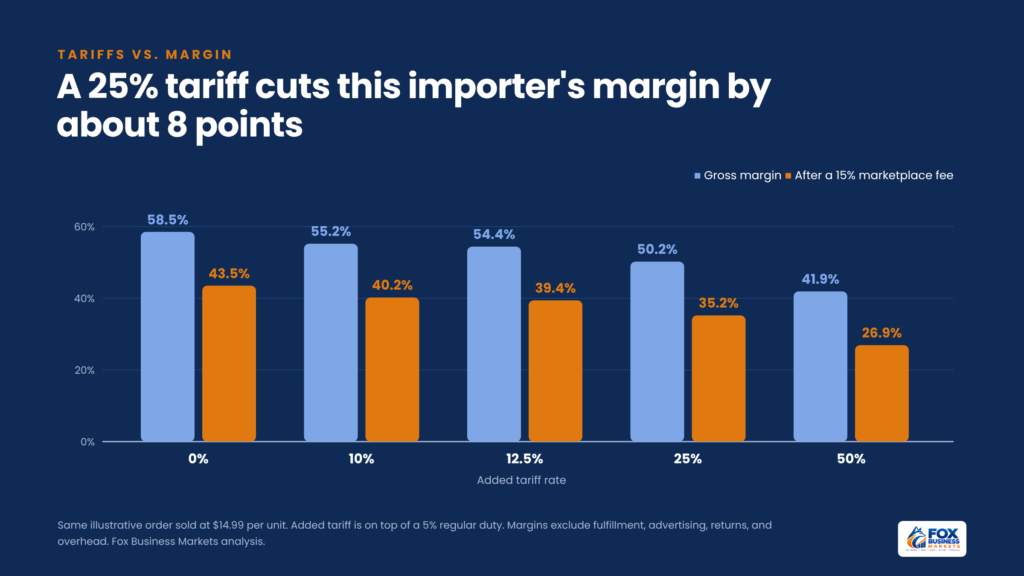
Gross margin at different tariff rates for an imported product
Moving from no added tariff to 25% cuts the gross margin by about 8 percentage points in this example. Once you subtract marketplace fees, fulfillment, and advertising, a product that looked profitable can lose money. Run these numbers for each product and each supplier country before you order.
Where Can You Sell Imported Products?
You can sell through several channels, and many importers use more than one:
- Online marketplaces: Amazon, Walmart, and eBay offer huge audiences but charge referral fees, often around 15% for many categories, plus fulfillment fees.
- Your own website: Platforms such as Shopify let you keep more of each sale, but you pay for marketing to bring in buyers. Our guide to the best ecommerce platforms compares options.
- Wholesale: Selling to retailers in bulk means lower prices per unit but larger, steadier orders.
- Physical retail: Your own store, pop-ups, or local markets.
If you’re starting from scratch online, our guide to how to start an ecommerce business covers setup, payments, and shipping.
Is It a Myth That You Need a Big Company to Import?
Yes. Census data shows that 97% of U.S. importers in 2024 were small and medium-sized businesses, though large companies brought in most of the value:
| Importer size | Number of companies, 2024 | Share of companies | Share of known import value |
| Small and medium-sized (under 500 employees) | 232,804 | 97.3% | 31.3% |
| Large (500 or more employees) | 6,427 | 2.7% | 68.7% |
Preliminary 2024 data. Source: U.S. Census Bureau, A Profile of U.S. Importing and Exporting Companies; Fox Business Markets analysis.
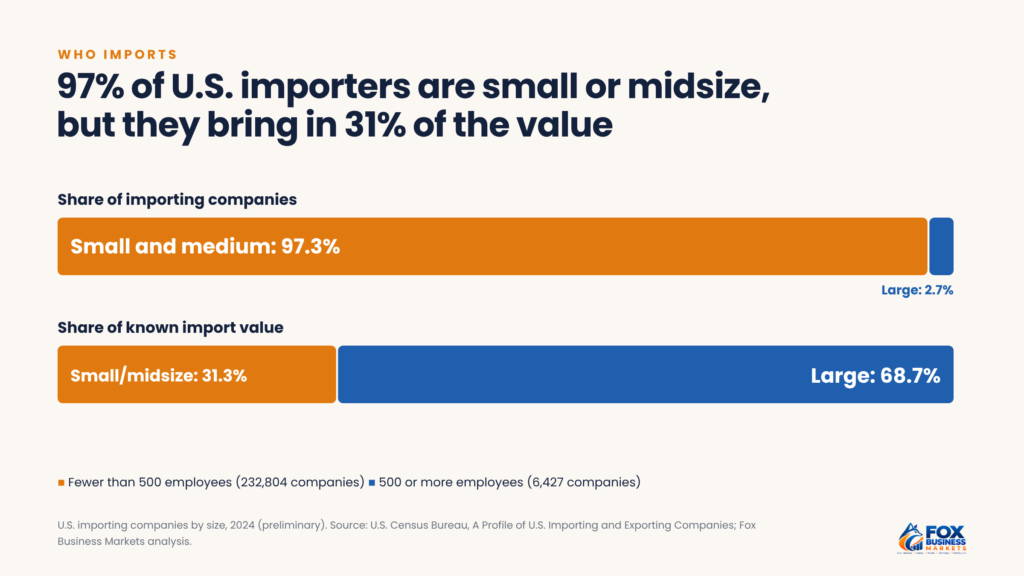
Small and large U.S. importers by share of companies and share of import value, 2024
Most products don’t require a special federal import license, and a customs broker can handle the filings.
You do need cash to cover your first order. A first order often ties up thousands of dollars between paying a deposit and selling the goods. Many new importers start with one product and a small order, then scale up once they know their real costs and demand. If you need funding, our guide to small business loans covers inventory financing.
What Mistakes Sink New Import Businesses?
New importers often lose money through these mistakes:
- Using the supplier’s price as your cost. Forgetting freight, duties, and fees can wipe out your margin.
- Misclassifying products. The wrong tariff code can lead to underpaid duties, penalties, or delays.
- Skipping samples and inspections. Defective goods are hard to return across borders.
- Ignoring product rules. Goods that need FDA, CPSC, or FCC approval can be refused entry.
- Ignoring minimum order quantities. Agreeing to a factory’s minimum without testing demand can leave you with unsold stock.
- Skipping a trademark. Private label sellers who don’t register their brand can lose it to copycats on marketplaces.
- Ordering too much. Overstock ties up cash and storage space.
- Not tracking tariff changes. Rates changed several times in 2025 and 2026, and they can change again.
How We Analyzed the Data
Our landed cost example uses a hypothetical $10,000 order of 2,000 units from Vietnam. We applied CBP’s merchandise processing fee (0.3464%) and harbor maintenance fee (0.125%), an assumed 5% regular duty, and a 12.5% Section 301 tariff rate. Freight, broker, bond, filing, and delivery costs are typical estimates, not quotes. For the margin table, we changed only the added tariff rate and assumed a $14.99 selling price and a 15% marketplace referral fee. Duties and tariffs are calculated on the $10,000 product cost, excluding freight, and the 12.5% Section 301 rate is assumed for this product and origin. For fiscal 2027, the merchandise processing fee has a $34.58 minimum and $670.86 maximum per formal entry. Real costs depend on the product, origin, shipping method, and timing. Census figures are preliminary 2024 data.
Frequently Asked Questions
Do you need a warehouse to start an import business?
No. Many new importers ship goods straight to a marketplace fulfillment center, such as Amazon’s, or to a third-party logistics company that stores and ships orders for a fee. Others start from a garage or small storage unit. Tip: Compare storage fees per cubic foot before choosing, since long-term storage charges can eat into slow-selling inventory.
How long does a first import order take?
Often two to three months from order to sale. Production can take two to six weeks, ocean shipping from Asia often takes three to six weeks, and customs clearance and delivery add more time. Tip: Plan your first order well ahead of peak seasons such as the holidays, and build in extra time for delays.
Do you need insurance for imported goods?
Usually, yes. Cargo insurance covers loss or damage in transit, since carriers’ liability for lost or damaged cargo is usually limited, and product liability insurance protects you if a product you sell causes harm. Marketplaces such as Amazon may require liability coverage once your sales reach a certain level. Tip: Ask your freight forwarder for cargo insurance quotes on each shipment.
Can you import and resell branded products?
Only if you have the right to. Importing counterfeit or trademark-infringing goods can lead to seizure and penalties, and some brands restrict who can sell their products on marketplaces. Genuine branded goods bought from an authorized source can usually be resold, but rules vary. Tip: Get written authorization from the brand or its distributor before importing branded products.
Run the Numbers on One Product Before You Order
Tariffs, fees, and freight can turn a cheap supplier price into a thin margin.
Pick one product, get real quotes, calculate your landed cost with today’s tariff rates, and make sure the margin still works after selling fees. If it does, start with a small order and scale up from there. For the reverse direction, see our guide to how to start an export business.
This article is for general information only and isn’t financial, tax, legal, or investment advice. Consider your own situation or talk to a qualified professional before making decisions.

