

Quick answer: Cash flow management means tracking, forecasting, and timing the money that moves in and out of your business so you can always pay bills on time. Know how many days of outflows your cash covers, keep a 13-week forecast, collect from customers faster, pay suppliers on the due date, and arrange a line of credit before you need it.
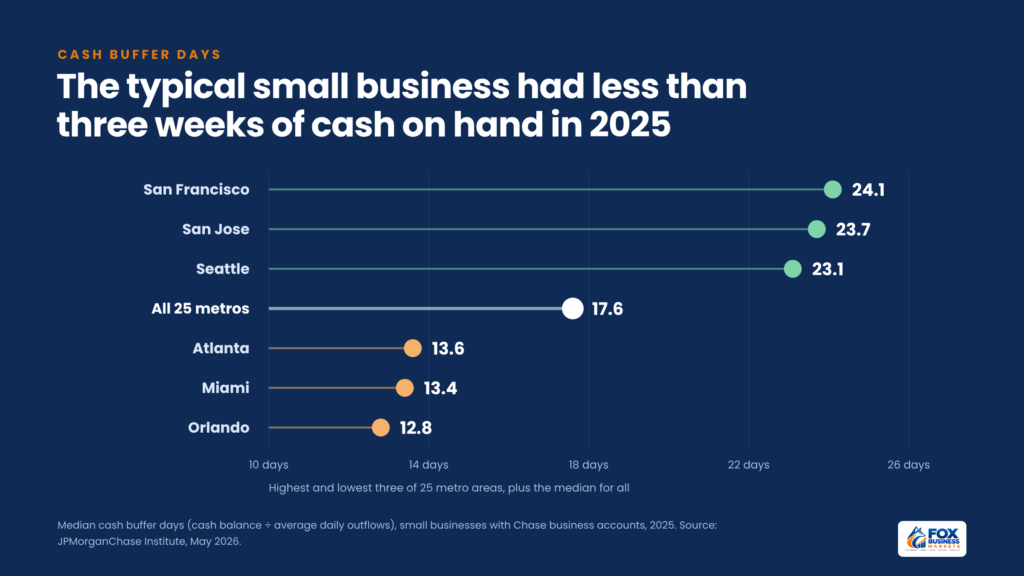
The typical small business with a Chase business account held just 17.6 days’ worth of cash in 2025, meaning it could cover less than three weeks of normal outflows if money stopped coming in, according to the JPMorganChase Institute.
That thin cushion helps explain why so many firms borrow just to keep the lights on. Among small employer firms that applied for financing in the Federal Reserve’s latest survey, 56% wanted the money to cover operating expenses, according to the 2026 Report on Employer Firms. Profit doesn’t guarantee cash: a business can book record sales and still come up short on payroll week.
This guide shows how to measure your cash cushion, build a 13-week forecast, shorten the time your money is tied up, and handle slow seasons, using one small manufacturer’s numbers as a running example.
What Is Cash Flow Management?
Cash flow is the movement of money into and out of your business. Cash flow management is the habit of watching those movements closely enough to see a shortfall coming and act before it arrives.
It has four parts:
- Measuring how much cash you have and how long it would last.
- Forecasting what’s coming in and going out over the next few months.
- Speeding up inflows by invoicing promptly and collecting reliably.
- Timing outflows so bills are paid on time but not earlier than needed.
The cash flow statement, one of the three core financial statements, looks backward and explains why your cash changed last month or last year. Cash flow management looks forward. Both use the same building blocks: cash from operations, cash spent on equipment and other investments, and cash from borrowing or owner contributions.
Do Higher Sales Always Mean More Cash?
No, and believing it is one of the most expensive mistakes a growing business can make. Sales and cash arrive on different schedules:
- You pay before you’re paid. A business that buys materials, pays staff, and then invoices customers on 30-day terms can be out of pocket for six weeks or more on every order.
- Growth multiplies the gap. If sales double, the money tied up in inventory and unpaid invoices roughly doubles too, even though profit also rises.
- Some big outflows aren’t expenses. Loan principal, equipment purchases, and owner draws drain the account without showing up as expenses on the income statement.
Consider Oakline Furniture, a fictional maker of tables and shelving that sells to independent retailers. It has $1.2 million in annual sales, a healthy profit margin, and two months of record orders. Yet each new order means buying lumber up front and waiting more than a month for retailers to pay. Without a forecast, the owner might not see the cash squeeze until a payroll check fails to clear.
Profit tells you whether the business model works. Cash tells you whether you can keep operating long enough for the profit to arrive.
How Many Days of Cash Does Your Business Have?
The simplest measure of your cushion is cash buffer days: how many days you could keep paying your normal outflows from cash on hand if every customer stopped paying.
Cash buffer days = Cash balance ÷ Average daily outflows
To find average daily outflows, total everything that left your business accounts over the past three to six months, including payroll, rent, supplies, loan payments, and owner draws, and divide by the number of days.
Oakline spends about $90,000 a month, or roughly $3,000 a day. With $60,000 in the bank, it has about 20 days of cash.
Oakline’s 20 days is slightly above the 2025 national median of 17.6 days, and metro areas vary widely: small businesses in San Francisco held a median of 24.1 days, while those in Orlando held 12.8.
There’s no single right target, but a common target is one to three months of outflows held in a separate business savings account, and more if your revenue is seasonal or concentrated in a few large customers. Recalculate your buffer days every month; the trend tells you more than any single reading.
How Do You Build a 13-Week Cash Flow Forecast?
A 13-week forecast projects your bank balance week by week for the next quarter. Thirteen weeks is long enough to see payroll cycles, quarterly tax payments, and large supplier bills, but short enough to estimate with reasonable accuracy.
- Start with today’s bank balance. Use actual cash in your business accounts, not the balance in your accounting software if it hasn’t been reconciled.
- List expected inflows by week. Use your accounts receivable aging report to estimate when each open invoice will actually be paid, based on how quickly that customer usually pays, not the due date. Add expected cash sales and deposits.
- List expected outflows by week. Include payroll, rent, supplier payments, loan payments, insurance, quarterly estimated taxes, and owner draws.
- Calculate the ending balance for each week. Each week’s ending cash becomes the next week’s starting cash.
- Set a minimum cash level. Pick a floor you never want to drop below, such as two weeks of outflows.
- Update it every week. Replace estimates with actual results and roll the forecast forward one week.
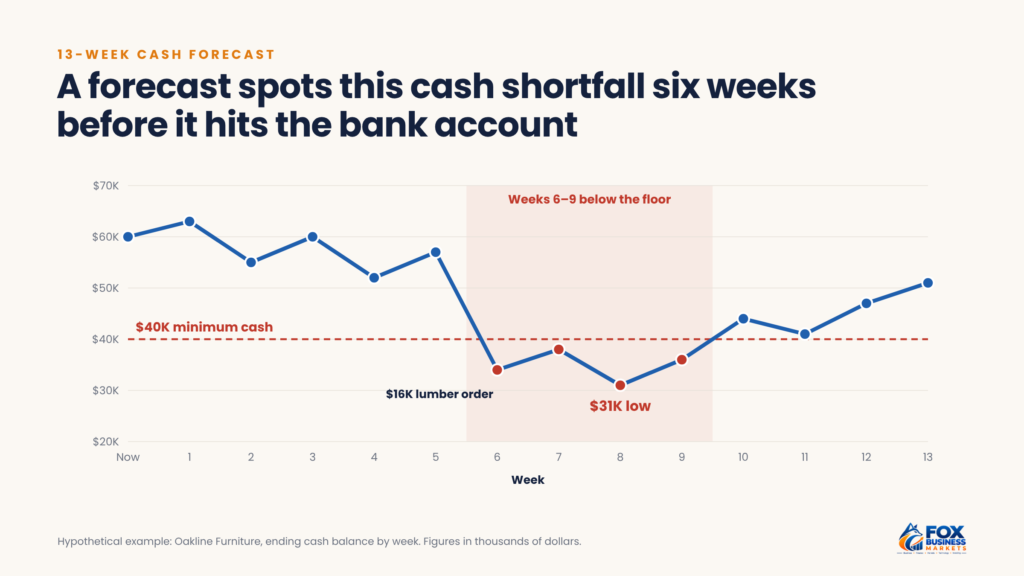
Oakline starts its forecast with $60,000 and sets a $40,000 minimum. The forecast shows a problem: a $16,000 lumber order for a large retail contract lands in week 6, on top of normal payroll and rent. Cash drops below the floor in week 6, bottoms out at $31,000 in week 8, and doesn’t recover until week 10, when the retailer’s payment for the first shipment arrives.
Weeks 6 through 9 fall below Oakline’s $40,000 minimum.
Week | Starting cash | Inflows | Outflows | Ending cash |
| 1 | $60,000 | $25,000 | $22,000 | $63,000 |
| 2 | $63,000 | $14,000 | $22,000 | $55,000 |
| 3 | $55,000 | $25,000 | $20,000 | $60,000 |
| 4 | $60,000 | $14,000 | $22,000 | $52,000 |
| 5 | $52,000 | $25,000 | $20,000 | $57,000 |
| 6 | $57,000 | $15,000 | $38,000 | $34,000 |
| 7 | $34,000 | $24,000 | $20,000 | $38,000 |
| 8 | $38,000 | $15,000 | $22,000 | $31,000 |
| 9 | $31,000 | $25,000 | $20,000 | $36,000 |
| 10 | $36,000 | $30,000 | $22,000 | $44,000 |
| 11 | $44,000 | $17,000 | $20,000 | $41,000 |
| 12 | $41,000 | $28,000 | $22,000 | $47,000 |
| 13 | $47,000 | $24,000 | $20,000 | $51,000 |
Because the gap shows up weeks in advance, the owner has options. Oakline can ask the lumber supplier to split the order into two deliveries, offer the retailer a small discount for paying the first invoice early, or arrange a short draw on a line of credit of about $9,000 and repay it from collections over weeks 10 to 13. Without the forecast, the first warning would have been an overdrawn account.
The same discipline behind a household budget applies here: write down every known payment, plan for irregular ones, and check actual results against the plan.
What Is the Cash Conversion Cycle?
The cash conversion cycle (CCC) measures how many days your cash is tied up between paying for inputs and collecting from customers. The shorter the cycle, the less cash the business needs to operate.
CCC = Days inventory outstanding + Days sales outstanding − Days payable outstanding
- Days inventory outstanding (DIO): how long materials and finished goods sit before they’re sold.
- Days sales outstanding (DSO): how long customers take to pay after a sale.
- Days payable outstanding (DPO): how long you take to pay suppliers.
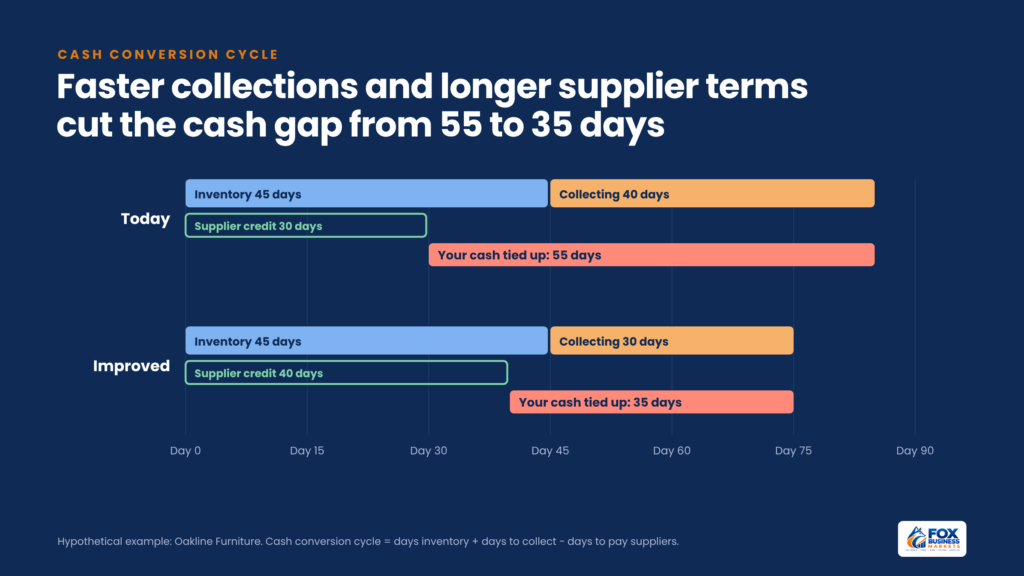
Oakline holds inventory for 45 days, collects from retailers in 40 days, and pays suppliers in 30 days, for a cycle of 55 days. In other words, each dollar Oakline spends on lumber comes back about eight weeks later.
Shortening the cycle frees cash without borrowing. If Oakline cut its collection time from 40 to 30 days, it would free up about $33,000, since its sales average roughly $3,300 a day. If it also negotiated 40-day terms with its suppliers, it would hold on to about $20,000 more, based on about $2,000 a day in purchases from suppliers. Together, those changes would cut the cycle to 35 days and release roughly $53,000, or about 18 days of outflows.
Service businesses with little inventory can use the same idea by tracking only DSO and DPO.
How Can You Get Paid Faster?
Faster collection is usually the quickest way to improve cash flow, because the money has already been earned.
- Invoice the same day the work is done or the product ships. Every day of delay adds a day to collection.
- Ask for deposits on large or custom orders. A 30% to 50% deposit can cover materials before you start.
- Make paying easy. Accept ACH transfers, cards, and online payment links on every invoice. Card fees, typically around 2% to 3%, can cost less than waiting weeks for a check.
- Set clear terms on every quote and invoice, including the due date, accepted payment methods, and any late fee allowed under your state’s law.
- Use milestone billing on long projects instead of one invoice at the end.
- Follow a collection routine. Send a friendly reminder before the due date, a follow-up on the day it’s late, and a phone call at 15 days past due.
- Review the receivables aging report weekly and focus on the largest and oldest balances first.
Early-payment discounts can help, but price them carefully. Offering “2/10, net 30,” a 2% discount for paying within 10 days instead of 30, works out to an annualized cost of about 37%. Offer it only if you’d otherwise borrow at a higher rate or face a real risk of not being paid.
How Should You Manage Bills and Payables?
Paying bills well means paying on time, not early, unless early payment saves money.
- Schedule payments for the due date. Paying a 30-day invoice on day 5 gives up 25 days of cash for nothing.
- Take early-payment discounts that beat your borrowing cost. If you have spare cash, a 2/10, net 30 discount (about 37% a year, as above) beats almost any savings rate.
- Negotiate longer terms once you’ve built a track record of on-time payments. Moving from 30 to 45 days with a key supplier can free significant cash.
- Avoid late fees and damaged relationships. Stretching payables past the due date may help for a week but can cost you discounts, credit terms, and trade references that help build business credit.
- Spread large annual bills, such as insurance, across monthly installments when the financing charge is low.
How Do Owner Pay and Taxes Affect Cash Flow?
Two of the largest outflows in many small businesses are the owner’s own pay and taxes, and both are easy to leave out of a forecast.
Owner pay. Irregular draws make cash hard to predict. Set a fixed amount and pay yourself on the same dates each month, the way you’d pay an employee. If the business has a strong quarter, take a planned bonus draw after checking the forecast rather than whenever the account looks full.
Quarterly estimated taxes. Owners of sole proprietorships, partnerships, LLCs, and S corporations generally pay income tax on their share of business profit through quarterly estimated payments, due around April 15, June 15, Sept. 15, and Jan. 15, unless enough is withheld from their wages. C corporations make their own estimated payments on a different schedule. Each payment can equal several weeks of profit. Put the next due date in your 13-week forecast and all four on your annual calendar, and move a fixed share of each customer payment into a separate tax account as it arrives.
Payroll taxes and sales tax. Withheld payroll taxes and sales tax collected from customers belong to the government, not the business, and owners can be held personally liable if withheld taxes go unpaid. Keep them, along with the employer’s share of payroll taxes, out of your available cash entirely, ideally in a separate account, so they’re never used to cover a short week.
Annual and irregular bills. Insurance premiums, license renewals, software subscriptions, and equipment maintenance often hit once or twice a year. List them by month and set aside one-twelfth of the annual total each month so they don’t land as a surprise.
How Do You Handle Seasonal Swings?
Landscapers, retailers, tax preparers, and tourism businesses can earn most of their revenue in a few months. The time to plan for the slow months is during the busy ones.
- Forecast the full year by month, using at least two prior years to spot the pattern.
- Build reserves during the peak. Move a set share of peak-season revenue into savings to cover the slow months.
- Turn fixed costs into variable ones where you can, such as seasonal staff, equipment rentals instead of purchases, and shorter lease commitments.
- Add off-season revenue, such as maintenance contracts, prepaid packages, or a complementary service.
- Time big purchases for when cash is strongest, not when the need first appears.
When Should You Use a Line of Credit?
A business line of credit works like a reusable cushion: you draw what you need, repay it, and draw again. It suits short-term timing gaps, such as Oakline’s week-6 lumber order or a seasonal inventory build, where you know where the repayment will come from.
It isn’t a fix for a business that consistently spends more than it earns. If your forecast shows the balance falling every month rather than dipping and recovering, the problem is pricing, costs, or sales volume, and borrowing will only delay the reckoning.
Apply for a line while business is healthy. Lenders look at recent revenue, cash flow, and existing debt, so approval is easier when your numbers are strong and you don’t urgently need the money. Our guide to small business loans compares lines of credit with term loans and other options, and our business finance statistics show how often small firms are approved.
What Cash Flow Warning Signs Should You Watch For?
These signals usually show up weeks or months before a business runs out of cash:
- Cash buffer days falling for several months in a row.
- Receivables growing faster than sales, a sign customers are paying more slowly.
- Paying suppliers later and later to cover other bills.
- Using a credit card or credit line for payroll or rent.
- Inventory piling up while sales stay flat.
- Skipping or reducing owner pay to keep the business running.
- Missing quarterly estimated tax payments.
One warning sign can be a timing blip. Two or three at once deserve a closer look at pricing, costs, and collections. Our small business finance guide covers the wider system of bookkeeping, budgeting, and funding behind healthy cash flow.
Frequently Asked Questions
What’s the difference between cash flow and free cash flow?
Cash flow from operations is the cash your business generates from its normal work. Free cash flow subtracts what you spend on equipment and other long-term assets, showing what’s left to repay debt, pay owners, or save. Lenders and buyers often focus on free cash flow, so calculate it each quarter alongside your profit.
Is invoice factoring a good way to fix cash flow?
Factoring means selling unpaid invoices to a company that advances most of their value right away and collects from your customers. It’s fast and doesn’t require strong credit, but fees can add up to a high annualized cost, and your customers will usually know, because they pay the factor directly. Compare the total fee with a line of credit’s cost before you sign.
How much cash can I safely keep at one bank?
The FDIC insures deposits up to $250,000 per depositor, per insured bank, for each account ownership category. A business with more cash than that at one bank can spread it across banks or use a sweep program that places the money at FDIC-insured banks in the business’s name. Check your total balances against the limit on the FDIC’s deposit insurance page whenever your reserves grow.
Should I use a business credit card to manage cash flow?
A credit card can bridge a few weeks between paying a supplier and getting paid, though relying on it for payroll or rent is a warning sign, and paying the full balance by the due date every month usually avoids interest. Carrying a balance, though, typically costs far more than a line of credit. Set up autopay for the full statement balance so the card stays a timing tool rather than a loan.
Start Your 13-Week Forecast This Week
Open a spreadsheet, enter today’s bank balance, and list every payment you expect to receive and make over the next 13 weeks. Set a minimum cash level, mark any week that falls below it, and decide now what you’ll do about it. Update the forecast every Monday morning, and recalculate your cash buffer days at the end of each month.
This article is for general information only and isn’t financial, tax, legal, or investment advice. Consider your own situation or talk to a qualified professional before making decisions.