

Quick answer: Business credit is your company’s borrowing record, tracked by Dun & Bradstreet, Experian, and Equifax under the business’s tax ID. To build it, register as a separate entity, get an EIN and a free D-U-N-S number, open vendor accounts and a business credit card that report payments, and pay every bill on time or early.
Fifty-nine percent of small employer firms with debt had at least one personal guarantee on it, according to the Federal Reserve’s 2026 Report on Employer Firms. For most small businesses, the owner’s personal credit is still doing the heavy lifting.
That doesn’t have to stay true. A business with its own credit history can get supplier terms, higher card limits, and better loan offers based on how the company pays, not just on the owner’s FICO score. Bureaus can open a file on your company from public records and supplier data without telling you, so it pays to know what’s in it.
This guide explains how business credit works, what each bureau’s score means, how to build a file from scratch in about a year, and which mistakes drag scores down.
What Is Business Credit?
Business credit is a record of how your company borrows and pays. Commercial credit bureaus collect payment data from suppliers, lenders, and card issuers, along with public records such as liens and judgments, and turn it into reports and scores that other businesses use to decide whether to extend credit.
It differs from personal credit in several ways:
| Personal credit | Business credit | |
| Tied to | Your Social Security number | Your business name, EIN, and D-U-N-S number |
| Main bureaus | Equifax, Experian, TransUnion | Dun & Bradstreet, Experian, Equifax |
| Common scores | FICO and VantageScore, 300–850 | PAYDEX, Intelliscore Plus, Equifax business scores, FICO SBSS |
| Who can see it | Lenders and others with a permissible purpose under federal law | Generally anyone who buys a report, including suppliers and competitors |
| Federal dispute rights | Fair Credit Reporting Act protections | Fewer legal protections; disputes go through each bureau’s own process |
| Reporting | Most lenders report automatically | Many suppliers and lenders don’t report at all |
That last row explains why many established businesses have thin or empty business credit files. If the companies you pay don’t report, your good habits don’t show up.
How Do Business Credit Scores Work?
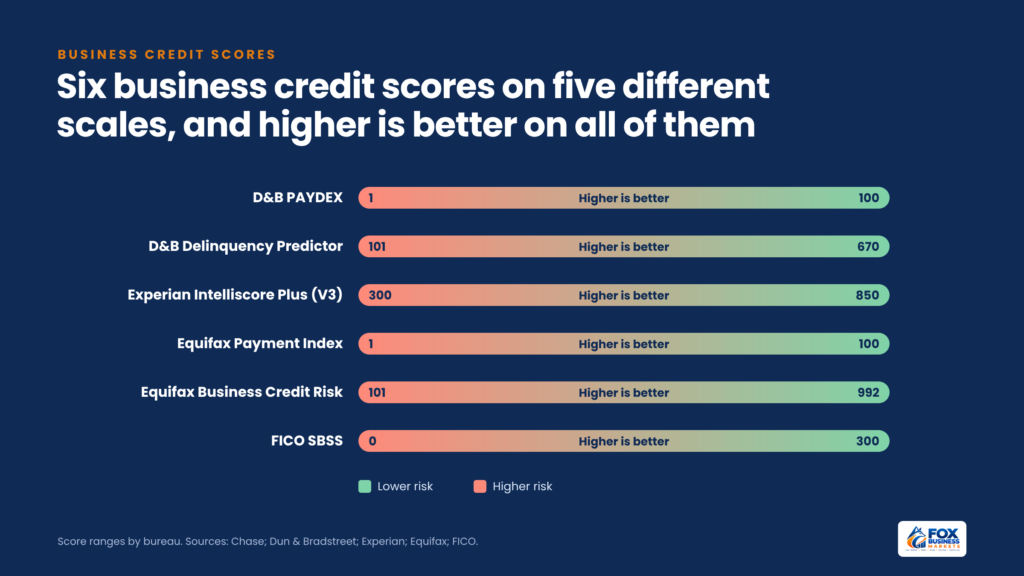
Each bureau calculates its own scores, using different data and scales:
Score | Bureau | Range | What it measures | Better score |
| PAYDEX | Dun & Bradstreet | 1–100 | How promptly you pay suppliers | Higher |
| Delinquency Predictor Score | Dun & Bradstreet | 101–670 | Risk of paying severely late (91+ days) in the next 12 months | Higher (101 = highest risk) |
| Intelliscore Plus | Experian | 300–850 (V3); older 1–100 version still common | Risk of serious delinquency | Higher |
| Payment Index | Equifax | 1–100 | Payment history with creditors | Higher |
| Business Credit Risk Score | Equifax | 101–992 | Risk of serious delinquency | Higher |
| FICO SBSS | FICO | 0–300 | Combines business and owner data for small business lending | Higher |
Because the scales differ, a single “business credit score” doesn’t exist. A lender or supplier may check one bureau, two, or none, so building a positive history with all three gives you the most coverage.
Our guide to small business finance explains how business credit fits with bookkeeping, cash flow, and funding.
What Is a Good PAYDEX Score?
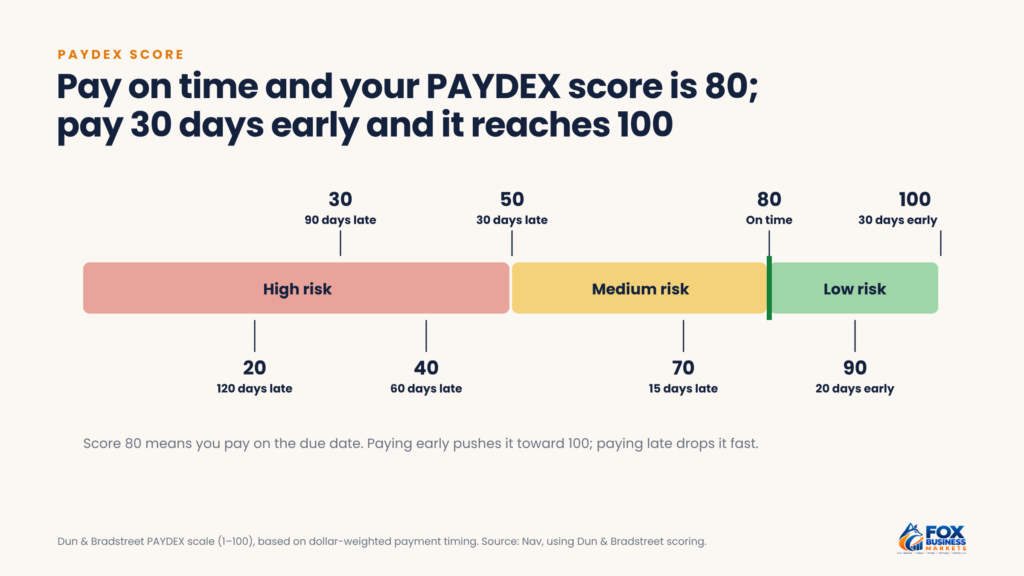
PAYDEX, Dun & Bradstreet’s payment score, is based entirely on payment timing. An 80 means you pay on the due date. Paying early pushes the score higher; paying late pulls it down quickly.
PAYDEX score | Payment timing |
| 100 | 30 days early |
| 90 | 20 days early |
| 80 | On time |
| 70 | 15 days late |
| 60 | 22 days late |
| 50 | 30 days late |
| 40 | 60 days late |
| 30 | 90 days late |
| 20 | 120 days late |
| 1–19 | More than 120 days late |
On Dun & Bradstreet’s scale, 80 or higher signals on-time payment and low risk. According to Nav, Dun & Bradstreet generally needs at least three payment experiences from at least two vendors that report to it before it can calculate a PAYDEX score.
Because PAYDEX weighs payments by dollar amount, a few large late payments can hurt more than many small on-time ones. Paying your biggest suppliers a few days early is one of the fastest ways to move the score.
How Do You Build Business Credit From Scratch?
Building a file takes deliberate steps, because nothing reports until you open the right accounts.
- Form a separate legal entity. An LLC or corporation has its own legal identity. A sole proprietorship can build some business credit, but the line between you and the business is thin. Our guide on how to start a small business covers choosing a structure.
- Get an employer identification number (EIN). It’s free from the IRS and serves as your business’s tax ID on credit applications.
- Set up consistent business details. Use the same legal name, address, and phone number everywhere: state filings, bank account, website, and directory listings. Mismatches can split your file or cause it to be missed.
- Open a business bank account. Lenders look for a separate account with steady deposits, and it keeps your records clean.
- Get a free D-U-N-S number. Dun & Bradstreet assigns this nine-digit identifier, which many suppliers and lenders use to identify your business.
- Open trade accounts that report. Ask suppliers before you buy whether they report payments to Dun & Bradstreet, Experian, or Equifax. Office supply, packaging, and industrial supply companies often offer net-30 terms to new businesses.
- Get a business credit card that reports to business bureaus. Use it for regular expenses and pay the full balance each month.
- Pay early or on time, every time. Payment history is the only input to PAYDEX and a major factor in the other bureaus’ scores.
- Monitor your reports. Check each bureau’s file a few times a year and correct errors.
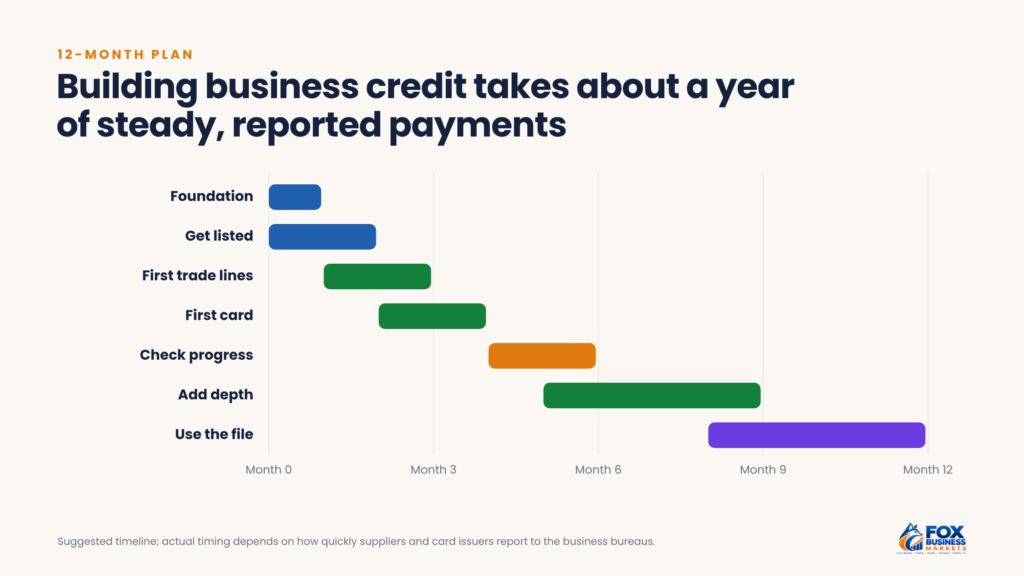
The table below shows how these steps typically play out over the first year.
How Long Does It Take to Build Business Credit?
Months | Focus | Actions |
| 1 | Foundation | Confirm entity, EIN, business bank account, and consistent name, address, and phone |
| 1–2 | Get listed | Request a D-U-N-S number; check whether Experian and Equifax already have a file |
| 2–3 | First trade lines | Open two or three net-30 supplier accounts that report; make small purchases and pay early |
| 3–4 | First card | Apply for a business credit card that reports to business bureaus; keep balances low |
| 5–6 | Check progress | Pull your reports; confirm payments appear and fix errors |
| 6–9 | Add depth | Open another supplier account or two with larger terms; request limit increases |
| 9–12 | Use the file | Apply for a line of credit or equipment financing once revenue and history support it |
The timeline stretches if suppliers report slowly or if your business is very new. Steady on-time payments count for more than speed: a short file of perfect payments beats a long file with late ones.
Does Business Credit Protect Your Personal Credit?
Not automatically. Many owners assume that once the business has its own credit, their personal finances are walled off. In practice, the two stay connected for years:
- Personal guarantees are standard. Most small business loans, lines of credit, and business cards require one, which makes you personally responsible if the business can’t pay.
- Applications often check your personal credit. Many business card issuers and lenders pull your personal report, especially for newer businesses.
- Some issuers report to personal bureaus. Some business cards report all activity, including balances, to your personal file; many others report only serious delinquency.
- Small business scores blend both. FICO’s Small Business Scoring Service score can combine business credit data with the owner’s personal credit.
Business credit still helps. As the company builds history, revenue, and assets, lenders may offer higher limits and better terms, and some suppliers and card issuers will extend credit on the business’s record alone. Treat business credit as a way to reduce your personal exposure over time, not as a shield from day one.
Does Your Business Structure Change How Credit Works?
Yes. Your legal structure affects whether the business has a credit identity of its own and how much of your personal credit stays involved:
Structure | Separate credit file? | Personal liability for business debts | Practical effect |
| Sole proprietorship | Possible, but closely tied to you | Full | Lenders rely mostly on your personal credit |
| General partnership | Yes, under the partnership’s name | Each general partner is fully liable | Partners’ personal credit usually checked |
| LLC | Yes | Generally limited, unless you sign a personal guarantee | Can build a file that lenders weigh more over time |
| Corporation (C or S) | Yes | Generally limited, unless you sign a personal guarantee | Same as LLC |
Limited liability protects you from the company’s general debts, but not from debts you guarantee personally.
Which Credit Products Help Build Business Credit?
Not every account helps. The ones that build your file report to at least one business bureau:
Product | How it builds credit | Watch out for |
| Net-30 trade account with a supplier | Reports on-time payments; often the easiest first account | Confirm the supplier reports before you rely on it |
| Business credit card | Reports monthly balances and payments | Rates and fees; check which bureaus it reports to |
| Secured business credit card | Easier approval with a cash deposit | Low limits; make sure it reports to business bureaus |
| Business line of credit | Shows you can manage revolving credit | Usually requires revenue history and a personal guarantee |
| Equipment financing | Reports installment payments; equipment serves as collateral | Total cost over the term |
| Term loan or SBA loan | Builds history with larger amounts | Strict qualification; often a personal guarantee |
Accounts that typically don’t build business credit include personal credit cards used for business, cash payments, and suppliers that don’t report. Our guide to small business loans compares the financing options in detail.
How Do You Check Your Business Credit Reports?
Unlike personal credit reports, business reports aren’t free by federal law. You have a few options:
- Dun & Bradstreet offers free and paid monitoring products; the free version shows limited score information.
- Experian sells business credit reports and offers subscription monitoring.
- Equifax sells business credit reports, often through its small business products.
- Some business banks, card issuers, and financial platforms provide free business score summaries to customers.
When you review a report, check that the business name, address, EIN, and ownership details are correct; that every trade line is yours; and that no liens, judgments, or collections appear that you don’t recognize. Dispute errors directly with the bureau that reports them, and keep copies of invoices and payment confirmations to support your case.
How Does Business Credit Affect Your Financing?
Lenders use business credit alongside your personal credit, revenue, time in business, and cash flow. A strong business file can mean:
- Higher credit limits on cards and lines of credit.
- Better rates and terms on loans.
- Supplier terms that let you buy inventory now and pay in 30, 60, or 90 days, which helps cash flow management.
- Fewer surprises when a large customer or landlord runs a credit check before signing a contract.
Weak credit has the opposite effect. Among small businesses in the Fed survey that were turned down for at least some of the financing they sought, 30% cited a low credit score as a reason. Too much existing debt was cited by 37%.
For SBA 7(a) small loans approved on or after March 1, 2026, the SBA dropped its requirement that lenders prescreen applications with the FICO SBSS score. Lenders may now use their own credit analysis and scoring, and many still use SBSS, and they must review the two most recent months of business bank statements. The SBA kept this approach in its updated lending rules, SOP 50 10 8.1, effective Oct. 1, 2026, so ask your lender which scores it checks. Lenders will also review your financial statements, and our business finance statistics show how often small firms are approved.
How Do You Use Business Credit Without Overextending?
Easy approvals make it easy to overborrow. Set these limits:
- Match the credit to the need. Use supplier terms and cards for short-term purchases you’ll pay within the cycle, lines of credit for timing gaps, and term loans for long-lived assets such as equipment.
- Keep card balances low. High balances relative to limits can pull scores down, so keep balances well below each card’s limit and pay in full each month to avoid interest.
- Borrow against a forecast. Before taking on a new payment, check that your cash flow forecast covers it in slow months as well as busy ones.
- Watch total debt. Lenders look at how much you already owe, and existing debt is a common reason for denial (see the figures above).
- Take early-payment discounts when suppliers offer them and you have the cash; a 2% discount for paying in 10 days instead of 30 works out to an annual return of more than 35%, far above typical savings yields.
What Hurts Business Credit?
Avoid these common mistakes:
- Paying late, even by a few days, on accounts that report.
- Maxing out business cards. High balances relative to limits can hurt scores, even when you pay on time.
- Letting tax liens or judgments go unresolved. Public records stay on business reports and can weigh heavily.
- Using inconsistent business details, which can create duplicate or incomplete files.
- Mixing personal and business spending, which makes it harder to show the business’s own payment pattern.
- Closing your oldest accounts without a reason, which can shorten your credit history.
- Ignoring your reports, so errors or fraud go unnoticed.
Frequently Asked Questions
Can you get business credit with bad personal credit?
Yes, but your options narrow. Net-30 supplier accounts often focus less on personal scores, and some lenders weigh business revenue more heavily. Start with two or three reporting supplier accounts and repair your personal credit at the same time, since many lenders will still check it.
How long does negative information stay on a business credit report?
It depends on the bureau and the type of record. Late payments, collections, liens, and judgments can each stay on business reports for years, and business bureaus don’t follow the same federal time limits that apply to personal credit reports. Dispute outdated items with the bureau, and keep proof that liens were released.
Does business credit transfer if you sell the business?
Business credit belongs to the legal entity, so it stays with the company if a buyer purchases the entity itself. In an asset sale, where the buyer forms a new company to buy the assets, the buyer usually starts a new credit file. Review the deal structure with your attorney before you sign.
Can you get a personal guarantee removed?
Sometimes. Once a business has strong revenue, cash reserves, and credit history, some lenders will release or limit a guarantee, especially when the loan is refinanced or renewed. Ask about release terms before you sign a new loan, and request them in writing.
Open Your First Reporting Trade Line This Month
Check that your business name, address, and EIN match everywhere, request a free D-U-N-S number, and open one supplier account that reports to the business bureaus. Pay it a few days early every month, and pull your business reports in six months to confirm the payments are showing up.
This article is for general information only and isn’t financial, tax, legal, or investment advice. Consider your own situation or talk to a qualified professional before making decisions.