Quick answer: The Uyghur Forced Labor Prevention Act (UFLPA) is a U.S. law that presumes goods made wholly or partly in China’s Xinjiang region, or by companies on a government list, were made with forced labor. U.S. Customs and Border Protection (CBP) can block those goods unless the importer proves otherwise with clear and convincing evidence.
CBP stopped 44,188 shipments worth about $4.1 billion under the UFLPA from June 2022 through August 2026, according to CBP enforcement data compiled by Gatewell Group. About 61% of those shipments were denied entry.
The government’s UFLPA Entity List, which names companies whose goods are presumed barred, reached 190 entities on Oct. 29, 2026, according to a Federal Register notice. Almost half of all stopped shipments came from countries other than China, including Vietnam and Malaysia.
This guide covers the law’s rules, CBP’s enforcement data, what happens when a shipment is stopped, how the law differs from 2026’s new forced labor tariffs, and steps to lower your risk.
What Is the Uyghur Forced Labor Prevention Act?
The UFLPA is a federal law that bars goods the U.S. government links to forced labor in the Xinjiang Uyghur Autonomous Region of China from entering the United States. Congress passed it with broad bipartisan support, and President Joe Biden signed it on Dec. 23, 2021. Its main rule took effect on June 21, 2022.
The law builds on Section 307 of the Tariff Act of 1930, which has long banned imports made with forced labor. The difference is who has to prove what:
- Before the UFLPA: CBP generally had to gather evidence that specific goods were made with forced labor before blocking them.
- Under the UFLPA: Goods tied to Xinjiang or to listed companies are presumed to be made with forced labor. The importer must prove they weren’t.
That shift, called a rebuttable presumption, is the law’s central feature. The U.S. government has said that the Chinese government runs labor programs in Xinjiang that subject Uyghurs and other mostly Muslim minority groups to forced labor. China rejects those claims.
Which Goods Does the UFLPA Presume Were Made With Forced Labor?
The presumption covers two broad groups of goods:
- Anything made wholly or partly in Xinjiang. This includes finished products and any raw material or component from the region, even if the final product was assembled in another country.
- Anything made by a company on the UFLPA Entity List. The list names companies that the U.S. government says use forced labor, work with the Xinjiang government on labor transfer programs, or source materials from Xinjiang or from those programs.
The “wholly or partly” wording has the biggest effect on importers. A T-shirt sewn in Vietnam can fall under the law if its cotton came from Xinjiang. A solar panel made in Malaysia can be stopped if its polysilicon traces back to a listed company.
The Department of Homeland Security (DHS) maintains the Entity List through the Forced Labor Enforcement Task Force, an interagency group it chairs. The list grew from 144 entities in August 2025 to 187 in August 2026, when the task force added 43 companies in its largest single expansion. Three more companies tied to the genetics firm BGI were added on Oct. 29, 2026, bringing the total to 190.
Many recently added companies aren’t based in Xinjiang. The August 2026 additions included companies located in nine other provinces and regions, including Gansu, Shandong, Fujian, Anhui, and Jiangsu, according to an analysis by trade consultancy Mallory Group.
Which Industries Face the Most UFLPA Scrutiny?
The Forced Labor Enforcement Task Force, the interagency group that maintains the Entity List, names “high-priority sectors” where it focuses enforcement. Its August 2025 strategy update listed 12:
Original high-priority sectors | Added in 2025 |
| Aluminum | Caustic soda |
| Apparel | Copper |
| Cotton and cotton products | Jujubes (red dates) |
| Polyvinyl chloride (PVC) | Lithium |
| Seafood | Steel |
| Silica-based products, including polysilicon | |
| Tomatoes and tomato products |
Source: Forced Labor Enforcement Task Force 2025 strategy update, via Thompson Hine.
CBP’s own enforcement data shows where shipments actually get stopped. We compared each industry’s share of stopped shipments with its share of the total value stopped:
Industry | Share of shipments stopped | Share of value stopped |
| Apparel, footwear, and textiles | 30.7% | 2.5% |
| Automotive and aerospace | 20.5% | 2.7% |
| Electronics | 16.3% | 82.2% |
| Consumer products and mass merchandising | 12.1% | 1.0% |
| Industrial and manufacturing materials | 8.0% | 2.2% |
Top five industries shown. Shipments stopped June 2022 through August 2026. Source: CBP UFLPA enforcement data compiled by Gatewell Group; Fox Business Markets analysis.
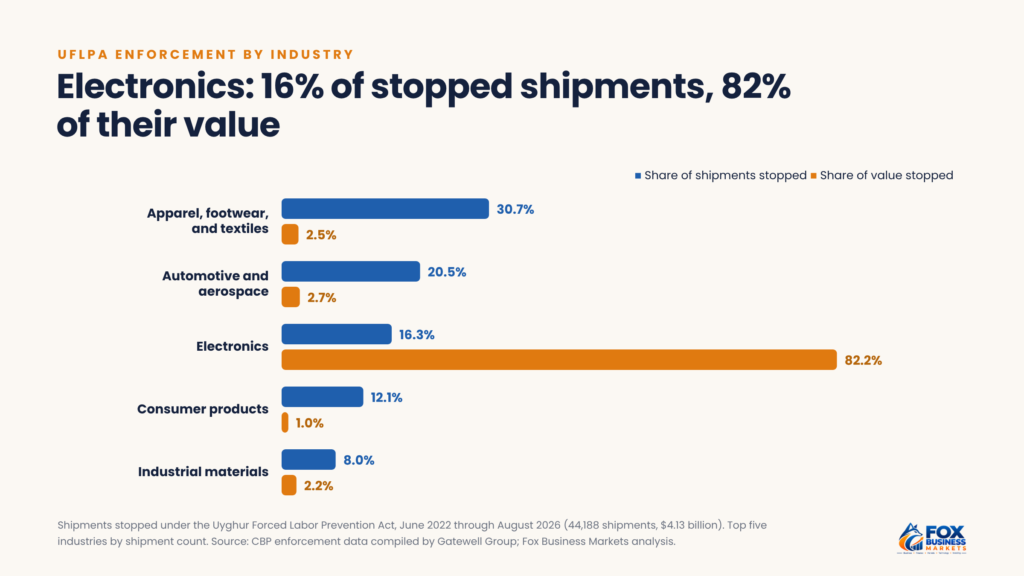
Share of UFLPA shipments stopped and share of their value, by industry
Clothing and textiles make up the most stopped shipments, but most of them are small. Electronics, which include solar panels and their components, account for about one in six stops and more than 80% of the money involved.
Which Countries Do Stopped Shipments Come From?
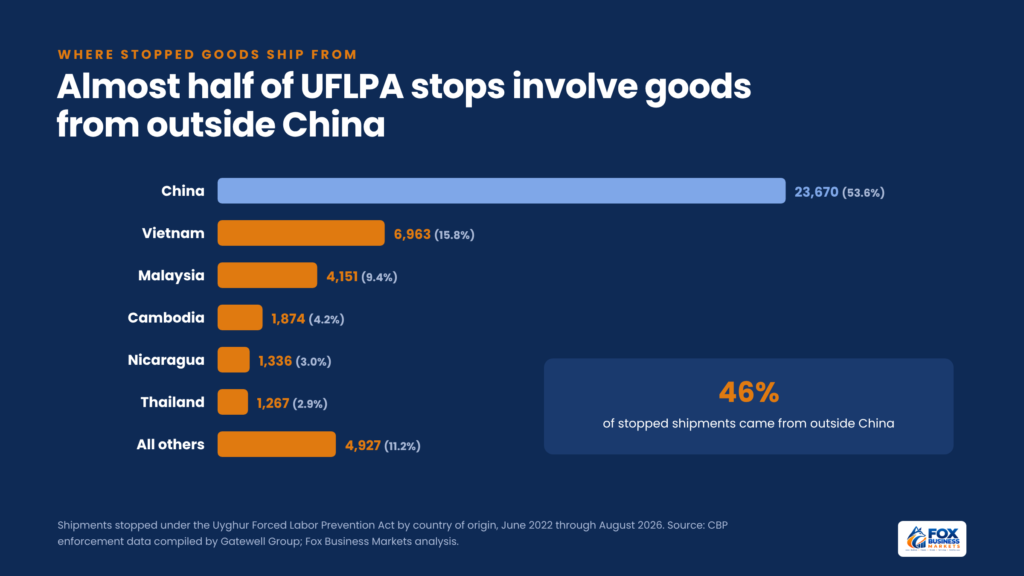
The UFLPA targets Xinjiang, but many stopped goods ship from elsewhere. Supply chains often run through third countries, where Chinese materials are turned into finished goods.
Country of origin | Shipments stopped | Share of total |
| China | 23,670 | 53.6% |
| Vietnam | 6,963 | 15.8% |
| Malaysia | 4,151 | 9.4% |
| Cambodia | 1,874 | 4.2% |
| Nicaragua | 1,336 | 3.0% |
| Thailand | 1,267 | 2.9% |
| All other countries | 4,927 | 11.2% |
Shipments stopped by country of origin, June 2022 through August 2026. Source: CBP UFLPA enforcement data compiled by Gatewell Group; Fox Business Markets analysis.
UFLPA shipments stopped by country of origin
About 46% of stopped shipments came from countries other than China.
How Has UFLPA Enforcement Changed Over Time?
CBP’s data shows the number of stopped shipments rising each full year, while their total value has swung widely:
Fiscal year | Shipments stopped | Value |
| 2022 (from June 21) | 2,356 | $474 million |
| 2023 | 10,902 | $1.42 billion |
| 2024 | 11,660 | $1.77 billion |
| 2025 | 12,272 | $191 million |
| 2026 (through August) | 6,998 | $274 million |
Federal fiscal years run from Oct. 1 to Sept. 30. Source: CBP UFLPA enforcement data compiled by Gatewell Group.
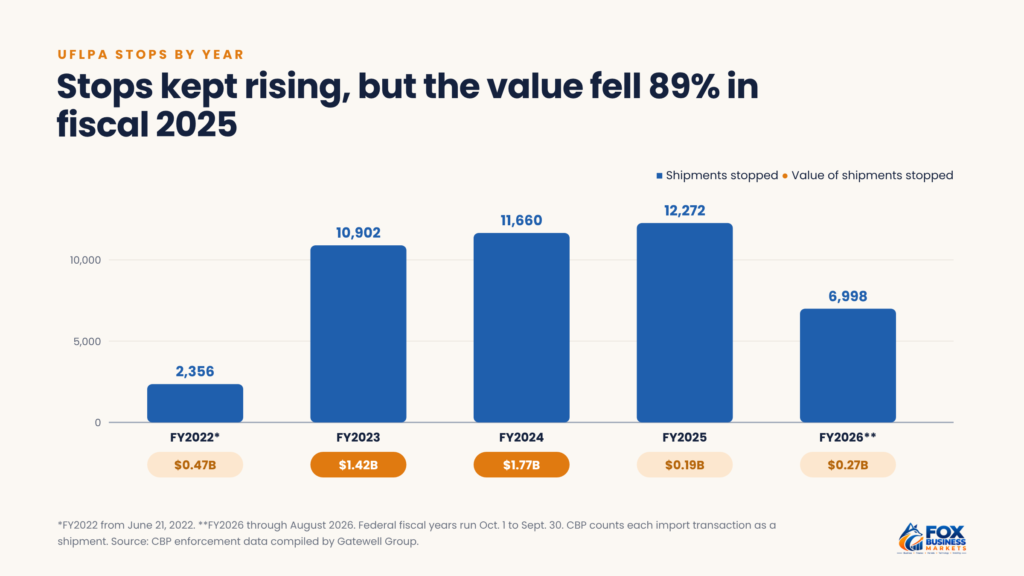
UFLPA shipments stopped and their value by fiscal year
The value of stopped goods fell by about 89% from fiscal 2024 to fiscal 2025, even as the number of stops edged up. That pattern fits a shift away from large solar and electronics shipments toward many smaller ones, though CBP’s data alone can’t show the reason.
Two caveats apply to these figures. CBP revised its dashboard in 2026 to count each import transaction as a shipment, and not every stopped shipment was physically held. The data also doesn’t show how often importers changed suppliers in response to the law.
Meanwhile, the government’s enforcement tools have grown. A June 2026 executive order on customs enforcement (EO 14411) directed DHS and the Justice Department to prioritize enforcement against imports made with forced labor, and a Justice Department trade fraud resource guide notes that importers can face civil penalties and criminal liability, according to law firm Covington & Burling.
What Happens When CBP Stops a Shipment Under the UFLPA?
CBP’s June 2026 Forced Labor Enforcement Operational Guidance for Importers sets out the process. The steps depend on how strong CBP’s evidence is:
Situation | What it means | Importer’s options |
| Possible UFLPA link | CBP suspects a tie to Xinjiang or a listed company but hasn’t confirmed it | Respond within 30 days through CBP’s Forced Labor Portal, asking for an applicability review or an exception |
| Confirmed UFLPA link | CBP has confirmed the goods fall under the law | Goods are excluded; the importer can export them, destroy them, or file a protest with evidence within 180 days |
Source: CBP guidance, as summarized by law firm Holland & Knight.
Importers have two main ways to fight a stop:
- Applicability review: You argue that the law doesn’t apply at all because no part of your supply chain touches Xinjiang or a listed company.
- Exception request: You accept that the law applies but try to rebut the presumption. You must show by clear and convincing evidence that the goods weren’t made with forced labor, prove you followed CBP’s guidance, and answer every CBP request completely. CBP must report each exception it grants to Congress.
Because the exception standard is so high, importers who can show no link to Xinjiang or a listed company often start with an applicability review. CBP’s guidance says affidavits, untranslated papers, and incomplete records on lower-tier suppliers are unlikely to be enough.
How Often Are Stopped Shipments Released?
Most stopped shipments never get in, but most of the money does. We split CBP’s outcomes by number of shipments and by value:
Outcome | Share of shipments | Share of value |
| Denied entry | 60.7% | 24.2% |
| Released | 34.7% | 72.2% |
| Still pending | 4.6% | 3.6% |
Shipments stopped June 2022 through August 2026. Source: CBP UFLPA enforcement data compiled by Gatewell Group; Fox Business Markets analysis.
The gap suggests that importers with large, high-value shipments, often in electronics, have been more likely to win release, possibly because they can afford detailed supply chain documentation. Smaller shipments are denied far more often. CBP’s data doesn’t show why each case ended the way it did, so this is a pattern, not proof of cause.
How Is the UFLPA Different From the 2026 Forced Labor Tariffs?
The two are separate measures, and they’re easy to confuse. The tariffs were imposed under Section 301 of the Trade Act of 1974.
| UFLPA | Section 301 forced labor tariffs | |
| What it does | Blocks goods tied to Xinjiang or listed companies | Adds a tariff on imports from many countries |
| Who runs it | CBP and DHS | Office of the U.S. Trade Representative (USTR) |
| Started | June 21, 2022 | July 24, 2026 |
| Who it hits | Specific goods with forced labor links | Imports from about 60 economies that USTR found hadn’t banned or enforced bans on forced labor imports |
| What it costs you | The shipment itself, if it’s blocked | Extra duty, generally 10% to 12.5% depending on the country |
The tariffs replaced a temporary global tariff that expired in July 2026, after the Supreme Court struck down earlier tariffs imposed under the International Emergency Economic Powers Act. Paying the tariff doesn’t make goods admissible if they fall under the UFLPA. A shipment from Vietnam can owe the new tariff and still be blocked if it contains Xinjiang cotton.
Our guides to what tariffs are and how to import products walk through duties, fees, and customs bonds for each shipment.
Is It a Myth That the UFLPA Only Affects Goods Made in China?
Yes. The law targets Xinjiang, but it follows the materials, not just the shipping label. Vietnam, Malaysia, and Cambodia alone accounted for about 29% of stopped shipments, according to CBP data.
Products commonly assembled outside China can still carry Xinjiang inputs:
- Clothing made in Vietnam, Cambodia, or Central America from Chinese cotton or yarn.
- Solar panels made in Malaysia, Thailand, or Vietnam with Chinese polysilicon.
- Aluminum products made from Chinese aluminum, which the Forced Labor Enforcement Task Force lists as a high-priority sector.
- Processed tomato products that use tomato paste from Xinjiang.
Moving production to another country doesn’t solve the problem on its own. Importers need to trace raw materials back to their source.
What Are the Risks for Small Importers?
Large companies have compliance teams. Small importers and online sellers often don’t, and they face real costs if a shipment is stopped:
- Lost inventory: Excluded goods must be exported or destroyed, so you may never sell them.
- Storage and demurrage fees: Goods sitting at a port during a review can rack up daily charges.
- Missed sales: A review that runs for weeks or months can wipe out a holiday or seasonal selling window.
- Supplier disputes: Your contract may not let you recover costs from a supplier that misrepresented its sourcing.
- Penalties: In serious cases, the government can pursue civil penalties or criminal charges.
- Reputation: Customers and marketplaces may drop a brand linked to forced labor.
Our guides to how to start an ecommerce business and how to open a retail store cover sourcing and inventory basics.
How Can Importers Comply With the UFLPA?
No single certificate proves compliance. CBP expects importers to know and document their full supply chain. These steps help:
- Map your supply chain to raw materials. Ask each supplier who made their components and where the raw materials came from, especially in sectors the government flags for extra enforcement, such as cotton, polysilicon, and aluminum.
- Screen against the Entity List. Check suppliers and their parent companies against the current list on the DHS website, and recheck after each update.
- Collect records before you ship. Gather purchase orders, invoices, bills of materials, production records, and transport documents for each tier of the supply chain.
- Put it in your contracts. Require suppliers to disclose sourcing, allow audits, and cover your costs if goods are stopped.
- Translate and organize documents. CBP wants records translated into English, indexed, and easy to search.
- Test high-risk materials. Some importers use isotopic testing to check where cotton or other materials came from, and CBP’s guidance says the agency may use such testing to check origin claims.
- Use a licensed customs broker. A broker or trade attorney can help you respond quickly if CBP stops a shipment.
- Review your exposure regularly. The Entity List and priority sectors change, so a supplier that was safe last year may not be today.
If you’re buying another company, check its suppliers too. Forced labor exposure can carry over to a buyer, so include supplier screening in mergers and acquisitions due diligence and in your company’s corporate governance policies.
How We Analyzed the Data
We used CBP’s UFLPA enforcement figures as compiled by Gatewell Group, current as of Sept. 4, 2026, covering shipments stopped from June 21, 2022, through August 2026. We calculated each industry’s and country’s share of the 44,188 shipments and $4.13 billion in value. CBP’s country values add up to slightly more than its stated total, so we used shipment counts rather than value for country comparisons. These figures show where enforcement happened, not where forced labor is most common.
Frequently Asked Questions
What is the difference between a withhold release order and the UFLPA?
A withhold release order, or WRO, is a CBP action under Section 307 of the Tariff Act of 1930 that blocks goods from a specific producer or region based on evidence of forced labor anywhere in the world. The UFLPA applies only to Xinjiang-linked goods and listed companies, and it starts from a presumption of forced labor. Tip: Check CBP’s WRO and Findings list as well as the UFLPA Entity List when screening suppliers.
Does the European Union have a similar law?
Yes. The EU’s Forced Labour Regulation will ban products made with forced labor from the EU market, with its rules applying from December 2027. Unlike the UFLPA, it isn’t limited to one region and doesn’t start with a presumption against a specific area. Tip: If you sell in both markets, build one supply chain tracing system that can meet both sets of rules.
Can a company be removed from the UFLPA Entity List?
In principle, yes. A listed company can ask the Forced Labor Enforcement Task Force to remove it by showing it no longer meets the criteria for listing, and DHS has published a process for these requests. We found no public record of a company being removed as of November 2026. In August 2026, the U.S. Court of International Trade largely upheld the task force’s denial of auto parts maker Camel Group’s removal request. Tip: Don’t rely on a supplier’s claim that it expects to be delisted; screen against the current published list.
How long can CBP hold a shipment during a UFLPA review?
After an importer responds, CBP reviews the evidence before deciding whether to release or exclude the goods, and that review can take weeks or months. Storage fees usually keep building while goods sit at the port. Tip: Ask your freight forwarder in advance what daily storage and demurrage charges apply, so you can budget for a long review.
Trace Your Supply Chain Before Your Next Order
The UFLPA puts the burden on importers to prove their goods are clean, and the Entity List and priority sectors keep changing. Where a product was assembled doesn’t settle where its materials came from.
Ask your suppliers where their raw materials come from, screen them against the Entity List, and keep records ready in case CBP asks.
This article is for general information only and isn’t financial, tax, legal, or investment advice. Consider your own situation or talk to a qualified professional before making decisions.

