Quick answer: Net worth is the value of everything you own minus everything you owe. Add up your cash, investments, retirement accounts, home, and other assets, then subtract your mortgage, loans, and credit card balances. The median U.S. family had a net worth of $215,900 in 2025, according to the Federal Reserve.
The typical American family’s net worth reached $215,900 in 2025, up 2% from 2022 after adjusting for inflation, according to the Federal Reserve’s 2025 Survey of Consumer Finances. The average was far higher, about $1.24 million, because a small number of very wealthy households pull it up.
Those national numbers hide a wide gap. Families headed by someone under 35 saw their median fall 23% over the same three years, while families headed by someone 75 or older posted the largest gain of any age group, 37%. Your age, your debts, and whether you own a home shape your number far more than any national average.
This guide shows how to calculate your net worth step by step, what counts as an asset or a liability, how your number compares by age using the newest Fed data, what a “good” number looks like, and practical ways to grow it year after year.
What Is Net Worth?
Net worth is a snapshot of your financial position at one moment in time. The formula is short:
Net worth = total assets − total liabilities
- Assets are things you own that have money value, such as bank accounts, investments, retirement accounts, real estate, vehicles, and business interests.
- Liabilities are debts you owe, such as a mortgage, car loan, student loans, credit card balances, and medical bills.
If your assets are worth more than your debts, the result is positive. If you owe more than you own, it’s negative. The figure alone doesn’t capture your full financial health, but tracking it over time shows whether you’re moving in the right direction.
Net worth is different from income. Income is the money that comes in each year, while net worth measures what you’ve kept and built. A high earner who spends everything can end up with less than a modest earner who saves steadily. That’s why this number is the starting point of any financial plan.
How Do You Calculate Your Net Worth?
You can do the math in about an hour with recent statements and a spreadsheet or notepad.
- Gather your statements. Collect the latest balances for bank accounts, brokerage accounts, retirement accounts, loans, and credit cards.
- List every asset at today’s value. Use current account balances, a realistic estimate of your home’s market value, and the private-party value of your vehicles.
- List every debt at its current balance. Use the payoff balance from your latest statement, not the original loan amount.
- Subtract total debts from total assets. The result is your net worth.
- Save the date and the number. Repeat the same steps every six or 12 months so you can compare like with like.
A worked example
Maya is 34, earns $85,000 a year, and owns a condo. Her balance sheet looks like this:
| Assets | Value | Liabilities | Balance |
| Checking and savings | $12,000 | Mortgage | $285,000 |
| 401(k) | $48,000 | Car loan | $9,000 |
| Roth IRA | $9,000 | Student loans | $22,000 |
| Home (market value) | $340,000 | Credit card | $3,000 |
| Car (resale value) | $14,000 | ||
| Total assets | $423,000 | Total liabilities | $319,000 |
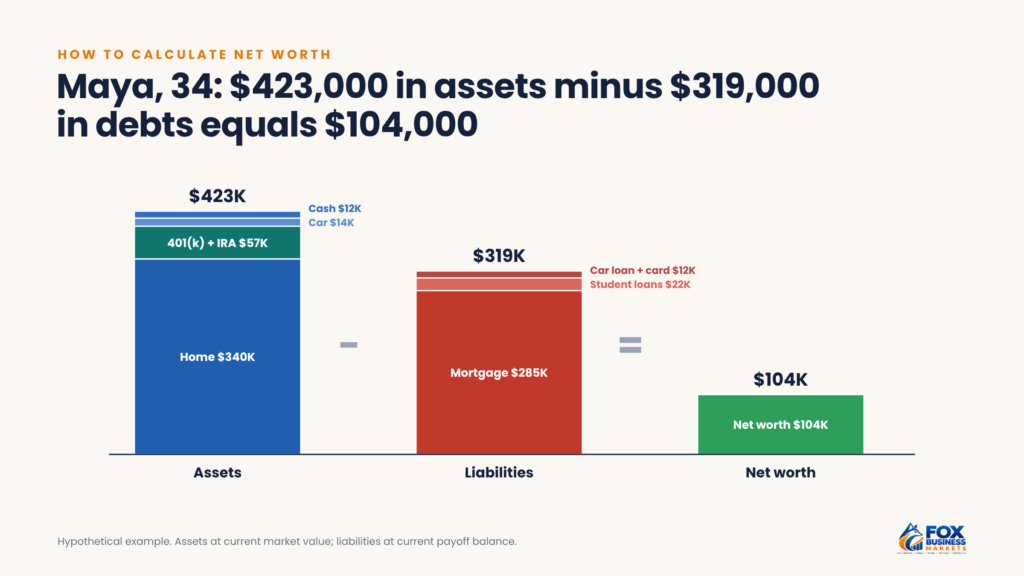
Maya’s net worth is $423,000 − $319,000 = $104,000. Most of her assets sit in her home, but most of her home is still owed to the bank. Her home equity is $55,000 ($340,000 − $285,000), her cash and retirement accounts add $69,000, and her car adds $14,000. Her $34,000 in car, student, and credit card debt brings the total back to $104,000.
What Counts as an Asset or a Liability?
| Category | Count it | Notes |
| Cash, checking, savings, CDs | Asset | Use current balances |
| Brokerage accounts, stocks, bonds, funds | Asset | Use current market value |
| 401(k), 403(b), IRAs, HSAs | Asset | Taxes may be owed on pre-tax accounts when you withdraw |
| Home and other real estate | Asset | Use a realistic sale price, not the purchase price |
| Vehicles | Asset | Use the private-party resale value |
| Business ownership | Asset | Use a conservative estimate unless it’s been appraised |
| Cash value of permanent life insurance | Asset | Use the cash surrender value, not the death benefit |
| Furniture, clothing, electronics | Usually skip | Resale value is low and hard to estimate |
| Mortgage and home equity loans | Liability | Use the payoff balance |
| Car loans, student loans, personal loans | Liability | Include deferred loans |
| Credit card balances | Liability | Include the full statement balance |
| Taxes owed, medical bills, loans from family | Liability | Easy to forget, but they still count |
Two items cause the most confusion. Your home counts as an asset at its market value, and your mortgage counts as a liability, so only the equity adds to your total. And a pension you’ll receive later is usually left out of a basic calculation, because it isn’t something you can sell or withdraw today, even though it has real value for your retirement planning.
What Is the Average Net Worth by Age?
Wealth usually climbs through your working years as you pay down debt, build home equity, and let investments grow, and in the 2025 data it kept rising into the oldest age group. Here are the latest figures from the Federal Reserve’s Changes in U.S. Family Finances from 2022 to 2025 report, in 2025 dollars:
| Age of head of household | Median net worth | Average (mean) net worth |
| Under 35 | $33,000 | $135,400 |
| 35 to 44 | $155,600 | $681,900 |
| 45 to 54 | $253,700 | $1,244,500 |
| 55 to 64 | $411,900 | $1,878,000 |
| 65 to 74 | $431,300 | $1,897,600 |
| 75 and older | $504,900 | $1,962,200 |
| All families | $215,900 | $1,241,500 |

Compared with these figures, Maya’s $104,000 is about three times the median for her age group. Next year, when she turns 35, her benchmark will shift to the 35 to 44 median of $155,600.
The survey groups families by the age of the “reference person”: in a couple, the man in a mixed-sex couple or the older partner in a same-sex couple, and otherwise the person who is economically dominant in the household. So a 30-year-old living with older parents may be counted in a different age group. The Fed runs the survey every three years, and the next one will cover 2028, with results likely in 2029.
Why Is the Median So Different From the Average?
The median is the middle value: half of families have more and half have less. The average (mean) adds up everyone’s wealth and divides by the number of families, so a small group of very wealthy households pulls it far above what a typical family holds.
In 2025, the average of $1.24 million was nearly six times the median of $215,900. Families in the top 10% by income had a median net worth of about $3.67 million, up 31% from 2022, and the top 10% by net worth had a median of about $4.94 million, up 19%. CBS News noted that families 75 and older are now the wealthiest age group by median. For most people, the median is the more useful comparison.
How Has Net Worth Changed Since 2022?

The 2025 survey showed gains at the top and the oldest ages, and losses at the bottom and the youngest ages. All changes below are adjusted for inflation:
- All families: median up 2%, average up 7%.
- Under 35: median down 23% and average down 33%, the steepest drop of any age group.
- 75 and older: median up 37%, the largest gain of any age group.
- Bottom 20% by income: median down 6%.
- Top 10% by income: median net worth up 31%, to about $3.67 million.
Older households benefited most from rising stock prices and home values, because they hold more of both. Debt stress also rose: about 20% of families had been late on a loan payment in the past year, up from 12% in 2022 and the highest share since the 2010 survey. For broader context on how households are doing, see our personal finance statistics roundup.
Is a Negative Net Worth a Sign You’re Failing?
No. Owing more than you own is common early in adult life and often reflects investments in your future rather than poor choices. Many people start their careers owing more than they own because of:
- Student loans taken out before their earning years begin.
- A new home purchase, where closing costs and a small down payment can leave equity close to zero at first.
- A car loan on a vehicle that loses value faster than the loan is paid down.
- Medical bills or a job loss that forced them to borrow.
What counts is the direction. If your negative number is shrinking each year because you’re paying down debt and starting to save, you’re on track. Focus first on high-interest balances, using a method from our guide on how to pay off debt, and build a small cash cushion so new emergencies don’t add to the hole.
What Is a Good Net Worth for Your Age?
There’s no single right number, because income, cost of living, family size, and goals differ. Still, a few benchmarks can show whether you’re roughly on pace:
- Compare with the median for your age, not the average. Being above the median puts you ahead of half of families in your age group.
- Use a savings-multiple guideline for retirement. Fidelity suggests saving about 1 times your salary by age 30, 3 times by 40, 6 times by 50, 8 times by 60, and 10 times by 67. This measures retirement savings, not your full balance sheet.
- Try the “Millionaire Next Door” formula. Authors Thomas Stanley and William Danko suggested an expected net worth of your age times your pretax income, divided by 10. For Maya, that’s 34 × $85,000 ÷ 10 = $289,000. The formula sets a high bar and works best for mid-career earners, so treat it as a stretch target.
By Fidelity’s guideline, Maya’s $57,000 in retirement accounts is about two-thirds of her $85,000 salary, short of the 1 times target for age 30 and further behind the pace toward 3 times by 40, even though her overall number beats her age group’s median. Benchmarks are most useful when they point you toward a specific next step.
How Often Should You Track Your Net Worth?
Once or twice a year is enough for most people. Pick fixed dates, such as January 1 and July 1, and use the same valuation methods each time so changes reflect real progress rather than guesswork. A spreadsheet with one row per asset and debt and one column per date works well and keeps your data private. If you use an app that links accounts, update home and car values by hand once a year.
Checking monthly can make you react to short-term market swings that don’t change your long-term plan. If you’re paying off debt aggressively or saving for a home, a quarterly check can keep you motivated without the noise.
Track three numbers each time: total net worth, liquid net worth (cash and taxable investments you could reach within days, without early-withdrawal penalties or selling your home), and the change since your last check. Liquid net worth tells you how much flexibility you have if your income stops. For Maya, that figure is about $12,000, her checking and savings, or roughly 11% of her total. Her retirement accounts are invested for later, and her home equity stays locked up until she sells or borrows against it.
How Can You Grow Your Net Worth?
Your number grows in two ways: by increasing what you own and by reducing what you owe. These steps work at any income level:
- Pay off high-interest debt first. Paying off a credit card that charges 22% interest works like a guaranteed 22% return, which few investments can match.
- Build an emergency fund. Three to six months of expenses in an emergency fund keeps a surprise bill from turning into new debt.
- Capture your full employer match. If your employer matches 401(k) contributions, contributing enough to get the full match is an instant return on your money.
- Automate investing. Set up automatic transfers to retirement and brokerage accounts on payday, and let compound interest do the heavy lifting over decades. If you’re new to this, start with our guide on how to start investing.
- Raise your savings rate when your income rises. Save at least half of every raise before your spending adjusts to it.
- Build home equity carefully. Extra mortgage payments raise equity, but only after you’ve covered high-interest debt and retirement savings.
- Protect what you’ve built. Adequate health, disability, and life insurance keeps one bad event from erasing years of progress.
To see how these steps add up, take Maya. If she contributes 10% of her pay ($8,500) to her 401(k), collects a 4% employer match ($3,400), and pays down about $9,000 of loan and card principal over the next year, her number rises by roughly $20,900. Subtract about $2,000 for her car’s depreciation, and she ends the year near $123,000, before any change in her home’s value or the markets.
One point trips people up: moving money between your own accounts doesn’t change your number. Using $3,000 from savings to clear a credit card lowers your assets and your debts by the same amount, so your total stays put. The gain shows up afterward, as interest you no longer pay stays in your pocket.
A written budget ties these steps together by showing exactly how much you can direct toward debt and savings each month.
What Mistakes Can Distort Your Net Worth?
An inaccurate number can make you feel richer or poorer than you are. Watch for these common errors:
- Using your home’s purchase price or an online estimate that’s too high. Check recent sales of similar homes nearby, and consider subtracting estimated selling costs of 6% to 8%.
- Valuing cars at what you paid. Vehicles lose value quickly; use a current resale estimate.
- Forgetting smaller debts, such as buy now, pay later plans, medical bills, or money owed to family.
- Counting personal belongings at replacement cost. Furniture and electronics rarely sell for anything close to what you paid.
- Ignoring taxes on pre-tax accounts. A $100,000 traditional 401(k) isn’t worth $100,000 to spend, because withdrawals are taxed as income. Some people track an after-tax version as a second number.
- Double counting. Count your home at market value and your mortgage as a debt, but don’t also add your home equity as a separate asset.
To see the effect, run Maya’s numbers conservatively. Subtracting 6% selling costs on her $340,000 condo ($20,400) and an estimated 22% tax on her $48,000 401(k), assuming it’s all pretax ($10,560), cuts her $104,000 to about $73,000. Neither version is wrong, but tracking both shows how much of her wealth is already claimed by taxes and transaction costs.
Frequently Asked Questions
Does your net worth affect your credit score?
No. Credit scores are based on how you’ve handled borrowing, such as payment history, balances, and length of credit history, not on your assets or savings. A wealthy person can still have a low score after missed payments. Check your credit reports for free at AnnualCreditReport.com, which now offers free reports weekly.
Is net worth taxed in the United States?
There’s no federal wealth tax. You pay taxes on income, on gains when you sell investments, and possibly property taxes on real estate. The federal estate tax applies only to very large estates, with a $15 million exemption per person in 2026 under the One Big Beautiful Bill Act. Check your state’s rules too, because some states have lower estate or inheritance tax thresholds.
Should married couples track net worth together or separately?
Most couples track one combined household number, because shared goals such as a home, children, and retirement depend on total resources. Couples who keep separate finances can also track individual numbers alongside the joint total. Agree on how you’ll value shared assets, such as your home, so you both read the number the same way.
What net worth do you need to be an accredited investor?
Under SEC rules, you qualify as an accredited investor with a net worth above $1 million, alone or with a spouse or spousal equivalent, not counting your primary home. You can also qualify with income above $200,000, or $300,000 jointly, in each of the past two years, or by holding certain professional licenses such as the Series 7. Accredited status opens access to private funds and offerings, which carry higher risks and less disclosure. Before you invest, recalculate your number without your home equity, because that’s the figure the rule uses.
Calculate Your Net Worth This Weekend
Pull your latest statements, list every asset and debt, and subtract one from the other. Write down the date and the number, then compare it with the median for your age. Pick the one step from this guide that will move your number most, whether that’s paying off a credit card, capturing your 401(k) match, or building an emergency fund, and set it up now. Revisit your number in six months. If your finances are complex or you’d like a second opinion, a financial advisor can help, and our retirement statistics roundup shows how others are preparing for later life.
This article is for general information only and isn’t financial, tax, legal, or investment advice. Consider your own situation or talk to a qualified professional before making decisions.

