Quick answer: A financial advisor helps you plan, invest, and make money decisions, usually for a percentage of assets, a flat fee, an hourly rate, or commissions. Look for a fee-only fiduciary with relevant credentials, verify their record on SEC and FINRA databases, compare total costs, and interview at least three advisors before you hire one.
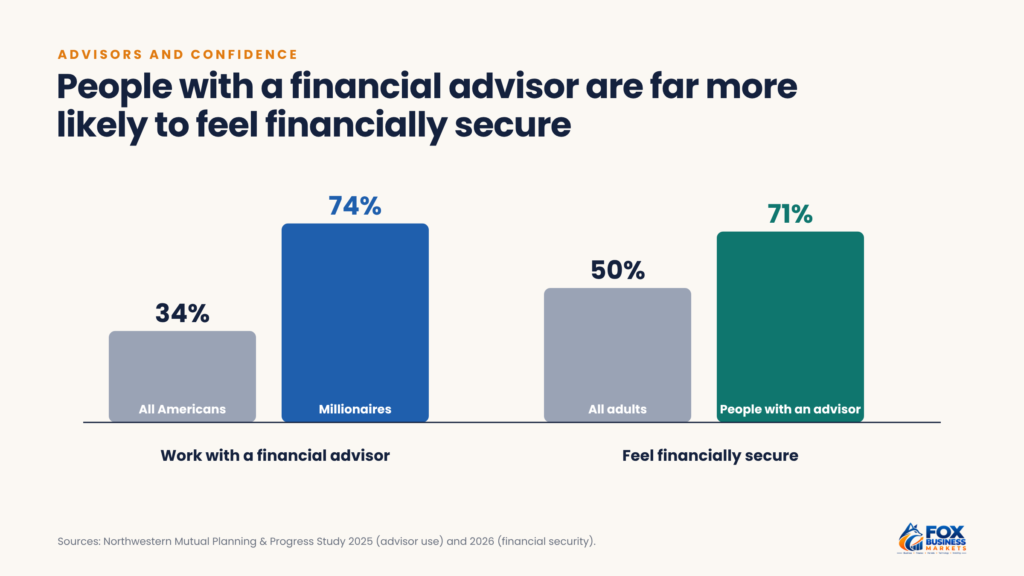
About one in three Americans, 34%, worked with a financial advisor in Northwestern Mutual’s 2025 Planning & Progress Study, while 74% of millionaires did. In the 2026 study, 71% of people with an advisor said they feel financially secure, compared with 50% of all adults.
Yet “financial advisor” isn’t a protected title. Anyone from a certified planner to an insurance salesperson can use it, and the way an advisor is paid can shape the advice you get. Two advisors with the same title can charge very different amounts and owe you very different legal duties.
This guide explains what a financial advisor does, the main types, how they’re paid and what they cost in 2026, how to tell whether you need one, and how to choose and vet an advisor before you sign anything.
What Does a Financial Advisor Do?
A financial advisor helps you make and carry out decisions about your money. Depending on the advisor, services can include:
- Financial planning: setting goals and building a written financial plan
- Investment management: choosing, monitoring, and rebalancing investments
- Retirement planning: estimating needs, choosing accounts, and planning withdrawals
- Tax planning: coordinating investments and withdrawals to reduce taxes
- Insurance and risk planning: reviewing life, disability, and long-term care coverage
- Estate planning coordination: working with attorneys on wills, trusts, and beneficiaries
- Special situations: stock compensation, business sales, inheritances, divorce, or college funding
Some advisors do all of these. Others focus on one, such as investment management or insurance. Ask exactly which services are included in the fee.
What Types of Financial Advisors Are There?
Some of these are credentials a person earns, others describe how a firm is registered, and one person can hold several.
| Type | What they do | How they’re regulated or credentialed |
| Certified Financial Planner (CFP) | Comprehensive financial planning | CFP Board certification; must act as a fiduciary when giving financial advice |
| Registered investment adviser (RIA) firm and its representatives (IARs) | Investment advice and management, often planning too | Registered with the SEC or state; fiduciary duty under federal or state law |
| Broker or registered representative | Buys and sells securities, often for commissions | Registered with FINRA and states; must follow the SEC’s Regulation Best Interest when recommending to retail customers |
| Robo-advisor | Automated, algorithm-driven portfolio management | Registered investment advisers; limited personal advice |
| Insurance agent | Sells life insurance, annuities, and other policies | Licensed by state insurance departments; often paid by commission |
| CPA with a Personal Financial Specialist (PFS) credential | Tax-focused financial planning | Licensed CPA plus AICPA credential |
| Chartered Financial Analyst (CFA) | Investment analysis and portfolio management | CFA Institute charter |
“Adviser” is the spelling used in federal law, while “advisor” is the common spelling.
There were 107,529 CFP professionals in the U.S. at the end of 2025, a record, according to the CFP Board.
What Is a Fiduciary Financial Advisor?
A fiduciary must put your interests ahead of their own, disclose conflicts of interest, and act with care and loyalty in the advice they give.
- Registered investment advisers owe clients a fiduciary duty under the Investment Advisers Act of 1940 or state law.
- CFP professionals must act as fiduciaries whenever they give financial advice, under the CFP Board’s standards.
- Brokers must follow Regulation Best Interest, which requires them to act in a retail customer’s best interest when they make a recommendation. The duty generally applies at that moment, not as an ongoing duty to monitor your account.
- Insurance agents generally follow state suitability or best-interest rules for insurance and annuity sales, which vary by state.
Many professionals are “dually registered” as both investment adviser representatives and brokers, so they may act as a fiduciary for some services and a salesperson for others. Ask in writing: “Will you act as a fiduciary at all times, for every account and recommendation?”
How Do Financial Advisors Get Paid?
How an advisor is paid shapes their incentives, so ask early and get the answer in writing.
| Pay model | How it works | Watch for |
| Fee-only | You pay the advisor directly; no commissions from products | Fees can still be high; check the total cost |
| Fee-based | A mix of fees from you and commissions from products | Potential conflicts when recommending products that pay commissions |
| Commission-based | Paid by the companies whose products they sell | Incentive to sell higher-commission products or trade more |
Within fee-only, there are several structures:
- Percentage of assets under management (AUM): an annual fee based on the money they manage, often around 1%, sometimes lower for larger accounts.
- Flat fee or retainer: a set annual or monthly fee, regardless of your assets.
- Hourly: you pay for time, which suits a one-time question or second opinion.
- Project or plan fee: a one-time fee for a written financial plan.
How Much Does a Financial Advisor Cost?
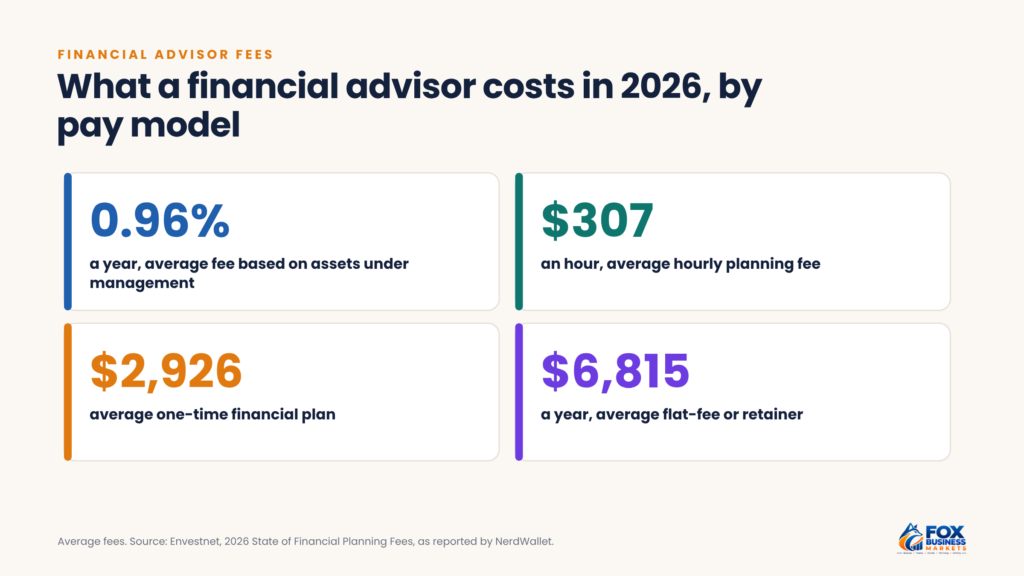
Average advisory fees reported in Envestnet’s 2026 State of Financial Planning Fees, as summarized by NerdWallet:
| Fee type | Average cost |
| Percentage of assets (AUM) | About 0.96% a year |
| Hourly | About $307 an hour |
| One-time financial plan | About $2,926 |
| Annual retainer or flat fee | About $6,815 a year |
These are advisory fees only. You may also pay fund expense ratios, trading or custody fees, or wrap-account fees, so ask for the total annual cost as a dollar figure. Robo-advisors typically charge 0.25% to 0.50% a year, according to NerdWallet’s estimate of typical robo-advisor pricing.
Many AUM advisors use breakpoints, where the rate falls as your balance rises. A common schedule might charge 1% on the first $1 million and 0.75% on assets above that. On a $1.5 million account, that works out to $10,000 plus $3,750, or $13,750 a year, an effective rate of about 0.92%. Ask for the full schedule, because a few thousand dollars of extra savings can push you into a lower tier, and some firms also cap fees or waive them for family accounts.
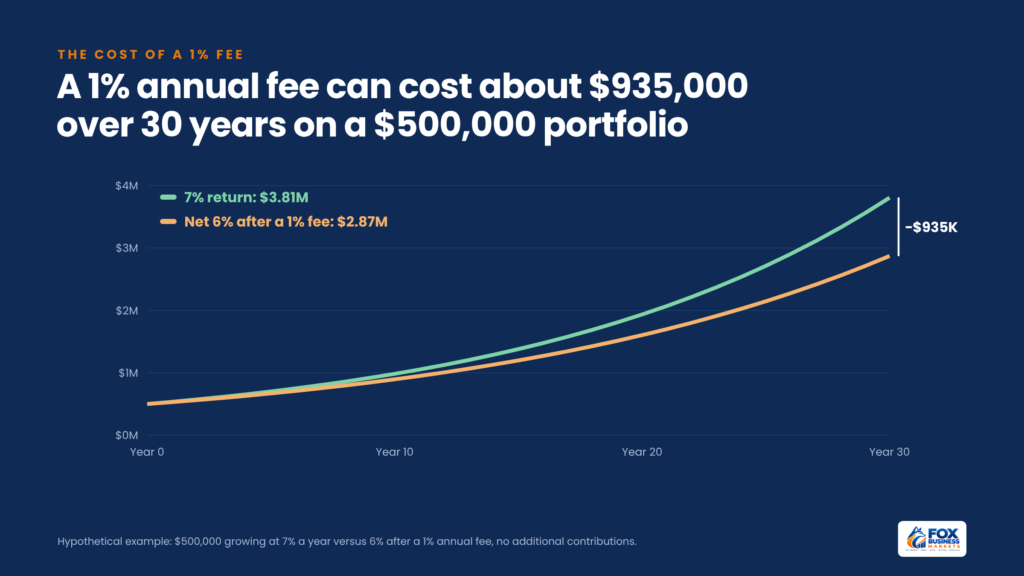
Fees compound over time. On a $500,000 portfolio, a 1% fee costs $5,000 in the first year. If the portfolio earns 7% a year for 30 years, it grows to about $3.81 million; at a net 6% after a 1% annual fee, it reaches about $2.87 million, a difference of about $935,000. That doesn’t mean an advisor isn’t worth it, but the value they add should clearly exceed what they cost.
Do You Need a Financial Advisor?
You may benefit from an advisor if:
- You’ve had a major life change, such as marriage, divorce, a new child, an inheritance, or a job loss.
- You’re within 10 years of retirement and need an income and withdrawal plan.
- You own a business, receive stock compensation, or have complex taxes.
- You don’t have the time, interest, or confidence to manage investments yourself.
- You tend to make emotional decisions during market swings.
You may not need ongoing help if:
- Your finances are straightforward: a steady job, a 401(k), an IRA, and no complex tax issues.
- You’re comfortable building a budget and investing in low-cost index funds.
- You only need occasional advice, which an hourly or one-time planner can provide.
Where Can You Find a Financial Advisor?
You don’t need to start with a cold call from a salesperson. These directories and networks make it easier to find an advisor whose pay model fits you:
- CFP Board’s Let’s Make a Plan: a free search tool at org that lists CFP professionals by location, services, and compensation method. Suits people who want a certified planner.
- NAPFA: the National Association of Personal Financial Advisors lists fee-only advisors who don’t accept commissions. Suits people who want to avoid product-sales conflicts.
- XY Planning Network: fee-only advisors, many of whom offer flat monthly or annual fees with no asset minimum. Suits younger professionals and people still building savings.
- Garrett Planning Network: advisors who work hourly or by project. Suits people who want a one-time plan or a second opinion.
- Your workplace or 401(k) plan: some employers and plan providers offer free or low-cost planning sessions. Check your benefits portal before paying for help elsewhere.
- Referrals: friends, family, or your CPA or estate attorney may know advisors they trust. Treat a referral as a starting point and still check the advisor’s record.
Whichever route you use, screen candidates the same way: confirm credentials, look up their record, and compare total costs before you book an introductory meeting.
Are Financial Advisors Only for the Wealthy?
No. Many people assume advisors only work with millionaires, partly because some firms set high account minimums. But plenty of options fit smaller budgets:
- Hourly and project-based planners charge for a one-time plan or review, with no asset minimum.
- Flat-fee and subscription planners charge a set monthly or annual fee, often aimed at younger professionals building savings.
- Robo-advisors manage portfolios for a small percentage of assets, often with low or no minimums, and some offer access to human planners for an added fee.
- Workplace programs sometimes include free or low-cost financial planning through your employer or retirement plan.
If you have less than $100,000 to invest, a one-time plan plus a low-cost robo-advisor or target-date fund can cover the core planning for much less than ongoing management. For example, a $2,000 plan plus a 0.25% robo fee on $80,000 ($200 a year) costs far less over 10 years than a 1% advisor fee on the same balance ($800 a year, before growth).
How Do You Choose a Financial Advisor?
- Decide what you need. A full financial plan, investment management, retirement income, tax planning, or a one-time review.
- Pick a pay model that fits. Hourly or flat-fee for occasional advice; AUM or retainer for ongoing management.
- Look for credentials. CFP for broad planning, CPA/PFS for tax-heavy situations, CFA for investment-focused work.
- Check the record. Search the advisor and their firm on the SEC’s Investment Adviser Public Disclosure site and FINRA’s BrokerCheck. Look for disciplinary history, complaints, and where they’ve worked.
- Read the disclosure documents. Form CRS, a short relationship summary, explains services, fees, and conflicts in plain language. Form ADV Part 2A, the firm brochure, gives more detail.
- Interview at least three advisors. Compare their answers, fees, and how well they listen.
- Get the services and total fees in writing, along with the fiduciary commitment described above.
What Happens at Your First Meeting?
Most advisors offer a free introductory call or meeting. A typical process looks like this:
- Introductory call. You describe your situation and goals, and the advisor explains services, fees, and whether you’re a good fit. Nothing should be sold at this stage.
- Information gathering. If you move forward, expect to share pay stubs, account statements, tax returns, insurance policies, and debts, along with your goals and how much risk you’re comfortable taking.
- Plan or proposal. The advisor presents recommendations, such as how much to save, how to invest, and which accounts to use. A good advisor explains the reasons behind each one and the trade-offs.
- You sign an advisory agreement that lists services, fees, and how either side can end the relationship. Read it before signing and ask about anything unclear.
- Accounts are opened or transferred to an independent custodian, and investments are set up.
- Ongoing reviews. For ongoing relationships, the advisor monitors your accounts and meets with you regularly.
Bring a list of your goals and questions to the first meeting, and pay attention to whether the advisor asks about your life and priorities before talking about products.
What Questions Should You Ask Before Hiring?
- Are you a fiduciary at all times, for all of my accounts?
- How are you paid, and what will I pay in total each year, in dollars?
- Do you receive commissions, bonuses, or other payments from any products you recommend?
- What credentials do you hold, and how long have you been advising clients?
- What services are included in your fee, and what costs extra?
- Who is your typical client, and what’s your account minimum?
- How often will we meet, and how will you communicate with me?
- Who holds my money? (It should be an independent custodian, not the advisor.)
- How do you choose investments, and how often do you trade?
What Red Flags Should You Watch For?
- Guaranteed returns or pressure to act quickly.
- Vague answers about fees, or reluctance to put costs in writing.
- Pushing products such as annuities or whole life insurance before understanding your situation.
- Frequent trading in your account without a clear reason.
- Asking you to make checks payable to them personally instead of to an independent custodian.
- Disciplinary history or complaints on BrokerCheck or the SEC database that they don’t explain.
- Not explaining your investments in terms you understand.
How Do You Know If Your Financial Advisor Is Worth the Fee?
Investment returns alone are a poor measure, because markets move up and down regardless of who manages your money. Instead, review the advisor’s value once a year against a few questions:
- Do you have a written plan, and is it updated when your life changes?
- Have they saved you money through tax planning, lower-cost investments, better account choices, or avoiding expensive mistakes?
- Do you understand your investments and why you own them?
- Did they keep you on track during market drops, rather than letting you sell at the wrong time?
- Do you know exactly what you pay, in dollars, including fund and account costs?
- Are they responsive when you have questions or a life event?
If you can’t answer yes to most of these, compare your total annual cost with a lower-cost alternative, such as an hourly planner for occasional reviews plus a robo-advisor for investing. If the gap is large, see the FAQ below on switching advisors.
Should You Use a Robo-Advisor or a Human Advisor?
| Robo-advisor | Human financial advisor | |
| Typical cost | 0.25% to 0.50% of assets a year | About 1% of assets, or flat or hourly fees |
| Minimums | Often low or none | Often higher for ongoing management |
| Services | Automated portfolios, rebalancing, sometimes tax-loss harvesting | Full planning, taxes, retirement income, estate coordination, behavioral coaching |
| Best for | Hands-off investors with simple needs | Complex situations, major life events, people who want a relationship |
| Hybrid options | Some offer access to human planners for an added fee | Some advisors use automated platforms to lower costs |
Many people start with a robo-advisor or a DIY approach using our guide on how to start investing, then hire a human advisor as their finances become more complex, often in the decade before retirement.
Frequently Asked Questions
Are financial advisor fees tax-deductible?
Generally not for individuals. Investment advisory fees used to be a miscellaneous itemized deduction, but that deduction was suspended starting in 2018 and then permanently eliminated by the One Big Beautiful Bill Act, signed July 4, 2025. Fees paid by a business for business purposes may still be deductible. Ask a tax professional whether paying fees from a traditional IRA or 401(k) makes sense for you.
Can you negotiate a financial advisor’s fees?
Often, yes, especially if you bring a larger balance or only need limited services. Ask whether the firm offers breakpoints, household pricing that combines family accounts, a fee cap, or a reduced rate if you skip services you don’t need. Ask for the firm’s fee schedule and request the next breakpoint if you’re close to it.
How do you switch or fire a financial advisor?
Open an account with the new advisor or brokerage first, then request a transfer of assets, which usually moves investments without selling them. Notify your old advisor in writing and check for termination or transfer fees. Review the tax impact before selling anything in a taxable account.
What happens if your financial advisor retires or leaves the firm?
If your advisor retires, the firm usually assigns you to another advisor, and you may be asked to sign a new agreement. If they move to another firm, they may invite you to follow, but your accounts stay at the custodian until you choose to transfer them. Either way, you’re free to stay, follow, or move your money elsewhere. Ask at the first meeting who your backup advisor is and get their name in writing.
Interview Three Advisors Before You Sign
List what you want help with, then find three advisors who fit, at least one of them fee-only. Look each one up on BrokerCheck and the SEC’s adviser database, read their Form CRS, and ask every question above. Choose the one who explains costs clearly, listens well, and puts their fiduciary duty in writing. Track your progress with our net worth guide, and see how others are preparing in our retirement statistics roundup.
This article is for general information only and isn’t financial, tax, legal, or investment advice. Consider your own situation or talk to a qualified professional before making decisions.

