Quick answer: An ACH payment is an electronic bank-to-bank transfer sent through the U.S. Automated Clearing House network. It powers direct deposit, bill pay, and many business payments. ACH usually settles in one to two business days, or the same day with Same Day ACH, and typically costs far less than card or wire payments.
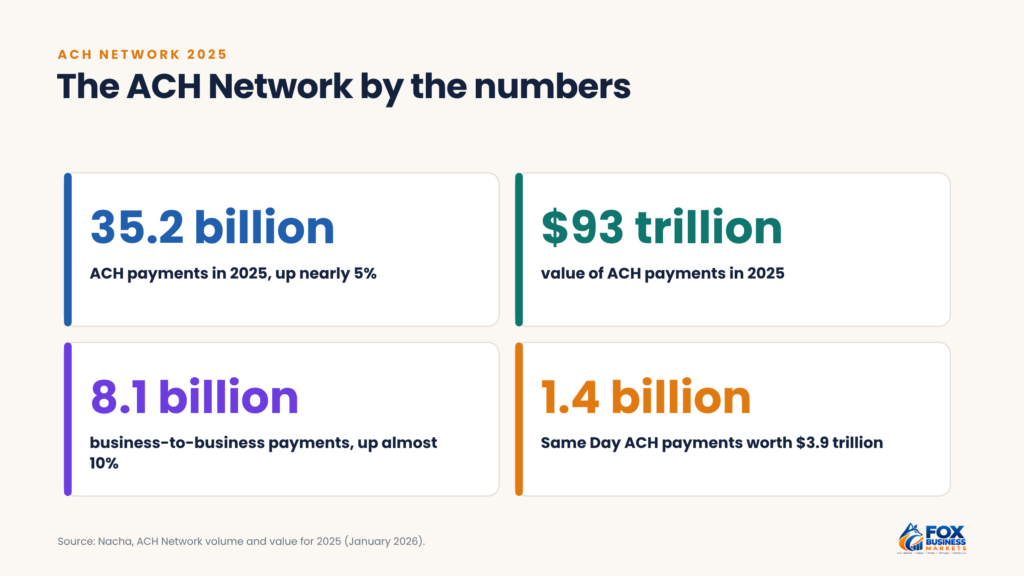
The ACH Network moved 35.2 billion payments worth $93 trillion in 2025, according to Nacha, the organization that governs it. Business-to-business payments grew almost 10%, to about 8.1 billion, as more companies moved away from paper checks.
ACH isn’t as fast as a wire or as familiar to shoppers as a credit card. But for invoices, payroll, rent, and subscriptions, it’s often the cheapest way to move money, and a single ACH payment can cost a few dollars where a card payment of the same size costs more than $100.
This guide explains how ACH works, the difference between credits and debits, how ACH compares with wires and cards, what it costs, the 2026 Nacha fraud rules, and how to start accepting and sending ACH payments, including payroll and international transfers. For how ACH fits into the wider payment system, see our guide to payment processing.
What Is an ACH Payment?
An ACH payment moves money electronically between bank accounts through the Automated Clearing House (ACH) Network. Instead of settling each payment one at a time, banks group ACH transactions into batches that are processed several times a day.
Two operators run the network: the Federal Reserve’s FedACH and The Clearing House’s Electronic Payments Network (EPN). Nacha writes the rules all participating banks and businesses must follow.
You probably use ACH already. Common ACH payments include:
- Paychecks paid by direct deposit
- Social Security and tax refunds
- Automatic bill payments for utilities, loans, and insurance
- Business payments to suppliers and contractors
- Transfers between your own accounts at different banks
- Many peer-to-peer apps when they move money to or from a bank account
How Does an ACH Payment Work?
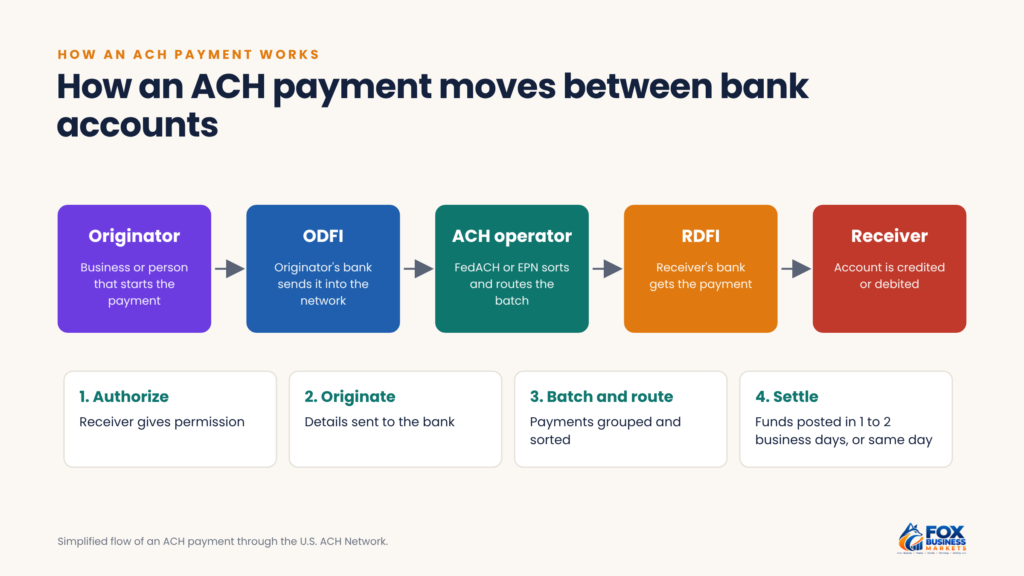
Every ACH payment involves five parties:
Party | Role |
| Originator | The person or business that starts the payment |
| ODFI (Originating Depository Financial Institution) | The originator’s bank, which sends the payment into the network |
| ACH operator | FedACH or EPN, which sorts and routes the batch |
| RDFI (Receiving Depository Financial Institution) | The receiver’s bank |
| Receiver | The person or business whose account is credited or debited |
The process follows four steps:
- Authorization: the receiver authorizes the payment, for example by signing a direct deposit form or agreeing to an online payment.
- Origination: the originator sends payment details, including routing and account numbers, to its bank, often through accounting or payroll software.
- Batching and routing: the bank groups the payment with others and sends the batch to the ACH operator, which routes each payment to the receiving bank.
- Settlement: funds move between the banks, and the receiving bank posts the money to the account.
What’s the Difference Between ACH Credit and ACH Debit?
ACH payments move in one of two directions:
- ACH credit (push): the payer sends money to someone else. Payroll, supplier payments, and tax refunds are ACH credits.
- ACH debit (pull): the payee pulls money from the payer’s account with permission. Automatic bill payments, subscriptions, and loan payments are ACH debits.
Feature | ACH credit | ACH debit |
| Who starts it | The payer | The payee |
| Common uses | Payroll, vendor payments, refunds | Bills, subscriptions, recurring invoices |
| Control over timing | Payer | Payee, under the payer’s authorization |
| Main risk for businesses | Sending to the wrong or fraudulent account | Returns for insufficient funds or unauthorized debits |
For businesses that collect recurring payments, ACH debit is convenient because you control the timing. For one-time invoices, many customers prefer to push an ACH credit so they don’t share account access.
Which ACH Authorization Type Applies to Your Payments?
Every ACH payment carries a three-letter Standard Entry Class (SEC) code that tells banks how it was authorized and which rules apply. Your provider will ask which codes you need. The three most common for small businesses:
Code | Stands for | Used for | Authorization |
| PPD | Prearranged Payment and Deposit | Payroll and recurring debits from consumer accounts | A direct deposit form, or a signed or similarly authenticated form for debits |
| CCD | Corporate Credit or Debit | Paying or collecting from another business | An agreement between the two businesses |
| WEB | Internet-initiated entry | Debits a consumer authorizes online or in an app | Online consent, plus account validation before the first debit |
Business debits sent as CCD have a much shorter window for unauthorized returns (R29) than consumer debits (R10), one reason B2B collection by ACH carries less return risk.
How Fast Is an ACH Payment?
Standard ACH transfers usually settle in one to two business days. Same Day ACH lets banks settle eligible payments on the day they’re sent:
- Same Day ACH limit: up to $1 million per payment.
- Three processing windows: banks can submit same-day payments in three windows during the business day; the latest submission deadline is 4:45 p.m. ET.
- Higher cost: banks and processors often charge more for same-day delivery.
Same Day ACH is growing quickly. Nacha reported 1.4 billion Same Day ACH payments worth $3.9 trillion in 2025, with volume up 16.7% from 2024. Growth sped up in 2026: in the third quarter, Same Day ACH volume rose 36.7% from a year earlier to 470.4 million payments worth $1.3 trillion, according to Nacha.
ACH doesn’t run on weekends or federal holidays, so a payment sent Friday evening usually settles the following Monday or Tuesday. For time-critical payments outside business hours, instant payment networks such as FedNow and RTP may be an option if your bank supports them.
How Does Direct Deposit Payroll Work Through ACH?
Direct deposit payroll is a batch of ACH credits from the employer’s account to each employee’s account:
- Collect authorization. Each employee completes a direct deposit form with their routing number, account number, and account type.
- Fund payroll. Your payroll provider or bank debits your account for the full payroll before payday.
- Submit the file. Payroll software sends the batch using the “PAYROLL” description Nacha now requires.
- Pay employees. With standard ACH, submit one to two business days before payday so funds arrive that morning. Same Day ACH can rescue a late run, usually for a higher fee.
The most common problems are closed accounts (R02) and mistyped numbers (R03). Some employers send a zero-dollar test entry, called a prenote, before a new hire’s first deposit.
How Does ACH Compare With Wires and Cards?
Feature | ACH | Wire transfer | Credit card |
| Speed | 1 to 2 business days; same day available | Usually same day, often within hours | Authorized in seconds; funds in 1 to 2 business days |
| Typical cost | Low flat fee or small capped percentage | About $25 to send and $15 to receive domestically (median bank fees) | About 1.5% to 3.5% of the sale |
| Reversible? | Can be returned in limited cases | Generally final once sent | Customers can dispute charges |
| Best for | Payroll, invoices, recurring payments | Large, urgent, or real estate payments | Retail and online purchases |
The median bank charges $25 to send a domestic wire and $15 to receive one, according to a NerdWallet survey updated in July 2026. Card payments cost a percentage of every sale, which adds up quickly on large invoices; our guide to credit card processing fees explains why.
Can You Use ACH for International Payments?
Only in limited ways. When a payment involves a bank outside the United States, Nacha rules require it to be sent as an International ACH Transaction (IAT). IAT entries carry extra details, including the names and addresses of the sender and receiver, so banks can screen them against U.S. sanctions lists. That screening can delay or hold a payment. IAT entries also aren’t eligible for Same Day ACH, and many banks and processors don’t originate them at all. For most overseas suppliers, a wire or an international payments provider is the more common choice.
How Much Do ACH Payments Cost?
ACH pricing depends on who’s sending and how:
- Consumers: most banks don’t charge to receive direct deposits or set up standard transfers between accounts. Some charge for same-day or expedited transfers.
- Businesses using their bank: banks usually charge a per-payment fee for ACH origination, often bundled with a monthly treasury or cash management fee. Prices vary, so check your bank’s commercial fee schedule.
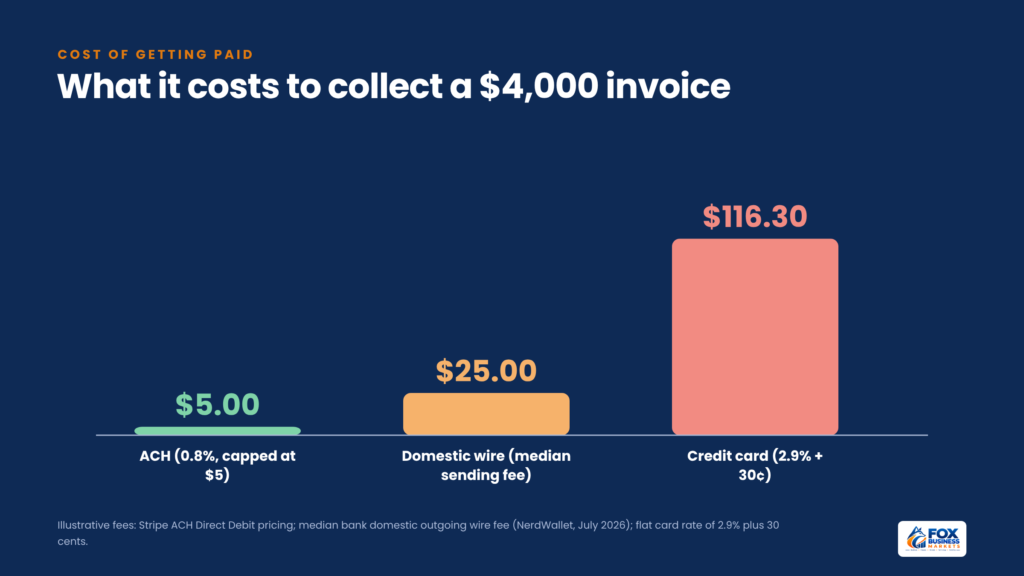
- Businesses using a payment processor: processors often charge a percentage with a cap. For example, Stripe lists ACH Direct Debit at 0.8% per payment, capped at $5.
- Return and failure fees: expect a flat fee when a payment fails or is disputed. Stripe, for example, charges $4 for a failed ACH payment and $15 for a dispute.
Example: a business that collects a $4,000 invoice pays about $5 with a capped 0.8% ACH fee. The same invoice paid by credit card at 2.9% plus 30 cents costs about $116.30. On 10 such invoices a month, that’s a difference of more than $13,000 a year.
What Are the 2026 Nacha Fraud Monitoring Rules?
Nacha approved new risk management rules in 2024 that took effect in 2026 to cut down on fraud, especially business email compromise and fake vendor schemes that trick companies into sending payments to criminals:
- Phase 1 (March 20, 2026): all originating banks (ODFIs), plus business originators, third-party service providers, and third-party senders that originated 6 million or more ACH payments in 2023, had to set up risk-based processes to spot ACH entries that may be unauthorized or authorized under false pretenses. Receiving banks (RDFIs) that received 10 million or more ACH payments in 2023 had to monitor incoming credits the same way.
- Phase 2 (effective June 19, 2026; compliance by June 22, because June 19 is a federal holiday): the size limits were removed, so all remaining business originators, service providers, third-party senders, and receiving banks are now covered.
- Standard descriptions: new rules also require two standardized company entry descriptions, “PAYROLL” for wage-type direct deposits and “PURCHASE” for consumer debits for online purchases of goods, so receiving banks can spot unusual activity.
For a small business, compliance usually means having written steps to verify payment requests before you send them, monitoring for unusual payments, and working with your bank’s fraud tools. Your bank or payment processor will typically explain what it expects from you.
Is ACH Too Slow and Risky for Business Payments?
No. Many business owners see ACH as a slow, risky legacy system, but that picture no longer fits. Same Day ACH settles eligible payments within hours, and ACH carries clear rules for authorization, returns, and dispute handling.
ACH also has advantages over checks, which are still a common target for fraud:
- No paper to steal or alter. Checks can be stolen from mailboxes, washed, and rewritten.
- No printed bank details. A paper check shows your routing and account numbers to everyone who handles it.
- Positive pay and debit blocks let businesses approve or reject ACH debits before they post.
- A defined dispute window: consumers generally have 60 calendar days from a payment’s settlement date to report an unauthorized ACH debit and have their bank return it.
The real risk is social engineering: a fraudster posing as a vendor asks you to change bank details. The fix is a verification process, not avoiding ACH.
How Can Businesses Accept ACH Payments?
- Choose a provider. Options include your bank’s ACH origination service, a payment processor that supports ACH, or invoicing and accounting software with built-in bank payments. Use the checklist below to compare them.
- Get authorization. For ACH debits, collect written or electronic permission from the customer that meets Nacha’s rules. For recurring debits, keep the authorization on file.
- Verify bank accounts. Use instant account verification or micro-deposits to confirm the account before the first debit, which reduces returns.
- Add ACH to your invoices. Include a “pay by bank” option on every invoice. Our guide on how to invoice shows where to put payment instructions.
- Plan for returns. Build in time for payments to clear before releasing goods for large first-time orders.
- Offer an incentive. Some businesses offer a small discount for paying by ACH instead of card, which can save more in card fees than it costs.
ACH provider checklist
- Pricing: per-payment fee or percentage, and whether there’s a cap
- Monthly and setup fees, including bank treasury fees
- Same Day ACH availability and cost
- Return and dispute fees, in exact dollars
- Payout timing: how long until collected funds reach your account
- Account verification: instant verification included or extra
- Limits on payment size and monthly debit volume
- Fraud tools that support the 2026 Nacha rules
- Integration with your accounting and invoicing software
- IAT support if you pay overseas vendors
How Can Businesses Pay Vendors by ACH Safely?
- Verify every change to vendor bank details by phone, using a number you already have on file, not one from the email requesting the change.
- Require two people to approve new payees and large payments.
- Turn on your bank’s fraud tools, including the positive pay and debit blocks above, plus payment alerts.
- Send a test payment before large first payments to a new vendor.
- Reconcile accounts daily so you spot unauthorized debits quickly.
- Train staff to recognize business email compromise, the most common way criminals redirect payments.
What Happens When an ACH Payment Is Returned?
An ACH return sends a payment back to the originator. Each return carries a code that explains why. Common codes include:
Code | Reason | Typical timing |
| R01 | Insufficient funds | Within 2 banking days |
| R02 | Account closed | Within 2 banking days |
| R03 | No account or unable to locate account | Within 2 banking days |
| R10 | Customer says the debit wasn’t authorized | Up to 60 calendar days after settlement (consumer accounts) |
| R29 | Corporate customer says the debit wasn’t authorized | Within 2 banking days |
Returns cost money: your provider may charge a return fee, and you lose the payment until you collect it another way. Nacha also monitors return rates, and businesses with too many unauthorized returns can face reviews or restrictions. Verifying accounts and keeping authorizations on file are the best ways to keep returns low.
Example: When Can You Count on an ACH Payment?
Say you debit a customer for a $4,000 invoice on Monday morning using standard ACH:
- Tuesday or Wednesday: the payment settles in your account.
- Through Thursday or Friday: the customer’s bank can still return it for insufficient funds (R01) or a closed account (R02), within two banking days of settlement.
- Up to 60 days: a consumer can still claim the debit wasn’t authorized (R10). A business customer debited under CCD has only two banking days (R29).
Start the same debit Friday afternoon and settlement slips to Monday or Tuesday, with the R01 window running to midweek. For large first orders, wait for the short return window to close before shipping.
Because ACH payments can be returned days later, they affect your cash flow differently than cards. Our guide to cash flow management explains how to plan for timing gaps, and our payment statistics roundup tracks how ACH use is growing.
Frequently Asked Questions
Is an ACH payment the same as an e-check?
Mostly, yes. An e-check, or electronic check, is a payment where a customer enters their routing and account numbers online, and it’s processed through the ACH Network. Some providers also call ACH debits “bank payments” or “pay by bank.” Check the label in your payment software so you know which network and fees apply.
Can an ACH payment be canceled?
Sometimes. You can usually cancel a scheduled ACH payment before your bank sends it, and consumers can stop future debits by notifying the company and their bank in time. Once a payment settles, getting it back usually requires the receiver’s cooperation or a valid return reason. Contact your bank immediately if you send a payment in error.
Do you need a business bank account to use ACH?
You can receive ACH payments into most checking and savings accounts, but originating ACH transfers as a business usually requires a business account and approval from your bank or processor. Banks may review your business credit and payment history before allowing you to send ACH debits. Ask your bank what limits apply before you launch automatic billing.
What information do you need to receive an ACH payment?
You’ll typically share your bank’s routing number, your account number, the account type (checking or savings), and the name on the account. Send these details through a secure portal or your invoicing software rather than by plain email, because criminals often intercept and alter payment instructions. Keep a bank-issued letter with your ACH details on file so you send the same verified information every time.
Add ACH to Your Payment Options This Week
Ask your bank or payment processor about ACH origination and its fees, add a “pay by bank” option to your invoices, and set up account verification for new customers. Write a short payment verification policy for staff before you send your next vendor payment, and turn on your bank’s ACH fraud tools. Then compare what you pay in card fees on large invoices with what ACH would cost. Our small business finance guide shows how faster, cheaper collections strengthen your overall finances.
This article is for general information only and isn’t financial, tax, legal, or investment advice. Consider your own situation or talk to a qualified professional before making decisions.

