1. How to Use the Mortgage Calculator
Our interactive mortgage calculation suite is designed to compute exact monthly debt service obligations across simple amortizations or comprehensive escrow-inclusive scenarios. Follow these five procedural steps to evaluate your borrowing structure:
- Select Your Operating Currency: Choose between USD ($), GBP (£), EUR (€), CAD (C$), or AUD (A$) from the top header dropdown to calibrate monetary values to your primary lending territory.
- Enter Purchase Price and Down Payment: Input the gross contractual real estate acquisition price. In the adjacent down payment fields, specify either your cash equity contribution or your targeted percentage (such as 20% to avoid insurance premiums).
- Input Fixed Interest Rate (APR): Provide the nominal annual percentage rate offered by your mortgage originator or commercial bank.
- Designate Amortization Schedule: Select your loan term from the dropdown menu (e.g., 30 Years, 20 Years, 15 Years, or 10 Years) to determine the baseline payment cycle.
- Toggle Standard vs. Full PITI Mode: Keep the default "Standard Principal & Interest" tab for basic debt service, or click "Full PITI" to integrate municipal property tax percentages, annual homeowner hazard insurance, and recurring monthly HOA dues.
2. How It Works & Core Mathematical Formulas
Residential mortgages operate under a fixed fully amortizing debt structure. Every monthly installment remains identical throughout the loan duration, but the internal allocation changes systematically: early payments are predominantly consumed by accrued interest, while later installments shift toward equity reduction.
The standard monthly principal and interest payment is governed by the universal annuity amortization equation:
Where:
M = Monthly Principal & Interest installment payment
P = Principal loan balance (Home Price - Down Payment)
r = Periodic monthly interest rate (Annual Nominal Rate / 12 / 100)
n = Total number of monthly amortization cycles (Term Years * 12)
When computing comprehensive PITI (Principal, Interest, Taxes, and Insurance) debt coverage, recurring escrow obligations and property fees are annualized and factored directly into the monthly cash outflow:
Where:
T_monthly = (Home Price * Annual Property Tax Rate %) / 12
I_monthly = Total Annual Hazard Insurance Premium / 12
HOA = Monthly Homeowners Association or Strata Assessment
3. Fully Worked Numerical Example
Case Study: Purchasing a $450,000 Suburban Single-Family Home
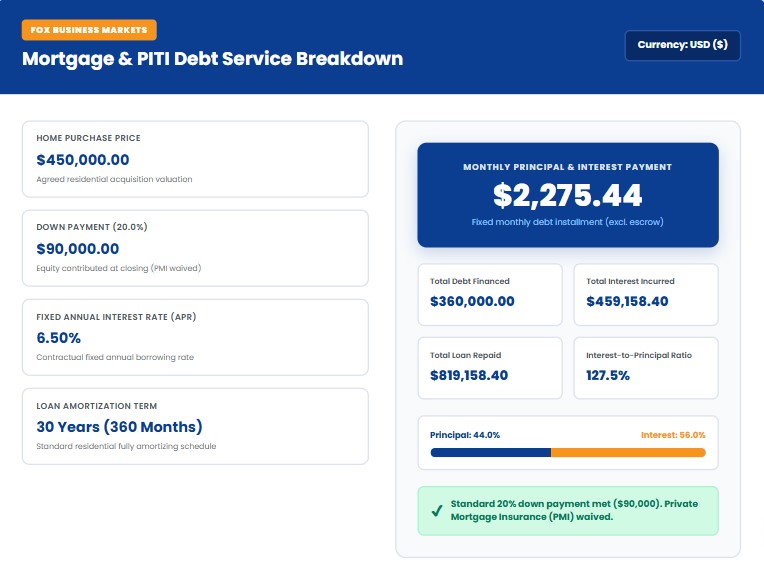
Consider an investor or homebuyer acquiring a residential asset with an agreed sales price of $450,000. The purchaser puts down a standard 20% cash equity stake ($90,000), leaving a net principal balance of $360,000 to be financed via a 30-year fixed mortgage at 6.50% APR.
- Principal Loan (P): $450,000 - $90,000 = $360,000.00
- Monthly Interest Rate (r): 0.065 / 12 = 0.0054167
- Total Installment Cycles (n): 30 * 12 = 360 monthly payments
- Compounding Factor [(1 + r)^n]: (1 + 0.0054167)^360 = 6.991798
Applying the amortization formula:
M = 360,000 * [ 0.037872 ] / [ 5.991798 ]
M = $2,275.44 per month
Lifetime Balance Sheet Summary:
- Total Repayment (360 * $2,275.44): $819,158.40
- Total Cumulative Interest Incurred: $819,158.40 - $360,000.00 = $459,158.40
- Interest-to-Principal Leverage Ratio: 127.54% (The borrower pays $1.28 in finance charges for every $1.00 borrowed over three decades).
4. Interactive Calculator Interface & Results Display
5. Loan Term & Financing Benchmarks
Selecting an optimal loan structure requires balancing ongoing liquidity against cumulative debt charges. The table below illustrates standard 2026 lending benchmarks across prevailing loan structures for a $360,000 financed principal balance:
| Financing Structure | Typical APR Range | Monthly Payment (P&I) | Total Lifetime Interest | Interest-to-Loan Ratio | Primary Balance Sheet Trade-Off |
|---|---|---|---|---|---|
| 30-Year Fixed (Benchmark) | 6.25% - 7.00% | $2,275.44 | $459,158.40 | 127.5% | Lowest monthly cash flow drain; highest cumulative interest drag. |
| 20-Year Fixed | 6.00% - 6.65% | $2,642.61 | $274,226.40 | 76.2% | Moderate payment elevation with a massive 40% interest reduction. |
| 15-Year Fixed | 5.50% - 6.15% | $2,940.35 | $169,263.00 | 47.0% | Accelerated equity velocity; requires aggressive free cash flow. |
| 10-Year Fixed | 5.25% - 5.85% | $3,861.80 | $103,416.00 | 28.7% | Near-zero financing inefficiency; severe monthly debt service ratio. |
| 5/1 Adjustable Rate (ARM) | 5.75% - 6.50% | $2,099.30 (Initial) | Floating Risk | Variable | Favorable short-term teaser rate; exposure to future rate hikes. |
6. Where to Find Your Underwriting Figures
To produce institutional-grade mortgage projections, pull verified financial inputs from the following official underwriting documents:
- Home Purchase Price & Earnest Money: Retrieved directly from your ratified Purchase and Sale Agreement (PSA) or certified residential appraisal report.
- Mortgage Interest Rate & APR: Listed on Page 1 of your official Lender Loan Estimate (LE). To verify whether your quoted financing charge includes compounded lender fees, cross-check using our verified APR Calculator or examine nominal yield via the APY Calculator.
- Debt Service Capacity: Review your ongoing operational overhead and existing balance sheet obligations using our Business Loan Calculator to ensure real estate leverage does not compress cash reserves.
- Local Real Estate Levies: Accessible through your municipal or county tax assessor’s online portal by looking up the parcel identification number (PIN).
- Hazard Insurance Premiums: Found on the declaration binder issued by your property casualty underwriter.
7. What This Calculator Can and Cannot Tell You
What It Tells You (Analytical Capabilities)
- Exact contractual principal and interest debt allocations for any amortization period.
- The comprehensive PITI burden when factoring in escrow components and HOA assessments.
- The precise down payment percentage threshold required to avoid Private Mortgage Insurance (PMI).
- The full cumulative interest expense over the lifecycle of the loan, highlighting the true cost of leverage.
What It Cannot Tell You (Model Limitations)
- Lender-specific upfront closing fees, transfer taxes, title policies, and discount points.
- Future escalation of municipal property taxes or insurance premiums reassessed over time.
- Rate reset adjustments on adjustable-rate mortgages (ARMs) beyond initial fixed terms.
- Borrower underwriting approvals governed by credit history and strict debt-to-income (DTI) ceilings.
8. Related Financing & Balance Sheet Calculators
Optimizing real estate debt requires evaluating capital yields, interest compounding dynamics, and working capital buffers across your broader portfolio. Explore these verified tools from Fox Business Markets:
Business Loan Calculator
Analyze commercial debt financing, monthly amortization schedules, and commercial origination costs.
Compound Interest Calculator
Forecast multi-year capital accumulation and assess the opportunity cost of large down payments.
APR Calculator
Convert stated interest rates into true Annual Percentage Rates factoring upfront lender closing points.
Working Capital Calculator
Verify that mortgage liquidity drains do not impair your operational liquidity and current ratio.
9. Frequently Asked Questions (FAQ)
10. The Bottom Line & Authoritative References
Securing a mortgage requires looking past simple purchase price numbers and understanding the full multi-decade debt service commitment. Over a 30-year term at prevailing rates, cumulative interest expenses routinely exceed 100% of the original borrowed principal. By modeling comprehensive PITI liabilities, evaluating loan tenure trade-offs, and maintaining an adequate equity buffer, buyers and real estate investors can safeguard their liquidity and build sustainable real estate equity.
For official lending guidelines, interest rate benchmarks, and statutory disclosures, consult these industry authorities:
- Consumer Financial Protection Bureau (CFPB) – Mortgage Resources & Loan Estimates
- Federal Reserve Economic Data (FRED) – 30-Year Fixed Rate Mortgage Averages
- Fannie Mae Single-Family Selling & Underwriting Guidelines
- Mortgage Bankers Association (MBA) – Lending Surveys and Forecasts