1. How to Use the APR Calculator
The Annual Percentage Rate (APR) Calculator uncovers the true annualized cost of debt by factoring in lender points, loan origination charges, and upfront administrative fees. Follow these steps to analyze any commercial or personal credit agreement:
- Select Loan Structure & Currency: Choose between the Standard Amortized Loan tab (for amortizing principal and interest debt) and the Interest-Only / Bullet Facility tab (for lines of credit and balloon notes). Set your active currency via the top right selector.
- Enter Gross Loan Principal: Input the face value of the borrowing facility prior to any lender fee withholdings.
- Input Contractual Interest Rate (%): Enter the stated nominal note rate specified on your promissory note or loan estimate disclosure.
- Define Term Duration: Enter your financing horizon and designate the term unit in either years or months.
- Add Prepaid Financing Fees & Points: Input upfront discount points (% of gross principal) and any fixed closing costs (such as underwriting, appraisal, processing, and origination charges). The calculator instantly solves the internal rate of return to display your real APR, monthly payment, and fee spread.
2. How It Works & Core Mathematical Formulas
Contractual interest rates (note rates) only determine the ongoing periodic interest calculation. Under the Truth in Lending Act (Regulation Z), the Annual Percentage Rate (APR) must capture total finance charges relative to the net cash disbursed to the borrower.
Monthly Debt Amortization Payment
For standard fully amortizing facilities, the monthly payment ($PMT$) is calculated using the standard annuity formula:
Where:
• P = Gross loan principal amount
• i = Periodic monthly nominal interest rate = Contractual Rate ÷ 12
• N = Total number of monthly installments = Term (Years) × 12
Net Financed Proceeds Equation
Prepaid finance charges reduce the net liquid funds transferred to the borrower at closing:
Actuarial APR Equation (Internal Rate of Return)
The true monthly APR rate ($r_{apr}$) is the internal discount rate that balances net proceeds received with the present value of all future scheduled payments:
Annualized Nominal APR = r_{apr} × 12 × 100%
Because $r_{apr}$ cannot be isolated algebraically, financial institutions and this calculator employ the iterative Newton-Raphson approximation technique to solve for the exact rate within six decimal places of precision.
3. Fully Worked Numerical Example
Commercial Term Loan Underwriting Evaluation
A business secures a growth facility to purchase specialized capital machinery under the following commercial loan covenants:
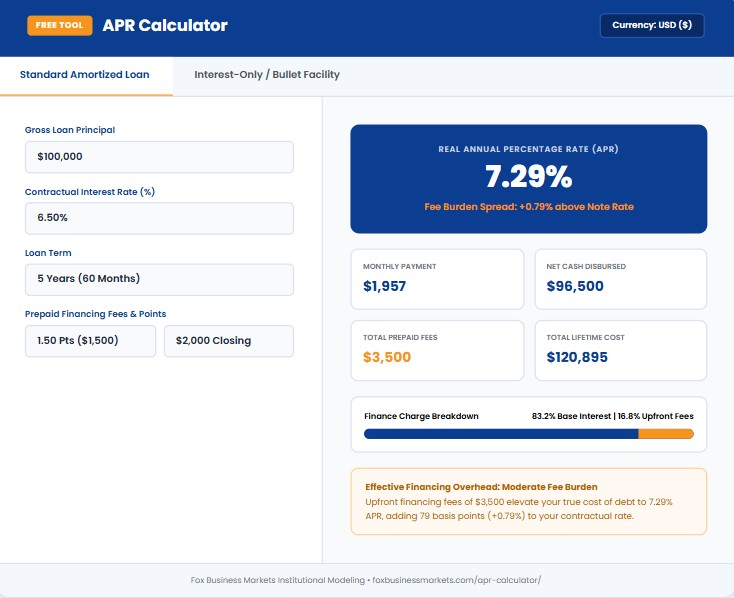
- Gross Loan Principal ($P$): $100,000
- Contractual Note Rate: 6.50% per annum (0.065 / 12 = 0.005417 monthly)
- Loan Maturity: 5 Years ($N = 60$ months)
- Lender Origination Points: 1.50% ($1,500)
- Underwriting & Closing Costs: $2,000 fixed
Step 1: Calculate Scheduled Monthly Amortization Payment ($PMT$)
PMT = 100,000 × [0.005417 × (1.005417)^60] / [(1.005417)^60 - 1]
PMT = 100,000 × [0.005417 × 1.382817] / [0.382817] = $1,956.61 (≈ $1,957 / month)
Step 2: Determine Total Prepaid Fees and Net Disbursed Capital
Total Prepaid Fees = (100,000 × 0.015) + 2,000 = $1,500 + $2,000 = $3,500
Net Disbursed Cash = $100,000 - $3,500 = $96,500
Step 3: Solve for the Actuarial Annual Percentage Rate (APR)
Solve IRR: $96,500 = ∑ [1,956.61 / (1 + r_{apr})^k] for k = 1 to 60
Solved monthly rate: r_{apr} = 0.006075 (0.6075% / month)
Annualized APR = 0.006075 × 12 × 100 = 7.29%
Fee Spread = 7.29% APR - 6.50% Note Rate = +0.79% (79 basis points)
Takeaway: Even though the contract states 6.50%, the borrower effectively pays 7.29% APR because only $96,500 was received while full debt service on $100,000 is repaid across the 60-month term.
4. Calculator Interface & Rate Spread Overview
5. Typical Financing Fees and APR Impact by Loan Category
Different credit instruments bundle distinct closing fee structures. The matrix below outlines standard upfront costs and their expected impact on quoted nominal rates:
| Credit Category | Typical Nominal Note Rate | Standard Closing Points & Fees | Average APR Spread | Primary Fee Drivers |
|---|---|---|---|---|
| Commercial Real Estate (CRE) | 6.25% – 8.00% | 1.0% – 2.5% + Legal/Appraisal | +0.35% to +0.85% | Environmental reviews, structural underwriting, title insurance. |
| SBA 7(a) Small Business Loans | Prime + 2.25% – 2.75% | 2.0% – 3.75% SBA Guaranty Fee | +0.60% to +1.20% | SBA statutory guaranty fee, packaging and closing charges. |
| Equipment Financing Leases | 5.50% – 9.00% | $500 – $2,500 Documentation | +0.25% to +0.65% | UCC lien filings, equipment inspection, administrative onboarding. |
| Residential 30-Year Mortgages | 5.75% – 7.25% | 0.5% – 1.5% Points + $3,000 Fees | +0.20% to +0.45% | Origination fees, title escrow, credit reporting, loan processing. |
| Short-Term Merchant Working Capital | 12.00% – 24.00% | 3.0% – 6.0% Origination | +2.50% to +6.00% | Fast-funding risk premiums, automated clearing house (ACH) fees. |
6. Where to Find Your Numbers
To configure your APR analysis accurately, retrieve itemized borrowing data from formal legal loan disclosures:
- Loan Estimate (LE) & Closing Disclosure (CD): Review Page 1 for gross principal and contractual interest, and Page 2 (Section A & B) for itemized lender origination fees.
- Commercial Promissory Notes: Identify stated note rates and origination holdbacks directly inside loan covenants. If evaluating interest without fees, verify terms using our Simple Interest Calculator.
- Balance Sheet Debt Capacity: Before taking on higher borrowing obligations, assess your company's leverage tolerance using the Debt-to-Equity Calculator.
- Comprehensive Amortization Analysis: For detailed principal paydown modeling across standard credit facilities, leverage our Business Loan Calculator.
7. What This Calculator Can and Cannot Tell You
What It Can Tell You
- The exact actuarial APR accounting for points and fees under Regulation Z disclosure standards.
- The precise basis-point spread added to your interest rate by lender fees.
- True net liquid funds disbursed to your bank account after closing deductions.
- Clean comparative data to evaluate a low-rate/high-fee loan versus a high-rate/zero-fee loan.
What It Cannot Tell You
- Early Prepayment Dynamic: If you refinance or pay off debt early, the effective APR rises substantially because upfront fees are amortized over fewer months.
- Third-Party Pass-Through Costs: Fees that do not directly enrich the lender (e.g., standard municipal recording fees or local property taxes) are excluded from federal APR calculations.
- Adjustable-Rate Index Swings: For variable-rate facilities, APR projections assume the benchmark index remains unchanged across the entire loan lifespan.
- Tax Deductions: Corporate interest write-offs under section 163(j) limitations are not factored into the pre-tax calculation.
8. Related Business & Financial Calculators
Integrate your debt capital modeling with other essential financial calculators from Fox Business Markets:
Business Loan Calculator
Model complete amortization schedules and monthly principal versus interest payments.
APY Calculator
Compare effective returns earned on cash deposits against the cost of your credit facilities.
Working Capital Calculator
Check your current assets and operating liquidity prior to absorbing new periodic debt payments.
Simple Interest Calculator
Calculate clean, non-compounding interest charges on short-term corporate bridge notes.
9. Frequently Asked Questions (FAQ)
Why is APR higher than the interest rate on my loan?
The contractual interest rate reflects only the ongoing percentage charged against your outstanding balance. The APR incorporates that interest rate along with all prepaid fees, points, and origination charges deducted upfront. Because you receive less net cash while paying interest on the full gross loan amount, the effective APR is higher.
Does buying discount points lower my APR?
Discount points involve paying upfront cash to reduce the ongoing note rate. If you keep the debt for its full multi-year term, buying points can lower your overall APR. However, if you plan to refinance or repay the debt early, paying points will significantly increase your effective APR because the upfront fee is absorbed over a shorter period.
What fees are legally included in an APR calculation?
Under federal Regulation Z rules, charges considered mandatory finance charges must be included: loan origination fees, discount points, underwriting costs, application fees, private mortgage insurance (PMI), and broker commissions. Costs like third-party appraisals, credit report fees, and title insurance are often excluded depending on loan structure.
Which is better for comparing loans: Interest Rate or APR?
APR is the standard metric for comparing loan terms across different lenders. A lender offering a 6.00% note rate with $5,000 in upfront fees may have a higher APR than a competitor offering a 6.25% note rate with zero closing fees. APR standardizes the comparison on an even playing field.
How does loan duration impact the APR fee spread?
The shorter the loan term, the more dramatically upfront fees impact the APR. For instance, a $3,000 fee on a 30-year mortgage spreads out over 360 monthly payments, causing a minor bump in APR. That exact same $3,000 fee on a 2-year bridge facility will sharply increase the APR by multiple percentage points.
10. The Bottom Line & Authoritative References
The Annual Percentage Rate represents the single most important figure when assessing the cost of capital. Looking past headline interest rates to evaluate fee burdens protects businesses and retail borrowers from predatory lending terms and unexpected closing expenses. By utilizing actuarial IRR formulas to capture all financing outlays, borrowers can negotiate favorable terms and optimize their balance sheets with confidence.
Authoritative References & Academic Reading:
- Consumer Financial Protection Bureau (CFPB): Official explanations of APR, Truth in Lending disclosure requirements, and closing document fee analysis.
- Federal Reserve Board (Regulation Z): Comprehensive statutory rules governing finance charges, loan APR calculation tolerances, and consumer credit protections.
- Federal Deposit Insurance Corporation (FDIC): Commercial credit risk assessment standards, interest rate risk handbooks, and fair lending compliance.
- Gup, Benton E., & Kolari, James W. (Commercial Banking: The Management of Risk): Foundational literature on credit underwriting, internal rate of return loan pricing, and fee-yield optimization.