Quick answer: Small business finance is how you track, plan, and pay for your company’s money. Open a separate business bank account, reconcile your books monthly, review your income statement, balance sheet, and cash flow statement, forecast cash 13 weeks ahead, and build a reserve of three to six months of expenses before you borrow.
Sixty percent of small employer firms sought financing in the 12 months before the Federal Reserve’s fall 2025 survey, and the top reason, cited by 56% of applicants, was to cover operating expenses, according to the 2026 Report on Employer Firms. Just 47% were operating at a profit at the end of 2024.
Many of those owners are good at what they sell but less sure about the numbers behind it. Money comes in and goes out, the bank balance looks fine one month and tight the next, and it’s hard to tell whether the business is actually healthy.
This guide explains small business finance in plain terms, from separating your money and keeping books to reading statements, managing cash, budgeting, funding, credit, and taxes, and points you to deeper guides on each.
What Is Small Business Finance?
Small business finance has three parts:
Area | What it covers | Key question |
| Record-keeping and accounting | Bookkeeping, financial statements, taxes | Where did the money go? |
| Cash management | Cash flow, budgeting, reserves, paying bills | Will we have enough cash next month? |
| Funding | Loans, credit, investors, owner contributions | How do we pay for growth or a slow season? |
Big companies have a chief financial officer and a finance team for this. The United States has about 36.2 million small businesses, 99.9% of all firms, according to the SBA Office of Advocacy, and in most of them the job falls to the owner, at least until revenue supports a bookkeeper or accountant. Once a system is in place, the basics take a few hours a month.
Why Should You Separate Business and Personal Finances?
Mixing personal and business money is a common early mistake, and it’s easy to fix. Keeping business and personal finances apart:
- Protects your personal assets. If you form an LLC or corporation, mixing funds can weaken the legal separation between you and the business.
- Makes taxes easier and safer. Clean business records make it simple to claim deductions and to back them up if the IRS asks.
- Shows the real performance of the business. You can’t tell if you’re profitable when groceries and inventory come out of the same account.
- Builds business credit. Lenders look for a business account history and credit separate from yours.
To separate them, get an Employer Identification Number (EIN) from the IRS, which is free, open a business checking account, and use a business credit card only for business costs. Pay yourself through a regular owner’s draw or salary instead of pulling money out whenever you need it. Our guide on how to start a small business covers choosing a business structure and registering.
How Do You Set Up Bookkeeping?
Bookkeeping is the daily or weekly habit of recording every transaction.
- Choose an accounting method. Cash-basis accounting records income when you receive it and expenses when you pay them; it’s simpler and common for very small businesses. Accrual accounting records income when you earn it and expenses when you incur them, which gives a truer picture for businesses with inventory or that bill customers, and is generally required for larger businesses.
- Pick a system. Accounting software connects to your bank and card accounts and categorizes transactions automatically. A spreadsheet can work for a very small business with few transactions.
- Set up a chart of accounts. These are the categories for income and expenses, such as sales, cost of goods sold, rent, payroll, marketing, and software.
- Save receipts digitally. Snap a photo of each receipt or forward email receipts to your software so you have records for taxes.
- Reconcile monthly. Match your books to your bank and credit card statements every month to catch errors, duplicate charges, or fraud.
Many owners do their own bookkeeping at first and hire a bookkeeper once transactions or payroll make it too time-consuming.
Which Financial Statements Should You Track?
Three financial statements tell you almost everything about the health of a business:
- Income statement (profit and loss): revenue minus expenses over a period, showing whether you made a profit.
- Balance sheet: what the business owns (assets), what it owes (liabilities), and what’s left for the owners (equity) at a point in time.
- Cash flow statement: where cash came from and where it went, split into operating, investing, and financing activities.
Accounting software produces all three automatically from your bookkeeping. Our guide to financial statements explains how to read each one, line by line.
How Do You Manage Cash Flow?
Cash flow is the movement of money in and out of the business, and even a profitable business can run short of it (see the next section).
A few habits keep cash flow healthy:
- Forecast cash weekly or monthly. List expected cash coming in and going out for the next 13 weeks so you can spot shortfalls early.
- Invoice promptly and follow up. Send invoices as soon as work is done, offer online payment, and follow up on overdue accounts.
- Time your payments. Pay bills by their due dates, not early, unless you get a discount for paying early.
- Keep a cash reserve. A common guideline is three to six months of operating expenses, kept in a separate business savings account. Build it by setting aside a fixed percentage of revenue each month.
- Watch inventory. Unsold stock is cash sitting on a shelf.
Our guide to cash flow management covers forecasting, collections, and what to do when cash runs short.
Does a Profitable Business Always Have Enough Cash?
No. Profit and cash are different things. Your income statement may show a profit because you’ve billed customers, but if they haven’t paid yet, that money isn’t in your account. Meanwhile, you may have bought inventory (expensed only when it sells), equipment (expensed gradually through depreciation), or paid down loan principal (never an expense), all of which drain cash without hitting the profit line.
A growing business is especially at risk. More sales often mean more inventory, more staff, and more unpaid invoices before the money arrives, so growth can drain cash even while profits rise. Watch the cash flow statement and forecast as closely as the profit line.
How Do You Create a Business Budget and Forecast?
A budget is your plan for income and spending over the next year. A forecast updates that plan as the year unfolds.
- Start with last year’s actual numbers from your income statement.
- Estimate revenue by month, based on past sales, seasonality, and signed contracts.
- List fixed and variable costs, from rent and salaries to materials and payment fees.
- Plan for taxes, owner pay, and reserves, including quarterly estimated tax payments.
- Compare budget with actual results every month and update the forecast.
If you’ve built a household budget, the method is the same: know your income, control fixed costs, and plan for irregular expenses.
What Numbers Should Every Small Business Owner Know?
A handful of numbers tell you whether the business is on track:
Number | Formula | What it tells you |
| Gross profit margin | (Revenue − cost of goods sold) ÷ revenue | How much you keep from each sale before overhead |
| Net profit margin | Net profit ÷ revenue | How much of each dollar of sales is profit |
| Break-even point | Fixed costs ÷ (price − variable cost per unit) | How many units you must sell to cover costs |
| Operating cash flow | Cash from day-to-day operations | Whether the core business generates cash |
| Days sales outstanding | (Accounts receivable ÷ revenue) × days in period | How long customers take to pay |
| Current ratio | Current assets ÷ current liabilities | Whether you can cover short-term bills |
| Cash runway | Cash on hand ÷ monthly net cash burn | How many months you can operate without new cash |
Example: A bakery sells cakes for $40 that cost $15 in ingredients and packaging, and it has $5,000 a month in fixed costs. It needs to sell 200 cakes a month to break even ($5,000 ÷ $25).
Which Type of Financing Fits Your Need?
Most businesses use a mix of funding sources over time:
Source | Typical use | Speed | Cost or risk | Repaid? |
| Owner savings | Starting up, small purchases | Immediate | Your own money at risk | No |
| Business credit card | Short-term expenses | Fast | High interest if you carry a balance | Yes |
| Line of credit | Cash flow gaps, seasonal swings | Fast once approved | Variable rate | Yes, as you draw |
| Term loan or SBA loan | Equipment, expansion, buying a business | Weeks to months | Lower rates, often a personal guarantee | Yes, over years |
| Equipment or invoice financing | Machinery; waiting on customer payments | Fast | Backed by the equipment or advanced against invoices | Yes |
| Investors | High-growth startups | Months | Give up ownership | No, but they own a share |
| Grants and crowdfunding | Specific projects, consumer products | Varies | Competitive; takes marketing effort | Usually no |
SBA 7(a) loans, the agency’s main loan program, go up to $5 million. Our guide to small business loans compares the options in detail.
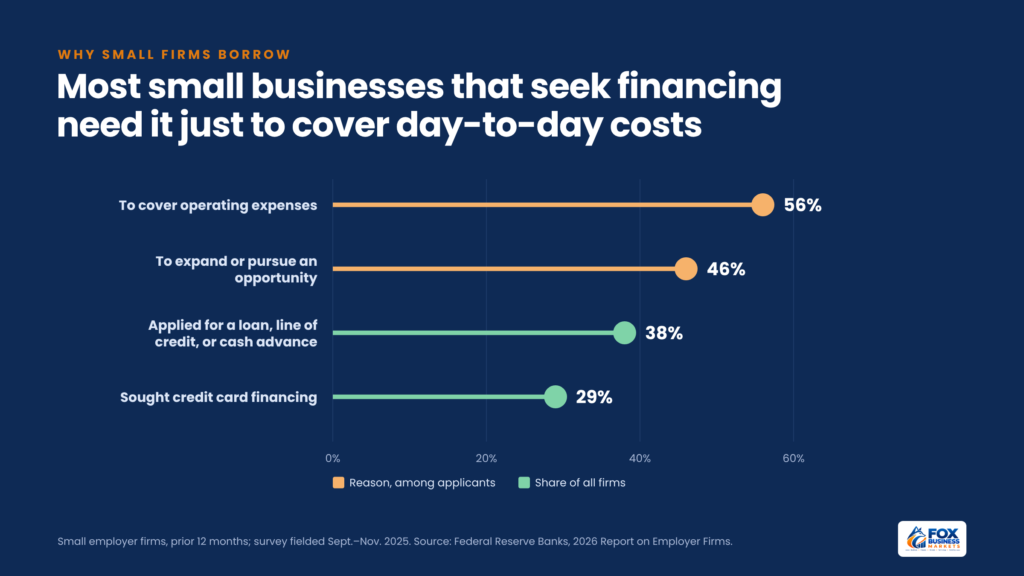
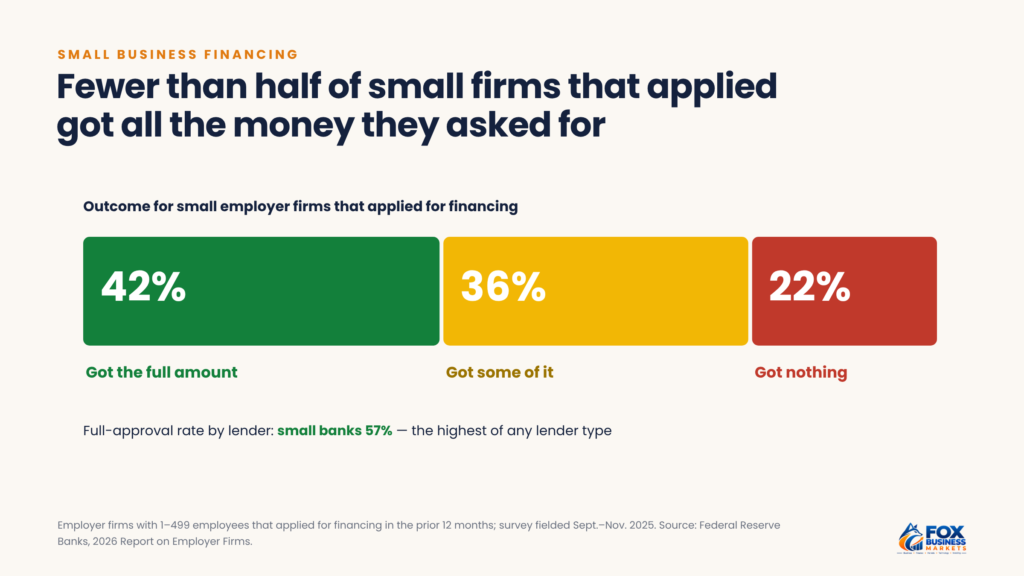
Getting approved isn’t guaranteed. Among small employer firms that applied for financing in the 2025 survey, 42% received the full amount they sought, 36% received part, and 22% got nothing, according to the Federal Reserve. Small banks had the highest full-approval rate, at 57%. Fintech lenders are a growing option: 29% of loan, line of credit, and cash advance applicants sought financing from online lenders, up from 17% in the 2020 survey. For more data on how small firms borrow and how often they’re approved, see our business finance statistics.
How Do You Build Business Credit?
Business credit is a separate credit history tied to your company’s EIN, tracked by business credit bureaus such as Dun & Bradstreet, Experian, and Equifax. Strong business credit can help you qualify for loans, better supplier terms, and lower rates without relying only on your personal credit.
The basics:
- Start with the EIN, business bank account, and business card described above.
- Open accounts with suppliers that report payments to business credit bureaus.
- Pay every bill on time or early.
- Check your business credit reports regularly.
Many lenders still require a personal guarantee for small businesses. Among firms with debt in the 2025 Fed survey, 59% had used a personal guarantee. Our guide to business credit explains how scores work and how long it takes to build them.
How Do Taxes Work for a Small Business?
How your business is taxed depends on its structure:
- Sole proprietorships and single-member LLCs by default report profit on Schedule C of the owner’s personal return.
- Partnerships and multi-member LLCs file an information return, and profits pass through to the owners.
- S corporations also pass profits through, but owners who work in the business must pay themselves a reasonable salary.
- C corporations pay a flat 21% federal corporate income tax, and shareholders pay tax again on dividends.
Sole proprietors, single-member LLC owners, and general partners generally pay 15.3% self-employment tax on most net earnings (the Social Security portion stops at an annual wage cap; S corporation owners instead pay payroll taxes on their salary), plus income tax, and usually must make quarterly estimated payments if they expect to owe $1,000 or more. If you have employees, you’ll also withhold and pay payroll taxes, and many states require you to collect sales tax on what you sell. Ordinary and necessary business expenses, from rent to software to business mileage, are deductible. Our guide on how taxes work covers the basics of brackets and deductions.
How Should You Pay Yourself?
How you pay yourself depends on your business structure:
- Sole proprietors and partners take owner’s draws, transfers from the business to themselves. Draws aren’t wages, so no payroll tax is withheld; you pay income and self-employment tax on the business’s profit instead.
- S corporation owners who work in the business must pay themselves a reasonable salary through payroll, and can take additional profit as distributions.
- C corporation owners are paid a salary as employees and may receive dividends.
Whatever the structure, pay yourself on a regular schedule and treat it as a fixed line in the budget, rather than taking money whenever the account looks full.
Who Should Handle Your Business Finances?
Most owners start by doing it themselves and add help as the business grows:
Option | What they do | When to consider it |
| Do it yourself with software | Record transactions, send invoices, run reports | Early stage, few transactions |
| Bookkeeper | Records and reconciles transactions, runs payroll | You spend more than a few hours a month on books, or have employees |
| CPA or enrolled agent | Tax returns, tax planning, entity choice | Every year at tax time, and before big decisions |
| Fractional CFO | Forecasting, pricing, fundraising, lender relationships | Growing quickly or raising money, but not ready for a full-time CFO |
Interview more than one provider, and ask whether they work with businesses in your industry and size.
How Do You Plan for Long-Term Growth?
Healthy finances give you options when it’s time to grow. Before you expand, check that:
- Your margins can absorb new costs, like staff or a second location.
- You have enough cash, or approved credit, to cover the gap between spending and new revenue.
- Your financial statements are clean enough to show a lender or investor.
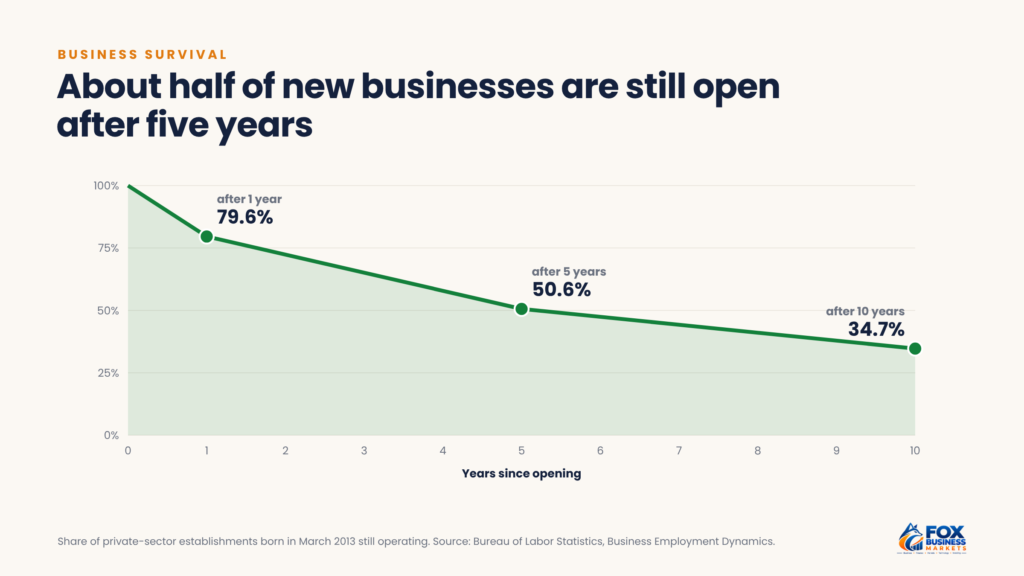
Only about half of new business establishments are still operating five years after they open, and about a third after 10 years, according to the Bureau of Labor Statistics. Our small business statistics roundup has more data on U.S. firms, and our guide to business growth strategies covers ways to grow without overextending.
Frequently Asked Questions
How long should I keep business financial records?
The IRS generally recommends keeping records that support your tax return for three years from the date you file. Keep employment tax records for at least four years, and records for a bad debt or worthless securities deduction for seven. Save scans in cloud folders organized by tax year so you can find them quickly.
How much should I set aside for taxes?
Many sole proprietors and single-member LLC owners set aside roughly 25% to 30% of net profit for federal and state income tax and self-employment tax, though the right share depends on your income and state. Move that percentage into a separate tax savings account every time a customer pays you, so the money is there for quarterly payments.
Can I change my business structure later?
Yes. A sole proprietorship can form an LLC, and an LLC can elect to be taxed as an S corporation by filing Form 2553 with the IRS, which has deadlines tied to the start of the tax year. Review the choice with a CPA in the fall, when you have a good estimate of the year’s profit.
What retirement plans can a small business owner use?
Common options include a SEP IRA, funded by the employer; a SIMPLE IRA, which lets employees contribute too; and a solo 401(k) for owners with no employees other than a spouse. Each has different contribution limits and setup deadlines. Open a plan before year-end so you have the full range of contribution options for that tax year.
Review Your Numbers Every Month
Set a recurring hour on your calendar each month to reconcile your accounts, read your three financial statements, and update your cash forecast. Compare the results with your budget and with the same month last year, and write down one action for the month ahead.
This article is for general information only and isn’t financial, tax, legal, or investment advice. Consider your own situation or talk to a qualified professional before making decisions.

