Free Life Insurance Calculator: Coverage & Policy Needs Tool
Securing the right life insurance coverage is one of the most critical financial safety nets for any household or business founder. Underinsuring leaves your dependents vulnerable to compounding debt obligations and sudden income gaps, while overinsuring locks precious capital into unnecessarily steep premium commitments. The Free Life Insurance Calculator utilizes the industry-standard DIME framework (Debt, Income replacement, Mortgage, and Education) to determine the exact lump-sum death benefit required to protect your family's financial future.
Who it's for:
Primary household earners, dual-income parents, mortgage borrowers, and small business owners evaluating term life or whole life policy amounts to ensure comprehensive financial insulation.
Why use it:
- Rigorous DIME Modeling: Account systematically for short-term debts, years of family income replacement, home mortgages, college education funding, and final expenses.
- Asset-Backed Netting: Automatically offset obligations against your liquid cash reserves, existing coverage, and retirement investments to avoid purchasing duplicate death benefits.
- Real-Time Policy Term Recommendations: Receive immediate baseline term recommendations based on mortgage tenure and children's dependency horizons.
Lump-sum death benefit required
Your income replacement obligation accounts for the majority of your insurance need. A 20-year level term policy offers the most cost-efficient structure to cover your dependents until independence while eliminating debt liability.
1. How to Use the Life Insurance Needs Calculator
Calculating your family’s life insurance death benefit requires balancing living expense coverage, long-term debt liabilities, and existing asset reserves. Follow these operational steps to produce an accurate coverage plan:
- Select Your Operating Currency: Use the header currency switcher to set your baseline denomination (USD $, GBP £, EUR €, CAD C$, or AUD A$). All calculations update instantly.
- Choose Your Evaluation Methodology: Stay on the DIME Method (Comprehensive) tab for complete itemized liability modeling, or switch to the Quick Multiplier Method for a rapid baseline benchmark based on annual salary multiples.
- Input Income Replacement Horizon: Enter your current gross annual salary and the specific number of years your family will depend on your earnings (typically the number of years until your youngest dependent graduates college or reaches financial self-sufficiency).
- Enter Secured & Unsecured Debt Obligations: Provide your remaining primary mortgage balance along with all secondary liabilities, such as auto loans, personal financing, revolving credit cards, or private debt facilities.
- Account for Educational & Final Expenses: Input the estimated total tuition and living costs for all children's higher education, alongside expected funeral, medical estate settlement, and legal probate costs (commonly $10,000 to $20,000).
- Deduct Existing Liquid Assets & Protection: Enter your liquid bank cash reserves, brokerage accounts, and any active group term policies provided by your employer to prevent purchasing redundant death benefit coverage.
- Review Policy Recommendations: Analyze your recommended net lump-sum coverage, obligation distribution percentages, and the suggested policy term duration (10, 20, or 30 years).
2. How It Works & Core Mathematical Formulas
The calculator operates on the actuarial DIME Model, which aggregates financial obligations into four distinct operational pillars: Debt, Income replacement, Mortgage, and Education, before netting out existing liquid reserves.
When you pass away, life insurance proceeds are distributed to designated beneficiaries as an income-tax-free lump sum under Section 101(a)(1) of the Internal Revenue Code. The goal of the DIME framework is twofold: instantly extinguish capital debt obligations (mortgage and consumer credit) so household baseline recurring expenses drop dramatically, and invest the remaining lump sum in high-grade liquid yield vehicles (such as Treasury securities or corporate bonds) to simulate ongoing salary replacement without consuming the principal balance too quickly.
3. Fully Worked Numerical Example
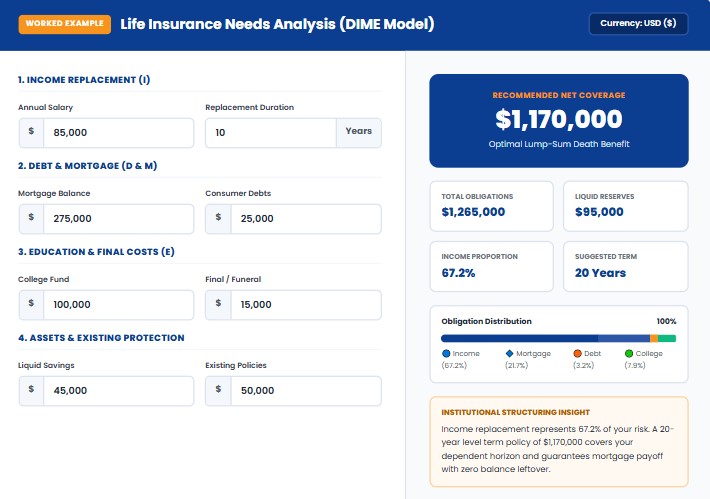
Consider an executive earning an annual salary of $85,000 who wishes to protect their spouse and two school-aged children over a 10-year transition period until college graduation.
- Annual Salary (I): $85,000 per year × 10 years = $850,000
- Remaining Mortgage Balance (M): $275,000
- Auto Loans & Credit Card Debt (D): $25,000
- College Tuition Fund (E): $50,000 per child × 2 = $100,000
- Final & Estate Administration Expenses: $15,000
- Existing Liquid Savings & Brokerage: -$45,000
- Employer Group Life Policy: -$50,000
Step 1: Calculate Gross Household Obligations
Gross Obligations = $850,000 + $275,000 + $25,000 + $100,000 + $15,000 = $1,265,000
Step 2: Calculate Deductible Asset Offsets
Offset Assets = $45,000 (Savings) + $50,000 (Group Policy) = $95,000
Step 3: Calculate Net Policy Death Benefit Required
Net Life Insurance Need = $1,265,000 - $95,000 = $1,170,000
Conclusion: The family requires an individual 20-year level term policy of $1,170,000. Income replacement constitutes 67.2% ($850,000 / $1,265,000) of gross liability, guaranteeing that daily living standards remain intact while debt is liquidated immediately upon claim settlement.
4. Calculator Interface & Output Breakdown
The visual preview below illustrates the exact input and output structure for the Henderson household scenario, highlighting the real-time liability distribution and recommended death benefit:
5. Industry Benchmarks & Policy Comparison Framework
Selecting the appropriate policy structure depends heavily on your demographic profile, wealth stage, and duration of financial risk. The table below outlines institutional life insurance benchmarks across major household profiles:
| Household Profile | Typical Income Multiple | Recommended Policy Type | Primary Driver of Need | Target Term Length |
|---|---|---|---|---|
| Young Single / No Dependents | 2x – 4x Income | 10-Year Level Term | Cosigned student debt & final burial expenses | 10 Years |
| Young Family (Toddlers/Infants) | 12x – 15x Income | 20 to 30-Year Level Term | Long-term income gap, daycare, and 30-yr mortgage | 20 – 30 Years |
| Established Dual-Earner Family | 8x – 10x Income | 15 to 20-Year Level Term | Mortgage payoff & college education funding | 15 – 20 Years |
| Empty Nesters / Near-Retirement | 3x – 5x Income | 10-Year Term or Guaranteed Universal | Surviving spouse pension offset & estate liquidity | 10 Years / Permanent |
| High-Net-Worth Estate Planning | Varies (Estate Tax Sized) | Survivorship / Whole Life (ILIT) | Federal/state estate tax settlement & wealth transfer | Permanent |
6. Where to Find Your Financial Inputs
Gathering accurate underlying documents ensures your life insurance coverage matches reality rather than guesswork:
- Gross Annual Salary: Locate Box 1 (Wages, tips, other compensation) on your IRS Form W-2 or your year-end business profit distributions. If you run a business, review your net earnings on your Net Profit Margin Calculator or Revenue Forecast Calculator.
- Remaining Mortgage Principal: Check your latest monthly mortgage statement. Look strictly for the "Principal Balance" figure, ignoring escrow reserves or future interest amortization schedules.
- Consumer Debt Balances: Aggregate current balances from credit card statements, auto loan portals, and personal installment schedules. For corporate debt commitments, analyze your liabilities using the Debt-to-Equity (D/E) Calculator or calculate monthly servicing costs via the Business Loan Calculator.
- Higher Education Cost Projections: Review published tuition and room-and-board rates from college financial aid offices or state 529 plan savings statements.
- Liquid Cash Reserves & Existing Policies: Review your checking, savings, and taxable brokerage account balances. Determine how your current cash reserves compound over time with our Compound Interest Calculator and verify employer-sponsored group term life certificates (typically capped at 1x to 2x basic salary).
7. What This Calculator Can and Cannot Tell You
What It Can Tell You
- Precise Death Benefit Target: Eliminates guesswork by mathematically matching obligations to death benefit proceeds.
- Asset Redundancy Avoidance: Offsets existing investments and company life policies so you don’t overpay in monthly premiums.
- Policy Duration Guidance: Identifies whether a 10, 20, or 30-year level term aligns best with your debt amortization and children's graduation dates.
- Currency Neutrality: Seamlessly converts inputs across global currencies for international households.
What It Cannot Tell You
- Medical Underwriting Underwriting: Does not calculate individual monthly premiums, which depend on age, tobacco use, and medical history.
- Cash Value Growth Projections: Designed primarily for pure protection (term life) rather than universal/whole life cash accumulation engines.
- Future Inflation Volatility: Assumes level purchasing power unless additional buffer years are added to the income replacement field.
- Complex Estate Tax Trusts: Does not structure Irrevocable Life Insurance Trusts (ILITs) for estates exceeding federal statutory thresholds.
8. Related Personal Finance & Corporate Calculators
A robust financial security strategy balances risk management, liquidity planning, and debt repayment. Explore these verified calculators from Fox Business Markets to optimize your broader capital structure:
9. Frequently Asked Questions (FAQ)
Why should I choose Term Life Insurance over Whole Life Insurance?
For over 90% of families, level term life insurance is the most cost-efficient financial instrument. Term life provides pure insurance protection during the critical years when your dependents rely on your income and your mortgage debt is highest. Because it carries no expensive investment fees or cash-value administrative overhead, term insurance premiums are 5 to 15 times cheaper than whole life insurance. This allows households to buy substantial coverage (e.g., $1,000,000+) for a modest monthly payment while investing the premium difference into tax-advantaged retirement accounts like 401(k)s and IRAs.
Is the death benefit payout subject to income taxes for my beneficiaries?
In the United States, life insurance death proceeds paid out to named individual beneficiaries are almost universally exempt from federal and state income taxes under IRC Section 101(a). However, any interest earned on proceeds delayed in escrow before distribution is taxable. Additionally, if the policyholder retains "incidents of ownership" in an estate that exceeds the federal estate tax exemption limit, the gross death benefit may be pulled into the taxable estate unless owned via an Irrevocable Life Insurance Trust (ILIT).
Isn't my employer-provided group life insurance policy enough?
Rarely. Most corporate group life insurance benefits provide a flat payout of $50,000 or 1x to 2x your base salary. For a breadwinner with a mortgage and growing children, 1x annual salary falls drastically short of the recommended 10x to 15x DIME standard. Furthermore, group life insurance is tied to employment; if you change companies, face layoffs, or become critically ill and leave the workforce, your coverage typically terminates immediately, leaving you uninsured at a time when purchasing individual coverage may be prohibitively expensive due to age or health.
How does inflation impact my coverage calculation over a 20 or 30-year term?
A fixed death benefit of $1,000,000 today will have lower purchasing power in 20 years due to inflation. However, your life insurance liability is naturally asymmetric: as the years progress, your mortgage balance steadily amortizes downward, your children become self-sufficient adults, and your retirement investment accounts grow. Consequently, your actual insurance need declines as you age. If you anticipate high long-term living expenses, simply increase the "Years of Replacement" input by 2 to 5 years to build an inflation cushion.
What is the "Laddering Strategy" in life insurance planning?
A laddering strategy involves purchasing multiple smaller term policies with overlapping durations instead of one massive single policy. For example, rather than buying a single 30-year policy for $1,500,000, you might purchase a $500,000 30-year policy (to cover your spouse), a $500,000 20-year policy (to cover the mortgage), and a $500,000 10-year policy (to cover the children until college graduation). As each milestone is reached, policies expire naturally, reducing your overall premium outlay while maintaining full protection during your highest-risk years.
10. The Bottom Line & Strategic Next Steps
Life insurance is not an investment vehicle; it is a defensive capital risk transfer tool designed to protect human life value. By adopting the systematic DIME methodology, you eliminate the emotional guesswork of coverage sizing and ensure that every dollar committed to annual premiums delivers maximum family balance sheet security. Regularly revisit your calculation whenever you experience a major life milestone—such as purchasing a home, welcoming a child, securing a substantial salary raise, or paying off long-term debts.
Authoritative References & Further Reading
- Life and Health Insurance Foundation for Education (Life Happens): Nonprofit educational guidelines on human life value calculation and income replacement principles.
- National Association of Insurance Commissioners (NAIC): Consumer guides on life insurance policies, term vs. permanent structures, and buyer protection regulations.
- Society of Actuaries (SOA): Actuarial research on mortality tables, family dependency horizons, and long-term financial risk modeling.
- Internal Revenue Service (IRS) Code Section 101(a): Federal statutory guidelines regarding the tax-exempt status of life insurance death benefit proceeds.