

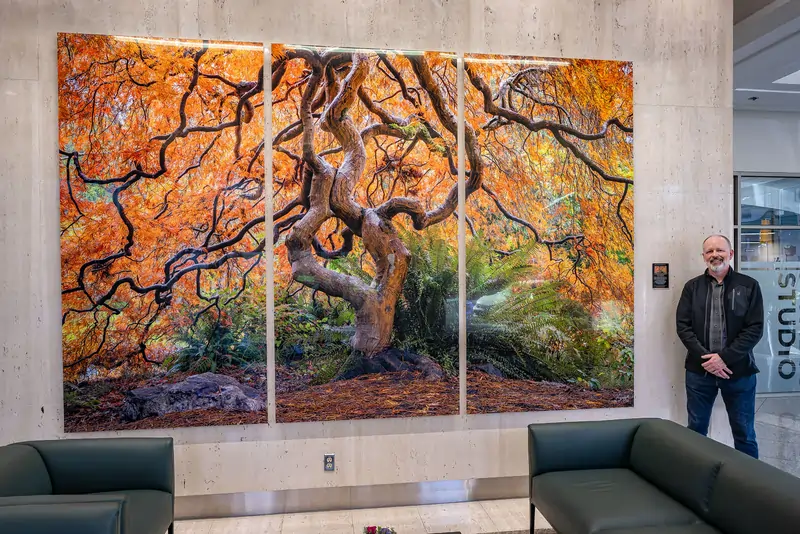
There’s a moment most homeowners know well: standing in a freshly decorated room, something feels off. The furniture is right, the colors are cohesive, yet the space still lacks a soul. More often than not, the problem is the walls. Bare or under-decorated walls are the silent saboteurs of interior design, and large format wall art is their most powerful antidote.
What “large format” actually means for your interior
In interior design, large-format wall art refers to pieces that genuinely command a wall: think widths starting at 80 cm and scaling up to 240 cm or more. At this scale, art stops being decoration and becomes architecture. A single large piece draws the eye, anchors the room, and eliminates visual clutter — instead of your gaze bouncing between numerous small frames, it settles on one impressive focal point.
This is the fundamental principle behind the growing demand for oversized prints on premium materials such as acrylic glass and aluminum Dibond . Unlike canvas, these substrates deliver a depth and luminosity that smaller formats simply cannot replicate. Acrylic glass prints, in particular, enhance color saturation and create a three-dimensional presence — the image seems to float within the wall rather than sit on it.
Large format wall art and the perception of space
One of the most underestimated powers of large format wall art decoration is its ability to physically reshape how a room feels. This is not aesthetics alone — it is spatial psychology.
- Horizontal pieces visually widen a room, making narrow spaces feel broader and more balanced
- Vertical formats pull the eye upward, adding perceived height to low-ceiling interiors
- Light-toned, open compositions (skies, seascapes, abstract minimalism) create airiness in compact rooms
Vertical wall art draws the eye upwards, making the room appear taller, while choosing light and neutral artwork contributes to a bright and airy atmosphere that enhances the perception of a larger room.
The golden rule used by interior designers: art should fill roughly two-thirds to three-quarters of the open wall space where it is displayed, or that same proportion of the width of the furniture below it. For a standard 200 cm sofa, this means targeting a piece between 130 and 150 cm wide — precisely the range where large format wall art enters its element.
The psychology behind the visual impact of large format wall art
The effect of a large piece on a room is not accidental. Neuroaesthetics — the study of how the brain responds to art — has revealed that viewing art triggers neurotransmitters like dopamine and oxytocin, leading to feelings of pleasure, relaxation, and inspiration.
Color choice within large format wall art becomes especially consequential at scale:
- Warm tones (ochre, terracotta, deep red) energize a living room or kitchen and create social warmth
- Cool tones (slate blue, sage green, muted teal) promote calm and focus, ideal for bedrooms and home offices
- Neutral abstract compositions adapt to any environment while still delivering visual weight
When the colors in a large piece harmonize with the rest of the room, the space reads as intentional and cohesive — conversely, a clash creates a subtle but persistent unease that no amount of furniture rearrangement can fix.
This is why investing in large format wall art is not simply a decorative decision: it is a functional one. A single well-chosen piece can define the emotional register of an entire space.
Choosing the right large format wall art for your interior style
Not all large prints are equal. The material and finish you choose will determine how the piece interacts with light, wall color, and surrounding furniture.
- Acrylic glass prints: ultra-high gloss finish, exceptional color depth, ideal for contemporary and minimalist interiors. The reflective surface interacts dynamically with natural and artificial light, making the piece appear different at different times of day
- Aluminum Dibond prints: a satin or brushed finish that absorbs light rather than reflecting it — ideal for industrial, Scandinavian, or loft-style interiors. Extremely durable and lightweight despite their large format
For rooms with significant natural light, acrylic glass is unrivaled. For darker rooms or spaces with directional lighting, aluminum Dibond’s matte variants prevent glare while preserving color fidelity.
A curated selection of premium large-format wall art decoration — covering abstract, modern, and contemporary subjects — is available at large format wall art decoration , where pieces are produced on both acrylic glass and aluminum Dibond in formats starting at 120×70 cm.
Practical placement guide for large format wall art
Buying the right piece is half the equation. Hanging it correctly is the other.
- Above a sofa: hang the bottom edge 15 to 20 cm above the backrest. The piece should span between two-thirds and three-quarters of the sofa’s width
- Above a bed: center the piece at eye level from a standing position (approximately 145–150 cm from the floor to the center). The piece should be slightly narrower than the headboard
- On a feature wall without furniture: art should cover 60 to 75% of the wall space it occupies — leaving margins creates balance rather than emptiness
- Corridor or staircase: large vertical formats are ideal, guiding the eye along the path
One common mistake buyers make is choosing a piece that is too small in an attempt to “play it safe.” In practice, a print that is too small will leave a living room feeling empty and incomplete, while a boldly scaled piece communicates intention and confidence.
Why large format wall art outperforms gallery walls in premium interiors
Gallery walls, clusters of smaller frames, became a dominant interior trend during the 2010s. Today, high-end interior design has shifted firmly toward fewer, larger, more deliberate pieces. The reason is both aesthetic and practical.
A single 160×90 cm acrylic glass print requires one hook, zero alignment, and no ongoing curation. It delivers immediate impact, communicates a clear design direction, and ages exceptionally well compared to collections of mismatched small frames. A single statement piece can have more impact than a cluttered gallery wall; the concept of white space amplifies rather than dilutes the work.
For buyers investing in their space for the long term, whether a primary residence, a rental property, or a professional environment, large format wall art on acrylic glass or aluminum Dibond represents the highest return on visual investment. It transforms a room not by filling it, but by giving it a center of gravity.
Also read: 7 Tips for Inspiring Home Wall Décor

