Free Home Insurance Calculator: Coverage & Premium Estimator
A standard homeowners policy (HO-3) protects your most valuable physical asset, but calculating adequate coverage requires distinguishing between real estate market value and true structural reconstruction cost. The Free Home Insurance Calculator models institutional property underwriting guidelines to project your required Dwelling (Coverage A), Personal Property (Coverage C), and Liability limits alongside estimated annual and monthly premiums.
Who it's for:
Prospective home buyers sizing escrow requirements, current homeowners reviewing policy renewals to avoid underinsurance penalties (such as the 80% coinsurance rule), and real estate investors evaluating landlord property coverage.
Why use it:
- Reconstruction Cost Sizing: Calculate replacement value based on regional square footage construction rates rather than inflated land and market valuations.
- Proportional HO-3 Coverage Stacking: Automatically generate statutory coverage splits across detached structures (Coverage B: 10%), personal contents (Coverage C: 50%), and loss of use (Coverage D: 20%).
- Deductible & Construction Age Risk Sensitivity: Test how home age, roof condition, fire protection proximity, and policy deductible choices alter annual premium cash outflows.
Approx. $122 / month (Escrow)
Your estimated dwelling replacement cost meets the institutional 100% replacement cost guideline. Raising your deductible from $1,000 to $2,500 can lower annual premiums by approximately 11%.
1. How to Use the Home Insurance Calculator
Homeowners insurance pricing hinges on calculating the exact cost to rebuild your physical dwelling from the foundation up rather than insuring its fluctuating real estate market value. Follow this systematic process to estimate your coverage requirements and annual escrow premium outlays:
- Select Your Denomination: Choose your preferred global currency (USD $, GBP £, EUR €, CAD C$, or AUD A$) using the currency picker in the top-right corner.
- Choose Estimation Mode: Use the default Square Footage & Construction Mode to estimate dwelling reconstruction based on square footage and regional materials pricing, or switch to Direct Dwelling Value Mode if you already have a certified builder or appraisal assessment.
- Set Living Area & Local Rebuild Rates: Enter the finished, heated square footage of your home (excluding unheated basements, open decks, or raw land) alongside your local construction cost per square foot (typically $140 to $220/sq ft for standard residential builds).
- Configure Deductible & Personal Liability: Select your standard all-peril deductible ($500 to $5,000) and choose your personal liability defense limit ($100,000 to $1,000,000) based on your net worth exposure.
- Identify Structural Risk Factors: Define your home’s construction era (new, modern, mature, or vintage), the age of your roof system, and your geographic weather exposure zone.
- Review Your HO-3 Policy Distribution: Examine your estimated annual and monthly carrying costs, alongside automatic statutory allocations for Coverage A (Dwelling), Coverage B (Other Structures), Coverage C (Personal Property), and Coverage D (Loss of Use).
2. How It Works & Core Mathematical Formulas
Standard homeowners insurance (HO-3 special form) uses an actuarial proportional framework. The entire package is anchored to Coverage A (Dwelling Replacement Cost), with secondary coverage lines calculated as statutory percentages:
A critical concept in property underwriting is the 80% Coinsurance Rule. If you carry coverage representing less than 80% of your home's total replacement cost at the time of a loss, the insurer applies a penalty formula to partial claims, paying only a fraction of repair costs minus your deductible. This calculator ensures your policy is sized at 100% replacement value to eliminate coinsurance risk completely.
3. Fully Worked Numerical Example
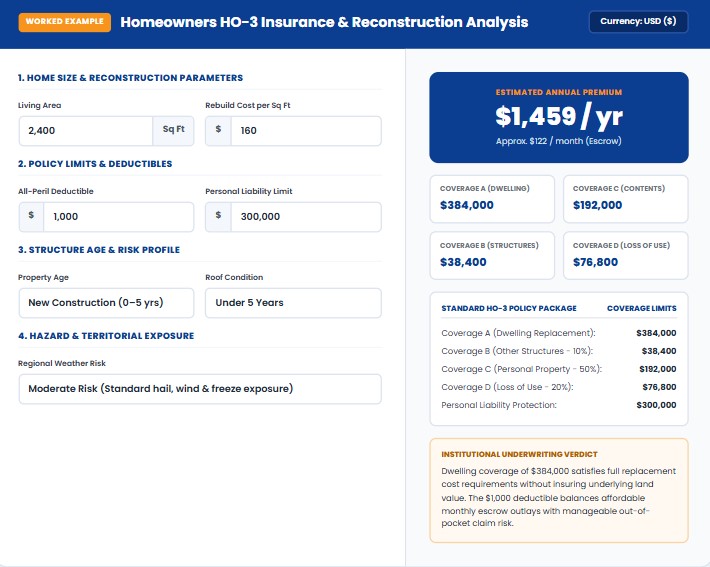
Consider a family purchasing a newly built single-family home with 2,400 square feet of finished living space in an area where local residential building costs average $160 per square foot.
- Finished Living Space: 2,400 sq ft
- Rebuild Labor & Materials Cost: $160 per sq ft
- All-Peril Deductible: $1,000 (Factor: 1.00x)
- Personal Liability Limit: $300,000 (Baseline standard)
- Property Demographics: New Construction (0–5 yrs: 0.85x), Roof under 5 yrs (0.90x), Moderate Hazard Zone (1.00x)
- Territory Loss Cost Base Rate: $3.25 per $1,000 of dwelling value
Step 1: Compute Coverage Lines (A through D)
Coverage A (Dwelling) = 2,400 sq ft * $160/sq ft = $384,000
Coverage B (Structures) = $384,000 * 0.10 = $38,400
Coverage C (Contents) = $384,000 * 0.50 = $192,000
Coverage D (Loss of Use) = $384,000 * 0.20 = $76,800
Step 2: Calculate Base Dwelling Loss Premium
Base Dwelling Premium = ($384,000 / 1,000) * $3.25 = $1,248.00
Step 3: Apply Risk Multipliers and Liability Adjustments
Composite Multiplier = 0.85 (New Build) * 0.90 (New Roof) * 1.00 (Territory) * 1.00 (Deductible) = 0.765
Risk-Adjusted Premium = $1,248.00 * 0.765 = $954.72
Combined Annual HO-3 Premium = $1,459 / year
Monthly Escrow Addition = $1,459 / 12 = $121.58 / month
Conclusion: Sizing Coverage A at $384,000 provides full structural replacement protection without insuring the non-depreciating plot of land. At $1,459/year ($122/month escrow), the home is fully insulated against total-loss casualty while generating $192,000 in personal contents protection.
4. Calculator Interface & Output Breakdown
The visual preview below illustrates the exact input and output structure for our 2,400 sq ft suburban home scenario, detailing the proportional coverage limits and annual premium calculation:
5. Home Insurance Policy Types & Coverage Benchmarks
Property insurance policies are categorized into standardized ISO forms based on property type, occupancy status, and peril coverage breadth. The table below compares the primary residential policy structures:
| Policy Form | Target Property Profile | Peril Coverage Scope | Dwelling Basis | Typical Annual Premium Range |
|---|---|---|---|---|
| HO-1 (Basic Form) | Vacant homes / distressed properties | Named Perils Only (10 specific perils) | Actual Cash Value (ACV) | $800 – $1,200 |
| HO-2 (Broad Form) | Older standard homes | Named Perils (16 common perils) | Replacement Cost | $1,100 – $1,500 |
| HO-3 (Special Form) | Single-family primary homes (Standard) | Open Perils (Dwelling) / Named (Contents) | Replacement Cost (100%) | $1,400 – $2,200 |
| HO-4 (Renters Insurance) | Tenants occupying rented homes/units | Named Perils (Contents only) | No Dwelling (Contents only) | $180 – $350 |
| HO-5 (Comprehensive) | High-value luxury single-family homes | Open Perils on both Dwelling and Contents | Extended Replacement (125%–150%) | $2,400 – $4,500+ |
| HO-6 (Condo Insurance) | Condominiums / townhomes | Walls-in / fixtures & personal property | Building additions & alterations | $450 – $900 |
6. Where to Find Your Property Underwriting Inputs
Entering precise structural data prevents substantial premium misquotes and avoids costly underinsurance traps:
- Finished Square Footage: Review your county tax assessor’s property card or your original home mortgage appraisal report. Use solely the "Gross Living Area" (GLA), omitting unheated detached workshops or open patios. If evaluating a commercial loan or mortgage, verify your financing terms using our Business Loan Calculator.
- Local Rebuild Cost per Square Foot: Contact local general contractors or homebuilder associations in your county. Reconstruction costs are significantly higher than new subdivision construction due to debris removal, architectural demolition, and modern municipal building code compliance.
- Personal Contents Inventory (Coverage C): Create an itemized room-by-room home inventory documenting high-value electronics, furniture, apparel, and tools. Track your household savings dedicated to replacement costs with our Deposit Growth Calculator.
- Roof Age and Material Class: Check your seller disclosures or home inspection report. Architectural asphalt shingles under 10 years old qualify for favorable discounts, whereas roofs over 15–20 years often face mandatory actual cash value (ACV) depreciation clauses.
- Personal Liability Exposure: Match your liability coverage to your total personal balance sheet assets. Protect your household net worth and business income using our Compound Interest Calculator and consider an umbrella policy if your personal wealth exceeds $500,000.
7. What This Calculator Can and Cannot Tell You
What It Can Tell You
- True Reconstruction Sizing: Separates non-insurable land value from the actual physical replacement cost of your house.
- Proportional HO-3 Packages: Instantly balances personal contents, detached structures, and temporary living costs against Coverage A.
- Deductible Impact on Escrow: Demonstrates exactly how raising your deductible from $1,000 to $2,500 or $5,000 lowers annual carrying costs.
- Coinsurance Compliance: Guarantees your structural limits meet lender and insurance carrier 80%–100% threshold rules.
What It Cannot Tell You
- Flood & Groundwater Damage: Standard HO-3 policies strictly exclude rising flood water; requires separate National Flood Insurance Program (NFIP) policies.
- Earthquake & Earth Movement: Seismic hazards are excluded by default and require dedicated catastrophic endorsements or specialized policies.
- Hyper-Local ISO Fire Suppression Ratings: Does not evaluate the exact distance to your nearest municipal fire hydrant or local volunteer fire department.
- Sewer & Drain Backup: Water backup from municipal sewers or sump pump failures requires a separate, affordable policy rider.
8. Related Personal Finance & Risk Planning Tools
Managing real estate holdings requires coordinating property protection, mortgage financing, and long-term liquidity reserves. Enhance your household financial planning with these verified Fox Business Markets resources:
9. Frequently Asked Questions (FAQ)
Why is Dwelling Replacement Cost different from my home's Market Value?
Market value represents what a willing buyer pays for the real estate, which includes the physical structure, neighborhood desirability, school district ratings, and crucially, the land itself. Land does not burn down, blow away in a hurricane, or get destroyed by hail. Insurance underwriters only insure the physical cost to rebuild the structure from scratch (Coverage A). In high-cost metro areas, a home might sell for $800,000, yet have a reconstruction cost of only $380,000. Sizing insurance to the $800,000 market price would force you to pay for hundreds of thousands of dollars in non-existent risk.
What is the 80% Coinsurance Rule in homeowners insurance?
The 80% coinsurance rule is a contractual clause stating that if you carry dwelling coverage representing less than 80% of your home’s full replacement cost at the time of a loss, the insurer will not pay the full cost of partial damages. Instead, the payout is calculated using the ratio of the coverage you actually purchased divided by the 80% requirement, multiplied by the loss amount, minus your deductible. For example, if your home’s rebuild cost is $400,000 (80% requirement = $320,000) and you only bought $240,000 in coverage, you only insured 75% of the requirement ($240,000 / $320,000). If you suffer a $40,000 kitchen fire, the insurer will pay only 75% of the repair bill ($30,000 minus deductible), leaving you to cover the remaining $10,000 out of pocket.
What is the difference between Replacement Cost and Actual Cash Value (ACV)?
Replacement Cost Value (RCV) pays the full current market price to repair or replace damaged property with new materials of like kind and quality, with no deduction for physical depreciation or age. Actual Cash Value (ACV) pays the replacement cost minus depreciation over time. For example, if a 12-year-old roof with a 20-year lifespan is destroyed by hail, an RCV policy pays the full $15,000 cost of installing a brand-new roof (minus your deductible). An ACV policy would calculate that the roof had used up 60% of its useful life and pay only $6,000, leaving you to pay the remaining $9,000 out of pocket. Always verify your policy includes RCV for both dwelling and personal property.
Does homeowners insurance cover water damage and plumbing leaks?
Coverage depends entirely on whether the water damage is sudden and accidental versus gradual. Standard HO-3 policies cover sudden and internal discharge—such as a burst frozen water pipe, a ruptured water heater, or an overflowing washing machine supply hose. However, policies strictly exclude continuous or repeated seepage over weeks or months, deferred maintenance issues, sewer line backups (unless you purchased an optional Water Backup Rider), and external surface flooding from heavy storms (which requires a standalone NFIP flood policy).
How does raising my property deductible from $1,000 to $2,500 benefit me?
Increasing your property deductible from $1,000 to $2,500 shifts low-level claims risk away from the insurance company, typically lowering your annual HO-3 premium by 10% to 15%. Because filing frequent small claims ($1,500 to $2,000) often triggers premium surcharges or non-renewal notices from underwriters, insurance should be reserved for catastrophic losses. Maintaining a higher deductible, paired with a dedicated liquid emergency fund, protects your loss history while saving substantial money on recurring mortgage escrow payments.
10. The Bottom Line & Property Protection Strategy
Securing adequate homeowners insurance is a balancing act between shielding your family balance sheet from devastating structural loss and avoiding overpaying on mortgage escrow charges. By calculating your structural Dwelling Coverage A based on construction square footage and material costs rather than real estate market price, you ensure complete compliance with the 80% coinsurance rule while keeping premiums lean. Review your reconstruction limits every two to three years or following major home renovations to keep pace with building material inflation.
Authoritative References & Further Reading
- Insurance Information Institute (Triple-I): Comprehensive guides on homeowners insurance structures, replacement cost valuation, and disaster mitigation standards.
- National Association of Insurance Commissioners (NAIC): State insurance department regulatory guides on homeowner policy rights, complaint indexes, and policyholder protection laws.
- Federal Emergency Management Agency (FEMA / NFIP): Flood map service centers and statutory flood insurance underwriting guidelines.
- Insurance Services Office (ISO): Standardized property policy forms (HO-1 through HO-8) and territorial fire suppression protection class ratings.