1. How to Use the Capital Gains Tax Calculator
Calculating tax liability prior to executing a significant asset sale is critical for preserving net profits and preventing unexpected year-end tax bills. Follow these steps to model your capital gains exposure:
- Select Your Accounting Currency: Use the currency selector at the top right to switch between USD ($), GBP (£), EUR (€), CAD (C$), or AUD (A$) based on your reporting jurisdiction.
- Select Holding Period: Choose either the Long-Term Gain (>1 Year) tab to take advantage of preferential federal brackets (0%, 15%, 20%) or the Short-Term Gain (≤1 Year) tab if the asset was held for 365 days or fewer (taxed at ordinary income rates).
- Enter Asset Selling Price (Gross Proceeds): Enter the total dollar value received from selling your shares, commercial property, real estate, or digital assets.
- Enter Original Cost Basis: Input your original purchase expenditure, including brokerage commissions, legal closing fees, and capitalized improvements.
- Input Other Taxable Income: Provide your estimated annual salary, W-2 compensation, or active business income to establish your baseline tax bracket tier.
- Specify Filing Status & State Tax Rate: Select whether you file as Single or Married Filing Jointly, and input your state income tax rate (or 0% for states without income tax like Texas, Florida, and Washington).
- Analyze Your Tax Liability: Examine the estimated federal and state tax liabilities, effective tax rate, Net Investment Income Tax (NIIT) impact, and final after-tax cash proceeds.
2. How It Works & Core Mathematical Formulas
A capital gain occurs whenever a capital asset is liquidated for a price higher than its adjusted cost basis. The internal revenue code divides these transactions into two separate categories based on the exact holding period.
The core taxable capital gain equation is calculated as:
Taxable Gain = Gross Liquidation Proceeds - Adjusted Cost Basis
Where:
Gross Proceeds = Execution Sale Price - Selling Brokerage Commissions / Closing Costs
Adjusted Cost Basis = Original Purchase Price + Acquisition Fees + Capitalized Improvements
For long-term capital assets held for more than 365 days, federal tax rates are separated from ordinary wage brackets and structured into progressive tiers: 0%, 15%, and 20%. The statutory thresholds depend on your total taxable income:
Federal Tax = (Σ Capital Gain in Tier 0 * 0.00) + (Σ Capital Gain in Tier 15 * 0.15) + (Σ Capital Gain in Tier 20 * 0.20)
Plus Net Investment Income Tax (NIIT):
NIIT (3.8%) = Min [ Net Investment Income, (Modified AGI - Statutory Threshold) ] * 3.8%
(Statutory Thresholds: $200,000 for Single Filers; $250,000 for Married Filing Jointly)
For short-term gains (held 12 months or less), profits are stacked directly onto ordinary income and taxed at marginal income tax brackets ranging from 10% to 37%. Total tax liability is then calculated by combining federal obligations with state taxes:
Total Tax Liability = Federal Capital Gains Tax + NIIT Surcharge + State Tax Liability
Net Profit After Tax = Taxable Capital Gain - Total Tax Liability
Effective Capital Gains Tax Rate (%) = (Total Tax Liability / Taxable Capital Gain) * 100
3. Fully Worked Numerical Example
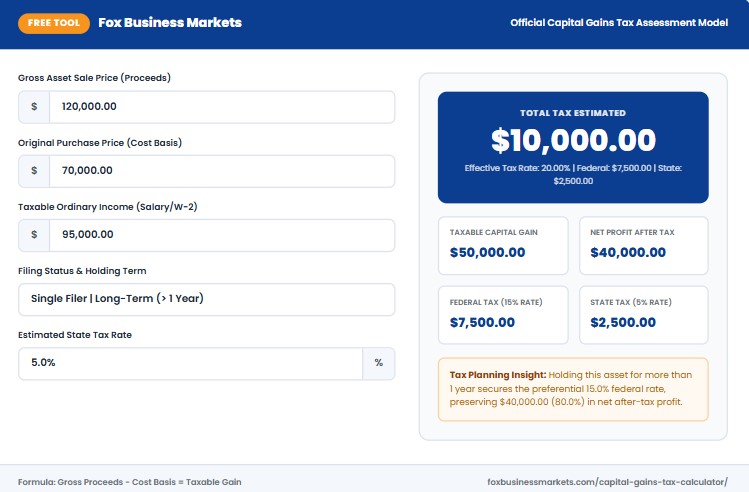
Consider a single filer liquidating a long-held block of stock after a 3-year holding period. The transaction parameters and investor income details are structured as follows:
Worked Scenario: Long-Term Equity Liquidation
- Gross Asset Sale Proceeds: $120,000.00
- Original Purchase Cost Basis: $70,000.00
- Holding Period: 3 Years (Long-Term Classification)
- Annual Taxable Ordinary Income (Salary): $95,000.00
- Filing Status: Single Filer
- State Income Tax Rate: 5.0%
Step-by-Step Calculation:
- Calculate Taxable Capital Gain:
$120,000.00 (Proceeds) - $70,000.00 (Basis) = $50,000.00 Capital Gain - Determine Total Combined Income:
$95,000.00 (Salary) + $50,000.00 (Gain) = $145,000.00 Total Income - Determine Federal Long-Term Tax Rate Tier:
For Single filers, income between $49,450 and $545,500 falls in the 15% long-term bracket. Because baseline ordinary income ($95,000) already exceeds the 0% threshold, the entire $50,000 capital gain is taxed at 15%.
Federal Capital Gains Tax = $50,000.00 * 0.15 = $7,500.00 - Evaluate Net Investment Income Tax (NIIT):
Single filer NIIT threshold is $200,000. Total income ($145,000) is below this statutory threshold, resulting in $0.00 NIIT liability. - Calculate State Tax Liability:
$50,000.00 * 0.05 (5.0%) = $2,500.00 - Compute Total Combined Tax:
$7,500.00 (Federal) + $2,500.00 (State) = $10,000.00 Total Tax - Calculate Net Profit After Tax and Effective Tax Rate:
Net Profit = $50,000.00 - $10,000.00 = $40,000.00 After-Tax Profit
Effective Tax Rate = ($10,000.00 / $50,000.00) * 100 = 20.00%
Verdict: Qualifying for long-term capital gains rates allows the investor to retain 80.0% ($40,000.00) of their profit. If this transaction had closed within 12 months, marginal ordinary income brackets would have pushed total tax liability to over $14,500.
4. Interactive Calculator Interface & Visual Output
The visual model below highlights the exact configuration, data inputs, and real-time tax breakdowns generated by our calculation engine using the worked baseline parameters:
5. Federal Capital Gains Tax Rates & Statutory Income Brackets
Understanding statutory income thresholds is essential for tax planning and timing asset liquidations. The table below outlines federal tax treatment across filing statuses and holding horizons:
| Holding Term & Tax Bracket | Single Taxable Income Threshold | Married Filing Jointly Threshold | Strategic Characteristics |
|---|---|---|---|
| Long-Term (0% Federal Rate) | Up to $49,450 | Up to $98,900 | Completely tax-free federal capital gains for low-income or early retirement brackets. |
| Long-Term (15% Federal Rate) | $49,451 to $545,500 | $98,901 to $613,700 | The primary rate tier covering the majority of retail and professional investors. |
| Long-Term (20% Federal Rate) | Over $545,500 | Over $613,700 | Maximum statutory federal capital gains rate applied to top-tier capital earners. |
| NIIT Surtax (+3.8%) | MAGI Over $200,000 | MAGI Over $250,000 | Statutory surtax on net investment income established under the Affordable Care Act. |
| Short-Term (≤ 365 Days) | Taxed as Ordinary Income (10% to 37%) | Taxed as Ordinary Income (10% to 37%) | Treated identically to wages, eliminating preferential investment tax incentives. |
6. Where to Find Your Numbers
To ensure high calculation accuracy, retrieve your cost basis and tax information from verified financial and tax documents:
- Asset Selling Price (Gross Proceeds): Found on IRS Form 1099-B (Proceeds from Broker and Barter Exchange Transactions), real estate ALTA closing settlement statements, or cryptocurrency exchange trade logs.
- Adjusted Cost Basis: Check brokerage trade confirmations, historical purchase invoices, or Form 1099-B Box 1e (Cost or other basis). For commercial properties, ensure basis adjustments include depreciation deductions.
- Other Taxable Income: Locate your Adjusted Gross Income (AGI) on line 11 of IRS Form 1040, or review your year-to-date earnings on your final W-2 pay stub.
- State Income Tax Rates: Review your state department of revenue guidelines. Nine US states (including Alaska, Florida, Nevada, New Hampshire, South Dakota, Tennessee, Texas, Washington, and Wyoming) levy zero state income tax on individual investment gains.
- Investment Performance Context: To project how your after-tax capital can compound over time, use our Compound Interest Calculator and evaluate yield potential with our Deposit Growth Calculator.
7. What This Calculator Can and Cannot Tell You
Our Capital Gains Tax Calculator provides essential tax exposure modeling, but investors should understand its analytical scope and structural boundaries:
What It CAN Tell You
- Your exact taxable capital gain after subtracting adjusted cost basis.
- The tax savings realized by holding an asset for longer than 365 days.
- Combined federal and state tax liabilities based on your marginal tax profile.
- The impact of the 3.8% Net Investment Income Tax (NIIT) on high-income sales.
What It CANNOT Tell You
- Section 1031 Exchange Deferrals: Does not calculate deferred tax liabilities for real estate like-kind exchanges.
- Depreciation Recapture Rates: Unrecaptured Section 1250 depreciation on real estate is taxed at a flat 25% federal rate, which requires specialized scheduling.
- Wash Sale Rule Disallowances: Does not adjust cost basis for replacement shares purchased within 30 days of a loss sale.
- Alternative Minimum Tax (AMT): Does not calculate incentive stock option (ISO) exercise tax events.
8. Related Guides and Financial Calculators
Refine your investment planning, corporate financial modeling, and wealth preservation strategy using these verified Fox Business Markets resources:
9. Frequently Asked Questions (FAQ)
10. The Bottom Line & Authoritative References
Capital gains taxes can substantially reduce overall investment profitability if transactions are executed without proper tax planning. By timing asset sales past the 365-day threshold, monitoring personal income tax brackets, leveraging tax-loss harvesting, and accounting for state-level tax obligations, investors can protect their wealth and maximize after-tax compound returns.
To review current statutory tax codes, bracket thresholds, and IRS reporting guidelines, consult these authoritative institutions:
- Internal Revenue Service (IRS) — Topic No. 409: Capital Gains and Losses
- Internal Revenue Service (IRS) — Net Investment Income Tax (NIIT) Guidance
- Tax Policy Center — Capital Gains and Dividend Tax Rates Overview
- Investopedia — Capital Gains Tax Rates, Exemptions, and Rules