Quick answer: Fintech, short for financial technology, is software that delivers financial services such as banking, payments, lending, investing, and insurance through apps and websites instead of branches and paper. Many fintech companies aren’t banks. They partner with banks to hold your money, so deposit protection depends on how each app is set up.
Forty-four percent of Americans now handle their banking mostly through a mobile app, according to an ABA and Morning Consult survey released in November 2026. Only 10% still rely mainly on a branch. Paying a friend, applying for a loan, buying a stock, or splitting a purchase into four payments now takes a few taps.
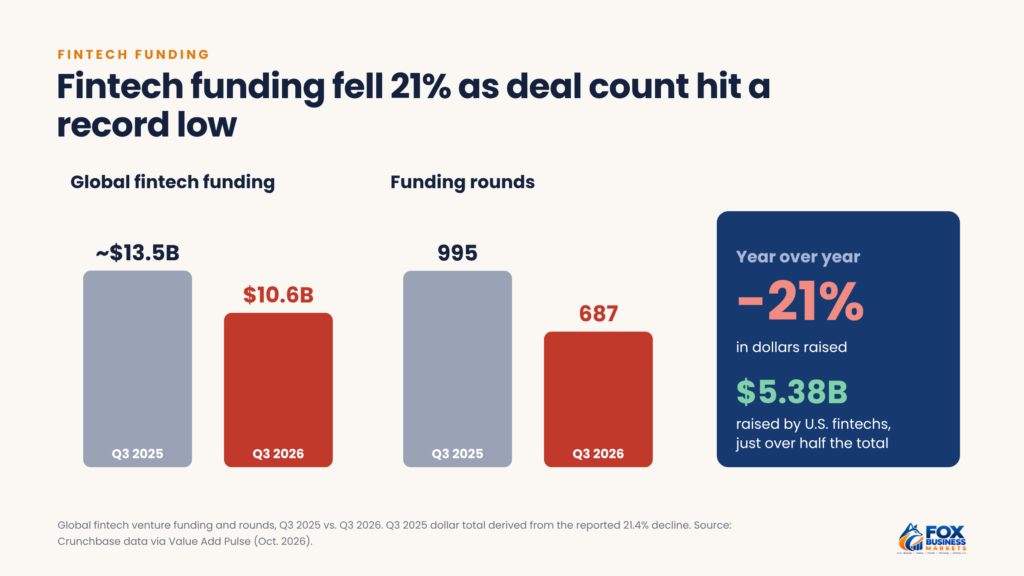
Yet the money behind the industry is pulling back. Global fintech startups raised $10.6 billion in the third quarter of 2026, down 21% from a year earlier, across the fewest funding rounds in Crunchbase data going back to 2018, according to Crunchbase data. And the 2024 collapse of middleware firm Synapse showed that a slick app doesn’t always mean your money is protected the way a bank account is.
This guide explains what fintech is, how it works behind the screen, and the main types you’ll run into. It also covers how these companies make money, who regulates them, and how to pick an app that keeps your money safe, whether for your household or your business.
What Is Fintech?
Fintech is any technology that changes how people and businesses save, spend, borrow, invest, or protect money. The term covers startups and tech giants as well as traditional banks that build their own digital tools.
Financial technology isn’t new. ATMs in the 1960s and online banking in the 1990s were fintech in their day. What changed after 2008 was speed and scale. Smartphones, cloud computing, and cheaper data let small companies launch financial products without building a bank first. A startup could offer a checking account, a stock-trading app, or a small-business loan to millions of people in a few years.
Today, fintech shows up in places you might not notice:
- Tapping your phone to pay at a coffee shop
- Sending rent to a roommate through a payment app
- Getting a loan decision in minutes instead of days
- Investing spare change automatically
- Sending a client an invoice with a “Pay now” button
If a financial task happens through software instead of a teller, a paper form, or a phone call, fintech is probably involved.
How Does Fintech Work Behind the Scenes?
Most fintech apps are built from several layers that work together. Knowing these layers helps you understand who actually holds your money and who’s responsible when something goes wrong.
| Layer | What it does | Example |
| The app | The screen you use to open accounts, move money, or invest | A neobank, payment, or investing app |
| Partner bank | Holds deposits, issues debit cards, and connects to payment networks | A state- or federally chartered bank |
| Banking-as-a-service (BaaS) | Software that connects apps to banks and tracks who owns what | Middleware and API providers |
| Payment networks | Move money between accounts | Visa, Mastercard, ACH, FedNow, RTP |
| Data and AI | Verify identity, check credit, flag fraud, personalize offers | Underwriting models and fraud screening |
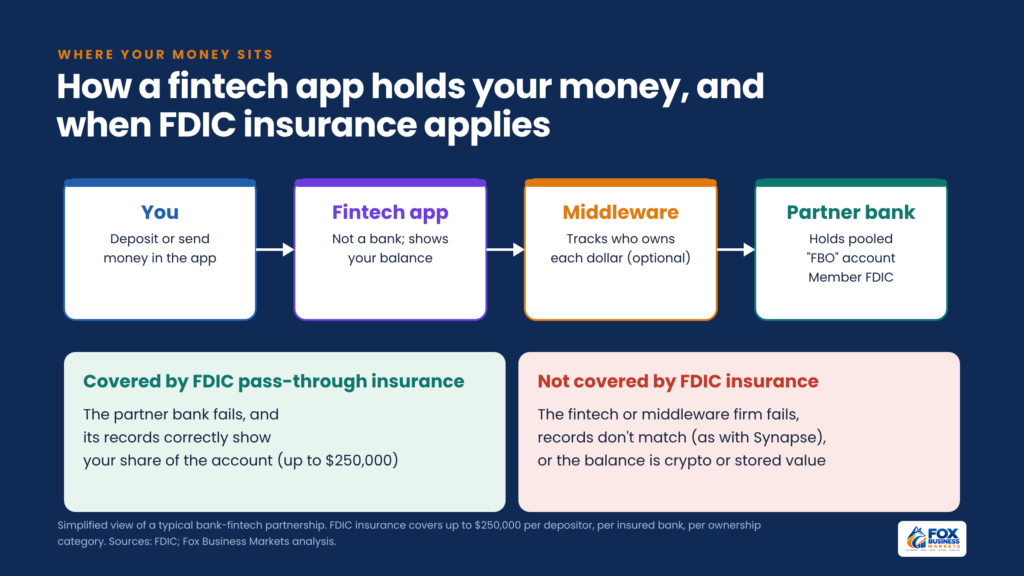
The most important link is the partner bank. Many popular apps don’t hold a bank charter. When you deposit money, it typically sits in a pooled account at a partner bank, often called a “for benefit of” (FBO) account. The bank, the app, or a middleware firm keeps records showing how much of that pool belongs to you.
Payments follow a similar path. When you send money, the app passes instructions through the ACH network, a card network, or an instant payment system. Our guide to payment processing walks through those rails step by step.
Application programming interfaces (APIs) tie it all together. APIs let one company’s software request data or actions from another’s. When you link a bank account to a budgeting app, an API usually passes your balance and transactions across, with your permission.
What Are the Main Types of Fintech?
Fintech isn’t one industry. It’s a group of sectors that each replace or upgrade a different part of traditional finance.
| Type | What it does | Common examples |
| Digital banking (neobanks) | Checking and savings accounts run entirely through an app | Chime, Varo, SoFi, Current |
| Payments | Card acceptance, peer-to-peer transfers, digital wallets | Stripe, Square, PayPal, Venmo, Zelle, Apple Pay |
| Lending | Personal, student, and small-business loans with online applications | SoFi, Upstart, LendingClub |
| Buy now, pay later (BNPL) | Splits purchases into installments, often interest-free | Affirm, Klarna, Afterpay |
| Investing (wealthtech) | Commission-free trading and automated portfolios | Robinhood, Betterment, Wealthfront |
| Insurtech | Online quotes, claims, and usage-based pricing | Lemonade, Root |
| Crypto and stablecoins | Buying, holding, and sending digital assets | Coinbase, stablecoin issuers |
| Business finance | Corporate cards, expense tracking, invoicing, payroll | Ramp, Brex (now owned by Capital One), Mercury, Gusto |
| Regtech | Software that helps firms meet compliance and anti-fraud rules | Identity verification and monitoring tools |
The lines between these groups keep blurring. A payment app may offer a debit card, a savings account, crypto trading, and short-term loans in one place. Large banks have also built fintech-style features into their own apps, which helps explain why most Americans still bank with a traditional institution.
For a look at what’s emerging next in each sector, see our breakdown of the top trends shaping the future of fintech.
How Do Fintech Companies Make Money?
Free apps still need revenue. Knowing how a company gets paid shows you where its incentives lie.
- Interchange fees. Every time you swipe a debit or credit card, the merchant pays a fee, and part of it goes to the card-issuing bank. Banks with under $10 billion in assets are exempt from the federal cap on debit card fees. Fintechs that partner with these smaller banks can share in the higher fees. For many neobanks, this is the biggest source of revenue.
- Interest income. Lenders earn interest on loans, and deposit apps earn a spread between what the partner bank pays and what you receive.
- Transaction and processing fees. Payment companies charge merchants a percentage plus a flat fee per sale. Our guide to credit card processing fees shows how those costs add up.
- Premium tiers add perks like higher savings rates, metal cards, or financial planning tools.
- Instant transfer fees. Standard transfers may be free, but moving money in minutes often costs 1% to 2%.
- Payment for order flow and margin interest. Some brokerage apps earn money by routing trades to market makers or lending money to investors.
- Software fees. Business fintechs charge monthly fees for invoicing, payroll, or expense management.
None of these models are bad by default. But a “free” app that earns most of its revenue from fees on fast transfers or late payments has a reason to encourage those behaviors. Read the fee schedule before you sign up.
How Many Americans Use Fintech?
Digital banking is now the default for most Americans, but that doesn’t mean they’ve left traditional banks.
The ABA and Morning Consult survey of 4,402 adults, conducted October 9 to 12, 2026, found that 44% use a mobile app as their main way to bank and another 20% use a laptop or computer. Among Gen Z and millennials, 54% bank mostly by app. Baby boomers are the only group that banks by computer (34%) slightly more often than by app (32%).
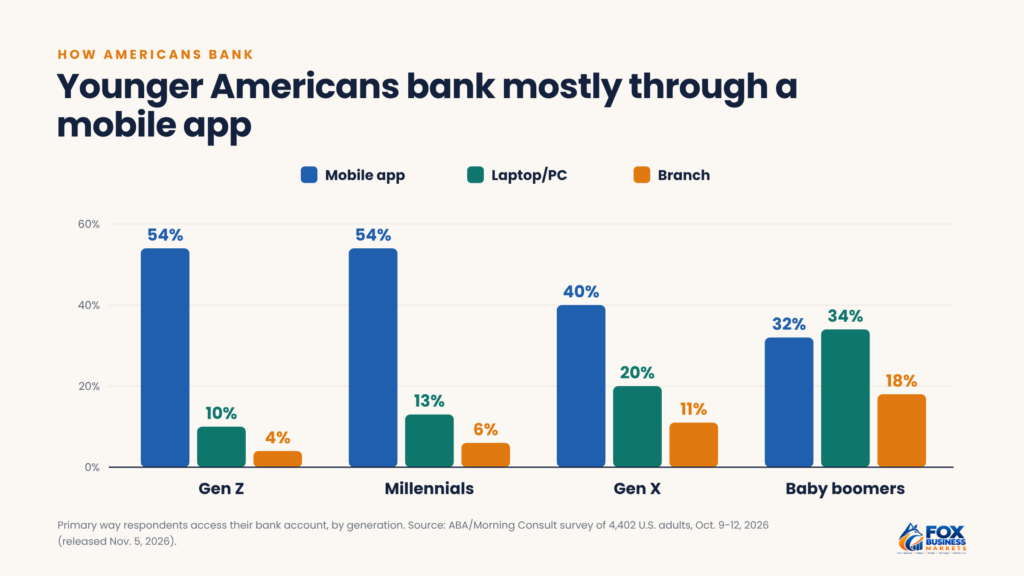
Satisfaction runs high. Ninety-five percent of respondents rated their bank’s online and mobile experience as good or better, and 75% agreed that bank technology makes financial services easier to access.
App-only banks are growing fast but remain a smaller slice. Chime, one of the largest U.S. neobanks, reported 10.9 million active members in the third quarter of 2026, up 20% from a year earlier, and revenue of $718 million, according to its earnings release. Crypto use remains a niche. The Federal Reserve’s 2025 household survey found that 10% of adults used cryptocurrency in 2025, mostly as an investment. Only 2% used it to make payments.
For a wider set of numbers on how Americans pay, see our roundup of payment statistics.
What Are the Benefits and Risks of Fintech?
Fintech solves real problems, but it also creates new ones. Weigh both before you move money.
Benefits
- Lower costs. Many digital accounts have no monthly fees or overdraft fees, and high-yield savings accounts at online banks often pay more than branch banks.
- Instant payments, same-day loan decisions, and early direct deposit can help people living paycheck to paycheck.
- People with thin credit files or no nearby branch can open accounts and build credit from a phone.
- Better tools. Automatic savings, spending alerts, and budgeting dashboards make money easier to track.
- Business efficiency. Small businesses can accept cards, send invoices, and run payroll without expensive software.
Risks
- Account freezes. Fintechs rely heavily on automated fraud screening. When a system flags your account, you may lose access to your money for days or weeks, often with limited customer service.
- Unclear protection. Not every balance in an app is FDIC-insured, as the next section explains.
- Fraud and scams. Peer-to-peer payments are fast and often final. Scammers exploit that speed, and getting money back after an authorized transfer is hard.
- Debt traps. Easy credit, BNPL loans stacked across several apps, and cash advances can lead to overspending.
- Data privacy. Linking accounts shares sensitive financial data with more companies.
Is It a Myth That Money in Any Fintech App Is FDIC-Insured?
Yes. Many people assume that because an app looks like a bank and offers a debit card, their balance is covered by the Federal Deposit Insurance Corporation (FDIC). That isn’t always true.
The FDIC insures deposits at FDIC-insured banks up to $250,000 per depositor, per bank, per ownership category. It doesn’t insure fintech companies themselves. When a non-bank app holds your money at a partner bank, you may qualify for “pass-through” insurance, but only if the bank’s records correctly show what you own. If the partner bank fails and the records are accurate, you’re covered up to the limit. If the fintech or its middleware provider fails, FDIC insurance doesn’t apply at all, and bad records can leave you waiting months or short of money.
That’s what happened with Synapse. The banking-as-a-service provider filed for bankruptcy in April 2024, and customers of apps that relied on it lost access to their funds for months. Reconciliations later found a shortfall of tens of millions of dollars between what customers were owed and what the banks held. The partner banks hadn’t failed, so deposit insurance never applied.
In response, the FDIC proposed a rule in September 2024 that would require banks to keep daily records of who owns money in custodial accounts. As of the agency’s latest regulatory agenda, a final rule has no set date.
Other products have their own rules:
- Brokerage accounts are protected by the Securities Investor Protection Corporation (SIPC) up to $500,000, including $250,000 in cash, if the broker fails. SIPC doesn’t cover investment losses.
- Crypto holdings generally have no FDIC or SIPC protection.
- Stored balances in payment apps may not be insured unless you’ve enrolled in a feature that sweeps the money to a partner bank.
Look for the line in an app’s disclosures that names the partner bank and states, “Banking services provided by [bank name], Member FDIC.” Then use the FDIC’s BankFind tool to confirm the bank is insured.
How Is Fintech Regulated in the U.S.?
No single agency regulates fintech in the United States. Oversight depends on what a company does and how it’s licensed.
| Regulator | What it oversees |
| Consumer Financial Protection Bureau (CFPB) | Consumer protection for lending, payments, and data rights |
| FDIC, OCC, and Federal Reserve | Partner banks and any fintech that holds a bank or trust charter |
| Securities and Exchange Commission (SEC) and FINRA | Investing apps, brokerages, and robo-advisors |
| State regulators | Money transmitter and lending licenses in each state |
| FinCEN | Anti-money laundering rules for money services businesses |
Three regulatory stories will shape fintech over the next year:
Open banking (Section 1033). The CFPB finalized a rule in October 2024 that would give consumers the right to share their financial data with other apps for free. Bank groups sued, a federal court in Kentucky blocked enforcement, and the CFPB began reconsidering the rule in August 2025. In August 2026, the bureau sent a revised proposal to the White House for review. The final shape will decide whether banks can charge fees for data access, which could raise costs for budgeting and payment apps.
Stablecoins (GENIUS Act). The GENIUS Act, signed into law in July 2025, created the first federal framework for payment stablecoins. The law requires issuers to back stablecoins one-to-one with safe, liquid assets and bars them from paying interest to holders. The OCC proposed implementing rules in February 2026, and other agencies are writing their own.
Bank partnerships. Regulators have taken enforcement actions against several banks that partner with fintechs, usually over weak anti-money laundering controls or poor oversight. At the same time, a growing number of fintechs have applied for their own bank or trust charters so they can hold deposits directly.
Rules can change quickly, so check the date on any guidance before you rely on it.
Where Is Fintech Headed?
Fintech is entering a more mature, more selective phase. Investors are writing fewer and larger checks, and most of the money is going to established companies rather than new startups.
According to Crunchbase, global fintech funding fell to $10.6 billion in the third quarter of 2026, down 28% from the prior quarter and 21% from a year earlier. Deal count dropped to 687 rounds from 995 a year earlier. U.S. companies raised $5.38 billion, just over half the global total. CB Insights reported a similar pattern for the second quarter, with deal volume at its lowest level in more than four years.
Five trends stand out:
- AI in everyday finance. Fintechs are using AI for fraud detection, underwriting, customer service, and personalized financial advice. Expect more AI assistants inside banking apps.
- Stablecoins and instant payments. With a federal law now in place, banks and payment companies are testing stablecoins for cross-border payments and business settlement. FedNow and RTP are also making instant bank payments more common.
- Embedded finance. Payments, loans, and insurance are being built into non-financial apps, such as a scheduling tool that lets you pay at booking or an online store that offers financing at checkout.
- Fintechs becoming banks. More fintechs are seeking charters, which would let them hold deposits directly instead of relying on partner banks. Business banking app Mercury, for example, received conditional approval for a national bank charter in April 2026.
- Profitability over growth. Chime posted its third straight quarterly profit under standard accounting rules (GAAP) in the third quarter of 2026. Investors increasingly favor fintechs that make money over those that only add users.
If you’re thinking about launching a fintech product, our guide to building a startup covers fundraising and growth after launch.
How Can Small Businesses Use Fintech?
Small businesses often get more value from fintech than consumers do, because the tools replace hours of manual work.
- Accepting payments. Card readers, online checkout, and tap-to-pay on a phone let any business take cards. Compare pricing models carefully, since fees vary widely.
- Getting paid faster. Digital invoices with built-in payment links shorten the wait for cash. Our guide on how to invoice covers terms and follow-up.
- Lower-cost transfers. ACH payments cost far less than cards for large or recurring bills.
- Spending control. Corporate card platforms issue cards to employees with set limits and automatically match receipts to expenses.
- Payroll and taxes. Payroll apps calculate withholdings, file returns, and pay contractors.
- Online lenders and revenue-based financing can approve working capital in days, though costs are often higher than bank loans.
Start with one pain point, such as slow customer payments or messy expense reports, and pick a tool that fixes it before adding more.
How Do You Choose a Fintech App Safely?
Before you move money or sign up for credit, run through this checklist:
- Find the partner bank. Confirm it’s FDIC-insured on the FDIC’s BankFind site.
- Check what’s insured. Ask whether your balance is held as a deposit at the bank, swept across several banks, or held as stored value by the app.
- Read the fee schedule. Look for instant transfer fees, inactivity fees, subscription costs, and charges for paper statements.
- Test customer service. Check whether you can reach a person by phone or chat, and read recent complaints in the CFPB’s consumer complaint database.
- Turn on security features. Use two-factor authentication, set transaction alerts, and lock your card when you’re not using it.
- Limit data sharing. Review which apps have access to your bank account and revoke any you no longer use.
- Don’t keep all your money in one app. Keep your emergency fund at an insured bank or credit union you can reach if an app freezes your account.
If you’re unsure how an app fits your broader plans, a financial advisor can help you weigh it against your savings and investing goals.
Frequently Asked Questions
Is PayPal a fintech company?
Yes. PayPal, founded in 1998, is one of the oldest and largest fintech companies. It also owns Venmo. PayPal isn’t a bank, so check which features hold your money at a partner bank. Tip: Move large balances to your bank account instead of leaving them in the app.
What careers are available in fintech?
Fintech hires software engineers, data scientists, product managers, compliance and risk specialists, fraud analysts, and customer support staff. Compliance roles are often in demand because every product must meet banking and consumer protection rules. Tip: A background in finance plus basic coding or data skills stands out to fintech recruiters.
Do fintech apps affect your credit score?
They can. Applying for a loan or credit card through a fintech app usually triggers a hard inquiry. Some BNPL providers and credit-builder apps now report payments to the credit bureaus, which can help or hurt depending on whether you pay on time. Tip: Check whether an app reports to Equifax, Experian, and TransUnion before you use it to build credit.
Do payment apps report your income to the IRS?
They can. Payment apps such as PayPal and Venmo send a Form 1099-K when you receive more than $20,000 in payments for goods or services across more than 200 transactions in a year. Splitting a dinner bill with friends isn’t taxable income, but business income is taxable whether or not you get a form. Tip: Keep personal and business payments in separate accounts so your tax records stay clean.
Check Your Fintech Apps Before You Add Another
Open each financial app on your phone this week and confirm three things: which bank holds your money, whether that balance is FDIC-insured, and what fees you’re paying. Move any savings you can’t afford to lose access to into an insured bank account, and remove apps you no longer use. Then track your full picture, including balances spread across apps, with our guide to calculating your net worth.
This article is for general information only and isn’t financial, tax, legal, or investment advice. Consider your own situation or talk to a qualified professional before making decisions.

